
PMP-160 · Lesson 1 of 12 · 27 min
The 2026 exam: blueprint, formats and eligibility
You have now studied every part of the PMP content outline. PMP-101 explained what the credential is and how to qualify. PMP-110 laid the foundations of project work. PMP-120 and PMP-121 covered the People domain, PMP-130 and PMP-131 the Process domain, PMP-140 agile and hybrid delivery, and PMP-150 the Business Environment. This last course turns that knowledge into a passing performance. It is about the exam itself: how it is built, how its questions are written, how to reason through them, how to handle the calculations, how to pace four hours of concentration, and how to use practice exams and review to close your remaining gaps.
Knowing the material and passing the exam are related but different skills. Many candidates who understand project management well still struggle because they read questions too quickly, answer from their own workplace habits instead of from the standard the exam assumes, run short of time, or spend their last weeks rereading notes instead of practising and fixing errors. Each lesson here deals with one of those problems. As in the earlier courses, the examples use Project Compass, the invented project to open the Eastgate branch of the invented Larkfield Regional Library, so the scenarios will feel familiar.
The exam at a glance
The current exam was introduced on 9 July 2026, replacing the version that had been in use since 2021. Its main features, as published by PMI and summarized by exam preparation providers in 2026, are set out below. PMI adjusts details from time to time, so check the current exam handbook on its website before you book.
| Feature | July 2026 exam | Previous exam (2021 to July 2026) |
|---|---|---|
| Total questions | 180 | 180 |
| Scored and unscored | 170 scored, 10 unscored pretest questions | 175 scored, 5 unscored |
| Time | 240 minutes | 230 minutes |
| Breaks | Two 10-minute breaks | Two 10-minute breaks, after questions 60 and 120 |
| Domains | People about 33 %, Process about 41 %, Business Environment about 26 % | People 42 %, Process 50 %, Business Environment 8 % |
| Tasks in the outline | 26 (8 People, 10 Process, 8 Business Environment) | 35 |
| Approaches | About 40 % predictive, about 60 % adaptive or hybrid | About half predictive, half adaptive or hybrid |
| New item types | Case or scenario sets, graphic-based questions | None new |
Two changes matter most for your preparation. First, the Business Environment domain grew from about one question in twelve to about one in four. Governance, compliance, benefits, organizational change and the external environment are no longer side topics. Second, the exam now includes case or scenario sets: a longer description of a project situation, sometimes with charts or tables, followed by several questions that all refer to it. Lesson 2 shows how to work through these efficiently.
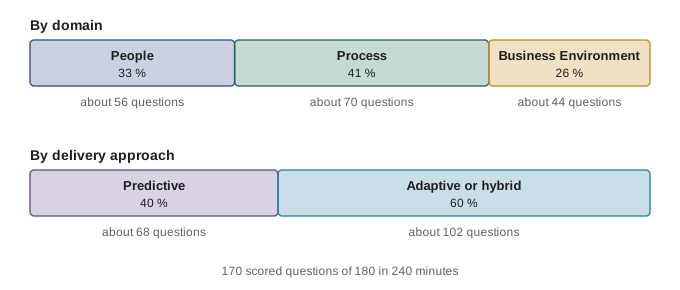
What the percentages mean in questions
The domain percentages are targets that PMI uses when assembling each candidate's exam, not exact counts. With 170 scored questions, they imply roughly 56 People questions, 70 Process questions and 44 Business Environment questions. The approach mix works across all three domains. A People question about a conflict can be set on an agile team; a Business Environment question about compliance can be set on a predictive construction project. You cannot sort questions neatly into predictive and agile boxes, which is one reason the exam feels integrated.
# Expected number of scored questions per domain and approach on the July 2026 PMP exam.
# Domain weights and the approach mix are approximate published shares; the split is illustrative.
scored = 170
domains = {"People": 0.33, "Process": 0.41, "Business Environment": 0.26}
approach = {"Predictive": 0.40, "Adaptive or hybrid": 0.60}
print(f"{'Domain':22}{'Share':>7}{'Questions':>11}")
for name, share in domains.items():
    print(f"{name:22}{share:>7.0%}{round(scored * share):>11}")
print()
for name, share in approach.items():
    print(f"{name:22}{share:>7.0%}{round(scored * share):>11}")
print()
# Where to spend 60 hours of final study, weighting each domain by share and by how weak it is.
weak = {"People": 1.0, "Process": 1.2, "Business Environment": 1.5}   # 1.0 = on target, higher = weaker
need = {d: domains[d] * weak[d] for d in domains}
total = sum(need.values())
for d, v in need.items():
print(f"{d:22} study {60 * v / total:5.1f} h")Domain Share Questions People 33% 56 Process 41% 70 Business Environment 26% 44 Predictive 40% 68 Adaptive or hybrid 60% 102 People study 16.3 h Process study 24.4 h Business Environment study 19.3 h
The program above also shows a useful planning idea. Study time in the final weeks should follow two things: how much of the exam a domain represents, and how weak you are in it. A domain with a large share in which you are already strong may need less time than a smaller domain in which you are weak. Lesson 10 shows how to measure weakness from practice exams instead of guessing.
The three domains and their tasks
The outline organizes the exam into domains, tasks and enablers. A task is a responsibility of a project manager, such as manage conflict or plan and manage compliance. Enablers are examples of the work involved in that task. You studied the tasks in the earlier courses; the table below maps them to where they were taught, so that you can return to the right course when practice results show a weakness.
| Domain | Examples of tasks (paraphrased) | Where taught |
|---|---|---|
| People (about 33 %) | Lead and empower the team, manage conflict, engage stakeholders, build shared understanding, mentor, support team performance, manage virtual and distributed work | PMP-120 and PMP-121, with agile team practices in PMP-140 |
| Process (about 41 %) | Integrate the plan, manage scope, schedule, resources and finance, deliver value incrementally, manage quality, procurement and artifacts, evaluate project status, close | PMP-130 and PMP-131, with adaptive delivery in PMP-140 |
| Business Environment (about 26 %) | Governance, compliance, change control, impediments and issues, risk, continuous improvement, organizational change, external changes | PMP-150, with risk and change control in PMP-131 |
The exam does not test memorized definitions for their own sake. It tests whether you can apply the tasks in realistic situations. A question will rarely ask what a risk register is. It is far more likely to describe a project manager who has just learned that a supplier may go bankrupt and ask what to do next. Your knowledge of definitions is the foundation, but the exam rewards judgement built on it.
Question formats
Every scored question is worth the same, whatever its format. The 2026 exam uses several formats, and not all of them appear in every delivery mode. Online proctored exams include case sets, graphic-based questions, single-answer multiple choice and multiple response. The interactive formats are offered at test centres.
| Format | What you do | Delivery | Watch for |
|---|---|---|---|
| Multiple choice, single response | Choose the one best answer from four options | All | Several options may be reasonable; pick the best for the situation described |
| Multiple response | Choose a stated number of correct options, for example two of five | All | The question tells you how many to pick; there is usually no partial credit |
| Case or scenario set | Read a longer scenario, then answer several linked questions | All | Read the questions first, then the scenario; keep details straight between questions |
| Graphic-based | Interpret a chart, board, diagram or table | All | Read titles, axes, units and legends before the question |
| Matching (drag and drop) | Match items in one list to items in another | Test centre | Each item is usually used once |
| Enhanced matching | Match with more options or more structure than simple matching | Test centre | Sort the easy pairs first to reduce choices |
| Hotspot (point and click) | Click the correct area of an image, such as a point on a chart | Test centre | Zoom in mentally on axis values and labels |
| Pull-down list | Pick the right term or value from a list inside a sentence or table | Test centre | Read the whole sentence with your choice in it |
Preparation providers did not report fill-in-the-blank items on the 2026 exam, so calculations appear as multiple choice or as a choice in a list. That does not make them easier: wrong options are usually the results of common mistakes, such as dividing earned value by actual cost the wrong way round. Lesson 8 shows how to avoid those traps.
Who can sit the exam
PMP-101 covered eligibility in detail. In short, under the 2026 rules a candidate needs project leadership experience gained within the last ten years, plus 35 contact hours of project management education or an active CAPM certification. The experience required depends on education:
- With a four-year degree or global equivalent: 36 months of experience leading projects.
- With an associate's degree or post-secondary vocational qualification: 48 months, a separate path introduced with the 2026 rules.
- With a secondary diploma: 60 months.
- Graduates of programs accredited by PMI's Global Accreditation Center can count that degree toward a reduced experience requirement, as described on PMI's site.
A further rule takes effect on 1 December 2026. From that date, live instructor-led hours count toward the 35-hour requirement only when they come from PMI Authorized Training Partners, China Registered Education Providers or eligible accredited academic programs. Training completed before that date is assessed under the earlier rules. Once your application is approved, you have one year to pass and may take the exam up to three times in that period.
Canadian candidates pay the exam fee in US dollars, so the amount on a card statement will vary with the exchange rate and any conversion fee from the card issuer. Many employers in Canada reimburse certification fees or count them as professional development, so ask before you pay. Test centres are concentrated in larger cities; candidates in smaller communities often choose the online option instead of travelling.
Fees are set by PMI and change from time to time. PMI members pay a substantially lower fee than non-members, and the saving has usually been larger than the cost of a year's membership, which also includes a digital copy of the PMBOK Guide and other standards. Retakes within the eligibility year carry a lower re-examination fee. Check the current amounts on PMI's website before you apply.
How the exam is scored
PMI does not publish a fixed passing percentage. The passing standard is set by panels of experienced practitioners and applied through psychometric analysis, so that candidates who sit different combinations of questions are held to the same standard. After the exam you receive a pass or fail result, followed by a score report that rates your performance in each domain in bands: above target, target, below target and needs improvement.
Two practical conclusions follow. First, you do not need a perfect score, and you should not let a few hard questions shake your confidence; everyone meets questions they find difficult. Second, because the result is overall, a weak domain can be offset by a strong one, but a domain that is far below target makes passing much harder. Balanced preparation is safer than excellence in one area and neglect of another.
Planning your preparation from here
Think of the remaining preparation in three phases. In the consolidation phase, you fill obvious gaps by revisiting the courses where your knowledge is thin and by doing focused sets of practice questions on each domain. In the practice phase, you take full-length timed exams and review every question, building an error log. In the final phase, roughly the last two weeks, you stop learning new material and sharpen recall, timing and confidence. Lessons 10, 11 and 12 cover these phases in detail.
Worked problem
Planning around the 2026 shares
Priya Natarajan, the project manager of Project Compass, decides to sit the PMP exam after the Eastgate branch opens. Her first diagnostic practice exam shows People on target, Process slightly below target, and Business Environment below target. She has about 60 hours to study before her booked date. How should she divide her time?
Show solution
- Start from the domain shares: People about 33 %, Process about 41 %, Business Environment about 26 %.
- Adjust for weakness. She is on target in People, a little weak in Process and weaker in Business Environment, so give those domains more weight. Using weights of 1.0, 1.2 and 1.5 in the program above gives about 16, 24 and 19 hours.
- Note that Business Environment receives more time than its share alone would suggest, because she is weakest there, while Process still receives the most because it is the largest domain.
- Reserve part of each block for mixed practice, because real questions combine domains, and repeat the diagnostic after two weeks to see whether the weights should change.
Answer: About 16 hours on People, 24 on Process and 19 on Business Environment, adjusted after the next diagnostic.
The example uses round numbers, but the method matters: allocate effort by evidence, revisit the allocation as results change, and keep mixed practice in every week.
Common mistakes
MistakePreparing as if the exam were still half predictive.
InsteadAbout 60 % of questions are set in adaptive or hybrid contexts.
MistakeTreating the Business Environment as a minor topic.
InsteadIt is about 26 % of scored questions, roughly 44 of 170.
MistakeTrying to spot the unscored pretest questions.
InsteadThey are indistinguishable; answer every question carefully.
MistakeAssuming online and test-centre exams have identical formats.
InsteadInteractive formats such as hotspot and matching are offered at test centres.
MistakeChasing a published pass mark.
InsteadPMI does not publish one; aim for consistently strong, balanced practice results.
Summary and key terms
- The July 2026 exam has 180 questions, 170 of them scored, in 240 minutes with two 10-minute breaks.
- Domain shares are about 33 % People, 41 % Process and 26 % Business Environment; about 60 % of questions use adaptive or hybrid contexts.
- New formats include case or scenario sets and graphic-based questions; matching, hotspot and pull-down items are offered at test centres.
- Eligibility combines experience in the last ten years with 35 hours of education or an active CAPM; a new training-provider rule starts on 1 December 2026.
- The score is reported as pass or fail with domain performance bands; there is no published passing percentage.
- Divide final study time by domain share and measured weakness, and revisit the plan as results change.
- Exam content outline
- The PMI document that defines the domains, tasks and enablers the PMP exam tests and their approximate weights.
- Domain
- One of the three major areas of the exam: People, Process and Business Environment.
- Task
- A responsibility of the project manager within a domain, such as manage conflict or plan and manage compliance.
- Enabler
- An example of the work involved in carrying out a task.
- Pretest question
- An unscored question included to gather data for future exams; it looks the same as scored questions.
- Case or scenario set
- A longer scenario followed by several questions that refer to it.
- Performance band
- The rating given for each domain in the score report, from above target to needs improvement.
- Eligibility period
- The year after application approval in which a candidate may take the exam up to three times.
Practice problems
Work each problem on paper first, then reveal the answer to check.
How many questions on the 2026 exam are scored?
Show answer
170 of the 180.
How long is the exam, and how many breaks are there?
Show answer
240 minutes, with two 10-minute breaks.
About how many scored questions come from the Business Environment domain?
Show answer
About 44, from 26 % of 170.
What share of questions is set in adaptive or hybrid contexts?
Show answer
About 60 %.
Name two question formats available online.
Show answer
Any two of single-answer multiple choice, multiple response, case or scenario sets and graphic-based questions.
Name two formats offered at test centres but not online.
Show answer
Any two of matching, enhanced matching, hotspot and pull-down list.
How much experience does a candidate with a four-year degree need?
Show answer
36 months of leading projects within the last ten years.
What changes on 1 December 2026?
Show answer
Live instructor-led hours count toward the 35 hours only from Authorized Training Partners, China Registered Education Providers or eligible accredited programs.
What does the score report show for each domain?
Show answer
A performance band: above target, target, below target or needs improvement.
How many attempts are allowed in the eligibility year?
Show answer
Up to three.
Lesson quiz · 5 questions
Score 60% or more to complete this lesson.
Create a free account to save your progress, take quizzes and earn a certificate.