
PLB-420 · Lesson 12 of 12 · 21 min
Customer communication, estimates, documentation and warranties; capstone service calls
At the end of Maya's rotation in the service department, Grace sat down with her to go over what made a service plumber good. Technical skill came first, she said, but customers judge a plumber on things they can see: whether the plumber arrived when promised, listened, explained the problem in words they understood, gave a clear price before starting, cleaned up, and stood behind the work. A plumber who solves the problem but leaves the customer confused or surprised by the bill has done half the job. This final lesson covers communication, estimates, documentation and warranties, and then works through three capstone service calls that pull together the whole course.
Arriving and listening
The service call starts before the plumber arrives. A call ahead with an arrival time, a vehicle and uniform that identify the company, and boot covers or a drop cloth at the door show respect for the customer's home. Grace introduced herself and Maya by name, asked the customer to show her the problem, and listened without interrupting. The diagnostic questions from lesson 1 are also good customer service: they show the customer that their observations matter.
- Ask open questions first: what happens, when did it start, what has changed.
- Repeat back what you heard: so the kitchen drain backs up when the dishwasher runs, and it started last week?
- Explain what you are going to do and roughly how long it will take before you start testing.
- Protect floors and finishes, and ask before moving furniture or belongings.
- Be aware of the people in the home: children, pets, a customer who is elderly or anxious, a tenant who is not the owner.
Explaining the problem
Customers are not plumbers. Grace explained the cause in plain words, showed the evidence where possible (the camera video, the worn part, the reading on the gauge), and explained the options with their pros, cons and prices. She avoided jargon or explained it, and she avoided alarming language. A customer who is told their sewer is collapsing will feel pressured; a customer shown the video of a cracked joint with roots, told what it means and what the options are, can decide.
When the news is bad, such as a failed water heater or a lateral that needs replacement, Grace said so clearly and early, explained why, and gave the options including the least expensive responsible one. When she did not know the answer yet, she said so and explained how she would find out. Honesty is the foundation of a service business: customers who trust the plumber call back and recommend them.
Estimates and pricing
Most service companies use one of two pricing methods. Time and materials charges for the hours worked and the materials used, at set rates. Flat-rate pricing charges a set price per task from a price book, regardless of how long the task takes. Either way, the customer should know the price, or a firm range, before work starts, and should approve it, usually in writing on the work order or a tablet.
| Item | Purpose |
|---|---|
| Diagnostic or service call fee | Covers travel and the time to diagnose the problem |
| Labour | Hours at the hourly rate, or the flat-rate task price |
| Materials | Parts and supplies at the company price, usually with markup |
| Permits and inspections | Fees for permits where the work requires them |
| Disposal | Disposal of old fixtures, water heaters and waste |
| Tax | Sales tax as required by the jurisdiction |
| Exclusions and assumptions | What the price does not include, such as wall or floor finishing |
Worked problem
Building an estimate
Replacing a 151 L electric water heater: diagnostic fee 95, labour 3.5 hours at 120 per hour, heater 780, fittings and expansion tank 165 at a 25 percent markup on materials, permit 85, disposal 40. Ontario HST of 13 percent applies to the total. What is the price?
Show solution
- \[\text{Materials} = (780 + 165) \times 1.25 = 1181.25\]
- \[\text{Subtotal} = 95 + 3.5 \times 120 + 1181.25 + 85 + 40 = 1821.25\]
- \[\text{Total} = 1821.25 \times 1.13 \approx 2058.01\]
Answer: The estimate shows each line so the customer can see what they are paying for. Rates and tax rules here are examples only; companies set their own rates, and tax treatment of service work and materials differs by jurisdiction, so the office confirms the rules that apply.
# Service estimate with good / better / best options (rates illustrative)
RATE, MARKUP, TAX = 120.0, 0.25, 0.13   # dollars per hour, materials markup, HST

def estimate(name, hours, materials, permit=0.0, disposal=0.0, diag=95.0):
    mat = materials * (1 + MARKUP)
    sub = diag + hours * RATE + mat + permit + disposal
    return name, sub, sub * TAX, sub * (1 + TAX)

options = [
    estimate("Repair: replace lower element and thermostat", 1.5, 95),
    estimate("Replace with same-size electric heater", 3.5, 945, permit=85, disposal=40),
    estimate("Replace with larger heater and mixing valve", 4.5, 1310, permit=85, disposal=40),
]
for name, sub, tax, total in options:
print(f"{name:46s} subtotal {sub:8.2f} tax {tax:7.2f} total {total:8.2f}")Repair: replace lower element and thermostat subtotal 393.75 tax 51.19 total 444.94 Replace with same-size electric heater subtotal 1821.25 tax 236.76 total 2058.01 Replace with larger heater and mixing valve subtotal 2397.50 tax 311.68 total 2709.17
Offering options lets the customer choose what fits their needs and budget. Grace always made the least expensive responsible option clear, explained what each option bought, and never pressured. If the cheapest option was not responsible, for example leaving a heater with a failed relief valve, she said so and did not offer it.
Changes and surprises
Service work often reveals more than expected: a seized valve that has to be replaced before the repair can go ahead, rotted subfloor under a toilet, a second leak behind the first. When the scope changes, Grace stopped, showed the customer, explained the change and the price, and got approval before continuing. A change order in writing protects both the customer and the company. Surprises on the final bill damage trust more than anything else.
Documentation
Every job needs a clear record. The work order or service report is the company's record of what happened, the customer's receipt, and often the evidence for a warranty claim, an insurance claim, an inspection or a future service call.
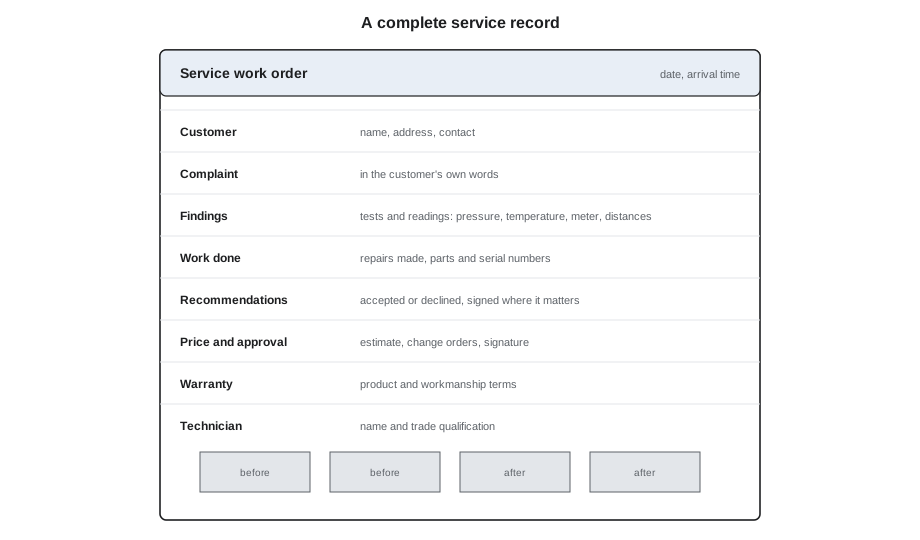
- The complaint in the customer's words.
- What was found, including measurements: pressures, temperatures, meter readings, camera distances and depths.
- What was done, and the parts used, with model and serial numbers for equipment.
- Recommendations made and whether the customer accepted or declined them. A declined safety recommendation should be noted and, where it matters, signed.
- Photos and videos before and after.
- Permit numbers and inspection results.
- The approved price, any change orders and the payment.
Grace pointed out that a note such as customer declined replacement of the relief valve discharge pipe, which is too short, explained the risk is a professional record. It shows that the plumber did their job of advising, and it reminds the next plumber to look.
Warranties and callbacks
Warranties come from two places. Manufacturers warrant their products for a period, often longer for the tank of a water heater than for its parts, subject to proper installation and, sometimes, registration and maintenance. Contractors warrant their workmanship for a period they set. The customer should receive the warranty terms in writing, know what is and is not covered, and know how to make a claim. Many manufacturer warranties require installation by a licensed plumber and to code, which is another reason to do the work properly and document it.
A callback, when the customer calls because the problem has returned, is a chance to keep a customer, not a nuisance. Grace returned callbacks quickly, looked at the problem with an open mind, and if her work had failed, fixed it without argument. If the new problem was unrelated, she explained why, with evidence, and offered the repair. Tracking callbacks helps a service department find training needs and parts problems.
Difficult conversations
- An angry customer: listen, acknowledge the frustration, do not argue, and focus on what you can do now.
- A customer who wants a shortcut that breaks the code or is unsafe: explain the reason and the risk, offer the safe options, and decline the unsafe work.
- A tenant or property manager: be clear about who authorises the work and who pays before starting.
- A price objection: explain what the price includes, offer alternatives where they exist, and never cut corners to meet a price.
- A mistake of your own: own it, apologise, and fix it. Customers forgive mistakes far more readily than cover-ups.
Capstone call 1: no hot water and a wet floor
Monday, 08:15. A homeowner reports no hot water and a puddle beside an 11-year-old 151 L gas water heater. Grace and Maya arrive, protect the floor, and listen: the puddle appeared over the weekend and the pilot light is out.
- Safety check: no gas odour, carbon monoxide alarm present and quiet, area around the heater clear of stored solvents.
- Look: water is dripping from the bottom of the tank jacket, not from a fitting or the relief valve; the burner compartment is wet and the pilot is out.
- Test: dry the fittings and watch; no leaks at the fittings. The tank itself is leaking.
- Diagnosis: a failed tank. The wet burner explains the pilot outage. Repair is not possible.
- Options: replace with the same size, or a larger or higher-recovery model; the family of five complains of running out. Grace calculates recovery for both (lesson 8) and prices both, including permit, expansion tank and disposal.
- The customer chooses the higher-recovery model. Grace shuts off gas and water, drains the tank to the floor drain, and replaces the heater to code with a new relief valve discharge, expansion tank and correct venting, then checks for gas leaks, spillage and the outlet temperature, and documents everything.
Capstone call 2: recurring backup in the basement
Wednesday, 13:30. A basement floor drain backed up for the third time this year, each time after heavy rain. The house is from the 1950s with a clay lateral.
- Questions: does it happen only after rain? Yes. Do the neighbours have trouble? One does.
- Clear and inspect: Maya cables the line from the cleanout, finding roots; Grace runs the camera and finds root intrusions at three joints and a sag near the property line, recorded with distances and depths.
- Locate: the sonde shows the sag at the property line; the city's rules make the homeowner responsible for the lateral to the property line, so the sag is on the private side.
- Interpretation: roots and a sag cause blockages, but the timing with rain and the neighbour's trouble suggest the sewer main also surcharges in storms.
- Options: maintenance cleaning; lining plus excavation of the sag; full replacement; and, separately, a backwater valve and downspout disconnection, with the municipal flood protection program (lesson 11).
- Grace reports the possible main surcharging to the municipality, gives the homeowner the video and a written comparison of options, and explains the program's steps. The homeowner chooses the lateral repair and the backwater valve, and applies to the program before work begins.
Capstone call 3: high bill, banging pipes and a smell
Friday, 10:00. A customer complains of a high water bill, banging pipes when the washer fills, and a rotten egg smell from the hot water.
- Meter test: with everything off, the low-flow indicator turns. Isolating the water heater does not stop it; dye in the toilet tanks shows one flapper leaking. Replacing the flapper stops the meter (lesson 7).
- Banging: the washer's solenoid valves close fast and the pipes are loosely strapped; static pressure is high because the PRV has failed and is creeping up overnight (lesson 9). Grace replaces the PRV, adds an expansion tank and installs arresters at the washer.
- Smell: only in the hot water; the heater has a magnesium anode. Grace recommends an aluminium-zinc or powered anode and disinfecting the tank per the manufacturer (lessons 8 and 10).
- Communication: Grace explains how the three problems were separate, gives a price for each, and documents the readings: meter test, static pressure before and after the PRV, outlet temperature.
What the capstones show
Each call followed the method from lesson 1: listen, look, test, think, fix, verify and document. Each needed safety awareness, measurement, knowledge of the equipment and the code, and clear, honest communication with the customer. Service plumbing rewards the plumber who is curious about the cause, careful with measurements, respectful of the customer and willing to explain. Those habits, more than any single tool, are what Grace hoped Maya would take from her time in the service department.
Common mistakes
MistakeStarting work without an approved price.
InsteadGive the price or a firm range and get approval first.
MistakeContinuing when the scope changes.
InsteadStop, show the customer, price the change and get approval.
MistakeLeaving out readings and declined recommendations.
InsteadRecord measurements and what the customer accepted or declined.
MistakeArguing with a customer on a callback.
InsteadLook with an open mind, fix your own failures and explain unrelated problems with evidence.
MistakeUsing jargon or alarming language to sell work.
InsteadExplain in plain words, show the evidence and give honest options.
Summary and key terms
- Respect the home, listen, repeat back and explain what you will do.
- Explain causes in plain words with evidence, and give honest options including the least expensive responsible one.
- Estimates list diagnostic fee, labour, materials, permits, disposal, tax and exclusions; get approval before starting.
- Stop and get approval for scope changes.
- Document the complaint, findings, readings, work, parts, recommendations, approval and warranty.
- Treat callbacks as a chance to keep the customer, and own your mistakes.
- Flat-rate pricing
- Charging a set price per task from a price book rather than by the hour.
- Time and materials
- Charging for hours worked and materials used at set rates.
- Change order
- A written approval for a change in the scope or price of a job.
- Callback
- A return visit because a problem has recurred after service.
- Workmanship warranty
- The contractor's guarantee of its own installation and repair work.
Practice problems
Work each problem on paper first, then reveal the answer to check.
What should happen before work starts on a service call?
Show answer
The customer approves the price or a firm range, usually in writing.
A seized valve must be replaced before the planned repair. What do you do?
Show answer
Stop, show the customer, price the change and get approval before continuing.
Why record a declined safety recommendation?
Show answer
It shows the advice was given and alerts the next plumber.
What two kinds of warranty may apply to a new water heater?
Show answer
The manufacturer's product warranty and the contractor's workmanship warranty.
What is the first step when a customer calls back about a returned problem?
Show answer
Return the call quickly and look at the problem with an open mind.
Lesson quiz · 5 questions
Score 60% or more to complete this lesson.
Create a free account to save your progress, take quizzes and earn a certificate.