
PLB-420 · Lesson 1 of 12 · 24 min
The service plumber's role and a diagnostic method
For three years, most of what Maya Chen had learned happened on new construction. She roughed in drains at Kingsway Tower, set fixtures in finished suites, tested stacks and helped Luis Ferreira commission booster pumps and backflow assemblies. In her fourth year, Northbridge Mechanical moved her into its service department for six months, riding with Grace Lin, the company's senior service plumber. On her first morning, Grace handed her a tablet with eleven calls on it: a slow kitchen drain, a toilet that ran all night, a water heater with no hot water, a mysterious water stain on a ceiling, a restaurant floor drain backing up, and six more. "New construction teaches you how things should go together," Grace said. "Service teaches you how they come apart. Today we figure out why."
This course follows Maya through those six months. It covers the skills a service and repair plumber uses every day: a disciplined way of diagnosing problems, working safely in occupied buildings, clearing and inspecting drains, finding leaks, repairing fixtures and valves, troubleshooting water heaters and pressure problems, dealing with water quality complaints, protecting basements from flooding, and communicating with customers. Many of these topics build on earlier courses. PLB-110 introduced pipe materials and joints, PLB-120 drainage and venting, PLB-130 water supply, PLB-220 fixtures and water heaters, and PLB-230 gas piping. Here the question is different: something is not working, and you have to find out why.
What makes service work different
In new construction, the plumber controls the work. The drawings show what goes where, the walls are open, the schedule is planned weeks ahead and the customer is a general contractor who speaks the same technical language. In service work, almost none of that is true. The system was installed years or decades ago by someone else, often modified several times since, and hidden behind finished walls and floors. The customer is usually a homeowner, a tenant or a property manager who knows only that something is wrong. The problem may be intermittent, the drawings rarely exist, and the plumber is expected to find and fix it in one visit, at a price agreed in advance, while keeping the home clean.
That changes what a good plumber needs. Technical knowledge still matters, but so does the ability to ask good questions, to test ideas systematically instead of guessing, to explain options clearly, and to leave the customer confident that the job was done right. Grace put it simply: a service plumber sells two things, a working system and trust. Lose either one and the customer calls someone else next time.
- Service calls are unscheduled problems; maintenance calls are planned work such as flushing a water heater, testing a backflow assembly or servicing a sump pump.
- Repair restores something to working order; replacement swaps it for a new unit; an upgrade improves it beyond the original, such as adding a backwater valve.
- Emergency calls, such as a burst pipe, a sewer backup or no water, are priced and scheduled differently, and often require the plumber to stabilize the situation first and return for a permanent repair.
- Service plumbers work alone or in pairs, carry most parts on the truck, and make many decisions without a supervisor on site.
A diagnostic method that works
Experienced service plumbers can make diagnosis look like instinct. Grace would listen to a toilet for five seconds and name the part that had failed. But when Maya asked how she knew, Grace explained that underneath the speed was a method she had followed thousands of times. When a problem was unusual, she slowed down and followed every step deliberately. The method has six parts, and it applies equally to a dripping faucet and a building-wide pressure problem.
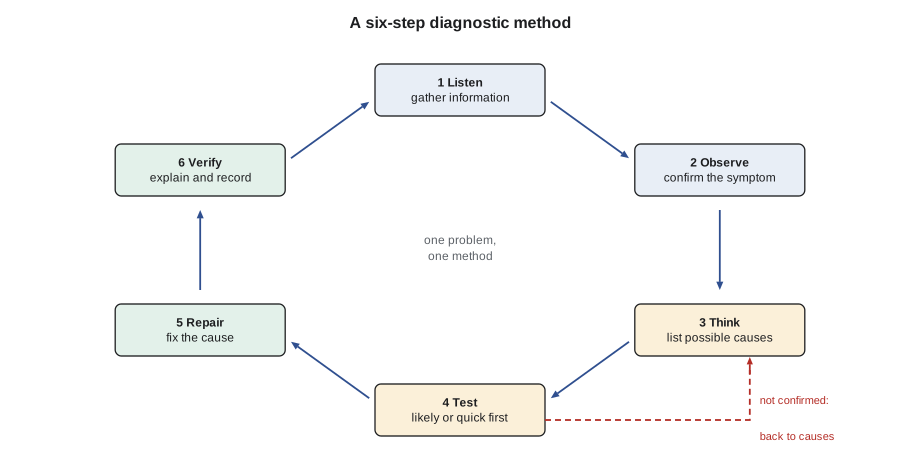
- Listen and gather information. Ask the customer what happens, when it started, whether it is constant or intermittent, what changed recently, and what they have already tried. Look at the age and type of the building and the fixtures.
- Observe and confirm the symptom. See the problem yourself. Run the fixture, look at the stain, listen to the noise. A customer's description is a starting point, not a diagnosis.
- List possible causes. Based on how the system works, write down or think through every cause that could produce the symptom. A slow drain could be a partial blockage in the trap, the branch, the stack or the building drain, or a blocked vent.
- Test, starting with the most likely or the easiest. Choose a test that separates the causes. Run water at another fixture on the same branch. Check whether the problem is hot only, cold only or both. Isolate a section and see whether the symptom remains.
- Repair the confirmed cause. Fix what the tests showed, not what you suspected at the start.
- Verify and explain. Run the system under the conditions that caused the problem, confirm it is fixed, and explain to the customer what was wrong, what you did and anything they should watch for.
The most common mistake in service work is jumping from the symptom straight to a repair, the plumber's equivalent of a doctor prescribing medicine before examining the patient. It works often enough to feel efficient, but when it fails, the customer pays for a part that did not fix the problem, the plumber loses credibility, and the real cause is still there. Grace's rule was that she never replaced a part without a test that pointed to it.
Asking good questions
The first conversation with a customer often contains the answer. Maya learned to use open questions first and then narrow down. "Tell me what's happening" invites a story; "Is it worse in the morning?" checks a specific idea. Customers rarely use plumbing terms, so it helps to translate. "The toilet makes a hissing sound every twenty minutes" points to a fill valve or flapper. "The water smells like rotten eggs, but only the hot" points to the water heater's anode. "The drain gurgles when the washer empties" points to a venting or partial blockage problem downstream of both fixtures.
| Question | Why it matters |
|---|---|
| When did it start, and did anything change around then? | Renovations, new fixtures, a city main break or a cold snap often explain a new problem. |
| Is it constant or does it come and go? | Intermittent problems often depend on use, temperature or pressure at certain times of day. |
| Which fixtures are affected? | One fixture points to that fixture or its trap; several fixtures point to a shared branch, stack or supply. |
| Hot, cold or both? | Hot-only problems point to the water heater or hot piping; both point to the supply or the fixture. |
| What have you already tried? | Chemical drain cleaners, replaced parts or closed valves change the situation and the risks. |
| How old is the building and the plumbing? | Pipe materials and common failures change by era. |
Grace also taught Maya to notice what customers do not say. A homeowner who mentions that the basement floor drain backed up "a little" during the last storm may be describing the early warning of a sewer lateral problem. A tenant who says the shower is fine "now" may have been running it for ten minutes before you arrived to get hot water. Gentle follow-up questions bring these details out.
Thinking in systems
Every plumbing symptom happens somewhere in a system: water supply, drainage, venting, hot water, gas or storm. Knowing where the symptom sits in the system narrows the causes quickly. Grace drew a simple sketch on almost every call, even when she had done similar calls hundreds of times: the main shutoff, the water heater, the branch serving the problem fixture, the drain path to the stack and building drain, and the vents. The sketch forced her to ask where in that path the problem could be.
A useful technique is to split the system in half. If several fixtures drain slowly, check a fixture closer to the building drain. If it drains well, the blockage is upstream of it. If it also drains slowly, the blockage is downstream. Each test halves the search area. The same logic applies to supply problems: check pressure at the hose bibb near the main, then at a fixture on the affected floor, and you know whether the restriction is in the service, the main distribution or the branch.
Systems thinking also means recognizing that one problem can cause another. A failed pressure-reducing valve can make a relief valve on the water heater discharge, which a homeowner reports as a leaking water heater. A partly blocked building drain can make a toilet on the lowest floor gurgle when an upper fixture drains, which looks like a toilet problem. Treating the visible symptom without finding the cause leads to callbacks.
Worked problem
Splitting the search on a slow drain
A bungalow has three slow fixtures: the kitchen sink, the bathroom sink and the bathtub. The laundry tub in the basement, which connects to the building drain just upstream of the cleanout at the front wall, drains well. What does this tell Maya, and what should she test next?
Show solution
- Three upstairs fixtures on different branches are slow, so the problem is probably in something they share.
- The laundry tub drains well, and it connects to the building drain close to the front wall, so the building drain downstream of that point is open.
- The shared section is the stack or the part of the building drain between the stack base and the laundry connection.
- Next test: open the cleanout at the base of the stack, or run water upstairs while watching the laundry tub and listening at the stack base.
- Half-splitting pays off quickly: if the drain system is thought of as eight sections, each test halves the search, so the number of tests needed is
- \[n = \lceil \log_2 8 \rceil = 3 \quad \text{tests, compared with up to } 8 \text{ testing one section at a time}\]
Answer: The blockage is most likely at the base of the stack or in the short section of building drain between the stack and the laundry connection. Maya should clear it from the stack cleanout, not by snaking each upstairs fixture.
Probability, cost and the order of tests
Not every test is equally useful. Grace taught Maya to choose tests by weighing how likely each cause was against how quick and cheap the test was. Checking whether a toilet flapper is leaking takes thirty seconds with a few drops of food colouring in the tank. Pulling the toilet to check the flange takes an hour. Even if the flange is a possible cause, the dye test comes first.
Experienced plumbers carry a mental table of how often each cause produces each symptom. For a running toilet, flapper problems are far more common than fill valve problems, which are more common than a cracked overflow tube. For no hot water on an electric heater, a tripped high-limit switch or a failed upper element is common; a failed thermostat is less common. Starting with the common, cheap tests usually finds the cause fastest.
# Choosing the order of diagnostic tests: likelihood per minute of testing
# (likelihoods and times are illustrative values for a running toilet)
causes = [
    # cause, likelihood (fraction of calls), minutes to test
    ("flapper or flush valve seat leaking", 0.55, 2),
    ("fill valve not shutting off", 0.25, 3),
    ("water level set too high, running into overflow", 0.12, 1),
    ("cracked overflow tube", 0.05, 4),
    ("hairline crack in tank", 0.03, 10),
]

ranked = sorted(causes, key=lambda c: c[1] / c[2], reverse=True)
elapsed, found_by = 0, 0.0
for name, p, minutes in ranked:
    elapsed += minutes
    found_by += p
print(f"{name:52s} test at {elapsed:2d} min, solved by now in {found_by:4.0%} of calls")flapper or flush valve seat leaking test at 2 min, solved by now in 55% of calls water level set too high, running into overflow test at 3 min, solved by now in 67% of calls fill valve not shutting off test at 6 min, solved by now in 92% of calls cracked overflow tube test at 10 min, solved by now in 97% of calls hairline crack in tank test at 20 min, solved by now in 100% of calls
The program sorts the tests by likelihood per minute. On a typical call, the cause is found within the first three tests in over ninety percent of cases. The point is not the exact numbers but the habit: think about which test gives the most information for the least effort, and do that one first.
Intermittent problems
The hardest problems are the ones that are not happening when you arrive. A water hammer bang that happens only at 6 a.m., a sewer smell that appears only on windy days, a drain that backs up only during heavy rain. For these, the diagnostic method shifts toward gathering evidence over time. Grace would ask the customer to write down when the problem happens and what else was going on: which fixtures were in use, what the weather was, whether a neighbour's lawn sprinkler was running. Sometimes she left a pressure gauge with a maximum-reading needle on a hose bibb, or a simple data-logging pressure recorder, and returned a few days later.
Intermittent problems also call for thinking about what changes over time in a building. Water pressure from the city varies with demand, so pressure-related problems may appear at night when demand is low and pressure is high. Temperature changes cause expansion and contraction, which can make pipes tick or allow joints to seep. Wind can blow sewer gas back down a vent stack terminal that is too close to a window or roof feature. Heavy rain raises groundwater and surcharges combined sewers.
Tools that support diagnosis
The service truck carries many tools for repairs, but a handful are mainly for diagnosis. Grace considered these essential:
A water pressure gauge that threads onto a hose bibb or laundry valve, ideally with a maximum-reading pointer, reading to about 1,400 kPa.
A digital thermometer for checking hot water temperature at fixtures and tanks.
A flashlight, inspection mirror and small camera or phone for looking into cabinets, crawl spaces and fixtures.
A moisture meter and an infrared thermometer or thermal camera for tracing leaks and hot water lines behind walls.
A multimeter and non-contact voltage tester for water heater elements, thermostats, sump pump circuits and switches.
A combustible gas detector and a carbon monoxide analyzer for gas appliance calls, used within the limits of the plumber's gas certification.
Food colouring or dye tablets, a flow cup or graduated bucket and a stopwatch.
A drain camera and locator, covered in lesson 4.
Tools do not replace thinking. A thermal camera shows a warm spot on a wall, but it takes an understanding of the system to decide whether that spot is a hot water leak, a heating pipe or a sunbeam.
When to stop and refer
Part of a good diagnosis is recognizing when a problem is outside the plumber's scope or licence. A water heater with a cracked gas valve may need a licensed gas technician, depending on the plumber's certificates. A damaged sewer lateral under the city sidewalk is the municipality's responsibility in many cities. Mould behind a leaking shower needs remediation beyond plumbing. Signs of electrical faults, such as a tingle from a faucet, need an electrician. Grace's rule was simple: diagnose as far as you safely and legally can, make the situation safe, explain clearly what you found, and refer the rest to the right person.
Common mistakes
MistakeReplacing parts based on the customer's description before seeing the problem.
InsteadObserve and confirm the symptom yourself, then test before replacing anything.
MistakeSnaking each slow fixture separately when several are slow.
InsteadLook for what the slow fixtures share and test the shared section first.
MistakeStarting with the most difficult test because it seems most thorough.
InsteadStart with tests that give the most information for the least time.
MistakeLeaving an intermittent problem because it is not happening now.
InsteadGather evidence over time with the customer's notes or a recording gauge.
MistakeFixing the visible symptom without asking what caused it.
InsteadAsk why the part failed, such as high pressure behind a leaking relief valve.
Summary and key terms
- Service work diagnoses and fixes problems in existing systems, often hidden, undocumented and urgent.
- A six-step method works for every call: listen, observe, list causes, test, repair, verify and explain.
- Open questions first, then specific ones, reveal when, where and how the problem happens.
- Locating the symptom in the system and splitting the search in half narrows causes quickly.
- Order tests by likelihood and ease; the common cheap tests usually find the cause.
- Intermittent problems need evidence over time, and some problems must be referred to other trades.
- Service call
- An unscheduled visit to diagnose and repair a problem.
- Diagnosis
- Finding the cause of a symptom by observation and testing.
- Callback
- A return visit because the first repair did not fix the problem.
- Half-split method
- Testing at the middle of a system to tell which half contains the fault.
- Intermittent fault
- A problem that occurs only under certain conditions or at certain times.
Practice problems
Work each problem on paper first, then reveal the answer to check.
Name the six steps of the diagnostic method.
Show answer
Listen and gather information, observe and confirm, list possible causes, test, repair, verify and explain.
Three upstairs fixtures are slow but a basement fixture near the front wall drains well. Where is the blockage likely to be?
Show answer
In the shared section downstream of the upstairs fixtures and upstream of the basement fixture, often at the stack base.
Why test a toilet flapper with dye before pulling the toilet?
Show answer
The dye test is fast and cheap and finds the most common cause; pulling the toilet is slow and rarely needed for a running toilet.
A relief valve on a water heater discharges at night. What upstream cause should you check?
Show answer
High system pressure, often from a failed pressure-reducing valve or thermal expansion in a closed system.
Give two ways to diagnose a problem that happens only early in the morning.
Show answer
Ask the customer to log when it happens and what is in use; leave a maximum-reading or recording pressure gauge.
Lesson quiz · 5 questions
Score 60% or more to complete this lesson.
Create a free account to save your progress, take quizzes and earn a certificate.