
PLB-420 · Lesson 11 of 12 · 20 min
Sump pumps, sewage ejectors and backwater valves
In late summer, a line of thunderstorms dropped more rain on the city in two hours than usually falls in a month. By evening, the service department had more calls than it could answer: basements with water seeping through the floor, sump pumps running nonstop or not at all, and, worst of all, sewage coming up through basement floor drains. Grace and Maya spent the next three days going from house to house. Grace told Maya that most of what they saw could have been prevented, and that the best service work after a flood is not only fixing the immediate problem but helping the homeowner protect the basement for next time. This lesson covers sump pumps, sewage ejectors and backwater valves, how they fail, and the municipal programs that help homeowners pay for flood protection.
Two different kinds of basement water
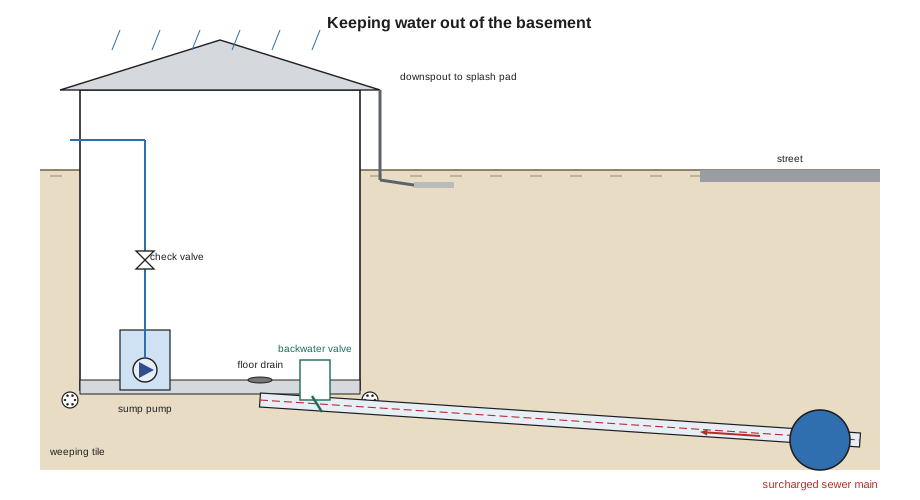
Basement flooding comes in two forms. Groundwater and surface water come through the walls and floor, or in at window wells and doors, when the soil around the foundation is saturated. A sump pump handles this water. Sewer backup happens when the municipal sewer cannot carry the flow, usually during heavy rain when stormwater enters a sanitary or combined sewer, and wastewater flows back up the sewer lateral and out of the lowest drain in the house. A backwater valve prevents this. The difference matters: one is clean if muddy water, the other is sewage and a health hazard, and the fixes are different.
Sump pumps
A sump pump sits in a pit (the sump) in the basement floor, where the foundation drainage, often called weeping tile or footing drain, collects groundwater. When the water rises to the switch's on level, the pump starts and pumps the water out through a discharge pipe with a check valve to the outside, well away from the foundation, or to a storm sewer where permitted.
- Pedestal pumps have the motor above the pit; submersible pumps sit in the water and are quieter and usually more powerful.
- Float switches are tethered, vertical or electronic. A switch that hangs up on the pit wall or a cord is a common failure.
- The check valve stops the water in the discharge pipe from running back into the pit each time the pump stops. Without it, the pump short-cycles.
- The discharge should drain away from the house, not onto a neighbour's property or a sidewalk, and must not freeze. Many municipalities prohibit sump discharge to the sanitary sewer, because it adds clean water to the sewer and causes backups elsewhere.
- A high water alarm in the pit warns the homeowner if the pump fails.
Common failures: a stuck or tangled float, a failed motor, a seized impeller from debris, a check valve stuck or installed backwards, a frozen or crushed discharge line, a tripped breaker or ground fault interrupter, a power failure during the storm (the most common time to need the pump), or a pump simply too small for the inflow.
Backup pumps
A primary pump fails most often when it is needed most. Battery backup pumps sit beside the primary pump in the pit, with their own float and a charger, and run during power failures or when the primary fails. Their run time depends on the battery and the inflow. Water-powered backup pumps use municipal water pressure to create suction, needing no electricity, but they use a lot of potable water and must be protected with an approved backflow preventer; some codes or utilities restrict them. Grace recommended a backup for any basement that had flooded before or had finished living space, and a high water alarm in every pit.
Sizing a sump pump
A sump pump must remove water faster than it flows in, at the head it works against. The inflow can be measured during wet weather by timing how fast the water rises in the pit with the pump off. The head is the vertical lift from the pit water level to the discharge outlet, plus friction in the pipe, check valve and fittings.
Worked problem
Measuring sump inflow
During a wet day, Grace unplugs the pump and times the water in a 450 mm diameter pit rising 100 mm in 30 seconds. The vertical lift to the discharge is 3.0 m, and she allows 0.8 m for friction. What flow and head should the pump handle?
Show solution
- \[A = \frac{\pi \times 0.45^2}{4} \approx 0.159\ \text{m}^2\]
- \[Q_{\text{in}} = 0.159 \times \frac{0.100}{30} \approx 0.00053\ \text{m}^3\text{/s} \approx 32\ \text{L/min}\]
- \[\text{Design flow} \approx 1.5 \times 32 = 48\ \text{L/min at } 3.0 + 0.8 = 3.8\ \text{m}\]
Answer: The pump should deliver at least about 48 L/min at 3.8 m of head, read from the pump's performance curve, not its maximum flow at zero head. A 1.5 factor gives margin for heavier storms.
# Sump pump check: inflow from a timed rise, required duty point, and cycle time
import math
D, rise, t = 0.45, 0.100, 30.0          # pit diameter m, rise m, seconds
lift, friction = 3.0, 0.8               # m
A = math.pi * D**2 / 4
q_in = A * rise / t * 60000             # L/min
need = 1.5 * q_in
head = lift + friction
print(f"Inflow {q_in:.0f} L/min; choose a pump giving at least {need:.0f} L/min at {head:.1f} m")

# Candidate pump curve (head m -> flow L/min), read from a manufacturer-style table
curve = [(0, 190), (2, 160), (3, 135), (4, 105), (5, 70), (6, 30)]
def flow_at(h):
    for (h1, q1), (h2, q2) in zip(curve, curve[1:]):
        if h1 <= h <= h2:
            return q1 + (q2 - q1) * (h - h1) / (h2 - h1)
    return 0.0
q_pump = flow_at(head)
print(f"Candidate delivers about {q_pump:.0f} L/min at {head:.1f} m -> {'OK' if q_pump >= need else 'too small'}")

# Cycle time between on and off levels 250 mm apart, at the measured inflow
v_cycle = A * 0.25 * 1000               # L
pump_out = v_cycle / (q_pump - q_in)    # minutes running
refill = v_cycle / q_in                 # minutes off
print(f"Each cycle moves {v_cycle:.0f} L: runs {pump_out*60:.0f} s, off {refill*60:.0f} s")Inflow 32 L/min; choose a pump giving at least 48 L/min at 3.8 m Candidate delivers about 111 L/min at 3.8 m -> OK Each cycle moves 40 L: runs 30 s, off 75 s
Short cycles wear out pumps. If a pump starts more than a few times a minute in heavy rain, the on-off range may be too small for the pit, the check valve may be leaking back, or the pump may be oversized for a small pit. A larger pit or a wider switch range often helps.
Sewage ejectors and grinder pumps
A basement bathroom, laundry or kitchen below the level of the building sewer needs a sewage ejector to lift wastewater up to the drain. The ejector sits in a sealed basin with a gasketed lid, a vent connected to the venting system, a discharge with a check valve and a full-port shutoff valve, and a high-level alarm. Solids-handling ejector pumps pass solids up to a certain size; grinder pumps shred solids so they can be pumped through small pipe over longer distances or to a pressure sewer.
- A basin lid that is not sealed lets sewer gas into the basement; a missing vent causes the pump to air lock or the basin to pressurise.
- Wipes, grease and feminine products jam ejector pumps. Grace explained to every homeowner with an ejector what not to flush.
- The shutoff valve above the check valve lets the pump be removed without draining the discharge line back into the basin.
- Laundry tray pumps and small drain pumps for sinks are separate products with their own limits; they are not ejectors for toilets.
Ejector service is sewage work, with the hygiene and safety precautions from lesson 2. Before opening the basin, Grace pumped it down, isolated the power, closed the discharge valve and wore gloves, eye protection and, when splashing was likely, a face shield.
Backwater valves
A backwater valve is installed in the building drain or sewer, with an access cover at the floor, to let wastewater flow out but close when sewage flows back from a surcharged sewer. Most designs have a hinged flap that floats closed on rising water. A normally open valve stays open so air can move through the drain to the sewer, closing only when backflow occurs. Valves must be accessible for inspection and cleaning, because debris on the seat or a stuck flap defeats them.
- A main-line backwater valve protects every fixture upstream of it. While it is closed during a backup, fixtures in the house must not be used, or their wastewater will back up in the basement instead; homeowners need to understand this.
- Some installations put the valve on the branch serving basement fixtures only, so upper floors drain by gravity even while the valve is closed. The design depends on the building's layout and the local code.
- Sump pumps and foundation drains must not discharge upstream of the backwater valve into the sanitary drain; otherwise the closed valve traps groundwater in the basement.
- Installation means cutting the basement floor, installing the valve at the right elevation and slope in the building drain, and providing an access box. It requires a permit and inspection, and it is a job for a licensed plumber.
Regular maintenance keeps the valve working: remove the cover, check that the flap moves freely and seals, clean debris and grease from the seat, and check the cover's O-ring before replacing it. Grace recommended inspecting every few months and after any backup, and showed each homeowner how to do it.
Municipal flood protection programs
Many municipalities offer grants or subsidies to help homeowners install flood protection, because preventing backups in many homes is cheaper than enlarging sewers. Rules, amounts and eligibility change, so Grace always checked the current program details with the municipality before quoting.
Hamilton's Protective Plumbing Program, often called 3P, offers grants toward a backwater valve, a sump pit and pump, a camera inspection of the sewer lateral and disconnecting downspouts from the sewer system. The work requires a building permit and a licensed plumber, and the program has an application process with the city before and after the work. Other Ontario cities have similar subsidies with their own amounts and rules.
Programs like these also encourage disconnecting downspouts and foundation drains from the sanitary sewer, which reduces the flow that causes backups for the whole neighbourhood. When Grace explained a program to a homeowner, she gave them the city's contact information, explained the steps and her company's role, and was clear about what the program would and would not cover.
After a flood
- Safety first: do not enter a flooded basement until power to the area is off, and treat sewage water as a health hazard.
- Report sewer backups to the municipality, which may need the information and may be responsible for a blockage in the main.
- Clear the drain, inspect the lateral with a camera and find whether the backup came from the city sewer, a blockage in the lateral, or groundwater.
- Recommend a protection plan: backwater valve, sump pump with backup and alarm, downspout disconnection, lot grading and window well covers, and the applicable municipal program.
- Document everything for the homeowner's insurance: photos, the camera video, findings and recommendations.
Common mistakes
MistakeDischarging a sump pump into the sanitary drain.
InsteadDischarge to grade or a storm system where permitted; sump water in the sanitary sewer causes backups.
MistakeSizing a sump pump from its maximum flow.
InsteadUse the pump curve at the actual head, with margin over the measured inflow.
MistakeInstalling a backwater valve without access.
InsteadProvide an accessible cover so the valve can be inspected and cleaned.
MistakeConnecting a sump or foundation drain upstream of the backwater valve.
InsteadKeep groundwater out of the protected sanitary drain.
MistakeQuoting a municipal subsidy from memory.
InsteadCheck the current program rules with the municipality before quoting.
Summary and key terms
- Groundwater flooding needs a sump pump; sewer backup needs a backwater valve.
- Sump pumps fail at floats, motors, check valves, discharge lines and power; add a backup and alarm.
- Size sump pumps from measured inflow and the head on the pump curve, with margin.
- Ejectors need sealed, vented basins, check and shutoff valves, alarms and care with what is flushed.
- Backwater valves must be accessible and maintained, and homeowners must know not to use fixtures while they are closed.
- Municipal programs help pay for flood protection; check current rules and explain them clearly.
- Sump pump
- A pump in a basement pit that removes groundwater collected by the foundation drainage.
- Sewage ejector
- A pump in a sealed, vented basin that lifts wastewater from below the sewer level.
- Backwater valve
- A valve in a building drain that closes to stop sewage flowing back from the sewer.
- Surcharge
- A condition in which a sewer is full and under pressure, pushing flow back up connections.
- Weeping tile
- Perforated drain pipe around a foundation footing that collects groundwater.
Practice problems
Work each problem on paper first, then reveal the answer to check.
A 500 mm pit rises 80 mm in 20 seconds. What is the inflow?
Show answer
About 47 L/min (0.196 m² × 0.08 m ÷ 20 s).
Why should a homeowner not use fixtures while a main backwater valve is closed?
Show answer
Their wastewater cannot leave and will back up in the basement.
Why are sump discharges to the sanitary sewer prohibited in many cities?
Show answer
Clean groundwater overloads the sanitary sewer and causes backups.
What does a shutoff valve above an ejector's check valve allow?
Show answer
Removing the pump or check valve without draining the discharge line into the basin.
Name three parts of a flood protection plan.
Show answer
Backwater valve, sump pump with backup and alarm, downspout disconnection, grading, window well covers.
Lesson quiz · 5 questions
Score 60% or more to complete this lesson.
Create a free account to save your progress, take quizzes and earn a certificate.