
PHYS-460 · Lesson 4 of 12 · 24 min
Optical resonators: modes, stability and the Fabry–Pérot cavity
▶ Video coming soon A video version of this lesson is on the way.
A gain medium alone is only an amplifier. To make an oscillator, part of the amplified light must be fed back into the medium again and again, and the feedback must select a small number of well-defined patterns of the field. That is the job of the optical resonator. The simplest resonator, proposed for lasers by Schawlow and Townes in 1958, is a pair of mirrors facing each other: the Fabry–Pérot interferometer of PHYS-230, now containing a gain medium. In this lesson we find which mirror arrangements trap light and which let it escape, describe the transverse and longitudinal modes of a cavity, and characterize the cavity by its free spectral range, finesse, photon lifetime and quality factor.
Why open resonators work
At microwave frequencies, a resonator is a closed metal box whose dimensions are comparable to the wavelength, so it supports only a few modes. At optical wavelengths a closed box a few centimetres across would support around \(10^{14}\) modes in the gain bandwidth, and the laser would have no reason to choose any one of them. The insight of Schawlow and Townes, and independently of Prokhorov, was to remove the side walls. In an open resonator, light travelling at any appreciable angle to the axis walks off the mirrors after a few passes and is lost. Only the few modes travelling nearly along the axis survive long enough to build up. Losses then select the modes, and the laser oscillates on those with the highest gain and lowest loss.
Ray matrices
The behaviour of rays in a resonator can be analysed with the ray transfer matrices, or ABCD matrices, of paraxial optics. A ray at a plane is described by its height \(y\) above the axis and its angle \(\theta\). After passing through an optical element, the new height and angle are linear combinations of the old:
Free propagation over a distance \(d\) has matrix \(\begin{pmatrix} 1 & d \\ 0 & 1\end{pmatrix}\); a thin lens of focal length \(f\) has \(\begin{pmatrix} 1 & 0 \\ -1/f & 1\end{pmatrix}\); and a spherical mirror of radius of curvature \(R\), concave toward the incoming light, acts like a lens of focal length \(R/2\), with matrix \(\begin{pmatrix} 1 & 0 \\ -2/R & 1\end{pmatrix}\). A sequence of elements is represented by the product of their matrices in reverse order. In free space and in a uniform medium, the determinant of every matrix equals one.
For a resonator, multiply the matrices for one complete round trip to get \(M\). A ray that makes \(m\) round trips is transformed by \(M^m\). The eigenvalues of a unit-determinant 2×2 matrix are \(e^{\pm i\theta}\) when \(|A + D|/2 \le 1\), in which case \(M^m\) stays bounded and rays oscillate back and forth about the axis forever: the resonator is stable. When \(|A + D|/2 > 1\), the eigenvalues are real, one of them exceeds one in magnitude, and rays walk away from the axis exponentially: the resonator is unstable.
The stability diagram
For two mirrors with radii \(R_1\) and \(R_2\) separated by \(L\), the condition takes a famous simple form. Define the g parameters
Working out the round-trip matrix gives \((A + D)/2 = 2g_1g_2 - 1\), and the stability condition becomes
Plane mirrors have \(R = \infty\) and \(g = 1\). In the \(g_1g_2\) plane, stable resonators lie between the axes and the hyperbola \(g_1g_2 = 1\).
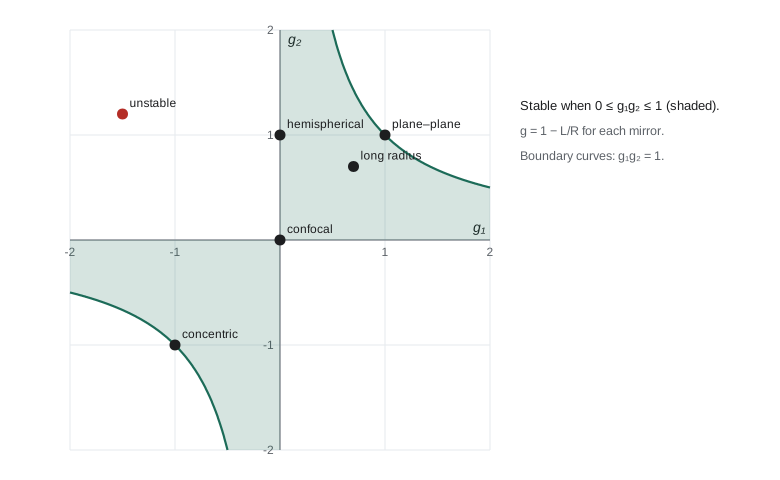
Several important designs lie exactly on the boundary. The plane–plane resonator (\(g_1 = g_2 = 1\)) is marginally stable and very sensitive to mirror tilt. The confocal resonator, with \(R_1 = R_2 = L\), has \(g_1 = g_2 = 0\) and is the least sensitive to mirror misalignment. The concentric resonator, with \(R_1 = R_2 = L/2\), has \(g_1 = g_2 = -1\) and focuses the beam to a very small waist in the middle. The hemispherical resonator, one plane mirror and one with \(R = L\), focuses the beam onto the plane mirror. Practical cavities are usually built slightly inside the boundary for robustness: a slightly near-hemispherical design is popular for helium–neon lasers.
Unstable resonators have their uses too. In a high-gain laser, such as a large carbon dioxide or excimer laser, a deliberately unstable cavity lets light walk outward and escape around the edge of a small mirror. The beam then fills a large volume of gain medium, and the high single-pass gain compensates for the large loss per round trip.
Gaussian modes
Ray optics says which cavities trap light; wave optics says what pattern the trapped light takes. The lowest-order mode of a stable cavity is a Gaussian beam, whose transverse intensity profile is \(I(r) = I_0e^{-2r^2/w^2}\), with a spot size \(w\) that varies along the axis. Lesson 7 develops Gaussian beams in detail. The essential fact here is that the wavefronts of a Gaussian beam are curved, and a stable mode is one whose wavefront curvature matches each mirror exactly, so that the beam reproduces itself after a round trip. For a symmetric cavity of length \(L\) with mirror radius \(R\), the spot size on the mirrors is
and the beam has its narrowest point, the waist, at the midpoint, with \(w_0^2 = (\lambda/2\pi)\sqrt{L(2R - L)}\). As the cavity approaches the plane–plane or concentric limits (\(g \to \pm1\)), the spot on the mirrors grows without limit and the mode becomes sensitive to every imperfection.
Higher-order transverse modes have more structure. In Cartesian form they are Hermite–Gaussian modes, labelled \(\mathrm{TEM}_{mn}\), with \(m\) and \(n\) nodal lines across the beam in the two transverse directions. The fundamental \(\mathrm{TEM}_{00}\) mode is a smooth Gaussian spot; \(\mathrm{TEM}_{10}\) has two lobes, \(\mathrm{TEM}_{11}\) four, and so on. Higher-order modes are wider, so an aperture inside the cavity, often just the edge of the gain medium, adds more loss to them than to \(\mathrm{TEM}_{00}\) and can force a laser into the fundamental mode.
Longitudinal modes and the free spectral range
A mode must also reproduce its phase after a round trip: the round-trip phase must be a multiple of \(2\pi\). For a plane wave between plane mirrors, this means an integer number \(q\) of half-wavelengths fits in the cavity, \(L = q\lambda/2\), so the allowed frequencies are
where \(n\) is the refractive index of the material filling the cavity. The spacing \(\Delta\nu_{FSR}\) is called the free spectral range, and \(q\) is typically a very large integer, around a million for a 30 cm cavity at visible wavelengths. For Gaussian modes, there is an extra phase, the Gouy phase, which depends on the transverse mode numbers. The full resonance condition for a two-mirror cavity is
with the sign chosen to match the sign of \(g_1\) and \(g_2\). Transverse modes are therefore shifted in frequency from the longitudinal modes by a fraction of the free spectral range. In a confocal cavity the fraction is exactly one half, so the transverse modes fall halfway between the longitudinal modes or on top of them, a degeneracy that makes confocal cavities useful as optical spectrum analysers.
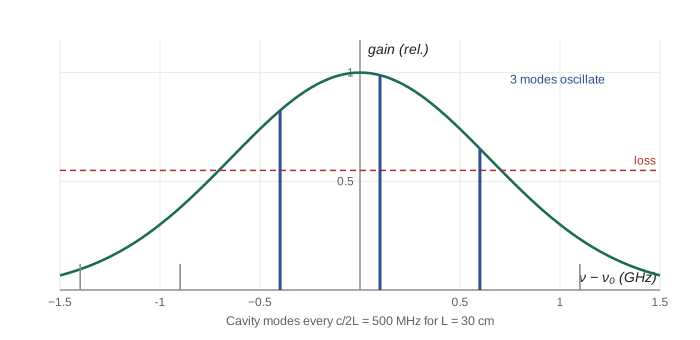
The number of longitudinal modes that can oscillate is roughly the width of the gain curve above threshold divided by the free spectral range. A 30 cm helium–neon laser with a 1.5 GHz Doppler width has room for about three modes; a 15 cm laser has room for one or two. To make a single-frequency laser, one can shorten the cavity, insert a frequency-selective element such as an etalon, or use a homogeneously broadened medium where the strongest mode suppresses the others.
Cavity losses: photon lifetime, finesse and Q
Light trapped in a cavity leaks out through the mirrors and is lost to scattering and absorption. If a fraction of the energy is lost each round trip, the stored energy decays exponentially with a time constant called the photon lifetime. For mirror reflectivities \(R_1\) and \(R_2\) and no other loss, the energy after one round trip of duration \(2L/c\) is multiplied by \(R_1R_2\), so
The cavity resonances are not infinitely sharp. A field that decays with time constant \(\tau_p\) in energy has a Lorentzian spectrum of full width \(\delta\nu = 1/(2\pi\tau_p)\). The ratio of the free spectral range to this width is the finesse,
which PHYS-230 met as the coefficient that sharpens the fringes of a Fabry–Pérot interferometer. Finally, the quality factor of the resonance is \(Q = \nu/\delta\nu = 2\pi\nu\tau_p\), the number of radians of oscillation during the energy lifetime. The program computes all of these for a 30 cm cavity.
Computing resonator properties
The program multiplies ABCD matrices to check the stability of seven cavities, extracts the Gaussian mode size from the eigenvalues of the round-trip matrix, and computes the free spectral range, photon lifetime, finesse and quality factor for a 30 cm cavity with mirror reflectivities of 0.999 and 0.98.
import math
c = 2.99792458e8
def mat(a, b, cc, d): return [[a, b], [cc, d]]
def mul(X, Y): return [[sum(X[i][k] * Y[k][j] for k in range(2)) for j in range(2)] for i in range(2)]
def space(d): return mat(1, d, 0, 1)
def mirror(R): return mat(1, 0, -2 / R, 1) if R != math.inf else mat(1, 0, 0, 1)
def round_trip(L, R1, R2):
    return mul(mirror(R1), mul(space(L), mul(mirror(R2), space(L))))
lam = 632.8e-9
print(f"{'cavity':26s}{'g1':>7s}{'g2':>7s}{'g1g2':>7s}{'|A+D|/2':>9s}  stable")
cases = [('plane-plane', 0.30, math.inf, math.inf), ('confocal', 0.30, 0.30, 0.30),
         ('hemispherical (near)', 0.30, 0.31, math.inf), ('long-radius', 0.30, 1.0, 1.0),
         ('concentric (near)', 0.30, 0.151, 0.151), ('too long', 0.30, 0.10, 0.10),
         ('convex-concave', 0.30, -1.0, 2.0)]
for name, L, R1, R2 in cases:
    g1 = 1 - L / R1; g2 = 1 - L / R2
    M = round_trip(L, R1, R2); half = abs(M[0][0] + M[1][1]) / 2
    print(f"{name:26s}{g1:7.3f}{g2:7.3f}{g1*g2:7.3f}{half:9.3f}  {'yes' if 0 <= g1*g2 <= 1 else 'no'}")
# Gaussian mode of a symmetric cavity from the round-trip matrix: 1/q = (D - A)/(2B) - i sin(theta)/B
L, R = 0.30, 1.0
M = round_trip(L, R, R); A, B = M[0][0], M[0][1]; D = M[1][1]
costh = (A + D) / 2; sinth = math.sqrt(1 - costh**2)
w = math.sqrt(lam * abs(B) / (math.pi * sinth))
g = 1 - L / R
w_formula = math.sqrt(lam * L / math.pi * math.sqrt(1 / (1 - g * g)))  # spot size on a mirror, symmetric
print()
print(f"spot radius on the mirrors (L = 30 cm, R = 1 m): {w*1e3:.3f} mm (formula {w_formula*1e3:.3f} mm)")
w0 = math.sqrt(lam / math.pi * math.sqrt(L * (2 * R - L)) / 2)
print(f"waist radius at the midpoint of the cavity: {w0*1e3:.3f} mm")
# longitudinal modes, photon lifetime, finesse, Q
R1r, R2r = 0.999, 0.98
FSR = c / (2 * L)
tau_p = (2 * L / c) / (-math.log(R1r * R2r))
F = math.pi * (R1r * R2r) ** 0.25 / (1 - math.sqrt(R1r * R2r))
nu = c / lam
print()
print(f"free spectral range c/2L = {FSR/1e6:.1f} MHz")
print(f"photon lifetime = {tau_p*1e9:.1f} ns, cavity linewidth = {1/(2*math.pi*tau_p)/1e6:.2f} MHz")
print(f"finesse = {F:.0f}, quality factor Q = {nu/(FSR/F):.2e}")
print(f"longitudinal modes inside a 1.5 GHz gain line: about {int(1.5e9 // FSR)}")cavity g1 g2 g1g2 |A+D|/2 stable plane-plane 1.000 1.000 1.000 1.000 yes confocal 0.000 0.000 0.000 1.000 yes hemispherical (near) 0.032 1.000 0.032 0.935 yes long-radius 0.700 0.700 0.490 0.020 yes concentric (near) -0.987 -0.987 0.974 0.947 yes too long -2.000 -2.000 4.000 7.000 no convex-concave 1.300 0.850 1.105 1.210 no spot radius on the mirrors (L = 30 cm, R = 1 m): 0.291 mm (formula 0.291 mm) waist radius at the midpoint of the cavity: 0.268 mm free spectral range c/2L = 499.7 MHz photon lifetime = 94.4 ns, cavity linewidth = 1.69 MHz finesse = 296, quality factor Q = 2.81e+08 longitudinal modes inside a 1.5 GHz gain line: about 3
The matrix calculation reproduces the g-parameter rule: \(|A + D|/2 = |2g_1g_2 - 1|\) is at most one exactly when \(0 \le g_1g_2 \le 1\). The plane–plane and confocal cavities sit on the boundary with \(|A + D|/2 = 1\). A cavity made too long for its mirrors, or one combining a convex and a concave mirror badly, is unstable. The mode size found from the eigenvector of the round-trip matrix, 0.291 mm on the mirrors, agrees with the formula, and the waist at the midpoint is 0.268 mm.
The cavity numbers are typical of a small gas laser. The free spectral range is 500 MHz, so three longitudinal modes fit under the helium–neon gain curve. The photon lifetime, 94 ns, is about 47 round trips of 2 ns each. The finesse is about 300 and the Q is nearly \(3 \times 10^8\). Passive reference cavities with mirrors of reflectivity 0.99999 or better reach finesses of hundreds of thousands and are used to stabilize lasers to linewidths below a hertz, the basis of optical atomic clocks and of the interferometers that detect gravitational waves.
Worked problem
Is this cavity stable?
A cavity has a concave mirror of radius 2.0 m and a plane mirror, separated by 1.5 m. Is it stable? What happens if the separation is increased to 2.5 m?
Show solution
- \(g_1 = 1 - 1.5/2.0 = 0.25\), \(g_2 = 1\); \(g_1g_2 = 0.25\), inside the stable range.
- At 2.5 m: \(g_1 = 1 - 2.5/2.0 = -0.25\), \(g_2 = 1\); \(g_1g_2 = -0.25 < 0\): unstable.
Answer: Stable at 1.5 m, unstable at 2.5 m. A plane–concave cavity is stable only while the mirror separation is less than the radius of curvature.
Worked problem
Modes in a diode laser
A semiconductor laser chip is 300 µm long with refractive index 3.6. Find its longitudinal mode spacing in frequency and in wavelength at 1550 nm.
Show solution
- \(\Delta\nu = c/(2nL) = 3.00 \times 10^8/(2 \times 3.6 \times 3.0 \times 10^{-4}) = 1.39 \times 10^{11}\) Hz \(= 139\) GHz.
- \(\Delta\lambda = \lambda^2\Delta\nu/c = (1.55 \times 10^{-6})^2 \times 1.39 \times 10^{11}/3.00 \times 10^8 = 1.11 \times 10^{-9}\) m.
Answer: About 139 GHz, or 1.1 nm. The gain of a semiconductor spans tens of nanometres, so a simple chip oscillates on several modes; telecom lasers add a grating (lesson 6) to select one. Strictly, the group index should be used here, which in semiconductors is somewhat larger than the phase index.
Common mistakes
MistakeAssuming any pair of mirrors forms a stable cavity.
InsteadStability requires \(0 \le g_1g_2 \le 1\); a plane–concave cavity longer than the radius is unstable.
MistakeUsing \(c/2L\) without the refractive index.
InsteadThe free spectral range is \(c/(2nL)\), with the group index for dispersive media.
MistakeTreating unstable resonators as useless.
InsteadHigh-gain lasers use them deliberately to fill a large mode volume.
MistakeForgetting that transverse modes have different frequencies.
InsteadThe Gouy phase shifts \(\mathrm{TEM}_{mn}\) modes by \((m + n)\) times a fraction of the free spectral range.
MistakeConfusing photon lifetime with upper-level lifetime.
InsteadThe photon lifetime describes how long light survives in the cavity; the upper-level lifetime describes the atoms.
Summary and key terms
- Open resonators select a few modes by losing all light that travels off axis.
- ABCD matrices give the stability condition \(|A + D|/2 \le 1\), which for two mirrors becomes \(0 \le g_1g_2 \le 1\).
- Stable cavities support Gaussian \(\mathrm{TEM}_{mn}\) modes whose wavefronts match the mirrors.
- Longitudinal modes are spaced by the free spectral range \(c/(2nL)\); transverse modes are offset by the Gouy phase.
- Photon lifetime \(\tau_p = (2L/c)/(-\ln R_1R_2)\), linewidth \(1/(2\pi\tau_p)\), finesse \(\Delta\nu_{FSR}/\delta\nu\), and \(Q = 2\pi\nu\tau_p\).
- g parameter
- \(g = 1 - L/R\) for a mirror of radius \(R\) in a cavity of length \(L\).
- Free spectral range
- The frequency spacing \(c/(2nL)\) of adjacent longitudinal modes.
- Transverse mode
- A pattern of the field across the beam, labelled \(\mathrm{TEM}_{mn}\).
- Finesse
- The ratio of mode spacing to mode linewidth; a measure of cavity sharpness.
- Photon lifetime
- The time constant for the decay of light energy stored in a cavity.
Practice problems
Work each problem on paper first, then reveal the answer to check.
Classify a cavity with \(R_1 = R_2 = 0.5\) m and \(L = 0.8\) m.
Show answer
\(g = 1 - 0.8/0.5 = -0.6\); \(g_1g_2 = 0.36\): stable.
Find the free spectral range of a 1.5 m cavity in air.
Show answer
\(c/2L = 3 \times 10^8/3 = 100\) MHz.
A cavity has \(R_1 = 1\), \(R_2 = 0.9\), \(L = 0.5\) m. Find the photon lifetime.
Show answer
\(\tau_p = (1/3 \times 10^8)/(-\ln0.9) = 3.33 \times 10^{-9}/0.105 = 31.6\) ns.
What is the finesse of a cavity with \(R_1 = R_2 = 0.99\)?
Show answer
\(\mathcal F = \pi \times 0.99^{1/2}/(1 - 0.99) = 3.126/0.01 = 313\).
Why does a confocal cavity make a good spectrum analyser?
Show answer
Its transverse modes are degenerate with the longitudinal modes or fall exactly halfway between them, so the transmission pattern is simple and insensitive to alignment.
Lesson quiz · 5 questions
Score 60% or more to complete this lesson.
Create a free account to save your progress, take quizzes and earn a certificate.