
PHYS-131 · Lesson 3 of 5 · 41 min
Capacitance
A capacitor stores energy in an electric field. It is one of the three basic passive circuit components, alongside resistors and inductors, and almost every electronic circuit contains dozens of them. Capacitors smooth the output of power supplies, filter noise out of signals, set the timing of oscillators, deliver the burst of energy in a camera flash or a defibrillator, correct the power factor of industrial motors, and, as supercapacitors, buffer energy in buses and wind turbines.
This chapter explains what capacitance is, calculates it for the parallel-plate capacitor, shows how dielectrics increase it, works out the energy stored, combines capacitors in series and parallel, and introduces the RC circuit, whose exponential charging curve appears throughout engineering.
What a capacitor is
Any two conductors separated by an insulator form a capacitor. Connect them to a battery and charge flows until one conductor holds \(+Q\) and the other \(-Q\), with a potential difference \(V\) between them. For a given capacitor, the charge is proportional to the voltage. The constant of proportionality is the capacitance:
Capacitance depends only on the geometry of the conductors and the insulating material between them, not on how much charge is present. A farad is very large; practical capacitors range from picofarads (pF, \(10^{-12}\) F) in radio circuits through microfarads (μF) in power supplies to thousands of farads in supercapacitors.
The circuit symbol is two parallel lines, representing the plates.
The parallel-plate capacitor
The simplest capacitor is two flat plates of area \(A\) a distance \(d\) apart. From Lesson 2, the field between them is \(E = \sigma/\varepsilon_0 = Q/(\varepsilon_0 A)\), and the voltage is \(V = Ed\). So \(V = Qd/(\varepsilon_0 A)\), and
Larger plates hold more charge at a given voltage; closer plates give a stronger field per volt. Both raise the capacitance.
Worked problem
An air-gap capacitor
Two plates of area 0.010 m² (10 cm × 10 cm) are 1.0 mm apart in air. Find the capacitance and the charge when connected to 100 V.
Show solution
- \(C = (8.854 \times 10^{-12})(0.010)/(0.0010) = 8.85 \times 10^{-11}\) F = 88.5 pF.
- \(Q = CV = (8.85 \times 10^{-11})(100) = 8.85 \times 10^{-9}\) C = 8.85 nC.
Answer: 88.5 pF; 8.85 nC. Even a large plate pair has tiny capacitance, which is why practical capacitors roll up long, thin layers
Real capacitors maximize \(A/d\): electrolytic capacitors use a chemically etched foil (huge surface area) coated with an oxide film only nanometres thick; ceramic capacitors stack hundreds of thin layers; supercapacitors use porous carbon with surface areas of over 1000 m² per gram.
Dielectrics
Filling the gap with an insulating material (a dielectric) increases the capacitance by a factor \(\kappa\), the dielectric constant:
The field polarizes the dielectric's molecules, and their bound charges partly cancel the field inside, so a given charge produces less voltage. Typical values: air 1.0006, paper about 3.5, glass 5 to 10, water 80, and specialist ceramics such as barium titanate over 1000.
A dielectric has a second benefit: it can withstand a much higher field than air before breaking down, so the plates can be closer and the capacitor can work at higher voltage. Every capacitor has a rated working voltage that must not be exceeded.
Worked problem
Adding a dielectric
The capacitor above is filled with paper (\(\kappa = 3.5\)). What is its new capacitance?
Show solution
- \(C = 3.5 \times 88.5 \text{ pF} = 310\) pF.
Answer: 310 pF, three and a half times larger
Energy stored in a capacitor
Charging a capacitor takes work, because each new bit of charge must be pushed onto a plate against the voltage already there. The voltage rises from 0 to \(V\) as the charge builds, so the average voltage is \(V/2\) and the work done is \(\tfrac12 QV\). Using \(Q = CV\), the stored energy can be written three ways:
The energy lives in the electric field between the plates. Dividing by the volume \(Ad\) gives the energy density \(u = \tfrac12\varepsilon_0 E^2\), a result that holds for any electric field. Even at the breakdown field of air (3 MV/m) this is only about 40 J/m³, which is why ordinary capacitors store far less energy than batteries of the same size.
Worked problem
A defibrillator
A defibrillator charges a 100 μF capacitor to 2000 V. How much energy does it store?
Show solution
- \(U = \tfrac12 CV^2 = \tfrac12(100 \times 10^{-6})(2000)^2 = 200\) J.
Answer: 200 J, delivered in a few milliseconds: a peak power of tens of kilowatts. Capacitors release energy far faster than batteries can
Worked problem
A supercapacitor
A 3000 F supercapacitor is rated at 2.7 V. How much energy can it store, in joules and watt-hours?
Show solution
- \(U = \tfrac12(3000)(2.7)^2 = 10\,900\) J.
- \(10\,900/3600 = 3.0\) Wh.
Answer: About 10.9 kJ or 3.0 Wh. Large banks of these are used for regenerative braking in buses and trams, where quick charge and discharge matter more than total energy
Worked problem
Inserting a dielectric after charging
The 88.5 pF air capacitor is charged to 100 V, then disconnected from the battery. A paper sheet (\(\kappa = 3.5\)) is slid between the plates. Find the new voltage and the change in stored energy.
Show solution
- Disconnected, so the charge stays at \(Q = 8.85\) nC. The capacitance rises to 310 pF.
- New voltage: \(V = Q/C = 8.85 \times 10^{-9}/3.10 \times 10^{-10} = 28.6\) V.
- Energy before: \(\tfrac12 CV^2 = \tfrac12(88.5 \times 10^{-12})(100^2) = 4.43 \times 10^{-7}\) J. After: \(Q^2/2C = 1.26 \times 10^{-7}\) J.
Answer: The voltage falls to 28.6 V and the stored energy drops by a factor of 3.5. The missing energy did work pulling the dielectric into the gap
Capacitors in real equipment
Capacitors come in families suited to different jobs. Ceramic capacitors are small and fast and filter high-frequency noise on circuit boards. Electrolytic capacitors pack large capacitance into a small can for power supplies, but they are polarized (they must be connected the right way round) and wear out with heat. Film capacitors are robust and are used for motor starting, power-factor correction in factories and high-voltage pulses. Every capacitor carries two ratings that matter: its capacitance and its maximum working voltage.
Worked problem
Smoothing a power supply
A rectifier recharges a 4700 μF smoothing capacitor 120 times per second, and between recharges a 1.0 A load drains it. Estimate the ripple: how far the voltage sags between peaks.
Show solution
- Between peaks the capacitor supplies the load for about \(\Delta t = 1/120\) s, losing charge \(\Delta Q = I\Delta t\).
- Voltage sag: \(\Delta V = \Delta Q/C = I/(fC) = 1.0/(120 \times 4700 \times 10^{-6})\).
Answer: About 1.8 V of ripple. Doubling the capacitance would halve it, which is why power supplies use such large capacitors
Worked problem
How dangerous is a static spark?
A person walking across a carpet can charge to 10 kV. Treating the body as a 150 pF capacitor, how much energy is released in a spark? The minimum ignition energy of gasoline vapour is about 0.2 mJ.
Show solution
- \(U = \tfrac12 CV^2 = \tfrac12(150 \times 10^{-12})(10\,000)^2 = 7.5 \times 10^{-3}\) J = 7.5 mJ.
Answer: 7.5 mJ, more than thirty times what is needed to ignite fuel vapour. That is why refuelling sites warn against re-entering a vehicle while fuelling, and why hazardous-area workers wear static-dissipative footwear
Capacitors in parallel and series
In parallel, capacitors share the same voltage, and their charges add. It is as if the plate areas add:
In series, capacitors carry the same charge (whatever leaves one plate arrives on the next), and their voltages add. It is as if the gaps add:
These are the reverse of the rules for resistors in Lesson 4. Series capacitance is always smaller than the smallest capacitor in the chain. For two in series there is a handy shortcut: \(C = C_1C_2/(C_1 + C_2)\).
Worked problem
A capacitor network
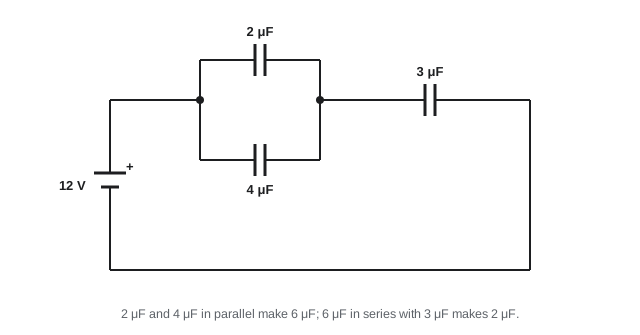
In the circuit shown, find the equivalent capacitance, the total charge, and the charge and voltage on each capacitor.
Show solution
- Parallel pair: \(2 + 4 = 6\) μF.
- In series with 3 μF: \(C = (6)(3)/(6 + 3) = 2\) μF.
- Total charge from the battery: \(Q = CV = (2 \text{ μF})(12 \text{ V}) = 24\) μC.
- The 3 μF capacitor and the parallel pair are in series, so each carries 24 μC. Voltage across 3 μF: \(24/3 = 8\) V. Across the pair: \(24/6 = 4\) V.
- Within the pair (both at 4 V): 2 μF holds \(8\) μC and 4 μF holds \(16\) μC. Check: \(8 + 16 = 24\) μC.
Answer: C = 2 μF; Q = 24 μC. The 3 μF capacitor has 24 μC at 8 V; the 2 μF has 8 μC and the 4 μF has 16 μC, both at 4 V
Notice that the smallest capacitor in a series chain takes the largest share of the voltage. Designers must check that every capacitor in a series string stays within its voltage rating.
RC circuits: charging and discharging
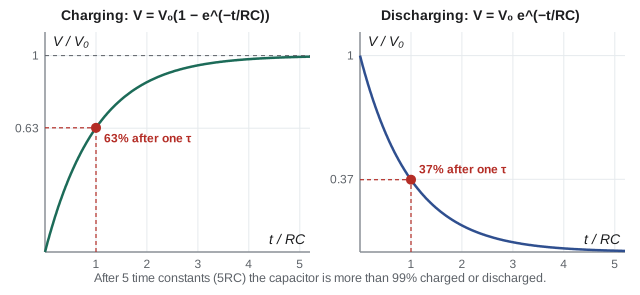
A capacitor never charges instantly. In a real circuit there is always resistance, which limits the current. When a capacitor \(C\) charges from a voltage \(V_0\) through a resistor \(R\), the current starts at \(V_0/R\) and falls as the capacitor fills, because the capacitor's own voltage opposes the source. Applying Kirchhoff's voltage law gives a first-order differential equation whose solution is
The product \(\tau = RC\) is the time constant, measured in seconds (ohms times farads). After one time constant, a charging capacitor reaches 63% of its final voltage; a discharging one falls to 37%. After five time constants it is within 1% of the end value, which engineers usually treat as "fully" charged or discharged.
Worked problem
Time to 90%
A 100 μF capacitor charges through a 10 kΩ resistor from a 5.0 V supply. Find the time constant and the time to reach 4.5 V.
Show solution
- \(\tau = RC = (10 \times 10^3)(100 \times 10^{-6}) = 1.0\) s.
- 4.5 V is 90% of 5.0 V: \(1 - e^{-t/\tau} = 0.90\), so \(e^{-t/\tau} = 0.10\).
- \(t = \tau\ln 10 = 2.30\) s.
Answer: τ = 1.0 s; 2.3 s to reach 4.5 V
The same exponential appears in heating and cooling, in draining tanks and in the response of sensors. An engineer who recognizes a first-order system can predict its behaviour from a single number, its time constant.
RC circuits are everywhere: they debounce switches, set the delay before a light turns off, and, combined with transistors, form the timing core of the classic 555 timer chip. Paired with a resistor, a capacitor also makes a simple filter that passes slow signals and blocks fast ones (or the reverse), a topic for circuits courses.
Common mistakes
MistakeUsing the resistor rules for capacitors: adding series capacitors directly.
InsteadCapacitors in parallel add; in series their reciprocals add. It is the opposite of resistors.
MistakeAssuming capacitors in series have equal voltages.
InsteadThey have equal charges. The voltage on each is Q/C, so the smallest capacitor takes the most voltage.
MistakeComputing stored energy as QV.
InsteadU = ½QV = ½CV². The voltage builds up from zero while charging.
MistakeForgetting to convert μF, nF and pF to farads.
Instead1 μF = 10⁻⁶ F, 1 nF = 10⁻⁹ F, 1 pF = 10⁻¹² F.
MistakeExpecting a capacitor to charge fully in one time constant.
InsteadOne RC gives 63%. Allow about 5RC for practical completion.
Summary and key terms
- Capacitance C = Q/V depends only on geometry and the insulator; the unit is the farad.
- A parallel-plate capacitor has C = κε₀A/d.
- A dielectric raises capacitance by κ and allows a higher working voltage.
- Stored energy U = ½CV² = ½QV = Q²/2C; the energy is in the electric field.
- Parallel: C = C₁ + C₂ + …. Series: 1/C = 1/C₁ + 1/C₂ + …; series capacitors share the same charge.
- An RC circuit charges as V₀(1 − e^(−t/RC)) and discharges as V₀e^(−t/RC), with time constant τ = RC.
- Capacitor
- Two conductors separated by an insulator, used to store charge and energy.
- Capacitance
- Charge stored per volt, C = Q/V.
- Farad (F)
- The SI unit of capacitance, 1 C/V.
- Dielectric
- An insulating material that increases capacitance.
- Dielectric constant
- κ, the factor by which a dielectric multiplies capacitance.
- Energy density
- Energy per unit volume in a field, ½ε₀E².
- Time constant
- τ = RC, the characteristic charging time of an RC circuit.
Practice problems
Work each problem on paper first, then reveal the answer to check.
A capacitor stores 60 μC at 12 V. What is its capacitance?
Show answer
C = Q/V = 60/12 = 5.0 μF.
What plate area would a 1.0 μF air capacitor with a 0.10 mm gap need?
Show answer
A = Cd/ε₀ = (10⁻⁶)(10⁻⁴)/(8.854 × 10⁻¹²) = 11.3 m², about the floor of a small room.
If the gap of a parallel-plate capacitor is halved, what happens to its capacitance?
Show answer
It doubles, since C ∝ 1/d.
Find the energy stored in a 470 μF capacitor at 25 V.
Show answer
U = ½(470 × 10⁻⁶)(625) = 0.147 J.
Find the equivalent capacitance of 10 μF, 20 μF and 30 μF (a) in parallel and (b) in series.
Show answer
(a) 60 μF. (b) 1/C = 1/10 + 1/20 + 1/30 = 11/60, so C = 5.45 μF.
Capacitors of 4 μF and 12 μF are in series across 24 V. Find the charge and the voltage on each.
Show answer
C = 48/16 = 3 μF; Q = 72 μC on each. V₄ = 72/4 = 18 V; V₁₂ = 72/12 = 6 V.
A capacitor bank must store 500 J at 400 V. What capacitance is needed?
Show answer
C = 2U/V² = 1000/160 000 = 6.25 × 10⁻³ F = 6250 μF.
A 2.2 μF capacitor discharges through a 470 kΩ resistor. Find the time constant and the voltage after 2.0 s if it starts at 9.0 V.
Show answer
τ = 1.034 s. V = 9.0e^(−2.0/1.034) = 9.0 × 0.145 = 1.30 V.
How long does it take an RC circuit to charge to 99% of its final voltage?
Show answer
e^(−t/τ) = 0.01, so t = τ ln 100 = 4.6τ.
Why does a capacitive touchscreen not respond to a gloved finger?
Show answer
It senses the change in capacitance caused by a conductive finger near the electrodes. A thick insulating glove keeps the conductor too far away to change C noticeably.
Lesson quiz · 5 questions
Score 60% or more to complete this lesson.
Create a free account to save your progress, take quizzes and earn a certificate.