
PHIL-330 · Lesson 9 of 12 · 21 min
Work, automation and the economy
▶ Video coming soon A video version of this lesson is on the way.
Raúl comes to the ninth session with news from the hospital. The administration has told staff that if Pathfinder works well, the emergency department will 'reallocate' one triage nurse position per shift. Officially no one will lose their job; positions will be left unfilled as nurses retire. The nurses' union has asked to be consulted, and some of Raúl's colleagues are angry. 'They keep saying the tool will free us up for patient care,' he says. 'Then they cut the people who do the patient care.' Kwame's insurer has just introduced an AI system that drafts claim decisions for adjusters to review, and he has noticed that the company now measures adjusters by how many drafts they approve per hour. Mei has lost two illustration contracts this year to clients who now generate images themselves.
Technology has always changed work, and debates about whether it destroys jobs are as old as the industrial revolution. This lesson asks what the evidence says about automation and employment, how gains and losses are distributed, what work means to people beyond income, how AI is changing the experience of work, and what we owe the people whose work is changed.
An old fear and an old reassurance
In 1930 the economist John Maynard Keynes predicted 'technological unemployment', which he defined as unemployment due to our discovery of means of economizing the use of labour outrunning the pace at which we can find new uses for labour. He thought it would be a temporary phase on the way to a world in which his grandchildren worked fifteen hours a week. In the 1960s, American commissions studied automation anxiety. Each time, employment overall kept growing: new industries and occupations appeared, and rising productivity raised incomes and demand.
The standard economic reassurance is that technology destroys particular jobs but not work in general. Farm employment fell from a large share of the workforce to a small one over the twentieth century, but the workers and their children found other jobs, mostly better paid. Critics of the reassurance point out three things. First, the adjustment can take decades and can devastate particular communities and generations even if the long-run average improves. Second, the new jobs may require skills the displaced workers do not have, or be located elsewhere. Third, past patterns may not hold for technologies that can perform cognitive as well as physical tasks.
Tasks, not jobs
Economists now usually analyze automation in terms of tasks rather than whole jobs. In an influential 2003 study, David Autor, Frank Levy and Richard Murnane argued that computers substitute for workers in routine tasks, those that follow explicit rules, such as bookkeeping or assembly, and complement workers in non-routine tasks that require judgment, creativity or interpersonal skill. This helped explain job polarization in many rich countries from the 1980s: growth in high-paid professional jobs and in low-paid service jobs, with a hollowing out of middle-skill routine jobs.
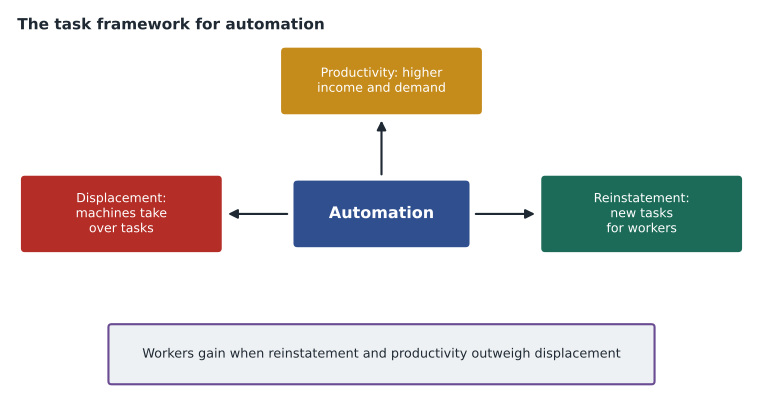
Daron Acemoglu and Pascual Restrepo developed a framework in which automation has two opposing effects. The displacement effect occurs when machines take over tasks workers used to do. The reinstatement effect occurs when new tasks are created in which workers have an advantage. The productivity effect raises overall income and demand. Whether workers gain or lose depends on the balance. They warned against 'so-so automation': technologies that are good enough to replace workers but not good enough to raise productivity much, so that they displace labour without generating the gains that create new jobs.
Estimates of how many jobs are at risk vary enormously depending on method. A widely cited 2013 study by Carl Benedikt Frey and Michael Osborne estimated that about 47 in every 100 American jobs were at high risk of automation within a decade or two. Studies that looked at tasks within jobs, such as a 2016 OECD analysis, produced much lower estimates, around 9 in 100 jobs on average across rich countries, because most jobs contain many tasks that are hard to automate. The decade that followed did not see the mass unemployment the higher estimates seemed to imply, though it did see continuing change in the content of jobs.
Generative AI and white-collar work
Earlier automation mainly affected manual and routine clerical work. Generative AI is different because it can perform tasks once thought to require education and creativity: drafting text, writing code, summarizing documents, answering customer questions and producing images. A 2023 study by Tyna Eloundou and colleagues estimated that about four in five American workers had at least a tenth of their tasks exposed to large language models, and that higher-wage occupations were on average more exposed than lower-wage ones.
Exposure does not mean replacement. In a study of more than five thousand customer support agents at one company, Erik Brynjolfsson, Danielle Li and Lindsey Raymond found that access to an AI assistant increased the number of issues resolved per hour by about 14 in 100 on average, with the largest gains, over 30 in 100, for novice and lower-skilled workers, and little gain for the most experienced. The assistant seemed to spread the know-how of the best workers to the rest. Other studies have found productivity gains in writing and coding tasks, sometimes with lower quality on tasks outside the system's strengths. Whether these gains lead to higher wages, fewer jobs or both depends on choices by firms, workers and governments.
# Who captures the gains? A department adopts an AI tool (illustrative numbers)
workers = 20
output_per_worker = 100          # cases per week before the tool
gain = 0.14                      # productivity gain per worker
price_per_case = 50              # revenue per case, in dollars

before = workers * output_per_worker * price_per_case
after_same_staff = workers * output_per_worker * (1 + gain) * price_per_case
staff_needed_same_output = workers / (1 + gain)
print("weekly revenue before:", before)
print("weekly revenue with same staff and more output:", round(after_same_staff))
print("staff needed to keep output unchanged:", round(staff_needed_same_output, 1))
for share in (0.0, 0.5):
    extra_pay = (after_same_staff - before) * share / workers
print("share of the gain paid to workers:", share, "extra weekly pay each:", round(extra_pay))weekly revenue before: 100000 weekly revenue with same staff and more output: 114000 staff needed to keep output unchanged: 17.5 share of the gain paid to workers: 0.0 extra weekly pay each: 0 share of the gain paid to workers: 0.5 extra weekly pay each: 350
The example shows the choice facing Riverton General and Kwame's insurer. The same productivity gain can be used to do more work with the same staff, to do the same work with fewer staff, or something in between. It can be shared with workers as higher pay or shorter hours, or kept as profit or savings. Technology does not determine which; ownership, bargaining power, competition and law do. Since the 1980s, in many rich countries, the share of national income going to labour has fallen somewhat, and economists debate how much of that is due to technology and how much to globalization, weaker unions and market concentration.
What work means
Discussions of automation often treat work only as a source of income, so that the problem is solved if people are compensated. But philosophers have long argued that work provides other goods. Anca Gheaus and Lisa Herzog have listed four goods of work beyond income: the opportunity to achieve excellence, to make a social contribution, to experience community with others, and to gain social recognition. Karl Marx argued that under industrial capitalism, workers were alienated from the products of their labour, from the activity of work, from their own human potential and from each other. Others emphasize the structure and purpose that work gives to a day and a life.
These goods are distributed unequally, and automation can affect them even when it does not cost jobs. A tool that takes over the interesting parts of a job and leaves the routine checking can reduce the opportunity for excellence; Mei says that a client who wants her only to 'touch up' generated images is asking her to stop being an illustrator. A tool that lets a novice perform like an expert can increase the sense of competence, or it can make experience less valued. Raúl says the core of nursing is the relationship with patients, and that a tool that gives nurses more time with patients would be welcome, while one that is used to cut nurses would be the opposite.
Algorithmic management
AI is changing not only what workers do but how they are managed. Algorithmic management is the use of software to assign tasks, set schedules, monitor performance and even discipline or dismiss workers. It is most visible in platform work, such as ride-hailing and delivery, where an app assigns jobs, sets prices and deactivates workers whose ratings fall, and in warehouses, where workers' pace is tracked by the second. It is spreading into offices, where software measures keystrokes, screen time and, as in Kwame's insurer, approvals per hour.
Algorithmic management raises several ethical concerns. Workers may not know how they are evaluated, or have anyone to appeal to when the system makes an error. Monitoring can be intrusive and stressful, and quotas can push workers to work unsafely. Metrics can distort work toward what is measured: if adjusters are rewarded for approving drafts quickly, they may stop scrutinizing them, which brings back the automation bias and moral crumple zones of earlier lessons. Defenders reply that algorithmic management can be more consistent than human managers, can reduce favouritism and can give workers flexibility.
There is also hidden labour behind AI. Large models are trained and refined using the work of people who label data, rate outputs and filter harmful content, often through contractors in lower-income countries. In 2023 a magazine investigation reported that workers in Kenya hired through a contractor to label violent and abusive content for a major AI company were paid less than two American dollars an hour and suffered psychological harm. The sociologists Mary Gray and Siddharth Suri have called this kind of labour 'ghost work', because it is essential but invisible.
Responses in Canada and beyond
Varga asks the class what society owes to people whose work is changed or eliminated by technology. Several responses have been proposed, and they are not mutually exclusive.
- Training and transition: education, retraining and employment services, ideally designed with employers and unions so that they lead to real jobs. Evidence on retraining programs is mixed; the best results tend to come from programs linked to specific employers and occupations.
- Income support: unemployment insurance, wage insurance that tops up the pay of workers who take lower-paid jobs, and, more radically, a universal basic income paid to everyone regardless of work.
- Shared gains: shorter working hours, profit sharing, worker ownership or higher wages, so that productivity gains reach workers.
- Worker voice: requiring consultation or bargaining over how new technology is introduced, so that workers can shape it.
- Limits on surveillance and algorithmic management: rights to know how one is monitored and evaluated, and to have decisions reviewed by a person.
In Canada, Ontario ran a basic income pilot from 2017 that paid low-income residents in several communities a guaranteed income; it was cancelled by a new government in 2018, before its planned end, and independent surveys of participants reported improvements in health and well-being. Ontario's Working for Workers Act, 2022, requires employers with twenty-five or more employees to have a written policy telling workers whether and how they are electronically monitored. In the arts, the 2023 strikes by the Writers Guild of America and the actors' union SAG-AFTRA, which affected productions filmed in Canada, won contract terms limiting how studios can use AI to write scripts or replicate performers.
The philosophical disagreements behind these policies are familiar from earlier lessons. A utilitarian asks which policy maximizes well-being, including the well-being of people who lose not only income but meaning. A Rawlsian asks which arrangement benefits the least advantaged. A libertarian may hold that firms are entitled to use technology as they choose and that workers have no claim to particular jobs. A care ethicist asks what happens to care work, which is hard to automate and has often been undervalued.
Worked problem
Advising the hospital and the union
Riverton General plans to leave one triage nurse position per shift unfilled if Pathfinder works well. Advise the hospital and the union on a fair approach.
Show solution
- Clarify the goal: is Pathfinder being adopted to improve patient care, to reduce cost, or both? The answer shapes what counts as success.
- Measure honestly: track whether the model actually reduces nurses' triage workload, or adds new work such as checking and overriding its rankings.
- Share the gains: if time is saved, consider using it for patient care, which was the stated aim, rather than cutting positions immediately.
- Give workers voice: involve nurses in testing, setting override policies and evaluating results, which also makes the system safer.
- Protect against perverse metrics: do not evaluate nurses by how often they agree with the model, which would encourage automation bias.
Answer: Adopt the tool with the union's involvement, use the first year's gains for patient care, and decide on staffing only after measuring its real effect on workload and safety.
Common mistakes
MistakeAutomation always destroys jobs overall.
InsteadHistorically, employment has grown, though particular workers and communities have suffered long and serious losses.
MistakeExposure to AI means a job will disappear.
InsteadExposure means some tasks are affected; the job may change, grow or shrink depending on choices.
MistakeTechnology determines who gets the gains.
InsteadOwnership, bargaining power, competition and law decide how productivity gains are shared.
MistakeCompensation solves the problem of lost work.
InsteadWork also provides excellence, contribution, community and recognition, which income does not replace.
Summary and key terms
- Fears of technological unemployment are old; overall employment has kept growing, but transitions can be long and painful.
- Automation affects tasks: it displaces some, reinstates others and raises productivity; so-so automation displaces without large gains.
- Estimates of jobs at risk range widely depending on whether whole jobs or tasks are analyzed.
- Generative AI exposes many higher-wage tasks; early studies show productivity gains, often largest for novices.
- Work provides goods beyond income, and algorithmic management raises concerns about monitoring, opacity and metrics.
- Responses include training, income support, shared gains, worker voice and limits on surveillance.
- Technological unemployment
- Keynes's term for unemployment caused by labour-saving technology outpacing new uses for labour.
- Job polarization
- Growth of high-paid and low-paid jobs with a decline in middle-skill routine jobs.
- Displacement effect
- The reduction in demand for workers when machines take over their tasks.
- Reinstatement effect
- The increase in demand for workers when new tasks are created.
- Algorithmic management
- The use of software to assign, monitor, evaluate and discipline workers.
- Ghost work
- Gray and Suri's term for the hidden human labour that makes automated systems work.
Practice problems
Work each problem on paper first, then reveal the answer to check.
What did Autor, Levy and Murnane argue about computers and tasks?
Show answer
Computers substitute for routine tasks and complement non-routine tasks requiring judgment, creativity or interpersonal skill.
What is so-so automation?
Show answer
Technology good enough to replace workers but not good enough to raise productivity much.
In the code example, how many staff would be needed to keep output unchanged?
Show answer
About 17.5, from 20 divided by 1.14.
Name the four goods of work identified by Gheaus and Herzog.
Show answer
Excellence, social contribution, community and social recognition.
Lesson quiz · 5 questions
Score 60% or more to complete this lesson.
Create a free account to save your progress, take quizzes and earn a certificate.