
PET-440 · Lesson 9 of 12 · 19 min
Gas processing: dehydration and hydrates
With the reservoir side of the Caribou Ridge plan taking shape, Lena brings Sofia Reyes from facilities onto the team, along with Gwen Halvorsen, a process engineer seconded from the engineering contractor that will design the new Caribou Ridge gas plant. Their first workshop is about water. “Every molecule of gas leaves the reservoir saturated with water vapour,” Gwen says. “Cool it and the water drops out; cool it under pressure and it can freeze into hydrates that plug a pipeline in hours. Most of the money in a gas plant goes into taking things out of the gas: water, acid gas and liquids.” This lesson covers water and hydrates; Lesson 10 covers acid gas and NGLs.
A gas plant in outline
Raw gas from the Caribou Ridge wells passes through several stages before it can be sold. At each pad, separators remove free water and condensate, and the gas is metered. A gathering system of buried pipelines carries the wet gas, often with injected hydrate inhibitor, to the plant. At the plant inlet, slug catchers and separators remove liquids that have accumulated in the gathering lines. The gas is compressed if needed, treated to remove acid gas, dehydrated, chilled or expanded to recover NGLs, recompressed and delivered to the sales pipeline. The condensate is stabilized, by heating it to drive off light components, so that it can be stored and shipped at atmospheric pressure. Produced water is treated and disposed of or recycled.
The sales gas must meet the pipeline tariff. Typical specifications limit water content, hydrocarbon dew point, carbon dioxide (often 2 mole percent), hydrogen sulphide (about 23 mg/m³ or 4 ppm), total sulphur, oxygen, inerts and heating value. The water limit is commonly 65 mg/m³ on the major Canadian systems, which is about 4 lb/MMscf. The hydrocarbon dew point limit keeps liquids from condensing in the transmission line.
Water content of natural gas
The water vapour a gas can hold at saturation rises steeply with temperature and falls with pressure. At reservoir conditions in the Montney, about 31,000 kPa and 88 °C (4,500 psia and 190 °F), the gas holds about 3,000 mg/m³ (190 lb/MMscf). At the plant inlet, 6,900 kPa and 38 °C (1,000 psia and 100 °F), it holds about 960 mg/m³ (60 lb/MMscf). The difference condenses as the gas cools on its way to the plant. The McKetta-Wehe chart (1958), corrected for gas gravity and salinity, has long been the industry reference for sweet gas. Bukacek's correlation reproduces it closely in a form suited to calculation:
Here W is in pounds of water per million standard cubic feet, p_v is the vapour pressure of water at the gas temperature in psia, p is the gas pressure in psia and T is in °F. The first term is the ideal-gas contribution; the second accounts for non-ideal behaviour. Sour gas holds more water than sweet gas at the same conditions, because carbon dioxide and hydrogen sulphide are more polar, and corrections are needed above a few percent of acid gas.
Gas hydrates
Hydrates are ice-like crystalline solids in which water molecules form cages around small gas molecules, methane, ethane, propane, carbon dioxide or hydrogen sulphide. Unlike ice, they form above 0 °C when the pressure is high enough: at 6,900 kPa (1,000 psia) a typical natural gas forms hydrates below about 17 °C (63 °F). Free water must be present, and turbulence and nucleation sites such as weld beads or scale speed formation. Hydrate plugs have blocked pipelines, chokes and instrument lines, and they are a serious hazard: a plug can move like a projectile when pressure is released unevenly on its two sides, and remediation by depressurizing must be done from both sides.
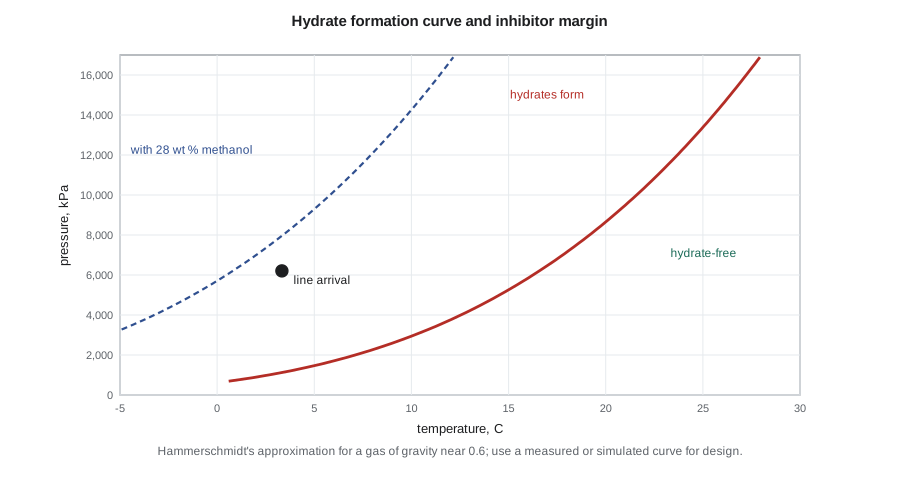
The hydrate formation curve, temperature against pressure, is measured or calculated with statistical-thermodynamic models. For quick estimates, the Katz gas-gravity chart (1945) gives the curve for sweet gases of different gravity. For a gas of gravity near 0.6, a simple approximation attributed to Hammerschmidt fits it reasonably over the usual pipeline range:
with T_h in °F and p in psia. Richer gases form hydrates at higher temperatures, and hydrogen sulphide raises the hydrate temperature markedly.
Preventing hydrates
Four approaches prevent hydrates: remove the water, keep the gas warm, keep the pressure low, or add an inhibitor. In the field, before dehydration is possible, inhibitors are the usual tool. Thermodynamic inhibitors, mainly methanol and monoethylene glycol (MEG), dissolve in the free water and lower its hydrate formation temperature, much as antifreeze lowers the freezing point. The Hammerschmidt equation (1934) estimates the depression:
where ΔT is in °F, W is the inhibitor's weight percent in the free water phase, M its molar mass (32.04 for methanol, 62.07 for MEG) and K a constant, 2,335 for methanol and commonly 2,200 for glycols. The equation is accurate up to about 20 to 25 weight percent methanol; above that, the Nielsen-Bucklin equation is used. Methanol also partitions into the gas and condensate, so actual injection rates are higher than the water-phase requirement, often by a factor of two or more in high-pressure gas. MEG is less volatile, is recovered and regenerated at the plant, and is preferred for large continuous injection; methanol is cheap and effective for intermittent use and start-ups. Low-dosage hydrate inhibitors, kinetic inhibitors that delay nucleation and anti-agglomerants that keep crystals small and dispersed, are used where large methanol volumes would be impractical.
Glycol dehydration
At the plant, the gas is dried by absorption into triethylene glycol, TEG, the industry's workhorse. Wet gas enters the bottom of a contactor tower and flows up through trays or structured packing against lean TEG flowing down. The glycol absorbs water and leaves the bottom as rich glycol. It passes through a flash tank, which releases dissolved hydrocarbons for use as fuel, filters, and a lean-rich heat exchanger, and is regenerated in a reboiler at about 200 °C (390 °F), just below TEG's decomposition temperature, where the water boils off through a still column. Lean glycol of 98.5 to 99 weight percent is pumped back to the contactor; stripping gas or other enhancements give 99.9 percent or more when very low water contents are needed.
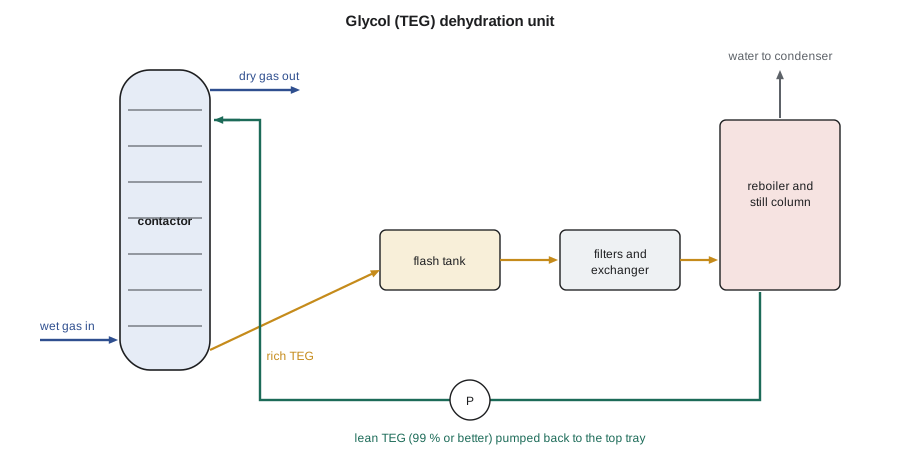
Two design rules of thumb anchor a first estimate. The glycol circulation rate is usually 2 to 5 US gallons of TEG per pound of water removed, about 17 to 42 litres per kilogram, with 3 a common value. The contactor needs enough theoretical stages, typically two to three, to approach equilibrium with the lean glycol. Reboiler heat duty is set by the circulation rate and must vaporize the absorbed water and heat the glycol. Benzene, toluene, ethylbenzene and xylenes (BTEX) dissolve in glycol and are released in the still vent, so the vent is routed to a condenser and combustion device to meet air emission limits.
# Water content of sweet natural gas (Bukacek), TEG dehydration for the plant inlet,
# hydrate temperature (Hammerschmidt's approximation) and methanol for a wet gathering line.
import math
SI = True      # True: metric units, False: oilfield units

def psat_water(T_F):
    """Vapour pressure of water in psia (Antoine equation, valid about 34 to 212 F)."""
    T_C = (T_F - 32) / 1.8
    return 10 ** (8.07131 - 1730.63 / (233.426 + T_C)) * 0.0193368   # mmHg to psia

def water_content(p, T_F):
    """Bukacek correlation: saturated water content in lb per MMscf."""
    B = 10 ** (6.69449 - 3083.87 / (T_F + 459.67))
    return 47484 * psat_water(T_F) / p + B

lbMM_to_mgm3 = 453592 / 28316.8                  # mg/m3 per lb/MMscf
show = (lambda w: f"{w * lbMM_to_mgm3:7,.0f} mg/m3") if SI else (lambda w: f"{w:7.1f} lb/MMscf")
fmtp = (lambda p: f"{p / 0.145038:7,.0f} kPa") if SI else (lambda p: f"{p:6,.0f} psia")
fmtT = (lambda T: f"{(T - 32) / 1.8:5.1f} C") if SI else (lambda T: f"{T:5.1f} F")
for p, T in [(1000, 100), (1000, 60), (4500, 190), (600, 40)]:
    print(f"Saturated at {fmtp(p)}, {fmtT(T)}: {show(water_content(p, T))}")

# TEG contactor at the plant inlet
Q, p_c, T_c, spec = 150.0, 1000.0, 100.0, 4.0     # MMscf/d, psia, F, lb/MMscf outlet
w_in = water_content(p_c, T_c)
water = Q * (w_in - spec)                         # lb/d removed
teg = 3.0 * water / 24 / 60                       # US gal/min at 3 gal TEG per lb of water
print(f"Water removed {water * 0.4536:,.0f} kg/d; TEG circulation {teg * 3.785 * 60:,.0f} L/h" if SI else
      f"Water removed {water:,.0f} lb/d; TEG circulation {teg:.1f} gal/min")

# Hydrates and methanol in a wet gathering line: wellhead 1,200 psia and 110 F; line arrives at 900 psia and 38 F
T_h = 8.9 * 900 ** 0.285                          # Hammerschmidt hydrate temperature, F (gas gravity near 0.6)
dT = T_h - 38 + 5                                 # depression needed with a 5 F margin
Wt = 100 * dT * 32.04 / (2335 + dT * 32.04)       # methanol weight percent in the water phase
qg = 25.0                                         # MMscf/d through the line
cond_water = qg * (water_content(1200, 110) - water_content(900, 38))   # lb/d of water condensed
meoh_liq = cond_water * Wt / (100 - Wt)
print(f"Hydrate temperature at {fmtp(900)}: {fmtT(T_h)}; depression needed {dT / 1.8 if SI else dT:.1f} {'C' if SI else 'F'}")
print(f"Methanol in the free water {Wt:.0f} wt%; water condensed {cond_water * (0.4536 if SI else 1):,.0f} {'kg' if SI else 'lb'}/d; "
f"methanol to the water phase {meoh_liq * (0.4536 if SI else 1):,.0f} {'kg' if SI else 'lb'}/d before vapour losses")Saturated at 6,895 kPa, 37.8 C: 965 mg/m3 Saturated at 6,895 kPa, 15.6 C: 286 mg/m3 Saturated at 31,026 kPa, 87.8 C: 2,997 mg/m3 Saturated at 4,137 kPa, 4.4 C: 207 mg/m3 Water removed 3,828 kg/d; TEG circulation 3,993 L/h Hydrate temperature at 6,205 kPa: 16.6 C; depression needed 16.0 C Methanol in the free water 28 wt%; water condensed 685 kg/d; methanol to the water phase 271 kg/d before vapour losses
For a plant inlet of 4.25 × 10⁶ m³/d (150 MMscf/d) at 6,900 kPa and 38 °C (1,000 psia and 100 °F), the TEG unit must remove about 3,800 kg (8,400 lb) of water per day to meet the sales specification, which takes about 4,000 litres of TEG per hour (18 gallons of TEG per minute) at 3 gallons per pound. For the A-12 pad gathering line, which carries 710 × 10³ m³/d (25 MMscf/d) of wet gas and arrives at the plant at about 6,200 kPa and 3 °C (900 psia and 38 °F) in winter, the hydrate temperature is about 17 °C (62 °F). A depression of about 16 °C (29 °F), including a margin, needs 28 weight percent methanol in the free water, or roughly 270 kg (600 lb) of methanol per day in the water phase alone, before the losses to the gas and condensate are added.
Worked problem
Methanol for a hydrate margin
Free water in a line must be protected to a hydrate depression of 11 °C (20 °F). The line condenses 400 kg (880 lb) of water per day. Find the methanol concentration in the water phase and the methanol required in that phase, using the Hammerschmidt equation.
Show solution
- Rearrange: W = 100 M ΔT / (K + M ΔT), with ΔT in °F. ΔT = 20 °F.
- W = 100 × 32.04 × 20 / (2,335 + 32.04 × 20) = 64,080 / 2,976 = 21.5 weight percent.
- Methanol mass in water phase = water × W / (100 − W) = 400 × 21.5 / 78.5 = 110 kg/d.
Answer: The water phase needs about 21.5 weight percent methanol, about 110 kg (240 lb) per day, plus the methanol lost to the gas and condensate, which the vendor's partitioning chart or a process simulator will supply.
Other dehydration methods
Solid desiccants, molecular sieves, silica gel and activated alumina, adsorb water on their internal surfaces and can dry gas to below 0.1 ppm of water. They are used ahead of cryogenic NGL plants and LNG liquefaction, where any water would freeze in the cold equipment; TEG alone cannot reach those levels. Beds are used in pairs or threes, one adsorbing while another is regenerated by hot gas. The Caribou Ridge gas plant design includes molecular sieve dehydrators downstream of the TEG unit to protect the turboexpander described in Lesson 10. Other methods include refrigeration with glycol injection, membranes and, at small sites, calcium chloride dehydrators.
Common mistakes
MistakeDesigning hydrate inhibition from the gas flow rate alone.
InsteadInhibitor dose depends on the free water to be protected and on losses to gas and condensate.
MistakeApplying the Hammerschmidt equation at very high methanol concentrations.
InsteadAbove about 20 to 25 weight percent, use the Nielsen-Bucklin equation or a simulator.
MistakeUsing TEG dehydration upstream of a cryogenic plant without further drying.
InsteadCryogenic and LNG plants need molecular sieves to reach parts-per-million water levels.
MistakeDepressurizing a hydrate plug from one side only.
InsteadDepressurize from both sides to avoid launching the plug like a projectile.
Summary and key terms
- Raw gas is saturated with water; its water content rises with temperature and falls with pressure.
- Hydrates are solid water-gas compounds that form above 0 °C at pipeline pressures when free water is present.
- Thermodynamic inhibitors such as methanol and MEG lower the hydrate temperature; Hammerschmidt's equation estimates the depression.
- TEG absorption is the standard method to meet pipeline water specifications, at roughly 3 gallons of TEG per pound of water.
- Molecular sieves dry gas to parts-per-million levels for cryogenic and LNG plants.
- Sales gas must meet tariff limits on water, dew point, acid gas, inerts and heating value.
- Hydrate
- An ice-like solid of water cages enclosing small gas molecules.
- Thermodynamic inhibitor
- A chemical, such as methanol or MEG, that lowers the hydrate formation temperature.
- TEG
- Triethylene glycol, the liquid desiccant used in most gas dehydration units.
- Contactor
- The tower in which gas and lean glycol meet and water is absorbed.
- Molecular sieve
- A crystalline solid desiccant that adsorbs water to very low concentrations.
- Pipeline specification
- The tariff limits on gas quality for acceptance into a pipeline.
Practice problems
Work each problem on paper first, then reveal the answer to check.
Does gas at higher pressure and the same temperature hold more or less water?
Show answer
Less.
Using Hammerschmidt, what methanol weight percent gives ΔT = 30 °F?
Show answer
W = 100 × 32.04 × 30 / (2,335 + 961) = 29 percent.
Why is MEG preferred over methanol for continuous injection into long subsea or gathering lines?
Show answer
It is less volatile and is recovered and regenerated, reducing losses and cost.
Why must the still vent of a TEG unit be controlled?
Show answer
It releases water vapour with BTEX and methane absorbed by the glycol.
Lesson quiz · 5 questions
Score 60% or more to complete this lesson.
Create a free account to save your progress, take quizzes and earn a certificate.