
PET-440 · Lesson 7 of 12 · 19 min
Gas condensate and wet gas reservoirs
The Caribou Ridge wells produce about 250 m³ of condensate per million m³ of gas (45 barrels of condensate per million standard cubic feet) in their first months. At current prices the condensate earns more per well than the gas does. Mei's laboratory has now finished the full PVT study on the A-12-3 recombined sample: a constant composition expansion, which found a dew point of 27,600 kPa (4,000 psia), and a constant-volume depletion test. The Montney at Caribou Ridge is a gas condensate, about 3,400 kPa (500 psi) above its dew point. Farid calls a meeting with Lena, Ethan and Mei. “Every well we drill will drop that liquid into the rock as soon as the pressure near the fractures falls below the dew point,” he says. “We need to know how much we lose and what it does to the gas rate.”
Wet gas: recombination and gas equivalent
For a wet gas, and for a gas condensate above its dew point, the reservoir contains a single gas phase. At the surface it splits into separator gas and stock-tank liquid. Every reservoir calculation must use the well stream, which includes the liquid's molecules in the gas phase. The well-stream gravity follows from a molar balance of the two surface streams, using the producing gas-liquid ratio R, the liquid specific gravity γ_o and its molar mass M_o. In field units, with R in scf/STB:
The term 132,800 γ_o/M_o is the gas equivalent of one stock-tank barrel of liquid: the standard cubic feet of gas it would form if vaporized. When M_o has not been measured, Cragoe's correlation, M_o = 6084/(API − 5.9), is a reasonable estimate for condensates. Gas in place from volumetrics or material balance is then a well-stream volume, which must be split into dry gas and condensate in place using the gas equivalent.
# Wet gas recombination (separator gas gravity behind a known well-stream gravity) and condensate recovery from a constant-volume depletion (CVD) test
# of the liquids-rich Caribou Ridge / Ten Mile Ridge gas condensate.
SI = True      # True: metric units, False: oilfield units

gw, api, cgr0 = 0.74, 52.0, 45.0               # recombined well-stream gravity (Lesson 1), condensate API, initial CGR (bbl/MMscf)
go = 141.5 / (131.5 + api)                      # condensate specific gravity
Mo = 6084 / (api - 5.9)                         # Cragoe's molar mass correlation
R = 1e6 / cgr0                                  # producing gas-condensate ratio, scf/STB
geq = 132800 * go / Mo                          # gas equivalent of one barrel of condensate, scf
gg_sep = (gw * (R + geq) - 4584 * go) / R      # separator gas gravity that recombines to gw
print(f"Condensate gravity {go:.3f}, molar mass {Mo:.0f} g/mol")
print(f"Separator gas gravity {gg_sep:.3f} for a well-stream gravity of {gw:.2f}; one {'m3' if SI else 'bbl'} of condensate = "
      + (f"{geq * 0.0283168 / 0.158987:,.0f} m3 of gas" if SI else f"{geq:,.0f} scf of gas"))
print(f"Condensate share of well-stream moles: {geq / (R + geq):.1%}")
# CVD report: pressure psia, liquid dropout % of cell volume, cumulative well-stream produced (% of initial moles),
# and condensate-gas ratio of the gas removed at that step (bbl/MMscf)
cvd = [(4500, 0.0, 0.0, 45.0), (4000, 0.0, 4.2, 45.0), (3500, 4.5, 14.6, 33.0), (3000, 9.8, 26.8, 23.0),
       (2500, 13.2, 39.0, 16.5), (2000, 14.6, 51.2, 12.5), (1500, 14.1, 63.3, 10.2), (1000, 12.8, 75.4, 9.0),
       (700, 11.9, 82.5, 8.8)]
G = 60.7e9                                      # initial well-stream gas in one spacing unit, scf (Lesson 3)
cond0 = G * (1 - geq / (R + geq)) / 1e6 * cgr0  # initial condensate in place, STB
cum_c = 0.0; prev = cvd[0]
print(" p kPa   dropout %  well stream %  condensate recovered %" if SI else
      " p psia  dropout %  well stream %  condensate recovered %")
for row in cvd:
    p, sl, np_, cgr = row
    dG = (np_ - prev[2]) / 100 * G * (1 - geq / (R + geq))
    cum_c += dG / 1e6 * (cgr + prev[3]) / 2
    prev = row
    pp = f"{p / 0.145038:6,.0f}" if SI else f"{p:6,.0f}"
    print(f"{pp}  {sl:8.1f}  {np_:11.1f}  {100 * cum_c / cond0:12.1f}")
k = 0.158987 if SI else 1.0
u = "10^3 m3" if SI else "MSTB"
print(f"Condensate in place {cond0 * k / 1000:,.0f} {u}; recovered by depletion to {cvd[-1][0] / 0.145038 if SI else cvd[-1][0]:,.0f} "
f"{'kPa' if SI else 'psia'}: {cum_c * k / 1000:,.0f} {u} ({cum_c / cond0:.0%})")Condensate gravity 0.771, molar mass 132 g/mol Separator gas gravity 0.607 for a well-stream gravity of 0.74; one m3 of condensate = 138 m3 of gas Condensate share of well-stream moles: 3.4% p kPa dropout % well stream % condensate recovered % 31,026 0.0 0.0 0.0 27,579 0.0 4.2 4.2 24,132 4.5 14.6 13.2 20,684 9.8 26.8 20.8 17,237 13.2 39.0 26.2 13,789 14.6 51.2 30.1 10,342 14.1 63.3 33.1 6,895 12.8 75.4 35.7 4,826 11.9 82.5 37.1 Condensate in place 420 10^3 m3; recovered by depletion to 4,826 kPa: 156 10^3 m3 (37%)
The Caribou Ridge condensate has an API gravity of 52 and a molar mass of about 132 g/mol, and each cubic metre of condensate is equivalent to about 138 m³ of gas. Although it makes up only 3.4 percent of the molecules, the condensate carries a large share of the value. The well-stream gravity of 0.74, from Lesson 1, corresponds to a separator gas of gravity about 0.61. An engineer who computed the reservoir z-factor from 0.61 instead of 0.74 would overstate it by about 3 percent and miss the liquid entirely.
Retrograde condensation
Ordinary condensation happens when a gas is compressed or cooled. Retrograde condensation is the opposite: liquid forms as pressure falls at constant temperature. It occurs because the reservoir temperature lies between the mixture's critical temperature and its cricondentherm. Below the dew point, the heavy components no longer fit in the gas phase as the gas expands and their solvent, the dense high-pressure methane, becomes less dense. As pressure falls further, the liquid volume reaches a maximum and then, at low pressure, part of it revaporizes, because light components boil off from the liquid and the heavier ones become more volatile relative to the thin gas.
Two laboratory tests describe this. The constant composition expansion holds the sample in a cell and lowers pressure in steps without removing anything; it measures the dew point and the relative volume. The constant-volume depletion, CVD, mimics a depleting reservoir: after each pressure step, gas is removed from the cell until its volume returns to the original value, as if produced, while the liquid stays behind, as it would in the rock. The CVD measures the liquid dropout, the two-phase z-factor, the composition of each removed gas and the cumulative production at each step. It is the standard test for gas condensate reservoir engineering.
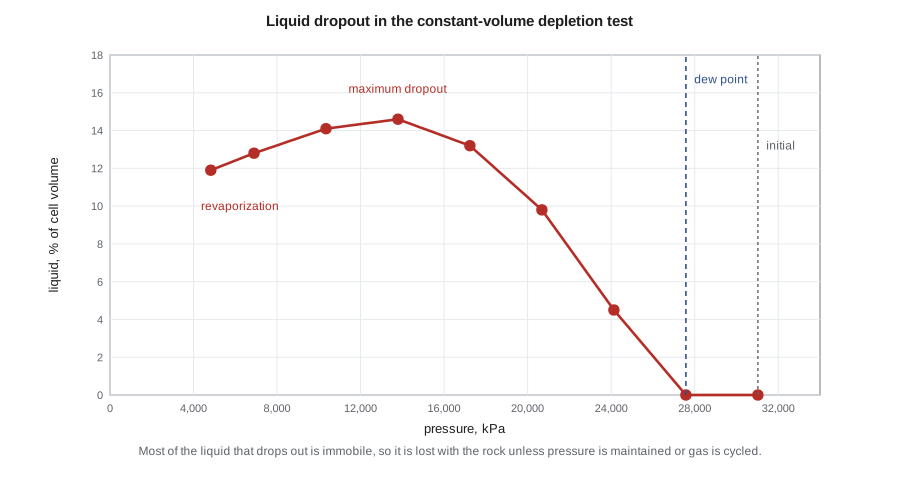
The CVD of the A-12-3 sample shows liquid dropout rising to about 15 percent of pore volume at 13,800 kPa (2,000 psia) and only slight revaporization below that. Very little of this liquid will ever flow: the critical condensate saturation, below which condensate is immobile, is typically 10 to 30 percent in conventional rock and higher in tight rock. The condensate-gas ratio of the produced gas falls as the heavy ends stay behind, from 250 at the dew point to under 60 m³ per million m³ (10 bbl/MMscf) at low pressure. Integrating that falling ratio over the produced gas, as the code does, shows that depletion to 4,800 kPa (700 psia) recovers only about 37 percent of the original condensate, while it recovers more than 80 percent of the gas.
Condensate banking and well productivity
The liquid that drops out does not form evenly through the reservoir. Near a producing well, pressure falls below the dew point long before the average reservoir pressure does. A ring of condensate builds up around the wellbore or along the hydraulic fractures, where the gas flowing through deposits liquid continuously until the saturation is high enough for the condensate to flow. Inside this condensate bank the gas relative permeability can fall to 0.1 to 0.3 of its single-phase value. Fevang and Whitson (1996) described three regions: the near-well bank, where both phases flow; an intermediate region where condensate accumulates but does not flow; and the outer region still above the dew point.
Condensate banking can cut a gas well's productivity by half or more in moderate-permeability rock, and the effect in tight rock with hydraulic fractures is a subject of active study. Two effects partly offset it. At high velocity, the capillary number near the well is large enough to reduce the condensate saturation and raise the gas relative permeability, a positive effect called velocity stripping. And the inertial non-Darcy pressure loss competes with the bank for the same small region. Simulation of the near-well region needs fine grids or special well models, and relative permeability data measured at realistic capillary numbers.
Worked problem
Gas equivalent and well-stream gas in place
A wet gas well produces separator gas of gravity 0.65 at a gas-condensate ratio of 4,450 m³/m³ (25,000 scf/STB) with condensate of 55 °API. Find the condensate molar mass, its gas equivalent and the well-stream gravity.
Show solution
- γ_o = 141.5 / (131.5 + 55) = 0.759; M_o = 6084 / (55 − 5.9) = 124 g/mol.
- Gas equivalent: 132,800 × 0.759 / 124 = 813 scf/STB (145 m³/m³).
- γ_w = (25,000 × 0.65 + 4,584 × 0.759) / (25,000 + 813) = (16,250 + 3,479) / 25,813 = 0.764.
Answer: The condensate molar mass is about 124 g/mol, its gas equivalent about 813 scf per barrel (145 m³ per m³), and the well-stream gravity 0.76, much heavier than the separator gas.
Managing a gas condensate reservoir
The classic answer to retrograde loss is gas cycling: produce the well stream, strip out the condensate and NGLs in a plant, and inject the dry residue gas back into the reservoir to keep its pressure above the dew point. Cycling recovered large volumes of liquids from conventional condensate fields in Alberta, Texas, the North Sea and elsewhere in the decades when gas markets were limited. Its cost is the deferral of gas sales for many years, so it pays only when liquids are valuable, gas is cheap or unmarketable for a time, and the reservoir is permeable enough for injected gas to sweep it. Partial pressure maintenance, lean gas injection after depletion and nitrogen injection are variations.
Cycling is not practical in the Montney, where permeability is in the microdarcies and the injected gas would barely move between wells. The Caribou Ridge team's levers are different. The first is completion design: longer laterals and more fracture area lower the drawdown needed for a given rate, delaying the near-fracture pressure drop below the dew point. The second is how the wells are flowed: managed drawdown, holding back the early rate, keeps the near-well pressure higher for longer. Its benefit to ultimate condensate recovery in tight rock is debated, and the team will compare pilot wells flowed both ways. The third is target selection, landing wells in the parts of the Montney where the condensate-gas ratio and the economics are best. The last is the surface: high-pressure separation and stabilization to keep as many molecules as possible in the condensate product, and a deep-cut NGL plant for what remains in the gas.
Condensate markets
Condensate is valuable for different reasons in the two countries. In Canada, condensate is in high demand as diluent for bitumen from the oil sands, which must be thinned to flow in pipelines, and western Canadian producers have long imported condensate from the United States to meet that demand. Montney condensate, much of it produced in British Columbia and Alberta, is trucked or piped to the Edmonton area for that market, and the CER has noted that condensate from wet gas areas of the Montney is one of the formation's attractions. Either way, the liquids yield, measured in m³ per million m³, is one of the strongest drivers of the value of a well.
Common mistakes
MistakeComputing gas in place for a wet gas from the separator gas gravity.
InsteadRecombine to the well-stream gravity and split the result into gas and condensate using the gas equivalent.
MistakeAssuming condensate that drops out in the reservoir will be produced later.
InsteadMost of it stays below the critical condensate saturation and is lost unless pressure is maintained or the gas is cycled.
MistakeUsing single-phase z below the dew point in material balance.
InsteadUse the two-phase z from the constant-volume depletion test.
MistakeIgnoring the condensate bank when forecasting gas well deliverability.
InsteadInclude near-well relative permeability reduction, with velocity stripping, in the well model.
Summary and key terms
- Wet gas and gas condensate reservoir calculations use the recombined well-stream composition or gravity.
- The gas equivalent of condensate, 132,800 γ_o/M_o scf per barrel, links liquid and gas volumes.
- Below the dew point, retrograde condensation drops liquid in the reservoir; the CVD test measures how much.
- Most retrograde liquid is immobile, so depletion recovers only a fraction of the condensate.
- A condensate bank near the wellbore or fractures reduces gas relative permeability and productivity.
- Gas cycling maintains pressure above the dew point in permeable reservoirs; tight reservoirs rely on completion, drawdown and target choices.
- Retrograde condensation
- Formation of liquid from a gas as pressure falls at constant temperature.
- Constant-volume depletion
- A laboratory test that removes gas in steps from a cell held at constant volume, simulating reservoir depletion.
- Gas equivalent
- The volume of gas that one unit of stock-tank liquid would form if vaporized.
- Condensate bank
- A zone of high condensate saturation near a producing well below the dew point.
- Critical condensate saturation
- The condensate saturation below which condensate cannot flow.
- Gas cycling
- Reinjection of dry gas into a condensate reservoir to maintain pressure above the dew point.
Practice problems
Work each problem on paper first, then reveal the answer to check.
A condensate has an API gravity of 60. Estimate its molar mass.
Show answer
6084 / (60 − 5.9) = 112 g/mol.
Why does the CGR of produced gas fall below the dew point?
Show answer
Heavy components condense and stay in the reservoir, so the produced gas becomes leaner.
What is velocity stripping?
Show answer
Reduction of condensate saturation near the well at high capillary numbers, which raises gas relative permeability.
Why is gas cycling rarely used in shale or tight condensate reservoirs?
Show answer
Injected gas cannot sweep the low-permeability rock between wells.
Lesson quiz · 5 questions
Score 60% or more to complete this lesson.
Create a free account to save your progress, take quizzes and earn a certificate.