
PET-380 · Lesson 3 of 12 · 19 min
Holdup, slip and mixture properties
With the single-phase tools refreshed, Ethan turns to the vocabulary of multiphase flow. Sofia hands him a page of field data for a point halfway along the existing gathering line from the north pad: stock-tank oil and water rates, the producing gas-oil ratio, and the pressure and temperature measured at a block valve. 'Before you can use any correlation,' she says, 'you have to turn those surface rates into what is actually flowing in the pipe at that point. Then you need to know the difference between what flows in and what sits in the pipe. Get those two ideas straight and the rest of the course is much easier.'
This lesson defines the variables used in every multiphase method: in-situ volumetric flow rates, superficial velocities, mixture velocity, no-slip liquid fraction, liquid holdup, actual phase velocities, slip and the mixture density and viscosity. It shows how to convert stock-tank rates to in-situ rates and why holdup, not the input fraction, controls the gravity term and the liquid inventory.
From surface rates to in-situ rates
Production is measured at stock-tank or standard conditions: barrels or cubic metres of oil and water at the tank, and standard cubic feet or cubic metres of gas. Inside the pipe the fluids are at a higher pressure and a different temperature. Some gas is still dissolved in the oil, the oil is swollen by that gas, and the free gas is compressed. The in-situ rates follow from the black-oil properties introduced in the reservoir fluids course.
The in-situ liquid rate is the oil rate times its formation volume factor plus the water rate times its formation volume factor, which is close to one. The in-situ free gas rate is the oil rate times the difference between the producing gas-oil ratio and the solution gas-oil ratio at the local pressure and temperature, times the gas formation volume factor:
Here R_p is the producing gas-oil ratio, R_s the solution gas-oil ratio at the local conditions, and B_g the gas formation volume factor, which is inversely proportional to pressure. As pressure falls along a line, R_s falls and B_g rises, so the free gas rate grows. In a well, the free gas rate may be zero at the bottom, above the bubble point, and dominate the flow at the top.
Superficial and mixture velocities
The superficial velocity of a phase is the velocity it would have if it filled the whole pipe alone: its in-situ volumetric rate divided by the pipe's cross-sectional area A.
The mixture velocity v_m is the sum of the two superficial velocities. Superficial velocities are not the real speeds of the phases, but they are easy to compute from rates and are the coordinates on most flow pattern maps.
No-slip liquid fraction and holdup
The no-slip liquid fraction, often written λ_L, is the liquid's share of the total in-situ volumetric flow:
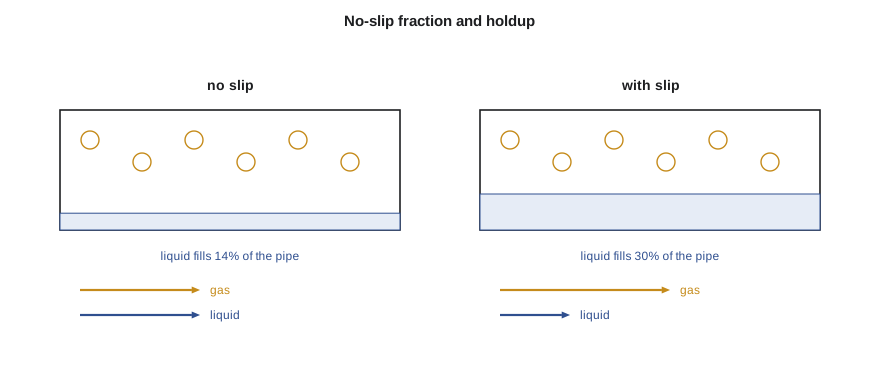
If gas and liquid moved at the same speed, the fraction of the pipe filled with liquid would equal λ_L. In reality they usually do not. Liquid holdup, H_L, is the fraction of a pipe segment actually occupied by liquid at an instant, averaged over a length of pipe or over time. The gas void fraction is 1 − H_L. Holdup can only be measured, for example with quick-closing valves in a laboratory loop or with gamma densitometers in the field, or predicted by a correlation or model.
In horizontal and upward flow, gas usually moves faster than liquid, so H_L is greater than λ_L. In downward flow, liquid can run faster than the gas and H_L can be less than λ_L. The difference matters in two ways. The gravity term depends on the actual mixture density in the pipe, which is set by holdup. And the volume of liquid stored in the line, which arrives at the facility when the line is pigged or when flow rates change, is the holdup times the line volume.
Actual velocities and slip
Once holdup is known, the actual average velocities of each phase follow from continuity:
The slip velocity is the difference v_G − v_L, and the slip ratio is v_G / v_L. A slip ratio of one means no slip and H_L = λ_L. Slip ratios of two to five are common in upward slug flow; in stratified horizontal flow the gas can move many times faster than the liquid.
Mixture density and viscosity
Two mixture densities are used. The no-slip density weights each phase by its share of the flow, and the slip or in-situ density weights each phase by the fraction of the pipe it occupies:
The slip density is the one that belongs in the gravity term, because gravity acts on what is actually in the pipe. Different methods use one or the other, or a combination, in the friction and acceleration terms. Mixture viscosity is defined in a similar way, by weighting with λ_L or H_L, although some methods use other averages. For oil and water flowing together, the liquid density and viscosity are themselves mixtures, and water-in-oil emulsions can be much more viscous than either phase, an effect that matters most in heavy oil and cold lines.
# Superficial velocities, no-slip holdup, mixture properties and slip in the gathering line
import math
SI = True
D = 0.154                        # m, 6-inch line
A = math.pi * D * D / 4
qo, qw = 120.0, 60.0             # m3/d stock-tank oil and water
gor = 180.0                      # m3 gas per m3 oil (produced gas-oil ratio)
p, T = 1500.0, 30.0              # kPa(a), degC at this point in the line
Rs = 25.0                        # m3/m3 gas still in solution at p, T (illustrative)
Bo, z = 1.08, 0.88
Bg = 101.325 / p * (T + 273.15) / 288.15 * z            # m3 per standard m3
qL = (qo * Bo + qw) / 86400                             # m3/s in situ
qG = qo * (gor - Rs) * Bg / 86400
vsl, vsg = qL / A, qG / A
vm = vsl + vsg
lam = vsl / vm
rhoL, rhoG = 880.0, 15.0
muL, muG = 0.003, 1.2e-5
rho_ns = rhoL * lam + rhoG * (1 - lam)
mu_ns = muL * lam + muG * (1 - lam)
f = 1 if SI else 3.2808
u = "m/s" if SI else "ft/s"
print(f"in-situ liquid {qL * 86400:6.1f} m3/d, in-situ gas {qG * 86400:7.1f} m3/d" if SI else
      f"in-situ liquid {qL * 86400 * 6.2898:6.0f} bbl/d, in-situ gas {qG * 86400 * 35.3147 / 1000:6.1f} Mcf/d (actual ft3)")
print(f"vSL = {vsl * f:5.2f} {u}, vSG = {vsg * f:5.2f} {u}, vm = {vm * f:5.2f} {u}")
print(f"no-slip liquid fraction lambda_L = {lam:.3f}")
print(f"no-slip mixture density {rho_ns:6.1f} kg/m3" if SI else f"no-slip mixture density {rho_ns * 0.062428:6.2f} lb/ft3")
for HL in (lam, 0.25, 0.40):
    vL, vG = vsl / HL, vsg / (1 - HL)
    rs = rhoL * HL + rhoG * (1 - HL)
    print(f"holdup {HL:4.2f}: vL = {vL * f:5.2f}, vG = {vG * f:5.2f} {u}, slip ratio {vG / vL:4.2f}, " +
(f"slip density {rs:6.1f} kg/m3" if SI else f"slip density {rs * 0.062428:5.1f} lb/ft3"))in-situ liquid 189.6 m3/d, in-situ gas 1163.2 m3/d vSL = 0.12 m/s, vSG = 0.72 m/s, vm = 0.84 m/s no-slip liquid fraction lambda_L = 0.140 no-slip mixture density 136.2 kg/m3 holdup 0.14: vL = 0.84, vG = 0.84 m/s, slip ratio 1.00, slip density 136.2 kg/m3 holdup 0.25: vL = 0.47, vG = 0.96 m/s, slip ratio 2.05, slip density 231.2 kg/m3 holdup 0.40: vL = 0.29, vG = 1.20 m/s, slip ratio 4.09, slip density 361.0 kg/m3
At 1,500 kPa absolute and 30 °C, Ethan finds an in-situ liquid rate of about 190 m³/d and an in-situ gas rate of about 1,160 m³/d. In the 6-inch line that gives superficial velocities of 0.12 m/s for liquid and 0.72 m/s for gas, and a no-slip liquid fraction of 0.14. The no-slip mixture density is only about 136 kg/m³. But if the true holdup is 0.40, a typical value for slow uphill flow in this line, the density in the pipe is 361 kg/m³, more than two and a half times as much, and the gas moves four times faster than the liquid. 'That is the whole problem in one table,' Sofia says. 'Use the no-slip density in the gravity term on a hill and you will undersize the line badly.'
Water cut and the three-phase problem
Most methods treat oil and water as a single liquid phase with averaged properties. That works when the two are well mixed, as they usually are at high velocity. At low velocity in a horizontal line, water can separate and run along the bottom of the pipe, with oil above it and gas above the oil. Separated water sits in low spots, where it can cause corrosion and freeze, and it changes the holdup. Three-phase models that track oil and water separately are available in commercial software, but for most design work the liquid is treated as one phase and the water's behaviour is checked separately where corrosion or freezing is a concern.
Holdup over the life of a line
Holdup changes as a field matures. Early in a pad's life, rates and velocities are high and the gas carries liquid through the line efficiently; holdup is close to the no-slip value. As rates fall, velocities drop, the gas can no longer sweep the liquid along, and holdup rises, especially on uphill sections. A line that held a few cubic metres of liquid in its first year may hold many times that late in life, which raises the pressure drop from the gravity term even as friction falls, and increases the size of the slug that arrives when the line is pigged. Lesson 12 shows this effect in the tie-in design.
Worked problem
Holdup and the gravity term on a hill
A segment of the line climbs 20 m. The liquid density is 880 kg/m³, the gas density 15 kg/m³ and the no-slip fraction 0.14. Compare the elevation loss if the holdup equals the no-slip fraction with the loss if the holdup is 0.40.
Show solution
- No-slip density: 880 × 0.14 + 15 × 0.86 = 136 kg/m³; loss = 136 × 9.81 × 20 = 26.7 kPa.
- Slip density at H_L = 0.40: 880 × 0.40 + 15 × 0.60 = 361 kg/m³; loss = 361 × 9.81 × 20 = 70.8 kPa.
Answer: Ignoring slip underestimates the elevation loss by a factor of about 2.7: 27 kPa instead of 71 kPa.
Measuring holdup
Because holdup cannot be calculated from rates alone, much of what is known about it comes from experiments. In laboratory flow loops, quick-closing valves at both ends of a test section trap the fluid in place, and the trapped liquid volume is measured directly. Capacitance and conductance probes measure the liquid film thickness and slug frequency, and gamma-ray or X-ray densitometers measure the average density across the pipe without disturbing the flow. In the field, holdup is usually inferred from pigging: when a pig is run, the liquid it pushes ahead of it is collected and measured at the slug catcher. Dividing that volume by the line volume gives an average holdup for the whole line. Sofia's team pigs the north pad line every month, and the records give Ethan a valuable check on the models in later lessons.
Field holdup measurements are noisy. Pigging collects liquid that was moving as well as liquid that was standing still, and the result depends on how long after the previous pig run it was taken. Still, a trend of pigged volumes over months is one of the best indications of how a line's holdup changes as rates decline, and it is the number the facility operators care about most, because it decides the size of the surge they must handle.
Common mistakes
MistakeUsing stock-tank rates as in-situ rates.
InsteadConvert with Bo, Bw, Rs and Bg at the local pressure and temperature.
MistakeConfusing superficial and actual velocities.
InsteadActual velocity is superficial velocity divided by the phase's area fraction.
MistakeUsing the no-slip density in the gravity term.
InsteadGravity acts on what is in the pipe; use the holdup-based density.
MistakeAssuming holdup stays constant over field life.
InsteadHoldup rises as velocities fall; check late-life cases.
Summary and key terms
- In-situ rates come from stock-tank rates using formation volume factors and solution gas-oil ratio.
- Superficial velocity is a phase's in-situ rate divided by the full pipe area; mixture velocity is their sum.
- The no-slip liquid fraction is the liquid's share of the flow; holdup is its share of the pipe.
- In upward and horizontal flow, holdup usually exceeds the no-slip fraction because gas slips past liquid.
- Actual phase velocities are superficial velocities divided by the phase area fractions.
- The holdup-based density belongs in the gravity term; liquid inventory is holdup times line volume.
- Superficial velocity
- A phase in-situ volumetric rate divided by the full pipe cross-sectional area.
- Mixture velocity
- The sum of the gas and liquid superficial velocities.
- No-slip liquid fraction
- The liquid share of the total in-situ volumetric flow rate.
- Liquid holdup
- The fraction of the pipe actually occupied by liquid.
- Slip ratio
- The ratio of actual gas velocity to actual liquid velocity.
- Slip density
- The mixture density weighted by holdup rather than by flow fraction.
Practice problems
Work each problem on paper first, then reveal the answer to check.
How do you find the in-situ free gas rate from surface data?
Show answer
Oil rate times (producing GOR minus solution GOR) times the gas formation volume factor.
What does a slip ratio of one mean?
Show answer
No slip; holdup equals the no-slip liquid fraction.
Which density belongs in the gravity term?
Show answer
The slip density, based on holdup.
Why does holdup rise late in a line's life?
Show answer
Lower velocities let liquid lag and accumulate, especially uphill.
Lesson quiz · 5 questions
Score 60% or more to complete this lesson.
Create a free account to save your progress, take quizzes and earn a certificate.