
PET-380 · Lesson 11 of 12 · 20 min
Flow assurance: slugging, liquid loading, corrosion and sand
Three problems land on Ethan's desk in the same week. Wes reports that the high-level alarm on the inlet separator at the Tamarack battery tripped twice during the monthly pig run on the north pad line. The Birch Coulee gas pool gas line, a 4-inch line 4.8 km long, is producing in surges, with long quiet periods followed by heads of water. And the latest in-line inspection of an older water line shows a cluster of internal pits at a low point. 'Same root,' Sofia says. 'Liquid in the wrong place at the wrong time. Work through them one at a time.'
This lesson covers the hydraulic and integrity threats that, together with the deposits of lesson 10, make up flow assurance: the different kinds of slugging and how to size for them, liquid loading in gas lines, internal corrosion in multiphase and water systems, and sand production and erosion.
Kinds of slugs
Slugs in gathering systems come from four main sources, and each needs a different response. Hydrodynamic slugs form naturally in the slug flow pattern, as lesson 4 described; they are usually tens to a few hundred pipe diameters long and arrive at a frequency that falls as the line gets longer. Terrain slugs form when liquid accumulates in a low spot or at the foot of an uphill section until it blocks the gas, which then builds pressure and pushes the liquid over the crest as a long slug. Operationally induced slugs form during transient operations: pigging, start-up after a shutdown, and rate changes, when liquid inventory held in the line is swept out. Severe slugging, the most extreme case, occurs where a downward-sloping line feeds a riser or a vertical rise, and can produce slugs as long as the riser itself.
Severe slugging
Severe slugging follows a cycle with four stages. First, at low gas and liquid rates, liquid accumulates at the base of the riser and blocks gas flow, while gas is compressed in the line upstream; this is slug formation. Second, the liquid column grows until it fills the riser, and liquid flows out of the top at a rate set by the incoming liquid; this is slug production. Third, the gas pressure behind the blockage reaches the hydrostatic head of the column, gas enters the riser and accelerates the liquid out in a violent surge; this is blowout. Fourth, with the gas vented, the remaining liquid falls back down the riser and the cycle starts again. The period can be from minutes to hours.
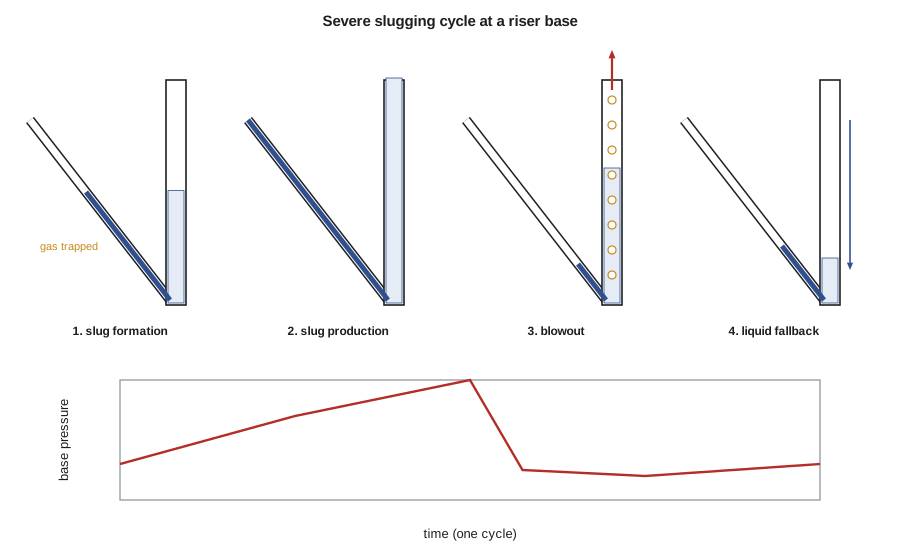
Bøe, in 1981, gave a widely used criterion: severe slugging is possible when the rate of pressure build-up from the growing liquid column in the riser exceeds the rate of gas pressure build-up in the line, which happens at low gas rates and with large line volumes. Severe slugging is best known in offshore risers, but onshore systems see a similar effect wherever a downhill line ends in a long climb, such as a valley crossing or the rise into a battery on a hill. Mitigations include raising the gas velocity with a smaller line or gas lift at the riser base, choking at the top of the riser to stabilize the flow, and active control systems that adjust a topside valve from the riser base pressure.
Slug catchers and pig slugs
Slugs must be absorbed at the facility by a slug catcher, a large inlet separator or a set of finger-type pipe vessels, whose surge volume can take the largest liquid volume that arrives faster than the downstream equipment can process it. For many gathering lines the largest slug is not hydrodynamic but the pig slug: when a pig is run, it pushes ahead of it much of the liquid that the line holds up, and that liquid arrives at the facility within minutes.
The liquid inventory of a line is its volume multiplied by the average holdup. A pig sweeps most of this inventory ahead of it, but because the gas behind the pig bypasses some liquid and the liquid ahead of the pig is also flowing out, only part of it arrives as one concentrated slug. Transient simulators predict the arrival volume and rate; for screening, engineers often assume that a large fraction of the inventory arrives as one slug. Pigging more often keeps the inventory smaller; reducing the pig speed or running the pig at reduced rate also helps the facility handle the arrival.
# Slugs, loading and corrosion: slug catcher volume, Turner check for the gas line, de Waard-Milliams CO2 rate
import math
SI = True
# Slug catcher: pigging slug from the liquid inventory displaced ahead of the pig
D, L = 0.154, 6200.0
A = math.pi * D * D / 4
for HL in (0.12, 0.20):
    inv = A * L * HL
    surge = 0.5 * inv            # assume half the inventory arrives as one pig slug (the rest arrives behind it)
    if SI: print(f"average holdup {HL:.2f}: line inventory {inv:5.1f} m3, design pig slug about {surge:5.1f} m3")
    else:  print(f"average holdup {HL:.2f}: line inventory {inv * 6.2898:5.0f} bbl, design pig slug about {surge * 6.2898:5.0f} bbl")
# Turner critical velocity (field form, water) for the Birch Coulee gas line at the lowest point
p_psia, T_R, z = 250.0, 520.0, 0.95
rho_g = 2.7 * 0.65 * p_psia / (z * T_R)        # lb/ft3
sigma, rho_w = 60.0, 67.0                        # dyn/cm, lb/ft3
vc = 1.593 * sigma ** 0.25 * (rho_w - rho_g) ** 0.25 / rho_g ** 0.5   # ft/s, includes the 20 percent allowance
d = 4.026
A_ft2 = math.pi / 4 * (d / 12) ** 2
qc = 3.067 * p_psia * vc * A_ft2 / (T_R * z)   # MMscf/d
if SI: print(f"Turner critical velocity {vc * 0.3048:4.2f} m/s; minimum rate to carry water {qc * 28.317:5.1f} thousand m3/d")
else:  print(f"Turner critical velocity {vc:4.1f} ft/s; minimum rate to carry water {qc:4.2f} MMscf/d")
# de Waard-Milliams (1975 form) CO2 corrosion rate, with no protective scale or inhibitor
for T_c, pco2 in ((20.0, 0.5), (40.0, 0.5), (40.0, 1.5)):
    Vcor = 10 ** (5.8 - 1710 / (T_c + 273.15) + 0.67 * math.log10(pco2))     # mm/yr
    if SI: print(f"{T_c:4.0f} degC, pCO2 {pco2:3.1f} bar: about {Vcor:4.1f} mm/yr uninhibited")
else: print(f"{T_c * 1.8 + 32:4.0f} degF, pCO2 {pco2 * 14.5038:4.1f} psi: about {Vcor / 0.0254:4.0f} mpy uninhibited")average holdup 0.12: line inventory 13.9 m3, design pig slug about 6.9 m3 average holdup 0.20: line inventory 23.1 m3, design pig slug about 11.5 m3 Turner critical velocity 4.09 m/s; minimum rate to carry water 52.1 thousand m3/d 20 degC, pCO2 0.5 bar: about 0.6 mm/yr uninhibited 40 degC, pCO2 0.5 bar: about 1.4 mm/yr uninhibited 40 degC, pCO2 1.5 bar: about 2.9 mm/yr uninhibited
For the north pad line, an average holdup of 0.12 to 0.20 gives a liquid inventory of 14 to 23 m³, and Ethan's screening suggests pig slugs of about 7 to 12 m³. The inlet separator has about 6 m³ of surge volume between normal and high level, which explains the alarms. Sofia suggests pigging every two weeks instead of monthly, to hold the inventory near the lower value, and reducing the line rate during the pig's arrival.
Liquid loading in gas lines
Ethan met liquid loading in gas wells in production engineering, where Turner and coworkers' 1969 droplet model sets the minimum gas velocity needed to carry liquid up the tubing. A similar problem occurs in wet gas gathering lines. On uphill sections, if the gas velocity is too low to carry the liquid film and droplets upward, liquid accumulates at the low points. The accumulated liquid restricts the gas, raises the back pressure on the wells and is released periodically as surges, which is exactly the behaviour of the Birch Coulee gas pool line. Mechanistic models predict the holdup of such lines more accurately, but the Turner velocity, evaluated at the pressure of the lowest point in the line, is a useful screening tool:
in field units of ft/s, with σ in dyn/cm and densities in lb/ft³; the constant includes Turner's 20 percent upward adjustment. For an inclined pipe the critical velocity for film reversal can be somewhat higher than this, especially at moderate inclinations, so lines are usually designed with a margin.
For the Birch Coulee gas pool line, Ethan's script gives a critical velocity of about 4.1 m/s at the line's lowest pressure point, and a minimum rate of about 52,000 m³/d (standard conditions) to keep the 4-inch line unloaded. The line now flows about 35,000 m³/d. Options include replacing the worst uphill section with smaller-diameter pipe, regular pigging or foam sticks at the pad, lowering the line pressure with compression at the battery, or combining the line with a wetter neighbour to raise the total rate.
Internal corrosion
Internal corrosion is the leading cause of failures in oil and gas gathering and produced water lines in many jurisdictions. It requires free water in contact with the steel. The most common mechanisms are carbon dioxide (sweet) corrosion, in which dissolved CO₂ forms carbonic acid; hydrogen sulphide (sour) corrosion, which can cause pitting and, in susceptible steels, cracking; oxygen corrosion, usually from air ingress at tanks and pumps, which is very aggressive even at low concentrations; and microbiologically influenced corrosion (MIC), caused by bacteria that thrive under deposits and in stagnant water. Under-deposit corrosion, where sand, wax or scale settles at low points and shields the steel from inhibitor, combines several of these.
For CO₂ corrosion, de Waard and Milliams, in 1975, proposed a simple relation for the uninhibited corrosion rate of carbon steel in water as a function of temperature and CO₂ partial pressure:
with V_cor in mm/yr, T in kelvin and the partial pressure in bar. Later versions added corrections for protective iron carbonate scale at higher temperatures, pH, flow velocity and oil wetting, and mechanistic models such as those developed at Ohio University and in the NORSOK M-506 standard are now used for design. The original relation is a conservative screening tool: it predicts the rate for bare steel in water with no protective scale or inhibitor.
Ethan's script gives uninhibited rates of about 0.6 to 2.9 mm/yr for the field's conditions. With a typical corrosion allowance of 1.5 to 3 mm, an uninhibited line in water-wet service could lose its allowance within a few years. That is why the field relies on continuous corrosion inhibitor injection, regular pigging to remove water and deposits from low spots, and corrosion monitoring with coupons, probes and in-line inspection.
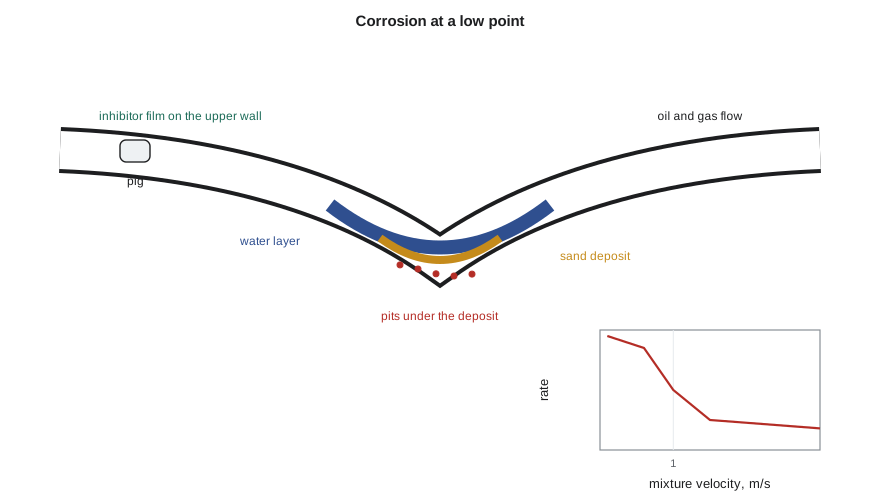
CSA Z662 requires operators to have an integrity management program that identifies hazards such as internal corrosion, assesses them and applies mitigation, and the Alberta Energy Regulator (AER) reviews pipeline failure data and has repeatedly identified internal corrosion as the leading cause of pipeline failures in the province. Inspection, inhibition and pigging records form part of that program.
Sand
Sand produced with oil and gas causes two kinds of problems. At high velocities, especially at bends, tees, chokes and reducers, sand particles erode the wall; erosion rates rise with roughly the second to third power of velocity, so a modest velocity increase can multiply the metal loss. At low velocities, sand settles and forms beds at low points, where it blocks pigs, harbours bacteria and shields the wall from inhibitor. The velocity window for sandy production is therefore narrow: fast enough to keep sand moving, slow enough to avoid erosion. Sand monitoring with acoustic or intrusive probes, sand traps and desanders at the pad, and erosion-resistant fittings at the worst locations are common measures. Many horizontal wells produce sand or proppant in their first months, so new tie-ins often have temporary sand handling at the pad.
Bringing the threats together
Each threat in this lesson and the last depends on the same few variables: velocity, holdup, temperature and where liquid collects. A line sized for high early velocity sweeps liquid and solids but may erode; a line sized for low friction may slug, load up, corrode and wax late in life. A flow assurance strategy brings the threats together, lists the operating envelope that controls each, and sets the monitoring and response for each. Lesson 12 uses that approach to choose the size and operating plan for the 04-22 tie-in.
Worked problem
Liquid inventory and pig slug
A 6.2 km, 6-inch line (ID 154 mm) has an average holdup of 0.15. Estimate the liquid inventory, and the pig slug if half the inventory arrives at once.
Show solution
- Pipe area: π × 0.154² / 4 = 0.01863 m².
- Line volume: 0.01863 × 6,200 = 115.5 m³.
- Inventory: 0.15 × 115.5 = 17.3 m³; half of this is 8.7 m³.
Answer: About 17 m³ held up, with a pig slug of about 9 m³, larger than the separator's 6 m³ surge volume.
Common mistakes
MistakeSizing the slug catcher for hydrodynamic slugs only.
InsteadCheck pig slugs and start-up slugs, which are often larger.
MistakeTreating surging from a wet gas line as a well problem.
InsteadCheck the line velocity against the critical velocity at its low points.
MistakeRelying on corrosion allowance instead of inhibition.
InsteadUninhibited CO₂ corrosion can consume the allowance in a few years.
MistakeRaising velocity to stop sand settling without checking erosion.
InsteadSand erosion rises steeply with velocity; check both limits.
Summary and key terms
- Slugs may be hydrodynamic, terrain-induced, operationally induced or severe.
- Severe slugging cycles through formation, production, blowout and fallback at a riser base.
- Slug catchers must handle pig slugs, which can approach the line's whole liquid inventory.
- Wet gas lines load up when the velocity falls below the critical value at their low points.
- Internal corrosion needs free water; CO₂, H₂S, oxygen and bacteria are the main causes.
- Sand imposes both a minimum velocity to avoid settling and a maximum to avoid erosion.
- Terrain slug
- A slug formed when liquid accumulated in a low point is pushed over the next crest.
- Severe slugging
- A cyclic instability at a riser base producing slugs as long as the riser.
- Slug catcher
- A vessel or pipe array at a facility inlet that absorbs incoming slugs.
- Liquid inventory
- The volume of liquid held up in a line at a given time.
- Corrosion allowance
- Extra wall thickness provided to allow for metal loss over the design life.
- Microbiologically influenced corrosion
- Corrosion accelerated by bacteria, often under deposits.
Practice problems
Work each problem on paper first, then reveal the answer to check.
List the four stages of severe slugging.
Show answer
Slug formation, slug production, blowout and liquid fallback.
Why are pig slugs often the largest slugs?
Show answer
The pig pushes much of the line's liquid inventory ahead of it.
At what pressure should the Turner velocity be checked in a gathering line?
Show answer
At the low points, where pressure and liquid accumulation are critical.
Why are low points prone to corrosion?
Show answer
Water and solids settle there and shield the steel from inhibitor.
Lesson quiz · 5 questions
Score 60% or more to complete this lesson.
Create a free account to save your progress, take quizzes and earn a certificate.