
PET-380 · Lesson 10 of 12 · 21 min
Flow assurance: hydrates, wax and asphaltenes
In January the north pad line plugged. Wes Brandt noticed the battery inlet rate falling over two hours while the pad pressure climbed, and by morning the line was flowing nothing. The cause was a hydrate plug at the creek crossing, where the line is shallowest. It took three days of careful depressurization from both ends to clear it. In the review afterward, Mei Lin asks Ethan to help her prepare the flow assurance section of the 04-22 design. 'Pressure drop is how you size a line,' she says. 'Flow assurance is how you keep it flowing.'
Flow assurance is the discipline of ensuring that production can flow from the reservoir to the facility throughout the life of the field. This lesson covers the three main solid deposits that can block a line: gas hydrates, paraffin wax and asphaltenes. It explains when each forms, how to predict the risk, and the methods used to prevent or remove them. Lesson 11 covers the hydraulic and mechanical threats: slugging, liquid loading, corrosion and sand.
Gas hydrates
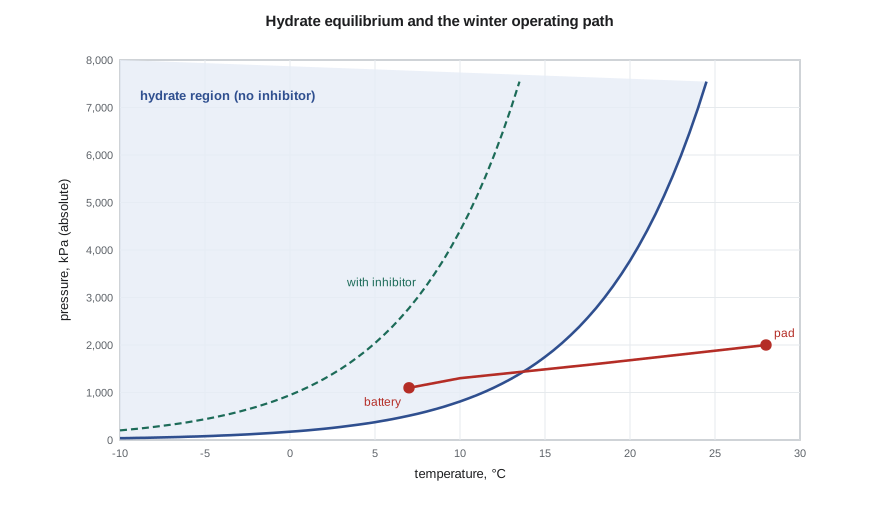
Gas hydrates are ice-like crystalline solids in which water molecules form cages that trap small gas molecules, such as methane, ethane, propane, carbon dioxide and hydrogen sulphide. They form when free water and gas are present together at high pressure and low temperature, and they can form well above the freezing point of water: at typical gathering line pressures of 2,000 to 7,000 kPa (300 to 1,000 psi), a natural gas may form hydrates below 10 to 18 °C (50 to 64 °F). Hydrates tend to form at the water-gas interface, agglomerate, stick to the pipe wall and eventually bridge the pipe. A hydrate plug can be several metres long and very hard.
The conditions for hydrate formation are summarized on a hydrate equilibrium curve: a plot of the pressure at which hydrates form against temperature, for a given gas composition. To the left of and above the curve, hydrates are stable; to the right and below, they are not. The curve is predicted from the gas composition using statistical thermodynamic models in most software, or estimated from charts such as the Katz gas-gravity chart for screening. A line is at risk when its operating pressure and temperature, at any point and at any time including shutdown, fall in the hydrate region.
Preventing hydrates
There are four basic ways to prevent hydrates: remove the water, keep the fluid warm, keep the pressure low, or add a chemical inhibitor. Dehydration is standard for sales gas but impractical in a multiphase gathering line, which carries produced water by design. Heating and insulation keep the temperature above the hydrate curve; buried lines lose heat to the ground slowly, but shallow sections, creek crossings and above-ground risers cool quickly. Pressure reduction works in some low-pressure systems but limits throughput.
Thermodynamic inhibitors, chiefly methanol and monoethylene glycol (MEG), lower the hydrate formation temperature by an amount that depends on their concentration in the water phase. For screening, the Hammerschmidt equation gives the temperature depression:
where W is the inhibitor concentration in weight percent in the water phase, M is its molecular weight, and K is 1,297 when ΔT is in degrees Celsius (2,335 in degrees Fahrenheit). The equation is reasonable up to about 20 to 25 weight percent for methanol and somewhat higher for MEG; above that, more rigorous methods such as Nielsen-Bucklin or software calculations are used. Methanol is volatile, and a significant fraction partitions into the gas and oil phases, so the injected amount must exceed what the water phase needs. MEG partitions less, can be recovered and regenerated, and is often preferred for large continuous systems.
Low-dosage hydrate inhibitors are a newer class. Kinetic hydrate inhibitors are polymers that delay hydrate nucleation and growth for a period of time, long enough for the fluid to reach the facility; they work only up to a certain subcooling below the hydrate curve. Anti-agglomerants allow small hydrate particles to form but keep them dispersed in the liquid as a transportable slurry. Both are used at concentrations of a few percent or less, much lower than thermodynamic inhibitors, but they must be tested with the field's fluids.
# Hydrates and wax: Hammerschmidt inhibitor dosing and where the line falls below the wax appearance temperature
import math
SI = True
def hammer_dT(W, M, K=1297.0):          # degC depression, W = mass percent inhibitor in the water phase
    return K * W / (M * (100 - W))
T_hyd, T_min = 14.0, 6.0                # degC: hydrate formation temperature at line pressure; coldest expected fluid
dT_need = T_hyd - T_min + 3.0           # 3 degC margin
water = 45.0                            # m3/d produced water in the line
for name, M, dens in (("methanol", 32.04, 792.0), ("MEG", 62.07, 1110.0)):
    W = 100 * dT_need * M / (1297.0 + dT_need * M)
    inh_kg = water * 1000 * W / (100 - W)              # kg/d in the water phase only
    if name == "methanol": inh_kg *= 1.3              # allowance for methanol lost to the gas and oil phases
    v = inh_kg / dens
    if SI: print(f"{name:8s}: {W:4.1f} wt% needed in the water, about {v:5.1f} m3/d injected ({inh_kg:6.0f} kg/d)")
    else:  print(f"{name:8s}: {W:4.1f} wt% needed in the water, about {v * 6.2898:5.0f} bbl/d injected ({inh_kg * 2.2046:6.0f} lb/d)")
# Steady temperature along a buried line: exponential approach to ground temperature
Tin, Tg, WAT = 38.0, 4.0, 22.0          # degC inlet, ground, wax appearance temperature
U, D, mdot, cp = 3.0, 0.154, 9.5, 2600.0   # W/m2K overall, m, kg/s, J/kgK
Lrel = mdot * cp / (U * math.pi * D)     # m, relaxation length
x = -Lrel * math.log((WAT - Tg) / (Tin - Tg))
Tout = Tg + (Tin - Tg) * math.exp(-6200.0 / Lrel)
if SI: print(f"relaxation length {Lrel / 1000:4.1f} km; fluid reaches the WAT of {WAT} degC after {x / 1000:4.1f} km; arrival {Tout:4.1f} degC")
else: print(f"relaxation length {Lrel / 1609:4.1f} miles; fluid reaches the WAT of {WAT * 1.8 + 32:.0f} degF after {x / 1609:4.1f} miles; arrival {Tout * 1.8 + 32:4.1f} degF")methanol: 21.4 wt% needed in the water, about 20.1 m3/d injected ( 15896 kg/d) MEG : 34.5 wt% needed in the water, about 21.3 m3/d injected ( 23689 kg/d) relaxation length 17.0 km; fluid reaches the WAT of 22.0 degC after 10.8 km; arrival 27.6 degC
Ethan's calculation shows the cost of thermodynamic inhibition. To lower the hydrate temperature by 11 °C, giving a 3 °C margin below the coldest expected fluid temperature, the water phase needs about 21 weight percent methanol, or roughly 20 m³/d injected once losses to the gas and oil are allowed for. 'That is why we inject methanol only in winter and only on the lines that need it,' Mei says. 'For 04-22, look at burying the creek crossing deeper and insulating the riser at the battery. Every degree you keep is methanol you do not have to buy.'
Remediating a hydrate plug
If a plug forms, the safest standard method is depressurization from both sides, which lowers the pressure until hydrates are no longer stable and lets the plug dissociate slowly. Depressurizing from one side only is dangerous: the pressure difference across the plug can launch it down the line at high velocity, like a projectile, damaging bends and equipment and endangering people. Heating a plug from outside must be done carefully, because gas released inside a trapped section can raise the pressure sharply. Methanol can be injected at the plug face where access allows. The January event on the north pad line was cleared by careful two-sided depressurization, and the review recommended a written hydrate response procedure for every line at risk.
Paraffin wax
Paraffin wax is a mixture of long-chain normal alkanes, typically from about C18 to C60 and above, that are dissolved in the crude oil at reservoir temperature. As the oil cools, the heaviest paraffins come out of solution as solid crystals. The temperature at which crystals first appear is the wax appearance temperature, or WAT, also called the cloud point. In a pipeline, wax deposits mainly on the cold pipe wall: dissolved wax diffuses toward the wall because the oil there is colder and holds less in solution, and crystals stick and build a layer that traps oil and gradually hardens. As deposition continues, the effective diameter shrinks, pressure drop rises, and pigging becomes harder.
A second wax property is the pour point, the temperature below which the oil stops flowing under gravity because the wax crystals form a gel network. If a waxy oil line is shut in and cools below its pour point, restarting it may require much higher pressure than normal flow, to break the gel. Pour point depressants and restart pressure studies address this risk.
Pipeline temperature profile
Predicting wax deposition requires the temperature along the line. For a buried line in steady flow, a heat balance gives an exponential approach of the fluid temperature toward the ground temperature:
where T_g is the ground temperature, T_in the inlet temperature, ṁ the mass flow rate, c_p the mixture heat capacity, U the overall heat transfer coefficient referred to the inside diameter, and L_r the relaxation length, the distance over which the temperature difference falls by a factor of e. The overall coefficient depends on the soil conductivity, burial depth and any insulation, and in multiphase flow also on the flow pattern. The equation ignores Joule-Thomson cooling of expanding gas and frictional heating, which can matter in high-pressure gas lines.
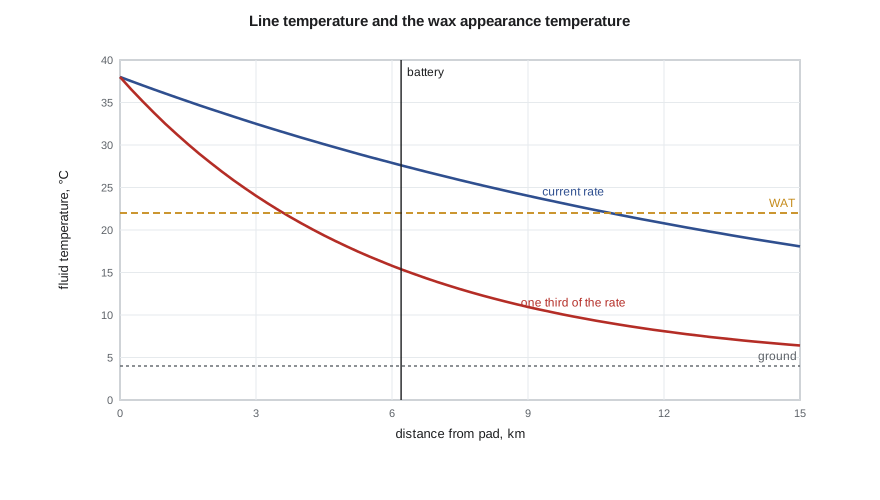
For the north pad line, Ethan's script gives a relaxation length of about 17 km, so a 6.2 km line loses only part of its heat; the fluid arrives at about 27.6 °C, above the 22 °C WAT, and would not reach the WAT until about 10.8 km. 'In steady flow at today's rate, this line is safe from wax,' Mei says. 'But the relaxation length is proportional to the mass rate. When the rate falls to a third, so does the relaxation length, and the cold end of the line will be below the WAT.'
Managing wax
Wax management combines prevention and removal. Keeping the fluid above the WAT by insulation or heating prevents deposition entirely, and is used for short lines and risers. Chemical wax inhibitors, also called paraffin inhibitors or crystal modifiers, interfere with crystal growth and reduce deposition rates; pour point depressants lower the gel temperature. Regular mechanical pigging scrapes deposits from the wall before they harden, and is the most common method in onshore gathering. Pigging frequency is set from deposition rate predictions and confirmed by the volume of wax returned with each pig; a long gap between runs can let the deposit harden so much that the pig stalls. Hot oiling and solvent treatments are used to clean wells and short lines.
Asphaltenes
Asphaltenes are the heaviest and most polar components of crude oil, defined by their solubility: they dissolve in aromatic solvents such as toluene but not in light alkanes such as n-heptane. In the reservoir they are held in suspension, stabilized by resins. When pressure falls during production, the oil's light components expand and the oil becomes a poorer solvent, so asphaltenes can flocculate and deposit. Deposition is usually worst just above the bubble point, where the oil is least dense; below the bubble point, the light gas leaves the oil and the asphaltenes become more stable again. The pressure at which asphaltenes first precipitate is the asphaltene onset pressure.
Asphaltene problems usually appear in the well tubing and near-wellbore region rather than in surface lines, because the pressure falls through the onset range downhole. They are more common in light oils with low asphaltene content than in heavy oils, which is counterintuitive but well established: light oils are poorer solvents. Injection of carbon dioxide or rich gas for enhanced recovery can also destabilize asphaltenes. Screening tools such as the de Boer plot, which compares reservoir pressure above the bubble point with oil density, give a first indication of risk. Treatment uses asphaltene inhibitors or dispersants, and deposits are removed with aromatic solvents such as xylene or by mechanical cleaning.
Other deposits
Two further deposits complete the picture. Inorganic scales, such as calcium carbonate, barium sulphate and iron sulphide, precipitate from produced water when pressure and temperature change or when incompatible waters mix; they are managed with scale inhibitors and acid treatment. Naphthenates and other soaps form in some acidic crudes at oil-water interfaces. Together with hydrates, wax and asphaltenes, they are summarized in a field's flow assurance strategy, which lists each threat, where and when it occurs, how it is monitored and how it is prevented or removed.
Worked problem
Hammerschmidt check for MEG
The line needs a hydrate temperature depression of 11 °C. Using the Hammerschmidt equation with K = 1,297 and M = 62.07 for MEG, find the required weight percent in the water phase.
Show solution
- Rearrange: W = 100 ΔT M / (K + ΔT M).
- ΔT M = 11 × 62.07 = 682.8.
- W = 100 × 682.8 / (1,297 + 682.8) = 34.5 weight percent.
Answer: About 35 weight percent MEG in the water phase, which agrees with Ethan's script.
Common mistakes
MistakeAssuming hydrates cannot form above 0 °C (32 °F).
InsteadAt line pressures they can form well above the freezing point.
MistakeDepressurizing a hydrate plug from one side only.
InsteadDepressurize from both sides to avoid launching the plug.
MistakeChecking wax risk only at initial rates.
InsteadThe relaxation length shrinks as the mass rate falls.
MistakeAssuming heavy oils have the worst asphaltene problems.
InsteadLight undersaturated oils are often more prone to deposition.
Summary and key terms
- Hydrates form from water and light gas at high pressure and low temperature, often well above 0 °C (32 °F).
- Hydrates are prevented by removing water, keeping the fluid warm, lowering pressure or injecting inhibitors.
- The Hammerschmidt equation estimates the temperature depression from inhibitor concentration.
- Wax deposits on cold walls below the wax appearance temperature; gels form below the pour point.
- Buried line temperatures approach ground temperature over a relaxation length proportional to mass rate.
- Asphaltenes destabilize as pressure falls toward the bubble point, mostly in wells.
- Gas hydrate
- A crystalline solid of water cages trapping light gas molecules.
- Thermodynamic inhibitor
- A chemical such as methanol or MEG that lowers the hydrate formation temperature.
- Wax appearance temperature
- The temperature at which wax crystals first form in the oil.
- Pour point
- The temperature below which the oil does not flow under gravity.
- Relaxation length
- The distance over which the fluid-ground temperature difference falls by a factor of e.
- Asphaltene onset pressure
- The pressure at which asphaltenes first precipitate as pressure falls.
Practice problems
Work each problem on paper first, then reveal the answer to check.
Name the four basic ways to prevent hydrates.
Show answer
Remove water, keep warm, keep pressure low or add inhibitor.
Why must a hydrate plug be depressurized from both sides?
Show answer
A one-sided pressure difference can launch the plug down the line.
What happens to the relaxation length if the mass rate halves?
Show answer
It halves, so the fluid cools faster along the line.
Where are asphaltene deposits most common?
Show answer
In well tubing and near the wellbore, where pressure falls toward the bubble point.
Lesson quiz · 5 questions
Score 60% or more to complete this lesson.
Create a free account to save your progress, take quizzes and earn a certificate.