
MEC-499 · Lesson 7 of 12 · 20 min
Materials and manufacturing process selection
Every part of the TDX-150 is made of something and made somehow, and the two choices are linked. A canopy panel can be galvanized steel or aluminium; if aluminium, it can be press-braked from sheet, but welding it needs different skills and equipment from the steel frame. A fuel tank can be welded steel, welded aluminium or rotationally moulded polyethylene, and each choice changes its mass, cost, corrosion behaviour and how it must be tested. Material and process selection is therefore a single decision made with the requirements, the quantities and the available suppliers in view.
This lesson follows the team's selection method: translate requirements into material properties, screen candidates, rank them with performance indices, and then check the choices against cost, process, environment and the real conditions of floodwater.
From requirements to properties
Michael Ashby's method, taught in materials courses around the world, starts by writing each component's function, its constraints, its objective and its free variables. For the canopy panels: the function is to enclose the engine and block noise; the constraints are that each panel must be stiff enough not to drum or dent when a volunteer leans on it, must resist corrosion from road salt and floodwater, and must be formable on a press brake; the objective is minimum mass; and the free variable is the panel thickness.
For a flat panel loaded in bending, stiffness depends on Young's modulus times thickness cubed, while mass depends on density times thickness. Fixing the stiffness and eliminating the free thickness gives a performance index to maximize:
Materials with a high value of this index make the lightest stiff panels. The cube root is the key point: it means low-density materials gain far more than their lower modulus loses. That is why aircraft and car body panels use aluminium and composites, and why steel, though stiffer, makes a heavy panel.
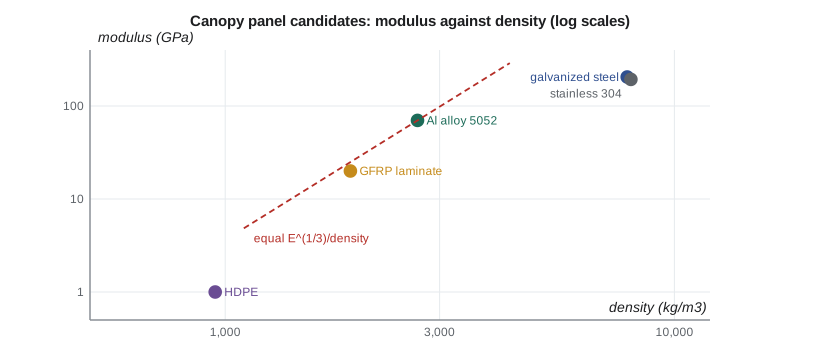
Ranking candidates
Hannah listed five candidate materials the shop could realistically work with and computed, for each, the thickness that matches the stiffness of the original 1.2 mm galvanized steel panel, the resulting canopy mass, its material cost and its sound insulation, using the field-incidence mass law for single panels, which predicts transmission loss from mass per unit area and frequency:
# Canopy panel material selection: equal bending stiffness, mass, cost and sound insulation
import math
area = 9.5                    # m^2 of canopy panels
t_steel = 1.2                 # mm, galvanized steel reference panel
mats = {  # name: (E GPa, density kg/m^3, cost per kg in local currency, approximate values)
    "galvanized steel": (205, 7850, 1.6),
    "aluminium 5052-H32": (70, 2680, 5.5),
    "stainless steel 304": (193, 8000, 5.0),
    "glass-fibre laminate": (20, 1900, 8.0),
    "HDPE sheet": (1.0, 950, 3.0),
}
E0 = mats["galvanized steel"][0]
print("material               t (mm)  mass (kg)  cost   index E^(1/3)/rho  TL at 500 Hz")
for n, (E, rho, c) in mats.items():
    t = t_steel * (E0 / E) ** (1 / 3)               # equal plate bending stiffness: t^3 E constant
    mass = area * t / 1000 * rho
    idx = (E * 1e9) ** (1 / 3) / rho
    msurf = rho * t / 1000                           # kg/m^2
    TL = 20 * math.log10(msurf * 500) - 47           # field-incidence mass law, dB
    print(f"{n:22s} {t:6.2f}  {mass:8.1f}  {mass * c:6.0f}  {idx:12.3f}  {TL:12.1f}")

# Batch cost of the canopy for six units, laser-cut and press-braked, versus a one-off
def unit_cost(n, setup=1800.0, material=245.0, labour_h=7.5, rate=85.0, programming=1200.0):
    return (setup + programming) / n + material + labour_h * rate
for n in (1, 6, 25):
print(f"aluminium canopy, batch of {n:2d}: {unit_cost(n):7.0f} per unit")material t (mm) mass (kg) cost index E^(1/3)/rho TL at 500 Hz galvanized steel 1.20 89.5 143 0.751 26.5 aluminium 5052-H32 1.72 43.7 240 1.538 20.2 stainless steel 304 1.22 93.1 465 0.722 26.8 glass-fibre laminate 2.61 47.1 376 1.429 20.9 HDPE sheet 7.08 63.9 192 1.053 23.5 aluminium canopy, batch of 1: 3882 per unit aluminium canopy, batch of 6: 1382 per unit aluminium canopy, batch of 25: 1002 per unit
Aluminium 5052-H32 halves the canopy's mass, from about 90 to 44 kg, for about 100 more in material cost, and it resists corrosion well in wet and salty conditions, which matters for equipment that will stand in floodwater and travel salted roads. Glass-fibre laminate is similar in mass but costs more and needs moulds. Polyethylene is cheap but the equal-stiffness panel would be 7 mm thick and heavier than aluminium. Stainless steel offers nothing over galvanized steel here except appearance.
The last column is the catch. A lighter panel blocks less sound. The mass law predicts the aluminium canopy transmits about 6 dB more noise than the steel one at 500 Hz, which is a large loss: 6 dB is a fourfold increase in sound energy reaching the listener through the panels. The team accepted this knowingly, for two reasons. The mass saving was needed to meet R-05, and noise could be recovered by other means: a lining of damped, dense mineral wool or acoustic foam on the inside faces, careful sealing of gaps, and the upward-facing air paths from the TRIZ session. Kwame estimated the lining would restore about 5 dB. Lesson 9 shows the result was not quite enough, which is how real projects often go.
Selecting the frame material
For the frame, the constraints are different. Strength and stiffness under the transport and lifting loads matter, but so do weldability by Tidewater's shop, the cost of material and fabrication, and corrosion. The team compared structural steel hollow sections with aluminium 6061-T6 extrusions. Aluminium would save about 70 kg of frame mass, but welding reduces the strength of 6061-T6 near the weld to roughly half of its parent value, its fatigue strength in welded joints is about a third of steel's for the same detail, and Tidewater's shop welds steel every day but aluminium rarely. The frame stayed steel: Canada structural hollow sections with a minimum yield of about 345 MPa, hot-dip galvanized after welding for corrosion protection.
Galvanizing after fabrication has its own design rules. Hollow sections must have vent and drain holes so molten zinc can flow in and out and trapped air cannot burst the section; Hannah added 12 mm holes at the ends of each member at positions the galvanizer specified. Galvanizing also adds a coating of roughly 85 micrometres to every surface, including threads and machined fits, so the adapter plate and other precision parts are bolted on after galvanizing rather than welded to the frame.
Corrosion and the real environment
Floodwater is not clean water. It carries silt, sewage, road salt in spring floods, fuel and oil from flooded vehicles, and in coastal storms, seawater. Materials that are perfectly adequate indoors can fail quickly in it. Rafael wrote a short environment statement for the design: wetted parts, including the pump casing and impeller, must tolerate brackish water and abrasive silt; everything else must tolerate splashing, road salt and storage in an unheated building with condensation.
That statement drove several choices. Tidewater's wet end is cast iron with a ductile-iron impeller and a hardened wear plate, standard for dewatering service, with a tungsten-carbide seal face pair that tolerates grit. Fasteners exposed to the weather are hot-dip galvanized or stainless steel, but stainless bolts are not used to clamp aluminium panels without insulating washers, because the two metals in contact in a wet, salty environment form a galvanic couple that corrodes the aluminium. The fuel tank is aluminium with welded baffles, avoiding the internal rust that plagues steel tanks when condensation collects in diesel fuel.
Manufacturing process selection
Processes are selected in the same spirit as materials: list the requirements on shape, size, tolerance, finish and quantity, screen the processes that can meet them, and rank by cost. Quantity matters most for cost. The cooperative wants six skids, and Tidewater might later build a few dozen a year. At those quantities, processes with high tooling costs, such as casting a frame or stamping panels in dedicated dies, cannot pay back their tooling. Processes that need only programming and general-purpose tools win: laser cutting, press braking, saw cutting and manual or robotic welding.
The code's batch-cost model shows why. A laser-cut and press-braked aluminium canopy costs about 3,900 as a one-off, because the set-up and programming are paid by a single unit; about 1,400 each in a batch of six; and about 1,000 each in a batch of 25. The material and labour costs per unit hardly change; the fixed costs spread out. This is the reason the team's cost requirement R-10 is stated for a batch of six, and why Tidewater's interest in a larger product run matters to the client's price.
| Part | Material | Process | Reason |
|---|---|---|---|
| Frame rails and cross-members | structural steel hollow section, about 345 MPa yield | saw cut, jig welded, hot-dip galvanized | weldability, fatigue strength, shop experience |
| Adapter plate | steel plate, 20 mm | laser cut, welded, then machined in one set-up | flatness and bore position after welding |
| Canopy panels | aluminium 5052-H32, 1.7 mm | laser cut and press-braked, lined with damped mineral wool | mass, corrosion, formability |
| Fuel tank | aluminium 5052, 3 mm, baffled | formed and TIG welded, pressure tested | no internal rust, lighter than steel |
| Pump wet end | cast iron casing, ductile iron impeller | Tidewater standard castings | abrasion and cost in dewatering service |
| Lifting eye | forged alloy steel, rated | bought-in, bolted to a welded plate | certified rating and traceability |
The lifting eye deserves a note. It is the one part whose failure could kill someone, so the team did not design and make it. A forged, rated lifting point bought from a supplier comes with a certified working load and traceability to its heat of steel; the team designed only the welded plate it bolts to, analysed it with finite elements, and specified a proof load test after fabrication. Buying a certified component instead of making a similar part is often the right engineering choice for safety-critical items.
Worked problem
Choosing a fuel tank material
A 200 L tank needs about 2.2 m² of wall. Compare 3 mm aluminium (2,680 kg/m³, about 5.5 per kg) with 2.5 mm steel (7,850 kg/m³, about 1.6 per kg), ignoring baffles and fittings.
Show solution
- Aluminium mass: 2.2 × 0.003 × 2,680 = 17.7 kg; material cost about 97.
- Steel mass: 2.2 × 0.0025 × 7,850 = 43.2 kg; material cost about 69.
- Aluminium saves about 25 kg for about 28 more in material, and does not rust inside.
- Steel would need an internal coating or regular water draining; aluminium welding costs more, but Tidewater can subcontract tanks to a specialist.
Answer: Aluminium is chosen: 25 kg lighter, corrosion-free inside, for a small cost increase.
Materials and the end of life
Selection also considers what happens when the skid is retired. Steel and aluminium are both widely recycled, and aluminium in particular holds its value as scrap. Keeping materials separable, with bolted rather than bonded joints between aluminium and steel, makes recycling easier. Lesson 11 returns to the carbon footprint of these choices, where aluminium's high embodied energy when made from ore is a real cost to be weighed against its weight saving and long life.
Common mistakes
MistakeChoosing the stiffest material for a light, stiff panel.
InsteadUse the performance index E^(1/3)/ρ; low-density materials usually win for panels.
MistakeIgnoring the acoustic cost of a lighter canopy.
InsteadCheck sound insulation with the mass law and plan linings, sealing and air path changes to recover it.
MistakeWelding aluminium 6061-T6 and using its parent strength near the weld.
InsteadUse the reduced heat-affected-zone strength and the lower fatigue class of welded aluminium.
MistakeGalvanizing hollow sections without vent and drain holes.
InsteadAdd holes where the galvanizer specifies, and fit precision parts after galvanizing.
MistakeClamping aluminium with stainless steel fasteners in wet, salty service.
InsteadInsulate dissimilar metals to prevent galvanic corrosion.
Summary and key terms
- Material and process selection is one decision, driven by function, constraints, objective and free variables.
- For light, stiff panels the index E^(1/3)/ρ favours aluminium, which halves canopy mass compared with steel.
- The mass law predicts the lighter canopy loses about 6 dB of sound insulation, to be recovered with linings and sealing.
- The frame stays galvanized structural steel for weldability, fatigue strength and shop experience.
- Floodwater, salt and condensation drove choices of wet-end materials, fasteners, insulation of dissimilar metals and an aluminium tank.
- At six units, low-tooling processes such as laser cutting and press braking win; fixed costs dominate one-off prices.
- Performance index
- A combination of material properties that measures performance for a given function and constraint.
- Free variable
- A dimension the designer can change to meet a constraint, such as thickness.
- Mass law
- The rule that sound insulation of a single panel rises about 6 dB per doubling of mass per area.
- Transmission loss
- The reduction in sound energy passing through a panel, in decibels.
- Heat-affected zone
- The region near a weld whose properties are changed by welding heat.
- Hot-dip galvanizing
- Coating steel with zinc by immersion in molten zinc after fabrication.
- Galvanic corrosion
- Accelerated corrosion of one metal in electrical contact with another in an electrolyte.
- Batch cost
- Unit cost when fixed set-up and tooling costs are shared across a production batch.
- Rated lifting point
- A certified lifting component with a stated working load limit and traceability.
- Environment statement
- A description of the conditions a product must survive, used to select materials.
Practice problems
Work each problem on paper first, then reveal the answer to check.
Two panel materials have E = 70 GPa, ρ = 2,700 and E = 200 GPa, ρ = 7,800. Which makes the lighter stiff panel?
Show answer
Indices about 0.00153 and 0.00075 (with E in GPa): the first, by about a factor of two.
A 1.0 mm steel panel is replaced by aluminium of equal bending stiffness. How thick is it?
Show answer
1.0 × (205/70)^(1/3) = 1.43 mm.
By the mass law, how much transmission loss is lost if panel mass per area halves?
Show answer
20 log(0.5) = −6 dB.
Set-up and programming cost 3,000; materials and labour 900 per unit. Find the unit cost for 1, 6 and 30 units.
Show answer
3,900; 1,400; 1,000.
Why is the adapter plate bolted on after galvanizing?
Show answer
Zinc coating of about 85 micrometres would spoil its machined fits.
Lesson quiz · 5 questions
Score 60% or more to complete this lesson.
Create a free account to save your progress, take quizzes and earn a certificate.