
MEC-499 · Lesson 12 of 12 · 23 min
The final report, presentation and reflection
In week 21 the TDX-150 prototype stood in Tidewater's yard with eleven of its twelve requirements verified and one failed with a fix designed. The engineering was mostly done. What remained was to communicate it: a final report that the cooperative, Tidewater and Professor Leger could each use for their own purposes, a presentation to all three at the final review, a handover that let Tidewater carry the work on, and each team member's reflection on what they had learned. Many capstone teams treat these as an afterthought. They are not. A design nobody can understand, check or build on has little value beyond the prototype in the yard.
Verification against requirements
The heart of the final report is the verification matrix: every requirement, the method used to verify it, the result and the status. It answers the question every reviewer asks first, 'does it do what it was supposed to do?', and it is only possible because the team kept traceability from lesson 2 onward.
# Final verification summary for the TDX-150 prototype against the twelve requirements
reqs = [  # id, requirement, target, result, method, status
    ("R-01", "flow at 18 m total head", "90 L/s", "91.2 L/s", "test", "pass"),
    ("R-02", "prime at 6.0 m lift", "120 s", "73 s", "test", "pass"),
    ("R-03", "prime at 7.5 m lift (reduced flow allowed)", "180 s", "142 s", "test", "pass"),
    ("R-04", "spherical solids passed", "75 mm", "76 mm ball", "test", "pass"),
    ("R-05", "wet mass", "950 kg", "941 kg", "weigh", "pass"),
    ("R-06", "run time on one tank at rated point", "24 h", "26.4 h (8 h run, scaled)", "test + analysis", "pass"),
    ("R-07", "sound level at 7 m", "75 dB(A)", "77.1 dB(A)", "test", "fail"),
    ("R-08", "set-up by two trained volunteers", "20 min", "17 min (3 crews)", "demonstration", "pass"),
    ("R-09", "cold start", "-10 C", "-12 C chamber", "test", "pass"),
    ("R-10", "unit manufacturing cost at 6 units", "48,000", "46,300 (estimate)", "analysis", "pass"),
    ("R-11", "fuel containment", "110 % of tank", "118 %", "inspection", "pass"),
    ("R-12", "transport fatigue, 10 years", "damage < 0.5", "0.04 + shaker test", "analysis + test", "pass"),
]
for r in reqs:
    print(f"{r[0]} {r[1]:42s} target {r[2]:14s} result {r[3]:26s} {r[5]}")
passed = sum(r[5] == "pass" for r in reqs)
print(f"{passed} of {len(reqs)} requirements verified; open items:", [r[0] for r in reqs if r[5] != "pass"])
# A 20-minute final presentation budget
slots = {"problem and client": 2, "requirements": 2, "concepts and selection": 3, "design": 5,
         "test results": 4, "cost, risk and next steps": 2, "lessons learned": 1, "questions": 1}
print("Presentation minutes:", sum(slots.values()), slots)R-01 flow at 18 m total head target 90 L/s result 91.2 L/s pass
R-02 prime at 6.0 m lift target 120 s result 73 s pass
R-03 prime at 7.5 m lift (reduced flow allowed) target 180 s result 142 s pass
R-04 spherical solids passed target 75 mm result 76 mm ball pass
R-05 wet mass target 950 kg result 941 kg pass
R-06 run time on one tank at rated point target 24 h result 26.4 h (8 h run, scaled) pass
R-07 sound level at 7 m target 75 dB(A) result 77.1 dB(A) fail
R-08 set-up by two trained volunteers target 20 min result 17 min (3 crews) pass
R-09 cold start target -10 C result -12 C chamber pass
R-10 unit manufacturing cost at 6 units target 48,000 result 46,300 (estimate) pass
R-11 fuel containment target 110 % of tank result 118 % pass
R-12 transport fatigue, 10 years target damage < 0.5 result 0.04 + shaker test pass
11 of 12 requirements verified; open items: ['R-07']
Presentation minutes: 20 {'problem and client': 2, 'requirements': 2, 'concepts and selection': 3, 'design': 5, 'test results': 4, 'cost, risk and next steps': 2, 'lessons learned': 1, 'questions': 1}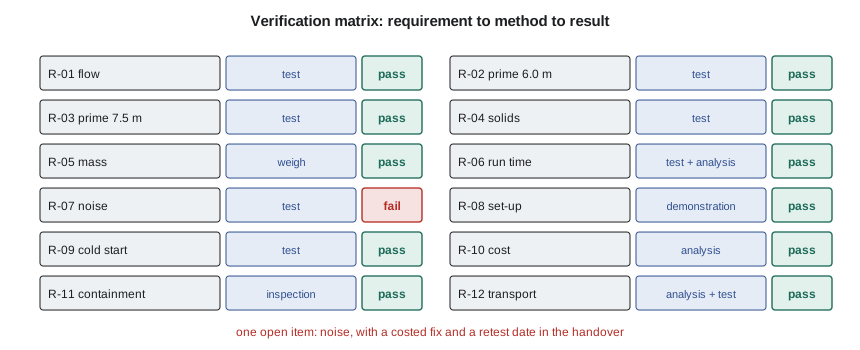
Each result in the matrix links to its evidence: a test record, an analysis, an inspection report or a demonstration log. Where a result was obtained by analysis rather than test, the report says so and explains why, as with R-10 cost, which could only be estimated until Tidewater quoted a production batch. Where a test was scaled, as with R-06, which ran for 8 hours and was extrapolated to the full tank, the report shows the scaling and its assumption that fuel consumption is steady. Honesty about method is as important as the result.
The failed requirement gets its own section. It states the requirement and the result, explains the diagnosis from the narrow-band measurements, describes the two fixes and their estimated effect, gives their cost and lead time, and records Tidewater's agreement to build the fixes and retest by a stated date, with the retest procedure attached. A reader comes away knowing exactly where the design stands and what remains. A failed requirement handled this way does not make the project a failure; it makes the report trustworthy.
The structure of the final report
Professor Leger gives every capstone team the same advice about the report: write for the busiest reader first. The cooperative's board will read two pages. Tidewater's engineers will read the design and test sections closely. The advisor will read everything. A structure that serves all three is standard in engineering reports.
| Section | Content | Main reader |
|---|---|---|
| Executive summary | problem, solution, results against requirements, open items, recommendation, in two pages | client board, sponsor managers |
| Introduction and requirements | client, needs, requirements with sources, scope and exclusions | all |
| Concept development and selection | concepts, matrices, sensitivity, decision record | advisor, sponsor |
| Detailed design | layout, analyses, materials, manufacturing, drawings referenced | sponsor engineers |
| Risk and safety | FMEA, risk assessment, safety measures, residual risks | sponsor, client |
| Testing and verification | test plan, results, verification matrix, open items | all |
| Project management | schedule, budget, earned value, changes | advisor |
| Sustainability and ethics | life-cycle screening, the brochure case, recommendations | advisor, client |
| Conclusions and recommendations | what was achieved, what remains, what to do next | all |
| Appendices | calculations, test records, drawings list, manuals, code listings | sponsor engineers |
The executive summary is the hardest section to write and the most read. It must stand alone. The team's version began: 'The TDX-150 is a 941 kg diesel-driven, self-priming pump skid that delivers 90 L/s against 18 m of head from up to 6 m below the pump, primes in under two minutes, runs 26 hours on a tank, and can be set up by two volunteers in under 20 minutes. A prototype built with Tidewater Pump Works met eleven of twelve requirements in testing. It measured 77 dB(A) at 7 m against a 75 dB(A) target; a fix estimated to reach 74 dB(A) is designed and will be retested by Tidewater. We recommend that the cooperative proceed with six units once the noise fix is verified.' Every number in that paragraph is traceable to a test or analysis in the body.
Writing that engineers can use
Engineering writing is judged by whether readers can find what they need, understand it once and act on it. A few habits make the difference. State the result first, then the evidence: 'The frame meets the transport load with a factor of 11 on yield (section 5.3)', not three paragraphs of method before the answer. Use figures and tables for anything with more than three numbers. Give every figure a caption that says what it shows and what to notice. Report numbers with sensible precision and units: '91.2 ± 0.6 L/s', not '91.2349 L/s'. Write in plain language; the cooperative's board includes a retired teacher and a farmer, and both read the executive summary closely.
The team also kept the report consistent with the configuration. Every drawing, calculation and test record referred to by the report carried a revision letter, and the report's appendix listed the revision of each. When Hannah updated the canopy drawing for the noise fix, the report referred to revision C and noted that revision B was the one tested. That kind of care is what lets a manufacturer take a student design forward.
The final presentation
The final review was a 20-minute presentation followed by questions, to Dale and two board members, Farah and Owen, Professor Leger and a second faculty examiner. The program's time budget allocated minutes to each part, with the largest share to design and test results, because that is what the audience most needed to judge. The team rehearsed three times, once in front of Professor Leger's other capstone team, and cut the concept section by a minute after the rehearsal showed it was running long.
Good technical presentations share some habits. Each slide carries one message, stated in its title as a sentence: 'The pump primes in 73 s at 6 m lift', not 'Priming test'. Graphs are readable from the back of the room, with large labels and only the data needed. The speaker talks to the audience, not the slides. And the presentation says what the audience should conclude and do: Émilie's last slide read 'Recommendation: proceed with six units after the noise retest, at an estimated 46,300 Canadian dollars each'. The team brought the prototype to the review, and the board members spent ten minutes after the formal questions watching Rafael demonstrate the set-up, which persuaded them more than any slide.
The questions were hard. The second examiner asked why the team had not tested at 7.5 m lift with the 9 m hose, the worst combination. Kwame answered that the factorial experiment had been run at 6 m, that the 7.5 m test had used the standard 6 m hose, and that the 9 m hose at 7.5 m was untested; he estimated from the experiment's effects that it would add about 22 s and remain within R-03, but he called it an estimate. Dale asked what the volunteers should do if the pump stopped priming in the middle of the night. Rafael pointed to the quick-start card and walked through the three most likely causes from the FMEA. Answering 'we did not test that, and here is our best estimate' is far better than bluffing; examiners and clients notice the difference.
The handover
A capstone ends, but the product does not. The handover package to Tidewater included the released drawing set at its current revision, the parts list with suppliers and lead times, the analysis files and spreadsheets, the FMEA and risk assessment, the test records, the operator's manual and quick-start card drafts, the open items list with owners, and the decision log. Owen took ownership of the noise retest and the production cost quotation. Dale received the operator documents and the recommendation. The team held a one-hour handover meeting to walk through the package, because documents alone rarely transfer the reasons behind decisions.
Reflection
Professor Leger asks every team member to write a two-page individual reflection, separate from the team report. It is not a summary of the project. It asks what each person learned, what they would do differently, and how the experience changed how they think about engineering. The the Canadian Engineering Accreditation Board (CEAB) criteria and the graduate attributes they assess include lifelong learning and professional judgment, which are hard to demonstrate in an exam but natural to show in a reflection.
The team's reflections were candid. Émilie wrote that she had learned more from the week 18 earned value report than from any course in project management, because the numbers forced decisions she would otherwise have put off. Kwame wrote about the fatigue error Owen found and how it changed his attitude to review: 'I used to think being checked meant I wasn't trusted. Now I think not being checked means nobody cares about the result.' Hannah wrote that the configuration error that cost 600 in re-cut panels taught her more about process than any lecture on product data management. Rafael wrote about the firefighter's story of exhaust in a stairwell, which had become the highest-priority item in the FMEA, and how it convinced him that the most important engineering information often comes from listening to users rather than from calculation.
A good reflection is specific, honest about mistakes, and connects experience to a principle that will be used again. 'Teamwork was important' says nothing. 'When we scored concepts independently before discussing, we found that Hannah and I disagreed by two points on concept B's cost, and resolving that disagreement revealed an error in my hose mass estimate' says a great deal.
Worked problem
Writing a result statement
Turn this draft into a clear result statement for the report: 'Several runs were done at different hose lengths and vacuum pump sizes and the priming times varied, with the bigger pump generally better and longer hoses a bit worse, so we think it meets the requirement.'
Show solution
- State the result first, with the requirement: 'The skid primes in 73 s at 6.0 m lift with the standard 6 m hose, against a 120 s requirement (R-02).'
- Give the key evidence compactly: 'A 2³ factorial experiment found the larger vacuum pump reduced priming time by 34 s and a 9 m hose added 22 s; with the selected configuration, all hose lengths tested met R-02, the longest at 97 s.'
- Point to the record: 'Test record T-02, revision B, appendix D.'
- State any limitation: 'The 9 m hose was not tested at 7.5 m lift; the estimated time is about 164 s, within R-03.'
Answer: Result first, evidence compactly, a reference to the record, and an explicit limitation.
Looking back over the program
The TDX-150 drew on almost every course in the mechanical engineering program: fluid mechanics for the operating point and NPSH, thermodynamics for engine fuel use, machine design for the coupling and fatigue, vibrations for the isolators and panel modes, finite elements for the lifting plate, measurement for the tests, materials for the canopy and tank, and the design and professional courses for everything that held them together. The capstone does not add a new subject so much as show what the subjects are for: helping real people with a real problem, under real constraints, honestly.
Common mistakes
MistakeWriting the report in the order the work was done.
InsteadPut results first and structure the report for its readers, with a stand-alone executive summary.
MistakeHiding or softening a failed requirement.
InsteadGive it its own section with the result, diagnosis, fix, cost and retest plan.
MistakeSlide titles that only name a topic.
InsteadMake each slide title a sentence stating its message.
MistakeBluffing an answer to a question the team cannot answer.
InsteadSay what was and was not tested, and give a clearly labelled estimate.
MistakeTreating the reflection as a project summary.
InsteadWrite about specific lessons, mistakes and how they will change your practice.
Summary and key terms
- The verification matrix shows eleven of twelve requirements met; noise failed at 77.1 dB(A) with a designed fix and agreed retest.
- Each result links to evidence, and analysis-based or scaled results state their method and assumptions.
- The report is structured for its readers, with a two-page executive summary that stands alone.
- Engineering writing states results first, uses captioned figures and tables, and keeps references consistent with the configuration.
- The presentation gave the most time to design and results, used message titles, and answered hard questions honestly.
- A complete handover and specific individual reflections close the capstone.
- Verification matrix
- A table linking each requirement to its verification method, result and status.
- Executive summary
- A short, stand-alone summary of problem, solution, results and recommendation.
- Open item
- A requirement or task not yet complete, with an owner and plan.
- Handover package
- The documents, files and records passed to those who carry the work on.
- Revision
- A controlled version of a drawing or document, identified by a letter or number.
- Message title
- A slide title written as a sentence that states the slide's conclusion.
- Final review
- The closing gate at which the client, sponsor and advisor assess the results.
- Reflection
- An individual written account of what was learned and how practice will change.
- Scaled test
- A shortened test whose result is extrapolated with a stated assumption.
- Recommendation
- A clear statement of what the reader should do next, with conditions.
Practice problems
Work each problem on paper first, then reveal the answer to check.
A requirement was verified by an 8 h run using 55 L of fuel. How should the report present the 24 h result?
Show answer
State the measured rate, the scaling to the 180 L usable, the result of about 26 h and the assumption of steady consumption.
Rewrite the slide title 'Noise results' as a message title.
Show answer
For example: 'Noise was 77 dB(A) at 7 m, 2 dB over target; a fix is designed'.
A 20-minute talk gives 5 minutes to design and 4 to results. What share is that?
Show answer
9 of 20, 45 per cent.
Name four items a handover package to a manufacturer should include.
Show answer
For example released drawings, parts list with suppliers, test records and the FMEA; also analyses, manuals and open items.
Why does the report note that the tested canopy drawing was revision B?
Show answer
So readers know which configuration the results apply to, since revision C includes the untested noise fix.
Lesson quiz · 5 questions
Score 60% or more to complete this lesson.
Create a free account to save your progress, take quizzes and earn a certificate.