
MEC-499 · Lesson 11 of 12 · 20 min
Sustainability, ethics and professional practice
Engineering is a profession because its work affects people who never see the engineer: the volunteer standing beside the pump at three in the morning, the family whose basement it empties, the neighbours who hear it, and everyone who breathes its exhaust or inherits the climate its fuel helps change. A capstone is the last chance in school to practise thinking about those people as part of design rather than after it. This lesson covers the TDX-150's environmental footprint, an ethical problem the team faced near the end, and the professional framework the team members are about to enter.
Life-cycle thinking
Life-cycle assessment counts a product's environmental impacts across its whole life: extracting and processing materials, manufacturing, transport, use and end of life. Full assessments follow the ISO 14040 and 14044 standards and need detailed inventories, but a screening assessment with typical emission factors is enough to show where the big impacts lie and which design choices matter. For a diesel pump, the answer is no surprise: the use phase dominates. Kwame's screening estimate puts the embodied carbon of the skid, its steel frame, aluminium canopy and tank, engine, pump and other parts, at about 2.8 tonnes of carbon dioxide equivalent. A single 24-hour run burns about 163 L of diesel, roughly 0.5 tonnes on a well-to-wheel basis.
# Ten-year carbon and cost for the cooperative: own a TDX-150 (diesel or renewable diesel) or keep renting
years, hours = 10, 250                   # pumping and exercise hours per year
fuel_lph = 6.79                          # L/h at the rated point (lesson 6)
EF = {"fossil diesel": 3.2, "renewable diesel (HVO)": 1.0}   # kg CO2e per litre, well to wheel, illustrative
embodied = 155 * 2.0 + 45 * 9.0 + 500 * 3.0 + 233 * 2.5      # frame steel, aluminium canopy, engine and pump, other parts
print(f"Embodied carbon of one skid about {embodied / 1000:.1f} t CO2e")
price = {"fossil diesel": 1.75, "renewable diesel (HVO)": 2.35}   # per litre, local currency, illustrative
capex, upkeep, rate = 48000.0, 1800.0, 0.04
def npv(annual): return sum(annual / (1 + rate) ** y for y in range(1, years + 1))
for fuel, ef in EF.items():
    L = fuel_lph * hours
    co2 = embodied + years * L * ef
    cost = capex + npv(L * price[fuel] + upkeep)
    print(f"{'Own, ' + fuel:29s}: {co2 / 1000:5.1f} t CO2e over {years} years, present cost {cost:9,.0f}")
# Renting: a similar towed unit, plus a 120 km round trip by delivery truck for each of 6 events a year
rent_day, days = 950.0, 14
truck = 6 * 120 * 0.9                    # kg CO2e per year for deliveries
co2_r = years * (fuel_lph * hours * EF["fossil diesel"] + truck)
cost_r = npv(rent_day * days + fuel_lph * hours * price["fossil diesel"])
print(f"{'Rent, fossil diesel':29s}: {co2_r / 1000:5.1f} t CO2e over {years} years, present cost {cost_r:9,.0f}")
print("Note: rented units are often unavailable in a regional flood, when every town needs one.")Embodied carbon of one skid about 2.8 t CO2e Own, fossil diesel : 57.1 t CO2e over 10 years, present cost 86,694 Own, renewable diesel (HVO) : 19.8 t CO2e over 10 years, present cost 94,955 Rent, fossil diesel : 60.8 t CO2e over 10 years, present cost 131,969 Note: rented units are often unavailable in a regional flood, when every town needs one.
Over ten years at 250 hours a year, owning a TDX-150 on fossil diesel produces about 57 tonnes, of which only about 5 per cent is embodied in the skid. Running it on renewable diesel, a hydrotreated vegetable oil fuel that diesel engines can usually use without modification, cuts the total to about 20 tonnes, at a higher fuel price. Renting a similar unit produces slightly more carbon than owning, from delivery trips, and costs far more over ten years. The emission factors and prices in the code are illustrative and are labelled as such in the team's report; the conclusions are robust to reasonable changes in them because the use phase is so dominant.
The design implications follow. Fuel efficiency matters more than the material choices discussed in lesson 7: a pump that runs two points closer to its best efficiency saves more carbon in a year than the whole aluminium canopy embodies. The night-speed feature from concept generation, which reduces power to about 58 per cent when the water level allows, may save more than any other single design choice. And the choice of fuel, which belongs to the cooperative, matters more than any choice the team makes. The team's report recommended renewable diesel where it is available and a policy of running at reduced speed whenever the water level allows, and noted that a battery-electric drive, screened out in lesson 3 on mass, deserves another look as battery energy density improves.
Other dimensions of sustainability
Carbon is one impact among several. Noise is an environmental impact on people, which the requirement R-07 addressed directly. Fuel spills into floodwater spread contamination far from the pump, which the containment of R-11 and the drip tray addressed. Local air quality depends on engine emissions; the engine meets Canada's off-road compression-ignition engine emission regulations, which are aligned with the US EPA Tier 4 standards, which limit particulate matter and nitrogen oxides from engines of this size. And social sustainability asks whether a product serves the people who need it: the TDX-150 exists so that small towns and volunteer services can protect their own communities rather than waiting for rental units that are always somewhere else during a regional flood. Several member communities of the cooperative are small and rural, and some include First Nations or other communities whose flood risk has historically received less attention; the team asked Dale how the six skids would be shared, and the cooperative's answer, a dispatch plan based on need rather than on which town paid most, went into the report.
An ethical problem
Two weeks before the final review, Tidewater's sales group saw the test results and drafted a one-page brochure for a trade show. It described the TDX-150 as 'quiet-rated at 75 dB(A) at 7 m'. Hannah saw the draft on Owen's desk and brought it to the team meeting. The prototype had measured 77.1 dB(A). The fix was designed and expected to reach about 74, but it had not been built or tested.
The team discussed it seriously. Nobody had asked them to lie, and the brochure was not their document. The fix would probably work. The trade show was for Tidewater, not the client. But the brochure stated, as a measured fact, a result the team knew had not been achieved, about a product partly designed by the team, and the cooperative's board would see it. Engineering codes of ethics are consistent on this point. Engineers and Geoscientists New Brunswick requires its members, and expects those working toward licensure, to hold paramount the safety, health and welfare of the public and to be honest and objective in professional statements; the the Canadian Engineering Accreditation Board (CEAB) criteria, likewise, expect graduates to recognize ethical and professional responsibilities.
Émilie raised it with Owen the same day, in writing, with the test record attached. Owen agreed immediately and took it to the sales manager, who changed the wording to 'designed for 75 dB(A) at 7 m; noise test in progress' and later thanked the team for catching it before customers did. Not every case ends so easily. Engineers sometimes face real pressure to sign off on results they have not verified. The habits the team showed, raising the problem early, in writing, with evidence, through the proper channel, and proposing a truthful alternative rather than only objecting, are the ones that work when the pressure is greater.
Codes of ethics and professional regulation
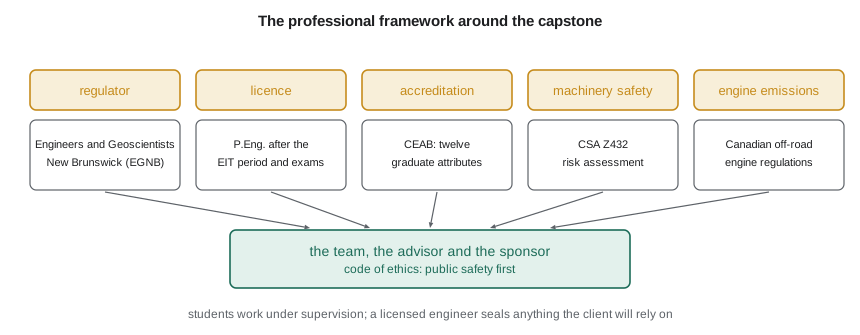
In Canada, engineering is regulated by provincial and territorial bodies under provincial law. In New Brunswick that body is Engineers and Geoscientists New Brunswick, which licenses professional engineers and enforces a code of ethics under its act and by-laws. Practising professional engineering, or using the title professional engineer, without a licence is an offence. The usual path to licensure is a degree from a program accredited by the Canadian Engineering Accreditation Board, a period of supervised experience as an engineer-in-training, typically four years, and a professional practice and ethics examination. Engineers Canada coordinates the accreditation system and publishes the twelve graduate attributes that accredited programs must demonstrate, among them a knowledge base, problem analysis, design, investigation, use of engineering tools, individual and team work, communication, professionalism, impact of engineering on society and the environment, ethics and equity, economics and project management, and lifelong learning.
The capstone maps naturally onto these graduate attributes. The requirements and concept work demonstrate design and problem analysis; the tests demonstrate investigation; the team charter and reviews demonstrate teamwork and communication; the budget and earned value demonstrate project management; and this lesson's material demonstrates ethics, professionalism and the impact of engineering. Professor Leger's assessment rubric is organized around the same twelve graduate attributes, so the team's report deliberately points to the evidence for each.
Intellectual property
Before the project began, the team, the university and Tidewater signed a sponsorship agreement covering intellectual property. Policies vary widely between institutions and sponsors. In this case Tidewater received the right to commercialize the TDX-150 design, the students kept the right to describe their work in portfolios and job interviews, and the university kept the right to use the project for teaching. Kwame's patent search in lesson 3 found no active patents covering the team's separator arrangement, but Tidewater's own patent agent would make that judgment before any product launch. Students should always read such an agreement before signing, and should not assume that work done on a sponsored project belongs to them.
Worked problem
Weighing an emission choice
The cooperative could buy renewable diesel at 2.35 per litre instead of fossil diesel at 1.75. Using the code's figures, what is the cost per tonne of carbon dioxide equivalent avoided?
Show solution
- Annual fuel: 6.79 L/h × 250 h = 1,698 L.
- Extra annual cost: 1,698 × (2.35 − 1.75) = 1,019.
- Annual emissions avoided: 1,698 × (3.2 − 1.0) = 3,735 kg, about 3.7 t.
- Cost per tonne avoided: 1,019 / 3.74 ≈ 270.
Answer: About 270 per tonne avoided, a figure the cooperative can compare with other ways of cutting its emissions.
Intellectual property also flows the other way. The team used published data from engine and hose makers, a standard textbook method for weld fatigue and a figure adapted from Tidewater's test reports. Each is cited in the report, and Tidewater's internal data appear only with Farah's permission. Citing sources is partly about honesty and partly practical: a reader who wants to check a number, or a future engineer who must update it when a supplier changes a product, needs to know where it came from.
Lifelong learning and the next step
In a few months the four team members will start work as engineer-in-trainings or equivalent. None of them will be allowed to seal a drawing for years, and all of them will be expected to keep learning. The capstone's last lesson in professional practice is that a graduate's competence has limits, and that a competent engineer knows where they are. When Farah asked Kwame at the critical design review whether he was confident in his weld fatigue method, his answer, 'I'm confident in the calculation, but I'd like someone who does this regularly to check the detail category', was exactly right. Owen's check found the stress range error described in lesson 6.
Common mistakes
MistakeTreating the use phase as minor because the product is small.
InsteadScreen the life cycle; for fuel-burning machines the use phase usually dominates.
MistakeStaying silent about a misleading claim because it is someone else's document.
InsteadRaise it early, in writing, with evidence, through the proper channel, and propose truthful wording.
MistakeAssuming capstone work belongs to the students.
InsteadRead the sponsorship and intellectual property agreement before starting.
MistakePresenting design competence as unlimited.
InsteadSay clearly what you have verified and ask for review where your experience is thin.
MistakeTreating sustainability as only carbon.
InsteadConsider noise, spills, air quality and who the product serves.
Summary and key terms
- A screening life-cycle assessment found the use phase about 95 per cent of ten-year emissions; renewable diesel cut the total by about two-thirds.
- Efficiency and reduced-speed operation matter more for carbon than the canopy material choice.
- Sustainability also covers noise, spills, air quality, emission rules and fair access to the equipment.
- A brochure claiming an unachieved noise result was corrected after the team raised it in writing with evidence.
- Licensure and accreditation in Canada rest on accredited education, supervised experience, examinations and a code of ethics that puts the public first.
- Sponsorship agreements decide intellectual property; competent engineers know and state the limits of their competence.
- Life-cycle assessment
- Accounting for environmental impacts across a product's whole life.
- Embodied carbon
- Emissions from making a product's materials and parts.
- Use phase
- The part of a product's life when it is operated.
- Renewable diesel
- A hydrotreated vegetable oil fuel usable in most diesel engines.
- Emission factor
- Emissions per unit of fuel, material or activity.
- Code of ethics
- A profession's statement of its members' duties, with public welfare paramount.
- Licensure
- Legal authorization to practise engineering and use a protected title.
- Accreditation
- Independent recognition that an education program meets defined criteria.
- Intellectual property agreement
- A contract deciding who owns and may use the results of a project.
- Duty of honesty
- The obligation to make only truthful and objective professional statements.
Practice problems
Work each problem on paper first, then reveal the answer to check.
A machine burns 5 L/h of diesel at 3.2 kg CO2e per litre for 300 h a year. Find its annual use-phase emissions.
Show answer
4,800 kg, about 4.8 t.
If embodied carbon is 3 t and use is 5 t a year, what share of ten-year emissions is embodied?
Show answer
3 / (3 + 50) ≈ 5.7 per cent.
Why might reduced-speed operation save more carbon than a lighter canopy?
Show answer
Use-phase fuel dominates; cutting power by about 40 per cent for part of every run outweighs the small embodied saving.
List three habits that make it easier to resolve an ethical concern at work.
Show answer
Raise it early; put it in writing with evidence; use the proper channel and propose a truthful alternative.
Name the main steps to licensure in Canada.
Show answer
An accredited degree, supervised experience as an engineer-in-training, a professional practice and ethics exam, and application to the provincial regulator.
Lesson quiz · 5 questions
Score 60% or more to complete this lesson.
Create a free account to save your progress, take quizzes and earn a certificate.