
MEC-440 · Lesson 7 of 12 · 20 min
Solar energy: photovoltaic and solar thermal
The price of solar photovoltaic modules has fallen by roughly 90 percent over the past fifteen years, and solar is now the largest source of new generating capacity in much of the world. Winnipeg is not a sunny place in winter, but its summers are long and bright, and its annual sunshine is better than that of much of Germany, which has built a very large solar industry. Northgate owns a large flat roof on its plant building, several hectares of land beside its yard, and a network that could take solar heat in summer. Tomás has been asked to estimate what solar electricity and solar heat could each contribute, and how well they match the network's needs.
The solar resource
Outside the atmosphere the Sun delivers about 1,361 W/m² on a surface facing it. At the ground on a clear day near noon the irradiance is about 1,000 W/m², the reference value used to rate solar modules. Irradiance has a direct component, the beam from the Sun's disc, and a diffuse component scattered by the sky and clouds; on cloudy days nearly all of it is diffuse. Over a year the energy received depends on latitude, climate and the orientation of the surface. It is measured in kilowatt-hours per square metre per day or per year, and one kilowatt-hour per square metre is the energy of one hour of sunshine at the reference irradiance, which is why the daily value is often called peak-sun hours.
Tilting a surface toward the equator increases the energy it collects. In Winnipeg, at about 50° N, a south-facing surface tilted at roughly the latitude angle collects about 1,600 to 1,750 kWh/m² a year, compared with about 1,300 to 1,400 kWh/m² on a horizontal surface. Steeper tilts favour winter production and shed snow better; flatter tilts favour summer. Single-axis trackers, which turn the modules to follow the Sun from east to west, add 15 to 25 percent more energy at extra cost and are common on large solar farms.
How a photovoltaic cell works
A photovoltaic cell is a semiconductor junction, usually in crystalline silicon. A photon with enough energy frees an electron from its bond, creating an electron and a hole; the electric field at the junction separates them, driving a current through an external circuit. Photons with less energy than silicon's band gap of about 1.1 eV pass through unused, and the extra energy of more energetic photons becomes heat. These two effects limit a single-junction silicon cell to an efficiency of about 30 percent in theory. Commercial modules today convert about 20 to 23 percent of sunlight to electricity at standard test conditions of 1,000 W/m², 25 °C cell temperature and a standard spectrum. A module rated at 400 W under those conditions is said to be 400 Wp, watts peak.
Cell efficiency falls as temperature rises, by about 0.3 to 0.4 percent per kelvin for crystalline silicon. In full sun a module runs 20 to 30 K above the air, so summer output is lower than the rating suggests, while on a cold, bright winter day it can exceed its rating. Bifacial modules, which collect light on both faces, gain extra energy from light reflected off the ground, especially from snow.
From modules to a system
Modules are wired in series strings to reach a voltage suitable for an inverter, which converts their direct current to alternating current synchronized with the grid. The performance ratio of a system is the ratio of its actual energy to the energy its rated modules would produce at the measured irradiance with no losses; it captures temperature effects, inverter efficiency, wiring losses, soiling, shading, mismatch between modules and downtime. Well-designed systems reach performance ratios of 0.80 to 0.88. In snowy climates, snow cover can remove a large share of winter output from modules tilted at shallow angles.
# Solar PV yield by month with a temperature derate, and a flat-plate solar thermal collector
SITE = 'ca'
# Monthly plane-of-array irradiation (kWh/m2 per month, south-facing, tilt about 45 degrees) and mean daytime air temperature (C)
d = {'ca': dict(city='Winnipeg',
                poa=[95, 125, 160, 165, 170, 165, 175, 170, 140, 110, 75, 75],
                tair=[-14, -11, -3, 7, 15, 20, 23, 22, 15, 7, -3, -11]),
     'us': dict(city='Minneapolis',
                poa=[100, 125, 155, 160, 170, 170, 180, 170, 145, 120, 85, 80],
                tair=[-8, -5, 2, 10, 17, 23, 25, 24, 18, 10, 2, -5])}[SITE]
kWp = 1000.0                     # 1 MWp array
gamma = -0.0035                  # power temperature coefficient per K (crystalline silicon)
pr_other = 0.86                  # inverter, wiring, soiling, mismatch, availability
snow = [0.70, 0.80, 0.90, 1, 1, 1, 1, 1, 1, 1, 0.95, 0.75]   # fraction of output kept after snow cover
months = 'Jan Feb Mar Apr May Jun Jul Aug Sep Oct Nov Dec'.split()
tot = 0.0; rows = []
for m in range(12):
    tcell = d['tair'][m] + 25.0               # cell runs about 25 K above air in sun
    ft = 1 + gamma*(tcell - 25.0)
    E = kWp*d['poa'][m]*ft*pr_other*snow[m]/1000   # MWh (irradiation in kWh/m2 = peak-sun hours)
    tot += E; rows.append((months[m], E, ft))
print(f"{d['city']}: 1 MWp south-facing array")
for name, E, ft in rows:
    print(f"  {name}: {E:6.1f} MWh   temperature factor {ft:.3f}")
print(f"Annual yield {tot:,.0f} MWh, specific yield {tot*1000/kWp:,.0f} kWh/kWp, capacity factor {tot/(kWp/1000*8760):.3f}")
print(f"Share produced Nov-Feb (heating season peak): {sum(r[1] for r in rows if r[0] in ('Nov','Dec','Jan','Feb'))/tot*100:.0f} %")
# Flat-plate thermal collector efficiency  eta = eta0 - a1 (Tm - Ta)/G
eta0, a1 = 0.78, 3.8
for Tm, Ta, G in ((40, 20, 800), (60, -10, 600), (75, 20, 800)):
    eta = eta0 - a1*(Tm - Ta)/G
print(f"Collector at mean {Tm} C, air {Ta} C, sun {G} W/m2: efficiency {max(eta,0):.2f}")Winnipeg: 1 MWp south-facing array Jan: 60.0 MWh temperature factor 1.049 Feb: 89.3 MWh temperature factor 1.038 Mar: 125.1 MWh temperature factor 1.010 Apr: 138.4 MWh temperature factor 0.976 May: 138.5 MWh temperature factor 0.948 Jun: 132.0 MWh temperature factor 0.930 Jul: 138.4 MWh temperature factor 0.919 Aug: 134.9 MWh temperature factor 0.923 Sep: 114.1 MWh temperature factor 0.948 Oct: 92.3 MWh temperature factor 0.976 Nov: 61.9 MWh temperature factor 1.010 Dec: 50.2 MWh temperature factor 1.038 Annual yield 1,275 MWh, specific yield 1,275 kWh/kWp, capacity factor 0.146 Share produced Nov-Feb (heating season peak): 21 % Collector at mean 40 C, air 20 C, sun 800 W/m2: efficiency 0.69 Collector at mean 60 C, air -10 C, sun 600 W/m2: efficiency 0.34 Collector at mean 75 C, air 20 C, sun 800 W/m2: efficiency 0.52
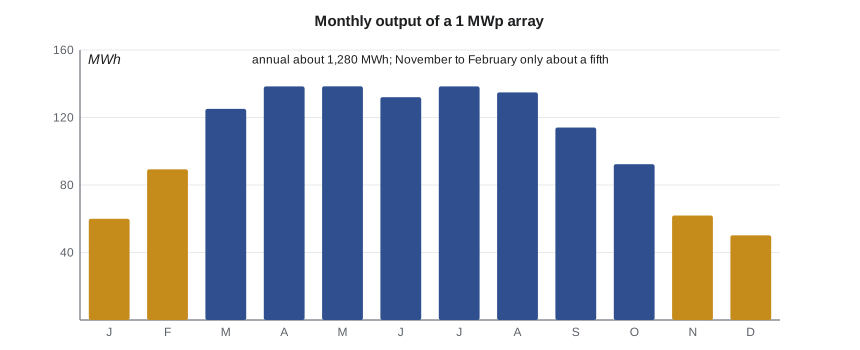
The specific yield of about 1,280 kWh per kilowatt-peak a year, a capacity factor of about 0.15, is typical of the northern plains. A 1 MWp array produces about 1.3 GWh a year, about what a 0.5 MW heat pump uses in 2,600 hours at full load. But the timing is poor for heating: only about a fifth of the output comes in the four darkest months, when Winnipeg's heat demand peaks.
Rooftops, fields and long-term performance
Solar arrays can be mounted on roofs, over parking lots, on the ground or on floating platforms. Rooftop systems use space that has no other value and deliver power at the point of use, but they are smaller, cost more per watt and must respect roof loads, fire access paths and wind uplift. Ground-mounted arrays are cheaper per watt and can use trackers, but they need land, a fence and a grid connection. Some farms now combine solar with grazing or crops beneath raised modules, an approach called agrivoltaics. Over their 25 to 35 year lives, modules lose about 0.3 to 0.7 percent of their output a year, and inverters usually need replacing once or twice. Snow loads, hail and freeze-thaw cycles are the main weather risks in the northern plains, and modules and racking are tested for them. A long-term yield estimate should include degradation, inverter replacement and occasional storm damage as well as the first-year output.
Cost and the value of solar electricity
Large ground-mounted solar farms in North America now cost roughly 1 to 1.5 million per megawatt of alternating-current capacity, and rooftop systems more. Their levelized cost is among the lowest of any new generation in sunny regions and is competitive in the north. The value of solar electricity is a separate question. Because all solar plants in a region produce at the same time, a large amount of solar on a grid depresses prices in sunny hours, and its value per megawatt-hour falls as more is built. Storage, flexible loads and the ability to export restore some of that value.
For Northgate, a solar array on its own land would supply electricity mostly in summer, when its heat pumps run little. Manitoba Hydro buys small amounts of customer generation under net metering rules, but Northgate's electricity is already almost carbon free and cheap, so an array would cut costs only modestly and cut carbon hardly at all.
Solar thermal collectors
Solar thermal collectors turn sunlight directly into heat. A flat-plate collector has a dark absorber plate under a glass cover, with fluid tubes bonded to the plate and insulation behind. Evacuated-tube collectors surround each absorber with a vacuum to cut heat loss and suit higher temperatures and cold climates. The instantaneous efficiency of a collector is often written
where \(\eta_0\) is the optical efficiency, \(a_1\) the heat loss coefficient, \(T_m\) the mean fluid temperature, \(T_a\) the air temperature and \(G\) the irradiance. At low temperature differences a good collector converts 70 to 80 percent of sunlight to heat, far more than a photovoltaic module converts to electricity. At the 60 to 80 °C supply temperatures of a district network in cold weather, efficiency falls sharply.
Large solar thermal fields connected to district heating networks are common in Denmark, where dozens of towns have fields of several hectares, many with large seasonal storage pits that hold summer heat for the autumn. In a fourth-generation network with low return temperatures, a solar field can supply 10 to 20 percent of annual heat, and with seasonal storage up to about half. The field and the storage pit both need land near the network, which Northgate has at its yard. Solar thermal fields compete with photovoltaic arrays driving heat pumps; at high latitudes and with low-temperature networks, the two are often close in cost, and photovoltaics have the advantage that their electricity can be sold when heat is not needed.
Worked problem
Solar heat for the summer load
Northgate's summer heat demand, for domestic hot water and a few process loads, is about 6 MW, and the network supplies 70/40 °C in summer. A flat-plate collector field has \(\eta_0 = 0.78\) and \(a_1 = 3.8\) W/(m² K). On a clear July day with 800 W/m² for about 8 hours and air at 25 °C, how much collector area supplies the full 6 MW at noon, with a mean fluid temperature of 55 °C?
Show solution
- Efficiency: \(\eta = 0.78 - 3.8(55 - 25)/800 = 0.78 - 0.143 = 0.64\).
- Heat per square metre at noon: \(0.64 \times 800 = 510\) W/m².
- Area: \(6 \times 10^6/510 = 11{,}800\) m², about 1.2 hectares of collector, or 2 to 3 hectares of land with spacing.
Answer: About 12,000 m² of collector would meet the summer load at noon, but in the evening and on cloudy days it would supply little, so the field needs a storage tank to be useful. The team records a solar thermal field with storage as an option to study further for the summer load, rather than as part of a main pathway.
The team's conclusion is that solar energy is a modest contributor for a northern heating utility: valuable in summer, cheap per kilowatt-hour, but unable to help on the design day. Its role in the plan is to supply part of the summer heat and electricity and to reduce the hours that other plant must run, not to provide capacity.
Common mistakes
MistakeUsing the module rating as the annual average output.
InsteadUse the specific yield in kWh per kWp, about 1,200 to 1,350 in the northern plains.
MistakeIgnoring module temperature.
InsteadApply the temperature coefficient; hot modules produce less, cold modules more.
MistakeCounting solar capacity toward the winter peak.
InsteadRecognize that solar contributes almost nothing at a winter evening peak.
MistakeComparing solar thermal and photovoltaic efficiencies directly.
InsteadCompare delivered useful heat, including the heat pump's multiplication of photovoltaic electricity.
MistakeForgetting snow and soiling losses.
InsteadAllow for them in the performance ratio, especially at shallow tilts.
Summary and key terms
- Peak irradiance is about 1,000 W/m²; annual irradiation on a tilted surface in the northern plains is about 1,600 to 1,750 kWh/m².
- Commercial silicon modules are 20 to 23 percent efficient at standard test conditions and lose about 0.35 percent per kelvin of temperature rise.
- Systems have performance ratios of about 0.80 to 0.88; specific yield in the study is about 1,280 kWh per kWp.
- Solar output is lowest in winter, when heat demand peaks, so it provides energy but not capacity.
- Solar thermal collectors are 70 to 80 percent efficient at low temperature differences but fall off at network temperatures.
- Large solar thermal fields with storage can supply a share of district heat; photovoltaics with heat pumps are a close competitor.
- Irradiance
- Solar power per unit area, in W/m².
- Irradiation
- Solar energy per unit area over a period, in kWh/m².
- Peak-sun hours
- Daily irradiation expressed as equivalent hours at 1,000 W/m².
- Watt peak
- A module's rated power at standard test conditions.
- Performance ratio
- Actual energy of a system divided by the energy its rated modules would give at the measured irradiance with no losses.
- Temperature coefficient
- Fractional change in module power per kelvin of cell temperature.
- Inverter
- Power electronics that convert direct current from modules to grid alternating current.
- Seasonal storage
- Large heat storage, such as an insulated water pit, that holds summer heat for later months.
Practice problems
Work each problem on paper first, then reveal the answer to check.
A module is 21 percent efficient and has an area of 1.95 m². What is its rating at 1,000 W/m²?
Show answer
About 410 W.
A 2 MWp array has a specific yield of 1,250 kWh/kWp. What is its annual output and capacity factor?
Show answer
2,500 MWh; capacity factor \(2{,}500/(2 \times 8760) = 0.14\).
A module rated 400 W at 25 °C runs at 55 °C with a coefficient of −0.35 percent per kelvin. What is its output at the same irradiance?
Show answer
\(400(1 - 0.0035 \times 30) = 358\) W.
Find the efficiency of a collector with \(\eta_0 = 0.80\), \(a_1 = 3.5\), mean fluid 70 °C, air 0 °C and \(G = 700\) W/m².
Show answer
\(0.80 - 3.5 \times 70/700 = 0.45\).
Why do steeper tilts suit snowy northern climates?
Show answer
They favour low winter sun and shed snow more readily.
Lesson quiz · 5 questions
Score 60% or more to complete this lesson.
Create a free account to save your progress, take quizzes and earn a certificate.