
MEC-440 · Lesson 10 of 12 · 20 min
Hydrogen and fuel cells
Hydrogen appears in almost every discussion of a low-carbon energy system. It can be made from water with electricity, stored, piped and burned without carbon dioxide, or converted back to electricity in a fuel cell. A board member who read about hydrogen boilers in Europe has asked whether Northgate could simply switch its gas boilers to hydrogen by 2040. Elena wants a clear answer grounded in thermodynamics and cost. This lesson covers how hydrogen is made, stored and used, and where it does and does not make sense.
Properties of hydrogen
Hydrogen is the lightest gas, with a density of about 0.084 kg/m³ at 15 °C and atmospheric pressure, about one eighth that of natural gas. Its higher heating value is 141.9 MJ/kg, or 39.4 kWh/kg, and its lower heating value 120 MJ/kg, or 33.3 kWh/kg; the difference is the latent heat of the water formed. By mass it carries almost three times the energy of methane, but by volume it carries only about a third, which is why hydrogen pipelines, compressors and stores must be much larger, or run at much higher pressure, to deliver the same energy. Hydrogen burns over a very wide range of concentrations in air, about 4 to 75 percent, ignites easily and burns with a nearly invisible flame. It diffuses through and embrittles some steels, which matters for pipelines and pressure vessels.
How hydrogen is made
Today almost all hydrogen is made from natural gas by steam methane reforming, in which methane reacts with steam at about 800 to 900 °C over a catalyst to form hydrogen and carbon monoxide, followed by a shift reaction that converts the carbon monoxide to carbon dioxide and more hydrogen. It emits about 9 to 10 kg of carbon dioxide per kilogram of hydrogen. Adding carbon capture to a reforming plant can remove most of that carbon dioxide. Electrolysis splits water into hydrogen and oxygen using electricity and, if the electricity is low carbon, produces low-carbon hydrogen. A colour shorthand is common in policy discussions: grey hydrogen from unabated reforming, blue from reforming with carbon capture, green from electrolysis with renewable electricity. The colours are imprecise; regulations increasingly define hydrogen by its measured life-cycle carbon intensity instead.
Three electrolyser technologies are in use. Alkaline electrolysers, the most mature, use a potassium hydroxide solution and nickel electrodes. Proton exchange membrane electrolysers use a solid polymer membrane and precious metal catalysts; they respond quickly to changing power, which suits variable renewables, and produce hydrogen at higher pressure. Solid oxide electrolysers operate at about 700 to 850 °C and use heat as well as electricity, so they need less electricity per kilogram; they are less mature. Commercial alkaline and membrane electrolysers use about 50 to 55 kWh of electricity per kilogram of hydrogen, including the balance of plant, an efficiency of roughly 70 to 78 percent on the higher heating value.
# Hydrogen: electrolysis energy, cost per kilogram and what a kilowatt-hour can do as heat
SITE = 'ca'
HHV, LHV = 39.4, 33.3            # kWh per kg
cur = 'CAD'
price = {'ca': 0.065, 'us': 0.075}[SITE]     # electricity price for a large customer, per kWh (study assumption)
for name, kwh_kg in (('alkaline', 52.0), ('PEM', 55.0), ('solid oxide (electricity only)', 40.0)):
    print(f"{name:31s}: {kwh_kg:.0f} kWh/kg -> efficiency {HHV/kwh_kg*100:4.1f} % (HHV), {LHV/kwh_kg*100:4.1f} % (LHV)")
kwh_kg = 53.0
capex_kg = 1.40                  # capital, operation and water per kg at a high utilization (study assumption)
cost = kwh_kg*price + capex_kg
print(f"\nElectricity {price:.3f} {cur}/kWh x {kwh_kg:.0f} kWh/kg = {kwh_kg*price:.2f}; plus {capex_kg:.2f} other -> {cost:.2f} {cur}/kg")
print(f"Cost per MWh of hydrogen (HHV): {cost/HHV*1000:.0f} {cur}")
# Heat delivered to the network from 1 kWh of electricity, three ways
eta_boiler_h2 = 0.92              # condensing hydrogen boiler on HHV
heat_h2 = (HHV/kwh_kg)*eta_boiler_h2
heat_eboiler = 0.99
cop = 3.0
print(f"\nHeat to the network per kWh of electricity:")
print(f"  electrolysis + hydrogen boiler : {heat_h2:.2f} kWh")
print(f"  electric boiler                : {heat_eboiler:.2f} kWh")
print(f"  heat pump at COP {cop:.1f}          : {cop:.2f} kWh")
# Fuel cell for backup power: hydrogen used per MWh of electricity
eta_fc = 0.50
print(f"\nPEM fuel cell at {eta_fc*100:.0f} % (LHV): {1000/(LHV*eta_fc):.0f} kg H2 per MWh; round trip power-to-power {LHV/kwh_kg*eta_fc*100:.0f} %")
# Storage volume
for name, dens in (('gas at 350 bar', 24.0), ('gas at 700 bar', 40.0), ('liquid at -253 C', 71.0)):
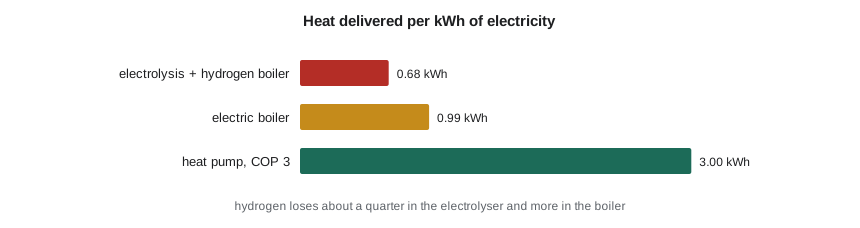
print(f" {name:18s}: {dens:.0f} kg/m3 -> {1000/dens:5.1f} m3 per tonne")alkaline : 52 kWh/kg -> efficiency 75.8 % (HHV), 64.0 % (LHV) PEM : 55 kWh/kg -> efficiency 71.6 % (HHV), 60.5 % (LHV) solid oxide (electricity only) : 40 kWh/kg -> efficiency 98.5 % (HHV), 83.2 % (LHV) Electricity 0.065 CAD/kWh x 53 kWh/kg = 3.45; plus 1.40 other -> 4.85 CAD/kg Cost per MWh of hydrogen (HHV): 123 CAD Heat to the network per kWh of electricity: electrolysis + hydrogen boiler : 0.68 kWh electric boiler : 0.99 kWh heat pump at COP 3.0 : 3.00 kWh PEM fuel cell at 50 % (LHV): 60 kg H2 per MWh; round trip power-to-power 31 % gas at 350 bar : 24 kg/m3 -> 41.7 m3 per tonne gas at 700 bar : 40 kg/m3 -> 25.0 m3 per tonne liquid at -253 C : 71 kg/m3 -> 14.1 m3 per tonne
Storage and transport
Because of its low volumetric energy density, hydrogen must be compressed, liquefied or chemically bound to be stored in useful quantities. Compressed gas at 350 to 700 bar, used in vehicles, holds about 24 to 40 kg/m³; compressing it from atmospheric pressure takes about 2 to 3 kWh/kg, a few percent of its energy. Liquid hydrogen at −253 °C holds about 71 kg/m³ but takes about 10 to 13 kWh/kg to liquefy, a third of its energy, and boils off slowly. Large quantities can be stored in salt caverns, as at a few sites in the US Gulf Coast and in Europe. Hydrogen can also be converted to ammonia, which is easier to ship but must be cracked back to hydrogen or burned directly.
Existing natural gas networks can accept limited blends of hydrogen, typically up to about 5 to 20 percent by volume depending on the pipe materials, appliances and meters. Beyond that, pipelines, compressors, meters, burners and seals need replacement. As lesson 3 showed, a 20 percent blend by volume replaces only about 7 percent of the energy, so blending does little for carbon.
Fuel cells
A fuel cell converts the chemical energy of hydrogen directly into electricity by reacting it with oxygen across an electrolyte, without combustion. Proton exchange membrane fuel cells, used in vehicles and backup power, run at about 80 °C and reach about 50 to 60 percent electrical efficiency on the lower heating value. Solid oxide fuel cells run at 600 to 800 °C, can use natural gas or hydrogen, and reach about 55 to 65 percent; their hot exhaust can provide heat. Fuel cells are quiet, have no moving parts in the stack, and keep their efficiency at part load, which makes them attractive for backup power and for some cogeneration applications.
The round trip from electricity to hydrogen and back is poor. With a 74 percent electrolyser on the higher heating value, compression and a 50 percent fuel cell on the lower heating value, only about 30 percent of the original electricity returns. That is far below a battery's 85 to 90 percent, though hydrogen can be stored for months in a way batteries cannot. Hydrogen's niche in power systems is therefore long-duration storage for rare events, such as a week of cold, calm weather, rather than daily cycling.
Hydrogen for heat
The central question for Northgate is whether to burn hydrogen in its boilers. Thermodynamics gives a clear answer. One kilowatt-hour of electricity produces about 0.74 kWh of hydrogen (higher heating value) in an electrolyser, and a condensing hydrogen boiler turns that into about 0.68 kWh of heat. The same kilowatt-hour in an electric boiler gives 0.99 kWh of heat, and in a heat pump with a coefficient of performance of 3, it gives 3 kWh. Heating with electrolytic hydrogen therefore needs about four to five times as much electricity as heating with heat pumps. Studies in several countries have reached the same conclusion: hydrogen is better reserved for uses that cannot easily be electrified, such as ammonia and steel production, refining, some heavy transport, and perhaps seasonal backup for the power system.
Cost reinforces the point. At Manitoba industrial electricity prices, electrolytic hydrogen in the study costs about 4.85 per kilogram, or about 123 per megawatt-hour of fuel, three to four times the price Northgate pays for natural gas on the same energy basis. Policy can narrow that gap: Canada offers a clean hydrogen investment tax credit of up to 40 percent of eligible capital costs, depending on the carbon intensity of the hydrogen produced. Even with support, hydrogen cannot match the efficiency of a heat pump for low-temperature heat.
Worked problem
Electricity needed to heat Northgate with hydrogen
Northgate delivers 210 GWh of heat a year. Compare the electricity needed if all of it came from (a) electrolytic hydrogen at 53 kWh/kg burned in boilers at 92 percent on the higher heating value, (b) electric boilers at 99 percent, and (c) heat pumps with a seasonal coefficient of performance of 3.0.
Show solution
- (a) Hydrogen needed: \(210 \times 10^6/(39.4 \times 0.92) = 5.79 \times 10^6\) kg. Electricity: \(5.79 \times 10^6 \times 53 = 307\) GWh.
- (b) \(210/0.99 = 212\) GWh.
- (c) \(210/3.0 = 70\) GWh.
Answer: Hydrogen would need about 307 GWh of electricity, more than four times the 70 GWh for heat pumps. The board's question is answered: converting the boilers to hydrogen is technically possible but would waste most of the electricity, and the team drops it from the pathways.
The team keeps one possible role for hydrogen in the record: if a regional hydrogen network develops for industry, a small amount could fuel peaking boilers for the few hours a year when nothing else is available. That is the same role the team assigned to renewable natural gas in lesson 8, and the two will compete on price.
Where hydrogen makes sense
The case for low-carbon hydrogen is strongest where it replaces hydrogen already made from fossil fuels, in oil refining and the production of ammonia for fertilizer, and where there is no practical electric alternative: steelmaking by direct reduction of iron ore, some high-temperature industrial heat, long-haul shipping using ammonia or methanol made from hydrogen, and perhaps aviation fuels. Governments in both countries have supported regional hydrogen hubs that cluster producers and users near pipelines and storage, so that the expensive infrastructure is shared. For buildings and district heating, the alternatives of heat pumps, thermal storage and electric boilers are cheaper and more efficient, and most independent studies place heating near the bottom of the list of sensible uses. A district energy utility should watch the regional hydrogen market, because it may one day offer a backup fuel for peaking plant, but it should not plan its main heat supply around it.
Safety
Hydrogen's safety issues differ from those of natural gas rather than being simply worse. It disperses upward quickly in open air, which helps outdoors, but it leaks more readily through small gaps, ignites with very little energy and burns with a flame that is hard to see in daylight. Indoors it can accumulate under ceilings. Hydrogen systems therefore need ventilation at high points, hydrogen detectors, flame detectors that work in ultraviolet or infrared, materials chosen to resist embrittlement, and hazardous-area electrical classification. Codes for hydrogen installations exist in both countries and are developing quickly as projects multiply.
Common mistakes
MistakeComparing hydrogen and natural gas by mass.
InsteadCompare by energy, and remember that hydrogen has a third of methane's energy per unit volume.
MistakeAssuming a hydrogen blend cuts carbon in proportion to its volume share.
InsteadUse the energy share, which is about a third of the volume share.
MistakeIgnoring the electricity cost of electrolysis.
InsteadCount 50 to 55 kWh per kilogram plus compression and storage.
MistakeTreating hydrogen as an efficient heating fuel.
InsteadCompare heat per kilowatt-hour of electricity; heat pumps deliver four to five times more.
MistakeCalling hydrogen green, blue or grey without data.
InsteadState its measured life-cycle carbon intensity.
Summary and key terms
- Hydrogen has 39.4 kWh/kg on the higher heating value but only about a third of methane's energy per unit volume.
- Most hydrogen today comes from steam methane reforming; electrolysers use about 50 to 55 kWh per kilogram.
- Storage requires high pressure, liquefaction or chemical carriers, each with energy costs.
- Fuel cells convert hydrogen to electricity at about 50 to 65 percent efficiency; the electricity-to-electricity round trip is about 30 percent.
- For low-temperature heat, electrolytic hydrogen needs four to five times the electricity of heat pumps.
- Hydrogen is best kept for hard-to-electrify uses and perhaps long-duration backup.
- Steam methane reforming
- Production of hydrogen by reacting methane with steam over a catalyst.
- Electrolyser
- A device that splits water into hydrogen and oxygen using electricity.
- Proton exchange membrane
- A solid polymer electrolyte that conducts protons, used in some electrolysers and fuel cells.
- Solid oxide cell
- A high-temperature electrochemical cell with a ceramic electrolyte, used as an electrolyser or fuel cell.
- Fuel cell
- A device that converts the chemical energy of a fuel directly to electricity.
- Round-trip efficiency
- Energy recovered from storage divided by energy put in.
- Hydrogen embrittlement
- Loss of ductility in some metals caused by absorbed hydrogen.
- Carbon intensity
- Life-cycle greenhouse gas emissions per unit of fuel produced.
Practice problems
Work each problem on paper first, then reveal the answer to check.
An electrolyser uses 55 kWh/kg. What is its efficiency on the higher heating value?
Show answer
\(39.4/55 = 0.72\).
How much hydrogen does a 10 MW electrolyser at 52 kWh/kg make in 6,000 hours?
Show answer
\(10{,}000 \times 6{,}000/52 = 1.15 \times 10^6\) kg, about 1,150 t.
A fuel cell is 55 percent efficient on the lower heating value. How much hydrogen does it use per MWh?
Show answer
\(1{,}000/(33.3 \times 0.55) = 55\) kg.
What volume holds 1 t of hydrogen at 700 bar (about 40 kg/m³)?
Show answer
About 25 m³.
Why might hydrogen still be useful in a power system dominated by wind and solar?
Show answer
It can store energy for weeks or months to cover long periods of low wind and sun, which batteries cannot do economically.
Lesson quiz · 5 questions
Score 60% or more to complete this lesson.
Create a free account to save your progress, take quizzes and earn a certificate.