
MEC-430 · Lesson 9 of 12 · 21 min
Central plants, heat recovery and heat pumps
The health centre's design assumes a district connection, but a good basis of design shows that the alternatives were considered. The hospital's board asked the obvious question at the first presentation: would the building be better off with its own plant? This lesson compares the district connection with two on-site alternatives, condensing boilers with an air-cooled chiller and ground-source heat pumps with a heat recovery chiller, on purchased energy and carbon. Cost follows in Lesson 12. MEC-440 treats power and energy conversion plants in depth; here the treatment is limited to what a building designer needs to choose and size a plant.
Boilers and chillers
The traditional building plant has boilers for heat and chillers for cooling. Condensing gas boilers reach seasonal efficiencies above 90 percent only when their return water is cool enough, below about 55 °C, to condense the water vapour in the flue gas, which MEC-340 showed is a condensing economizer's job at district scale. A building designed for 55/40 °C heating suits them. Chillers are rated by their coefficient of performance or, in North America, by kilowatts of electricity per ton of cooling. An air-cooled chiller rejects heat to outdoor air through condenser fans and has a seasonal COP of perhaps 3.5 to 4.5; a water-cooled chiller with a cooling tower does better, with a seasonal COP of 5 to 7 or more, at the cost of tower maintenance and water treatment. AHRI rating standards define full-load and integrated part-load values, and energy codes set minimum efficiencies for each type and size.
Heat pumps
A heat pump is a refrigeration machine used for its condenser heat. Its heating COP is the heat delivered divided by the work input, and it is bounded by the Carnot value, which depends on the temperatures of the source and the sink:
with temperatures in kelvin. Lifting heat from a 0 °C ground loop to 55 °C heating water gives a Carnot COP of about 6.0, and real machines achieve a little over half that, about 3.2. Lifting it to 82 °C would drop the Carnot COP to about 4.3 and the real COP to about 2.2. That is the thermodynamic reason the health centre's heating water was set at 55 °C: every degree saved on the sink side raises the COP of any heat pump the building or the district might use, now or later.
The heat source matters as much. Air-source heat pumps use outdoor air, which in a Prairie winter is coldest exactly when heat is most needed; cold-climate units now work well to −25 °C or below, but their capacity and COP fall as it gets colder. Ground-source heat pumps use a field of vertical boreholes, typically 100 to 200 m deep, in which a water or glycol loop exchanges heat with the ground, whose temperature at depth stays near the annual mean air temperature. The ground is a better source in winter and a better sink in summer, but the boreholes are expensive and the field must be designed so that its long-term temperature stays within limits, which depends on the balance between the heat extracted in winter and the heat rejected in summer.
Heat recovery
A building with simultaneous heating and cooling, like a clinic in winter, is throwing heat away from its interior zones while buying heat for its perimeter. A heat recovery chiller, or a heat pump that serves both loops at once, takes the heat it removes from the chilled water and delivers it, plus its compressor work, to the heating water. When both loads are present it produces two useful outputs for one input, and its combined COP, heating plus cooling divided by work, can exceed 7. The imaging suite's magnetic resonance equipment, which needs cooling all year, is an especially good heat source.
Sizing and redundancy
Whatever the plant, it must be sized and arranged for reliability. A single boiler or chiller is a single point of failure; the usual arrangement is two or three units sized so that the building can still be heated, though perhaps not at the full design load, with one out of service. Health care standards are explicit about this for heating: the plant serving patient areas must continue to provide heat with the largest unit out of service. Units are also staged so that each runs near its most efficient load for as many hours as possible; two boilers of 60 percent of the load each, or three of 40 percent, are common choices, and modern condensing boilers are most efficient at low fire, which makes running two at part load better than one at full load.
Thermal storage changes the arithmetic. A chilled water or ice store charged at night can cut a chiller's peak capacity, and a hot water store can let a heat pump run steadily while the building's load swings. District systems are the extreme case: Northgate's plant serves dozens of buildings whose peaks do not coincide, and its storage and diversity let it install far less capacity than the sum of its customers' individual plants would need. That diversity is part of what the district connection offers the health centre, and it is why the energy transfer station is sized for the building's block load but Northgate's plant is not sized for the sum of block loads.
# Plant options for the health centre: purchased energy and carbon over a year (study assumptions)
SITE = 'ca'
d = {'ca': dict(heat=235.0, cool=187.0, grid=0.002, gname='Manitoba hydro grid'),
     'us': dict(heat=146.0, cool=255.0, grid=0.40, gname='regional grid average')}[SITE]
gas, dh_ef, dc_kwe = 0.181, 0.20, 0.19              # kg CO2e/kWh gas; kg/kWh district heat delivered; kWh electricity per kWh district cooling
heat, cool = d['heat'], d['cool']                   # MWh/yr space heating and cooling delivered to the building
options = {}
options['1 district heat + district cooling'] = dict(e_elec=cool*dc_kwe, e_gas=0, co2=heat*dh_ef + cool*dc_kwe*d['grid'], note='utility plant')
options['2 condensing boilers + air-cooled chiller'] = dict(e_elec=cool/4.0, e_gas=heat/0.90, co2=heat/0.90*gas + cool/4.0*d['grid'], note='on site')
cop_h, cop_c = 3.2, 5.0
options['3 ground-source heat pumps'] = dict(e_elec=heat/cop_h + cool/cop_c, e_gas=0, co2=(heat/cop_h + cool/cop_c)*d['grid'], note='on site')
# heat recovery chiller: interior zones need about 60 kW of cooling for 1,800 occupied winter hours
winter_cool = 60*1800/1000                          # MWh of cooling the heat recovery chiller handles
rec = winter_cool*(1 + 1/4.5)                       # heat delivered: cooling plus compressor work, upper bound
e4 = (heat - min(rec, heat))/cop_h + (cool - winter_cool)/cop_c + winter_cool/4.5
options['4 option 3 with a heat recovery chiller'] = dict(e_elec=e4, e_gas=0, co2=e4*d['grid'], note='on site')
print(f"{SITE.upper()} grid assumption: {d['grid']} kg CO2e/kWh ({d['gname']}); heating {heat:.0f} MWh, cooling {cool:.0f} MWh delivered")
print("Option                                       electricity MWh   gas MWh   CO2e t/yr")
for n, o in options.items():
    print(f"{n:44s} {o['e_elec']:9.0f}        {o['e_gas']:6.0f}    {o['co2']/1:8.1f}")
print(f"Heat recovered by the heat recovery chiller: {rec:.0f} MWh/yr ({100*rec/heat:.0f} % of space heating)")
# Borefield for option 3: peak heat extraction and a rule-of-thumb 35 W per metre of bore
peak_heat = {'ca': 222, 'us': 195}[SITE]
extract = peak_heat*(1 - 1/cop_h)
L = extract*1000/35
print(f"Borefield: peak extraction {extract:.0f} kW -> about {L:,.0f} m of bore, e.g. {L/150:.0f} holes 150 m deep (screening only)")
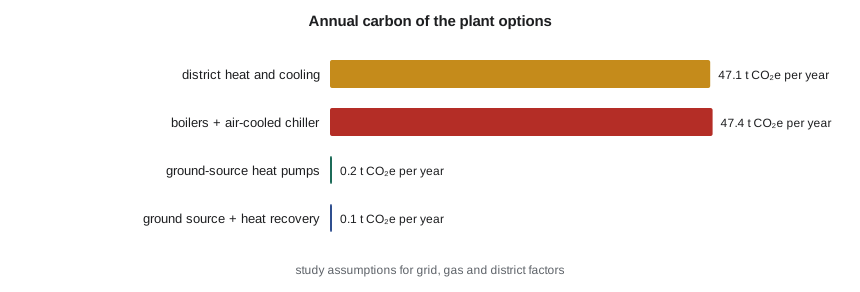
print(f"Annual ground balance: heat extracted {heat*(1 - 1/cop_h):.0f} MWh, heat rejected {cool*(1 + 1/cop_c):.0f} MWh")CA grid assumption: 0.002 kg CO2e/kWh (Manitoba hydro grid); heating 235 MWh, cooling 187 MWh delivered Option electricity MWh gas MWh CO2e t/yr 1 district heat + district cooling 36 0 47.1 2 condensing boilers + air-cooled chiller 47 261 47.4 3 ground-source heat pumps 111 0 0.2 4 option 3 with a heat recovery chiller 72 0 0.1 Heat recovered by the heat recovery chiller: 132 MWh/yr (56 % of space heating) Borefield: peak extraction 153 kW -> about 4,361 m of bore, e.g. 29 holes 150 m deep (screening only) Annual ground balance: heat extracted 162 MWh, heat rejected 224 MWh
Comparing the options
The program uses the annual heating and cooling energy from Lesson 11's simulation and a set of study assumptions: a district heat emission factor of 0.20 kg CO₂e per kWh delivered, reflecting Northgate's present mix of gas boilers and heat recovery; natural gas at 0.181 kg/kWh; and an electricity grid factor of 0.002 kg/kWh for Manitoba's grid, which is almost entirely hydroelectric. All of these factors are assumptions for the study and would be replaced with the latest published values in a real report.
The results differ sharply between the two countries. In Winnipeg, where electricity is almost carbon free, any option that heats with electricity is almost carbon free too. The ground-source options emit essentially nothing, while the district connection and the gas boilers both emit about 47 tonnes a year, because Northgate's heat today comes mostly from gas. The heat recovery chiller cuts the ground-source option's electricity from 111 to 72 MWh a year, because it supplies more than half the building's heating from heat that would otherwise be rejected. The district factor is not fixed either: Northgate's plan to add large heat pumps and recover heat from its own cooling plant will lower it, and the building benefits without any change of its own.
Borefield screening
For the ground-source options, the program makes a screening estimate of the borefield using a rule-of-thumb extraction rate of 35 W per metre of bore. The peak extraction, the heating load minus the compressor work, is about 153 kW, which suggests about 4,400 m of bore, some 26 to 29 holes 150 m deep. That would fill much of the site's parking area. The annual balance matters as much as the peak. In Winnipeg's climate the building extracts about 162 MWh a year and rejects about 224 MWh, a reasonably balanced field. A real design uses a thermal response test on site and borefield simulation software over a 20- to 50-year horizon.
Why the district connection was chosen
The board's question deserves a clear answer, and the basis of design gives it. The district connection needs no boiler room, no chiller, no cooling tower and no borefield, only a 35 m² energy transfer station room, which frees about 75 m² of ground-floor space for clinical use and the whole roof for the DOAS units. It gives the building the reliability of Northgate's redundant plant. Its carbon today is similar to gas boilers, but it falls as Northgate decarbonizes, and the building has been designed, with low heating water temperatures and a high chilled water temperature difference, to make that decarbonization easier. The ground-source option has the lowest emissions, decisively so where the grid is clean, and the report records it as the alternative if the district connection could not be made. Lesson 12 adds the costs.
| Option | Plant space in the building | Carbon (study assumptions) | Main risk |
|---|---|---|---|
| District heat and cooling | energy transfer station only | moderate, falling as the utility changes | service agreement terms |
| Boilers and air-cooled chiller | boiler room and roof chiller | moderate, fixed by gas | future carbon costs |
| Ground-source heat pumps | heat pump room, borefield under parking | lowest where the grid is clean | borefield cost and balance |
| Ground source with heat recovery | as above, plus heat recovery chiller | lowest | complexity of controls |
Worked problem
Heat pump COP at two sink temperatures
A heat pump takes heat from a ground loop at 2 °C. Estimate its heating COP when delivering water at 55 °C and at 70 °C, assuming it achieves half the Carnot value.
Show solution
- At 55 °C: \(T_{\text{sink}} = 328.15\) K, \(T_{\text{source}} = 275.15\) K; Carnot COP \(= 328.15/53 = 6.19\); real COP about 3.1.
- At 70 °C: \(T_{\text{sink}} = 343.15\) K; Carnot COP \(= 343.15/68 = 5.05\); real COP about 2.5.
Answer: Raising the delivery temperature by 15 K cuts the COP by about a fifth, which increases electricity use by about a quarter for the same heat.
Common mistakes
MistakeComparing plant options on energy alone.
InsteadCompare energy, carbon, space, reliability and life-cycle cost, with stated assumptions.
MistakeUsing a single grid emission factor everywhere.
InsteadUse the factor for the site's grid and test how it may change.
MistakeSizing a borefield from the peak load alone.
InsteadCheck the annual balance of extraction and rejection over decades.
MistakeDesigning high-temperature heating and expecting heat pumps to perform well later.
InsteadDesign for the lowest practical heating water temperature.
MistakeIgnoring simultaneous heating and cooling.
InsteadLook for heat recovery between interior and perimeter loads.
Summary and key terms
- Condensing boilers need cool returns; chillers are rated by COP or kW per ton, full and part load.
- Heat pump COP is about half the Carnot value and falls as the sink temperature rises.
- Ground-source fields must be sized for peak and for the long-term annual balance.
- Heat recovery chillers serve simultaneous heating and cooling with a combined COP above 7.
- Carbon results depend strongly on the grid: near zero for electric options on Manitoba's grid.
- The district connection was chosen for space, reliability and its decarbonization path.
- Coefficient of performance
- The ratio of useful heating or cooling delivered to the work input.
- Heat recovery chiller
- A chiller whose condenser heat is delivered to a heating loop rather than rejected.
- Ground-source heat pump
- A heat pump that exchanges heat with the ground through buried pipe loops.
- Borefield
- A group of vertical boreholes containing ground heat exchanger loops.
- Emission factor
- The mass of greenhouse gas emitted per unit of energy supplied.
- Condensing boiler
- A boiler that recovers latent heat by condensing water vapour from its flue gas.
- Integrated part-load value
- A single figure describing chiller efficiency weighted over typical part-load conditions.
- Thermal response test
- An on-site test that measures the ground's thermal properties for borefield design.
Practice problems
Work each problem on paper first, then reveal the answer to check.
Find the Carnot heating COP for a source at 0 °C and a sink at 45 °C.
Show answer
\(318.15/45 = 7.07\).
A chiller uses 0.6 kW per ton. What is its COP?
Show answer
\(3.517/0.6 = 5.86\).
A heat recovery chiller removes 60 kW from the chilled water with a COP of 4.5 in cooling. How much heat does it deliver?
Show answer
\(60 \times (1 + 1/4.5) = 73\) kW.
In the program, what happens to the district option's carbon if Northgate's heat factor falls to 0.05 kg/kWh?
Show answer
District heat emissions fall by three quarters, to about 12 tonnes plus the small cooling share, making it one of the lowest options.
Why does a cooling-dominated building need a larger borefield?
Show answer
Net heat rejection warms the ground year after year, so more bore is needed to keep loop temperatures acceptable.
Lesson quiz · 5 questions
Score 60% or more to complete this lesson.
Create a free account to save your progress, take quizzes and earn a certificate.