
MEC-370 · Lesson 3 of 12 · 26 min
Potential flow and superposition
The first project on Hana's list is a new raw-water intake on the Qu'Appelle River. The existing intake draws from the bank through a short channel, and frazil ice and floating debris collect at its mouth every winter. The proposed design moves the intake into the main current, where a vertical cylindrical screen will draw water from all directions. Before the consultant's detailed model, Hana wants a quick estimate of how the intake affects the river flow around it: how far the intake's influence reaches, where the dividing streamline lies between water that enters the intake and water that passes by, and what velocities a fish or an ice floe would feel near it. Potential flow, built by adding simple flows together, gives those estimates in an afternoon.
When the flow is irrotational
Lesson 1 showed that viscosity creates vorticity at walls. Far from walls, in a stream that approaches as a uniform flow, the vorticity stays close to zero. Such a flow is irrotational: \(\nabla \times \mathbf{V} = 0\). A vector field with zero curl is the gradient of a scalar, so the velocity can be written as the gradient of a velocity potential φ:
Substituting into the incompressible continuity equation gives Laplace's equation, \(\nabla^2 \phi = 0\). This is a linear equation, unlike the full Navier-Stokes equations, and that linearity is the key: if two potentials each satisfy Laplace's equation, so does their sum. Complicated flows can therefore be built by superposing simple ones. Once the velocity field is known, the pressure follows from Bernoulli's equation, which in irrotational flow applies between any two points.
In two-dimensional incompressible flow there is also a stream function ψ, defined so that continuity is satisfied automatically: \(u = \partial\psi/\partial y\) and \(v = -\partial\psi/\partial x\). Lines of constant ψ are streamlines, and the difference in ψ between two streamlines equals the flow rate per unit depth between them. In irrotational flow ψ also satisfies Laplace's equation, and lines of constant φ and constant ψ cross at right angles, forming a flow net like the ones used for seepage under dams. In fact groundwater flow through porous soil obeys Darcy's law, which makes the seepage velocity the gradient of a potential, so the same mathematics describes flow toward a well.
Elementary flows
Four building blocks generate most useful potential flows. In polar coordinates (r, θ):
| Flow | Velocity potential φ | Stream function ψ | Velocity |
|---|---|---|---|
| Uniform stream U in +x | \(U r\cos\theta\) | \(U r\sin\theta\) | \(u = U\) |
| Source (m > 0) or sink (m < 0) | \(\frac{m}{2\pi}\ln r\) | \(\frac{m}{2\pi}\theta\) | \(V_r = \frac{m}{2\pi r}\) |
| Free vortex, circulation Γ | \(\frac{\Gamma}{2\pi}\theta\) | \(-\frac{\Gamma}{2\pi}\ln r\) | \(V_\theta = \frac{\Gamma}{2\pi r}\) |
| Doublet, strength K | \(\frac{K\cos\theta}{r}\) | \(-\frac{K\sin\theta}{r}\) | Source and sink merged |
The free vortex deserves a comment. Its streamlines are circles, yet it is irrotational everywhere except at its centre: particles travel around the centre without spinning about their own axes, like the cars of a Ferris wheel. The swirl in a pump's volute, the whirlpool over a drain and the outer part of a tornado approximate free vortices, with the speed rising as the radius falls. At the centre the speed would be infinite, so real vortices have a viscous core that rotates like a solid body.
A sink in a uniform stream: the intake
Seen from above and averaged over the depth, the river is a uniform stream U and the intake screen, drawing water from the full depth, is a two-dimensional sink of strength m = Q/h, where h is the depth. Superposing them gives:
Along the axis downstream of the intake, the sink's inflow opposes the stream, and there is a stagnation point where the two cancel, at a distance \(x_s = m/(2\pi U)\) downstream. The streamline through the stagnation point divides the fluid that enters the intake from the fluid that passes by. Far upstream that dividing streamline is a distance m/(2U) from the axis on each side, so the intake captures a strip of width m/U, exactly as continuity requires: the strip carries U × (m/U) = m per unit depth.
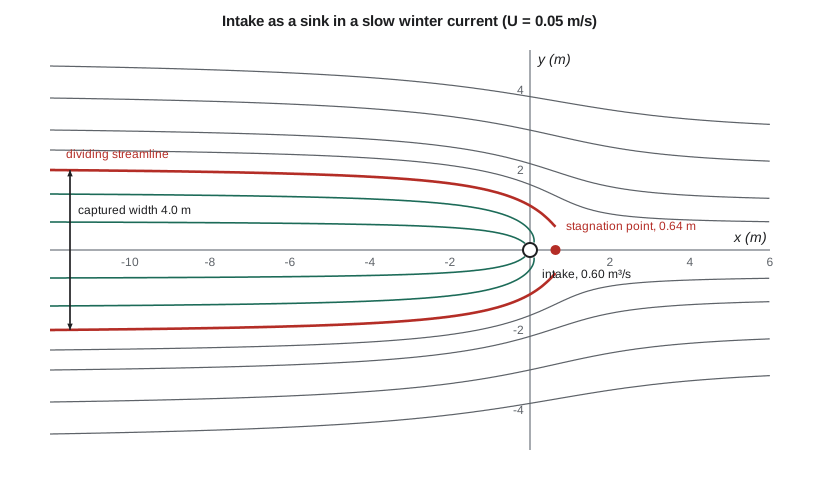
The program evaluates the model for the intake's design withdrawal of 0.60 m³/s in 3.0 m of water, which is a sink strength of 0.20 m² per second, in two currents: the normal 0.30 m/s and a slow 0.05 m/s current under winter ice.
# Potential flow by superposition: a river intake as a sink in a uniform stream,
# and flow past a circular pier as uniform flow plus a doublet
import math
Q = 0.60          # intake withdrawal, m3/s
h = 3.0           # river depth at the intake, m (depth-averaged, two-dimensional model)
m = Q / h         # sink strength per unit depth, m2/s
def psi(x, y, U):
    return U * y - m / (2 * math.pi) * math.atan2(y, x)
for U in (0.30, 0.05):            # summer current and a slow winter current under ice, m/s
    x_s = m / (2 * math.pi * U)   # stagnation point downstream of the sink
    width = m / U                 # width of the captured stream far upstream
    print(f"Current {U:.2f} m/s: sink strength {m:.2f} m2/s, stagnation point {x_s:.2f} m downstream")
    print(f"  capture zone width far upstream {width:.2f} m; psi on the dividing streamline {psi(-1e6, width/2, U):.3f} m2/s")
    for x in (-20, -5, -2, -1):
        u = U - m / (2 * math.pi * x)   # along the bank line upstream, the sink adds speed toward the intake
        print(f"    x = {x:>4} m: u = {u:.3f} m/s")

# Circular bridge pier, diameter 1.2 m, in the 0.30 m/s current: surface speed and pressure coefficient
a = 0.6
U = 0.30
print("\nPier surface (potential flow): theta, u_theta/U, Cp")
for deg in (0, 30, 60, 90, 120, 150, 180):
    th = math.radians(deg)
    ut = 2 * math.sin(th)
    print(f"  {deg:>3} deg: {ut:5.2f}  {1 - ut**2:6.2f}")
# Adding circulation (a vortex) gives lift: the Kutta-Joukowski theorem L' = rho U Gamma
rho = 998.0
Gamma = 2.0                       # m2/s, an illustrative circulation
print(f"With circulation {Gamma} m2/s: lift per metre {rho*U*Gamma:.0f} N/m, stagnation angle {math.degrees(math.asin(Gamma/(4*math.pi*U*a))):.1f} deg")Current 0.30 m/s: sink strength 0.20 m2/s, stagnation point 0.11 m downstream
capture zone width far upstream 0.67 m; psi on the dividing streamline 0.000 m2/s
x = -20 m: u = 0.302 m/s
x = -5 m: u = 0.306 m/s
x = -2 m: u = 0.316 m/s
x = -1 m: u = 0.332 m/s
Current 0.05 m/s: sink strength 0.20 m2/s, stagnation point 0.64 m downstream
capture zone width far upstream 4.00 m; psi on the dividing streamline 0.000 m2/s
x = -20 m: u = 0.052 m/s
x = -5 m: u = 0.056 m/s
x = -2 m: u = 0.066 m/s
x = -1 m: u = 0.082 m/s
Pier surface (potential flow): theta, u_theta/U, Cp
0 deg: 0.00 1.00
30 deg: 1.00 0.00
60 deg: 1.73 -2.00
90 deg: 2.00 -3.00
120 deg: 1.73 -2.00
150 deg: 1.00 0.00
180 deg: 0.00 1.00
With circulation 2.0 m2/s: lift per metre 599 N/m, stagnation angle 62.2 degIn the normal current the intake's influence is tiny: it captures a strip only 0.67 m wide, and the river speed changes by less than 1 percent a few metres upstream. In the slow winter current the captured strip is 4 m wide and the stagnation point moves 0.64 m downstream. The model says that the intake will draw from a wider band in winter, which matters for two reasons. Frazil ice and floating debris within that band will be carried to the screen, and the screen's approach velocity must stay low enough for fish to escape. Fish screen guidelines limit the approach velocity at the screen face, often to about 0.1 m/s or less for small fish, so the screen's surface area is chosen from that limit, not from the river current.
In Canada, intake screens on fish-bearing waters are reviewed under the federal Fisheries Act, and Fisheries and Oceans Canada publishes interim code of practice guidance on end-of-pipe fish screens that relates screen area to withdrawal and fish size. The consultant will size the Wascana Valley Water screen to that guidance and the province's water rights licence.
Flow past a cylinder: uniform flow plus a doublet
A doublet, the limit of a source and a sink brought together while their strength grows, combined with a uniform stream, produces the flow around a circular cylinder of radius \(a = \sqrt{K/U}\). On the cylinder surface the speed is:
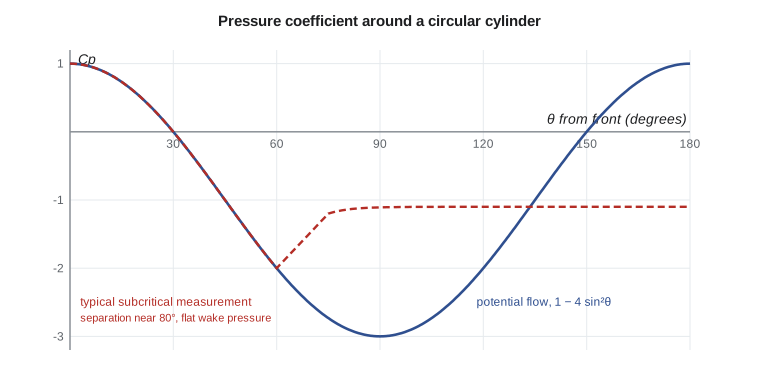
with θ measured from the front stagnation point. The speed is zero at the front and rear and reaches twice the free-stream value at the sides, where the pressure coefficient is −3. The program tabulates the distribution for a 1.2 m bridge pier just upstream of the intake site. The doubled speed at the sides is real in the forward part of the flow, and it explains why scour holes form at the sides of piers and why ice jams against them.
D'Alembert's paradox
The pressure distribution on the cylinder is perfectly symmetric front to back, so the net pressure force in the stream direction is zero. Potential flow predicts no drag on any body in steady flow. D'Alembert noticed this contradiction with experience in 1752. The resolution came 150 years later with Prandtl's boundary layer: viscosity, however small, acts in a thin layer at the wall, and in the adverse pressure gradient on the rear of the body that layer separates, leaving a low-pressure wake. The real pressure on the back of a cylinder stays near the value at the sides instead of recovering, and the front-to-back difference is the drag. Lessons 4 to 6 develop that story. Potential flow remains valuable for the front of a body, for streamlined bodies where separation is avoided, for the flow outside boundary layers, and for lift.
Circulation and lift
Adding a free vortex to the flow past a cylinder breaks the symmetry. The speed rises on one side and falls on the other, the stagnation points move toward the slower side, and Bernoulli's equation gives lower pressure on the fast side. The net force is perpendicular to the stream, and it is given exactly by the Kutta-Joukowski theorem:
per unit span, for any two-dimensional body with circulation Γ. A spinning ball curves for this reason, the Magnus effect, and rotating cylinders have been used as sails on ships. An airfoil produces circulation without spinning: its sharp trailing edge forces the flow to leave smoothly, the Kutta condition, and that sets the circulation and hence the lift. Lesson 7 uses the theorem to explain wind turbine blades.
Worked problem
Lift on the pier in a hypothetical swirl
If the river flow around the 1.2 m pier had a circulation of 2.0 m²/s, as might happen in the swirl downstream of a bend, find the side force per metre of depth and the angle of the stagnation points.
Show solution
- \(L' = \rho U \Gamma = 998 \times 0.30 \times 2.0 = 599\) N/m.
- The stagnation points are where \(2U\sin\theta = \Gamma/(2\pi a)\), so \(\sin\theta = \Gamma/(4\pi U a) = 2.0/(4\pi \times 0.30 \times 0.6) = 0.884\), giving θ ≈ 62°.
Answer: About 0.6 kN per metre of depth, or roughly 1.8 kN on 3 m of pier: small for a pier, but the same physics gives the large forces on blades and wings.
The method of images and other superpositions
A plane wall can be represented by placing an image of each source, sink or vortex on the far side of the wall, so that the combined flow has no velocity through the wall. An intake beside a straight riverbank is a sink with an image sink across the bank line, which doubles the effective strength seen by the stream. Combining a source and a sink of equal strength in a uniform stream produces the Rankine oval, a closed body shape, and distributions of sources and sinks along an axis can model streamlined bodies of any shape. Panel methods, which cover a body with many small source or vortex panels and solve for their strengths, are a direct extension that is still used in early aerodynamic and hydrodynamic design because it is fast.
Worked problem
Intake beside the bank
An alternative design places the screen against the riverbank instead of in mid-stream. Modelling the bank as a straight wall, estimate how far out from the bank the captured water extends far upstream in the 0.05 m/s winter current.
Show solution
- The image sink across the bank doubles the influence on the river side; all of the withdrawal must come from that side.
- Captured strip width \(= m/U = 0.20/0.05 = 4.0\) m, now entirely on the river side of the bank.
Answer: The bank intake draws from a 4 m wide strip along the bank, where floating debris and shore ice tend to collect. This supports the mid-stream design, which splits its captured strip between both sides of the screen and draws from water that is moving faster.
Limits of the potential-flow model
The intake model ignores the vertical structure of the river, the screen's own wake, turbulence and the real shape of the riverbank. It cannot predict the eddy that will form behind the screen or the frazil ice that sticks to cold steel. For the questions Hana asked, which are about the scale of the intake's influence and the approach flow, it is the right tool. The consultant's three-dimensional CFD model and the physical model of Lesson 2 will answer the detailed questions. Good engineering uses the simplest model that answers the question and knows where its answers stop being reliable.
Common mistakes
MistakeUsing potential flow to calculate drag on a bluff body.
InsteadPotential flow gives zero drag; drag comes from viscous effects and separation.
MistakeMeasuring the cylinder pressure angle from the side.
InsteadIn C_p = 1 − 4 sin²θ, θ is measured from the front stagnation point.
MistakeForgetting the depth when modelling an intake as a sink.
InsteadThe two-dimensional sink strength is Q divided by the depth it draws from.
MistakeAssuming a free vortex rotates particles about their own axes.
InsteadA free vortex is irrotational except at its core.
MistakeSizing a fish screen from the river current.
InsteadSize it from the allowed approach velocity at the screen face.
Summary and key terms
- In irrotational flow the velocity is the gradient of a potential that satisfies Laplace's equation.
- Because Laplace's equation is linear, flows can be built by superposing uniform flow, sources, sinks, vortices and doublets.
- A sink in a uniform stream models an intake: the captured strip is m/U wide and the stagnation point lies m/(2πU) downstream.
- For the Qu'Appelle River intake, the captured strip is 0.67 m wide at 0.30 m/s but 4 m wide in a 0.05 m/s winter current.
- Uniform flow plus a doublet gives flow around a cylinder, with twice the free-stream speed at the sides and C_p = −3.
- Potential flow predicts zero drag (d'Alembert's paradox); real drag comes from boundary-layer separation.
- Adding circulation gives lift L′ = ρUΓ, the Kutta-Joukowski theorem.
- Irrotational flow
- Flow with zero vorticity everywhere.
- Velocity potential
- A scalar function whose gradient is the velocity in irrotational flow.
- Stream function
- A function whose contours are streamlines and whose difference gives flow per unit depth.
- Superposition
- Adding solutions of a linear equation to form new solutions.
- Sink
- An elementary flow in which fluid moves radially inward to a point or line.
- Doublet
- The limit of a source and sink brought together, used to model a cylinder in a stream.
- Circulation
- The line integral of velocity around a closed curve.
- D'Alembert's paradox
- The prediction of zero drag on a body in steady potential flow.
- Kutta-Joukowski theorem
- The lift per unit span on a two-dimensional body equals ρUΓ.
- Method of images
- Representing a wall by placing mirror-image singularities on its far side.
Practice problems
Work each problem on paper first, then reveal the answer to check.
A sink of 0.5 m²/s sits in a 0.25 m/s stream. Find the stagnation distance and captured width.
Show answer
0.32 m downstream; 2.0 m wide.
Find the pressure coefficient on a cylinder at θ = 45° in potential flow.
Show answer
1 − 4(0.5) = −1.0.
Show that φ = x² − y² satisfies Laplace's equation and find u and v.
Show answer
∇²φ = 2 − 2 = 0; u = 2x, v = −2y.
A free vortex has Γ = 6.28 m²/s. Find the speed at r = 0.5 m.
Show answer
2.0 m/s.
In the program, raise the withdrawal to 0.90 m³/s. What is the winter captured width?
Show answer
6.0 m.
Why does the real pressure on the rear of a cylinder not recover?
Show answer
The boundary layer separates in the adverse pressure gradient, leaving a low-pressure wake.
Lesson quiz · 5 questions
Score 60% or more to complete this lesson.
Create a free account to save your progress, take quizzes and earn a certificate.