
MEC-370 · Lesson 2 of 12 · 26 min
Dimensional analysis and similitude
Wascana Valley Water has chosen Tidewater Pump Works of Moncton, New Brunswick, to supply the new Pump 2 for Northside. The pump is a single-stage, double-suction design with a 375 mm impeller, rated for 0.331 m³/s against 55 m at 1,780 rpm, and it draws about 210 kW. Before cutting patterns for the full-size casting, Tidewater will test a 150 mm geometric model in its test loop. Farah Siddiqui, Tidewater's senior design engineer, has invited Jun and Hana to witness the test, and Hana wants Jun to understand exactly how a model running at 3,560 rpm on a 42 L/s loop can tell the utility what a pump eight times its flow will do. The answer is dimensional analysis: the idea that physical laws do not depend on the units used to express them, and its practical consequence, similitude.
Why dimensional analysis works
Every equation that describes a physical process must be dimensionally homogeneous: each term must have the same dimensions. That requirement constrains how the variables can be combined. A pump's head depends on its flow, speed, diameter, the fluid's density and viscosity, and the roughness of its passages. Without any theory, dimensional analysis can reduce that list of seven variables to four dimensionless groups, and it guarantees that if two geometrically similar pumps have the same values of three of the groups, they will have the same value of the fourth.
The basic dimensions in mechanics are mass M, length L and time T. Velocity has dimensions L/T, force ML/T², pressure M/(LT²) and dynamic viscosity M/(LT). A dimensionless group, also called a Pi group, is a product of variables in which all the dimensions cancel. The Reynolds number \(\rho V D/\mu\) is the best known example.
The Buckingham Pi theorem
The Buckingham Pi theorem, stated by Edgar Buckingham in 1914 after earlier work by others, says that a relation among n dimensional variables that involve k independent dimensions can be rewritten as a relation among n − k independent dimensionless groups. The method of repeating variables builds the groups systematically:
First, list all n variables that affect the problem, including the one to be predicted. Second, write each variable's dimensions and count the independent dimensions k. Third, choose k repeating variables that together contain all the dimensions but do not themselves form a dimensionless group; for fluid problems, a density, a velocity or speed and a length are the usual choice. Fourth, combine each remaining variable with the repeating variables raised to unknown powers and solve for the powers that make the product dimensionless. Fifth, check each group and, if convenient, replace groups with products or powers of themselves to get familiar forms.
Worked problem
Pi groups for a centrifugal pump
The head rise gH of a pump (energy per unit mass, dimensions L²/T²) depends on the flow Q, the rotational speed n, the impeller diameter D, the density ρ, the viscosity μ and the roughness ε. Find the dimensionless groups.
Show solution
- Variables: gH, Q, n, D, ρ, μ, ε, so n = 7. Dimensions: M, L, T, so k = 3; there will be 4 groups.
- Repeating variables: ρ, n and D.
- \(\Pi_1 = gH\,\rho^a n^b D^c\): the dimensions \(L^2T^{-2}(ML^{-3})^a(T^{-1})^b L^c\) cancel when a = 0, b = −2 and c = −2, giving \(\Pi_1 = gH/(n^2D^2)\), the head coefficient ψ.
- Similarly \(\Pi_2 = Q/(nD^3)\), the flow coefficient φ; \(\Pi_3 = \rho n D^2/\mu\), a Reynolds number based on tip speed; and \(\Pi_4 = \varepsilon/D\), relative roughness.
Answer: The head coefficient is a function of the flow coefficient, the Reynolds number and the roughness ratio: \(\psi = f(\varphi, \text{Re}, \varepsilon/D)\). For large pumps the last two have only a weak effect, so a single curve of ψ against φ describes every geometrically similar pump. Adding power P gives the power coefficient \(P/(\rho n^3 D^5)\), and efficiency is already dimensionless.
Common dimensionless numbers
Many Pi groups appear so often that they have names. Each is a ratio of two effects, and its size tells the engineer which effect dominates.
| Group | Definition | Ratio of | Where it matters |
|---|---|---|---|
| Reynolds number | \(\rho V L/\mu\) | Inertia to viscous forces | Pipe flow, boundary layers, drag |
| Froude number | \(V/\sqrt{gL}\) | Inertia to gravity | Open channels, intakes, ship waves |
| Mach number | \(V/c\) | Flow speed to sound speed | Gas flow above about Mach 0.3 |
| Weber number | \(\rho V^2 L/\sigma\) | Inertia to surface tension | Droplets, sprays, small models |
| Euler number | \(\Delta p/(\rho V^2)\) | Pressure to inertia | Pressure drops, cavitation |
| Strouhal number | \(fL/V\) | Unsteadiness to convection | Vortex shedding, pulsation |
| Cavitation number | \((p - p_v)/(\tfrac12\rho V^2)\) | Margin above vapour pressure to dynamic pressure | Pumps, propellers, valves |
Writing the Navier-Stokes equations of Lesson 1 in dimensionless form shows where some of these come from. Scaling lengths by L, velocities by V, time by L/V and pressure by \(\rho V^2\) gives:
Any two flows with the same geometry, the same boundary conditions in scaled form and the same Reynolds and Froude numbers have identical dimensionless solutions. This is the formal basis for model testing: a model and its prototype obey the same dimensionless equation, so measurements on one can be scaled to the other.
Similitude and model testing
A model is similar to its prototype when three conditions are met. Geometric similarity requires all lengths to scale by the same ratio, including clearances and, ideally, surface roughness. Kinematic similarity requires the velocity ratios at corresponding points to be the same, which means the flow patterns look alike. Dynamic similarity requires the ratios of all forces to be the same, which is achieved when the governing dimensionless groups match. If dynamic similarity holds and the geometry is similar, kinematic similarity follows.
In practice, it is rarely possible to match every group. A model of an open-channel intake at 1:8 scale run with water cannot match both the Froude number and the Reynolds number: Froude similarity requires velocities to scale as the square root of length, while Reynolds similarity with the same fluid requires them to scale inversely with length. The engineer must decide which effect governs the behaviour being studied and accept a scale effect in the other. Intake and spillway models are run at equal Froude number because gravity controls the free surface and the formation of vortices, and they are built large enough that the Reynolds number stays high and viscous effects remain small.
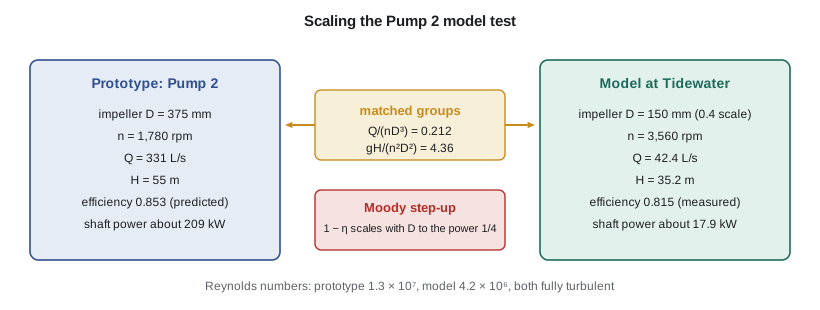
Scaling the Pump 2 model test
For pumps, the flow and head coefficients are matched, and the Reynolds number is allowed to differ because both model and prototype operate in the fully turbulent range, where its effect is small. Equal coefficients give the pump scaling laws, which are the affinity laws of MEC-270 extended to a change in size:
Tidewater's model is a 0.40-scale copy, run at twice the prototype speed so that its head is large enough to measure accurately and its Reynolds number stays as high as the loop allows. The program applies the laws.
# Similitude: scaling a model pump test and an intake model
import math
g = 9.81
# Prototype: new Pump 2 for Northside (from Lesson 11)
Dp, np_, Qp, Hp, eta_p_guess = 0.375, 1780, 0.331, 55.0, None
# Model built by Tidewater Pump Works for its test loop
Dm, nm = 0.150, 3560
phi = Qp / (np_ / 60 * Dp**3)            # flow coefficient Q/(nD^3), n in rev/s
psi = g * Hp / ((np_ / 60)**2 * Dp**2)   # head coefficient gH/(n^2 D^2)
Qm = phi * (nm / 60) * Dm**3
Hm = psi * (nm / 60)**2 * Dm**2 / g
print(f"Pi groups: flow coefficient {phi:.4f}, head coefficient {psi:.2f}")
print(f"Model at {nm} rpm: Q = {Qm*1000:.1f} L/s, H = {Hm:.1f} m")
# Reynolds numbers based on tip speed and diameter
nu = 1.0e-6
Re_p = math.pi * Dp * np_ / 60 * Dp / nu
Re_m = math.pi * Dm * nm / 60 * Dm / nu
print(f"Reynolds numbers: prototype {Re_p:.2e}, model {Re_m:.2e} (ratio {Re_p/Re_m:.1f})")
# Measured model efficiency and the Moody step-up formula
eta_m = 0.815
eta_p = 1 - (1 - eta_m) * (Dm / Dp) ** 0.25
print(f"Model efficiency {eta_m:.3f} -> prototype estimate {eta_p:.3f} (Moody, exponent 1/4)")
# Power coefficient check: P/(rho n^3 D^5)
rho = 998.0
Pm = rho * g * Qm * Hm / eta_m
Pp = rho * g * Qp * Hp / eta_p
print(f"Model shaft power {Pm/1000:.1f} kW; prototype {Pp/1000:.0f} kW")
print(f"Power coefficients: model {Pm/(rho*(nm/60)**3*Dm**5):.3f}, prototype {Pp/(rho*(np_/60)**3*Dp**5):.3f}")

# Froude-scaled model of the intake sump (1:8) for vortex testing
Lr = 1 / 8
Q_sump = 0.66                            # two pumps, m3/s
Q_model = Q_sump * Lr**2.5
V_ratio = Lr**0.5
print(f"\nIntake sump model 1:8: Q = {Q_model*1000:.2f} L/s, velocities x {V_ratio:.3f}, times x {Lr**0.5:.3f}")
Re_bell_p = 1.1 * 0.6 / nu                # bell velocity about 1.1 m/s, bell diameter 0.6 m
Re_bell_m = 1.1 * V_ratio * 0.6 * Lr / nu
print(f"Bell-mouth Reynolds number: prototype {Re_bell_p:.1e}, model {Re_bell_m:.1e}")Pi groups: flow coefficient 0.2116, head coefficient 4.36 Model at 3560 rpm: Q = 42.4 L/s, H = 35.2 m Reynolds numbers: prototype 1.31e+07, model 4.19e+06 (ratio 3.1) Model efficiency 0.815 -> prototype estimate 0.853 (Moody, exponent 1/4) Model shaft power 17.9 kW; prototype 209 kW Power coefficients: model 1.132, prototype 1.081 Intake sump model 1:8: Q = 3.65 L/s, velocities x 0.354, times x 0.354 Bell-mouth Reynolds number: prototype 6.6e+05, model 2.9e+04
To match the prototype's duty point, the model must deliver 42.4 L/s against 35.2 m at 3,560 rpm. Tidewater's loop can do that easily. The Reynolds number of the model is about a third of the prototype's, both above 10⁶, which is why the head curve scales almost perfectly. Efficiency does not scale perfectly. Friction losses in the smaller passages are relatively larger, and the clearances at the wear rings cannot be made 0.4 times as small as the prototype's. Larger pumps are therefore more efficient than their models. Several empirical step-up formulas exist; the oldest and simplest, attributed to Moody, scales the losses with the diameter ratio to the one-quarter power:
With a measured model efficiency of 81.5 percent, the prototype estimate is 85.3 percent. Modern standards for hydraulic machine model tests include more detailed methods that separate friction losses from other losses, and contracts state which method will be used before the test. For Pump 2, the contract with Tidewater uses the full-size factory acceptance test, not the model, to verify the guaranteed efficiency; the model test is a design check.
Worked problem
Checking the model power
At the duty point the model draws 17.9 kW. Using the power scaling law with equal efficiency, estimate the prototype power, then correct it for the efficiency step-up.
Show solution
- \[P_p = P_m\Big(\frac{n_p}{n_m}\Big)^3\Big(\frac{D_p}{D_m}\Big)^5 = 17.9 \times (0.5)^3 \times (2.5)^5 = 17.9 \times 0.125 \times 97.66 = 218\ \text{kW}\]
- With efficiency 0.853 instead of 0.815, the water power is the same but the shaft power falls by the ratio of efficiencies: \(218 \times 0.815/0.853 = 209\) kW.
Answer: The prototype needs about 209 kW at the shaft, which agrees with the program and confirms that the 250 kW motor already ordered has adequate margin.
Froude models of intakes and sumps
The second model in Jun's work term is a hydraulic model of the new raw-water intake sump. Pump intakes can draw air-entraining surface vortices and submerged vortices that disturb the flow into the pump's bell mouth, cause vibration and reduce efficiency. Pump intake design standards, such as ANSI/HI 9.8, give recommended dimensions and say when a physical model study is warranted, typically for larger stations or unusual layouts. A consultant will build a 1:8 model of the sump in a university hydraulics laboratory.
With Froude similarity, velocities scale as the square root of the length ratio, and flows as the length ratio to the 2.5 power. The sump's two pumps take 0.66 m³/s at full scale, so the model needs only 3.65 L/s. Model times are shorter by the same factor as velocities, so an hour of prototype operation takes about 21 minutes in the model. The model's Reynolds number at the bell mouth is lower than the prototype's by a factor of 8^1.5, about 23, which means vortices may appear slightly weaker in the model. Laboratories compensate by also testing at higher flows than the Froude value, sometimes at prototype bell velocity, to check that the conclusions do not change. This is the practical meaning of a scale effect.
Distorted models and the limits of similitude
River models often use a larger scale vertically than horizontally so that depths remain measurable and the flow stays turbulent; these are called distorted models, and they reproduce water levels well but not local details such as scour around a pier. Wind-tunnel models of buildings and structures cannot match the full-scale Reynolds number at all, but for sharp-edged bodies the drag coefficient is nearly independent of Reynolds number once the flow is turbulent, so tests at a lower Reynolds number are still useful. Rounded bodies, such as the elevated water tank in Lesson 6, are harder, because their drag changes sharply with Reynolds number, and engineers roughen the model surface to trip the boundary layer and imitate the full-scale behaviour.
In Canada, the National Research Council's laboratories in Ottawa test hydraulic and coastal models and have a long history of wind-tunnel testing, and several universities run hydraulic laboratories that do intake and spillway studies for utilities. The test standard for the pump's final acceptance test is cited in the purchase order; for Wascana Valley Water, it is an ISO-based pump test standard with tolerances agreed in advance.
Common mistakes
MistakeChoosing repeating variables that already form a dimensionless group.
InsteadThe repeating variables must be dimensionally independent, such as ρ, V and L.
MistakeExpecting a model to match every dimensionless group.
InsteadDecide which effect governs and match that group; estimate the scale effect of the others.
MistakeApplying the affinity laws to a pump with a different geometry.
InsteadScaling laws apply only to geometrically similar pumps.
MistakeAssuming model efficiency equals prototype efficiency.
InsteadLarger pumps have relatively smaller losses; use an agreed step-up method.
MistakeRunning a Froude model at the prototype velocity.
InsteadFroude similarity requires model velocities to be smaller by the square root of the scale.
Summary and key terms
- Dimensional homogeneity lets a relation among n variables with k dimensions be reduced to n − k dimensionless groups.
- The method of repeating variables builds Pi groups systematically; ρ, V or n, and L or D are the usual repeating set.
- Reynolds, Froude, Mach, Weber, Euler, Strouhal and cavitation numbers each compare two effects.
- Model and prototype behave alike when geometry is similar and the governing groups match.
- Pump models match flow and head coefficients; the Pump 2 model must deliver 42.4 L/s against 35.2 m at 3,560 rpm.
- Efficiency improves with size; the Moody step-up predicts 85.3 percent from a model's 81.5 percent.
- Intake models use Froude similarity, with scale effects from the lower Reynolds number.
- Dimensional homogeneity
- The requirement that all terms in a physical equation have the same dimensions.
- Pi group
- A dimensionless product of variables.
- Buckingham Pi theorem
- The theorem that n variables involving k dimensions form n − k independent dimensionless groups.
- Repeating variables
- The dimensionally independent variables combined with each other variable to form Pi groups.
- Similitude
- The condition in which a model and prototype behave in proportion.
- Dynamic similarity
- Equal ratios of all relevant forces in model and prototype.
- Flow coefficient
- The dimensionless flow Q/(nD³) of a turbomachine.
- Head coefficient
- The dimensionless head gH/(n²D²) of a turbomachine.
- Scale effect
- A difference between model and prototype behaviour caused by groups that could not be matched.
- Froude number
- The ratio of inertia to gravity forces, V/√(gL).
Practice problems
Work each problem on paper first, then reveal the answer to check.
The drag F on a sphere depends on V, D, ρ and μ. How many Pi groups are there, and what are they?
Show answer
Two: F/(ρV²D²) and ρVD/μ.
A 1:20 Froude model of a spillway carries 0.05 m³/s. What is the prototype flow?
Show answer
0.05 × 20^2.5 ≈ 89 m³/s.
The model pump is run at 2,950 rpm instead of 3,560 rpm. What flow and head match the prototype duty?
Show answer
35.1 L/s and 24.2 m.
A model with efficiency 0.80 is 0.25 scale. Estimate the prototype efficiency by Moody's formula.
Show answer
1 − 0.20 × 0.25^0.25 ≈ 0.859.
Why can't a 1:8 sump model match both Froude and Reynolds numbers with water?
Show answer
Froude needs V ∝ √L, Reynolds needs V ∝ 1/L with the same fluid; both cannot hold.
In the program, change the model diameter to 200 mm at 3,560 rpm. What head does it produce at the matched flow coefficient?
Show answer
About 62.6 m.
Lesson quiz · 5 questions
Score 60% or more to complete this lesson.
Create a free account to save your progress, take quizzes and earn a certificate.