
MEC-360 · Lesson 2 of 12 · 24 min
Static failure theories and stress concentration
The first check on any load-carrying part is whether it will fail the first time the largest load is applied. For the TP-80 shaft the critical point is the shoulder beside the inboard bearing, where the 35 mm bearing seat steps up to the 42 mm frame span. The overhung impeller bends the shaft hardest there, the motor torque twists it, and the fillet at the shoulder concentrates both stresses. Owen has the bending moment and torque from a free-body diagram; Farah asks him to find the factor of safety against yielding and to check the cast-iron bearing bracket at the same time. Doing both requires the two families of static failure theories: one for ductile materials such as steel, which fail by yielding, and one for brittle materials such as gray cast iron, which fracture.
Why a failure theory is needed
A tensile test gives one number for yield strength, measured under a single uniaxial stress. A real part sees a combination of normal and shear stresses on several planes at once. A failure theory is a rule for deciding when a combined state of stress is as damaging as the uniaxial stress that causes yielding or fracture in the test. The theories cannot be derived from first principles alone; they are models that have been checked against experiments on many materials. Ductile metals follow theories based on shear, because yielding in a metal crystal happens by slip on planes of high shear stress. Brittle materials follow theories based on normal stress, because they fracture by cracks opening under tension.
All the theories are written in terms of the principal stresses \(\sigma_1 \ge \sigma_2 \ge \sigma_3\). For the common case of plane stress with \(\sigma_x\), \(\sigma_y\) and \(\tau_{xy}\), the two in-plane principal stresses are
and the third principal stress is zero. Ordering them correctly, including the zero, matters for the maximum shear stress and the brittle theories.
Ductile materials: maximum shear stress
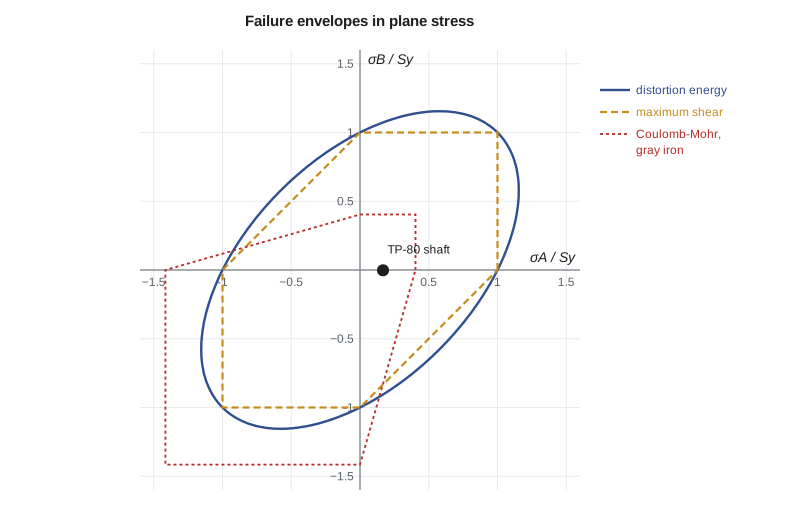
The maximum shear stress theory, also called the Tresca theory, says yielding begins when the largest shear stress reaches the shear stress at yield in a tensile test, which is \(S_y/2\). In terms of principal stresses:
The theory is simple and slightly conservative. It predicts a shear yield strength \(S_{sy} = 0.5 S_y\), while tests on ductile steels give values closer to 0.577 \(S_y\).
Ductile materials: distortion energy (von Mises)
The distortion energy theory says yielding begins when the strain energy associated with change of shape, not change of volume, reaches the value at yield in a tensile test. Hydrostatic pressure, which only changes volume, causes no yielding in this theory, which matches experiments. The result is expressed as an equivalent stress, the von Mises stress \(\sigma'\):
For plane stress with one normal stress and one shear stress, as in a shaft under bending and torsion, it simplifies to
and it predicts \(S_{sy} = 0.577 S_y\). Distortion energy fits the test data for ductile metals best and is the usual choice for design. Tresca is still used where a conservative, easily computed check is wanted, and in some pressure vessel codes.
Stress concentration
Any change of section, such as a shoulder, groove, keyway, hole or thread, disturbs the flow of stress through a part and raises the local stress above the nominal value calculated from simple formulas. The theoretical stress concentration factor \(K_t\) is the ratio of the peak stress to the nominal stress:
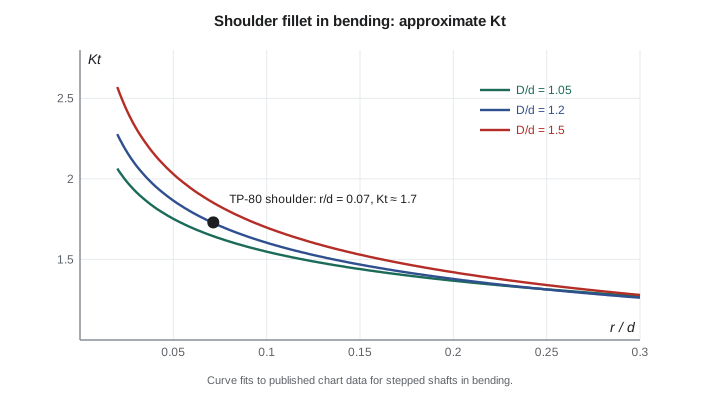
Values of \(K_t\) come from elasticity theory, photoelastic tests or finite element analysis and are published as charts for standard geometries. For a shaft shoulder they depend on two ratios: the fillet radius to the smaller diameter, r/d, and the larger to the smaller diameter, D/d. Sharp fillets give large factors; generous fillets give factors near 1.3. Bearing makers limit how large the fillet can be, because the bearing's inner ring has its own corner radius and must seat firmly against the shoulder, so shaft designers often face a conflict between a small fillet for the bearing and a large fillet for the shaft.
For static loading of a ductile material, stress concentration is usually ignored. When the peak stress at a fillet reaches yield, the material there yields locally, the load is shared with the surrounding material, and the part as a whole does not fail. This is why ductile parts are checked with nominal stresses for static strength. Two exceptions apply. Brittle materials have no such reserve, so \(K_t\) must be applied to them. Ductile parts under fatigue loading are also sensitive to stress concentration, which is the subject of the next two lessons. Farah's practice, which Owen follows here, is to include \(K_t\) in the static check as well, so that the static and fatigue checks use the same stresses and the static factor of safety is conservative.
The TP-80 shaft at the inboard shoulder
At the inboard bearing the overhung impeller load of 1,350 N acting 160 mm away produces a bending moment of 216 N·m. The motor delivers 11 kW at 1,760 rpm, so the torque is 59.7 N·m. The shoulder has a fillet radius of 2.5 mm on the 35 mm seat (r/d ≈ 0.07) and a 42 mm span diameter (D/d = 1.2). From charts, \(K_t \approx 1.7\) in bending and \(K_{ts} \approx 1.5\) in torsion. Because the bearing's corner radius is smaller than 2.5 mm, the bearing seats against a narrow spacer ring with a chamfered bore rather than directly against the shoulder, a common way to resolve the conflict described above. The shaft is cold-drawn 1045 steel with a typical yield strength of 530 MPa.
# Static failure: the TP-80 shaft at the inboard bearing shoulder, and a cast-iron bracket
import math
d = 0.035                              # m, shaft diameter at the bearing seat
M, T = 216.0, 59.7                     # N.m, bending moment and torque at the shoulder
Kt, Kts = 1.7, 1.5                     # stress concentration factors at the fillet (r/d = 0.07, D/d = 1.2)
sx = Kt * 32 * M / (math.pi * d**3) / 1e6      # MPa
txy = Kts * 16 * T / (math.pi * d**3) / 1e6
print(f"sigma_x = {sx:.1f} MPa, tau_xy = {txy:.1f} MPa")
c = sx / 2; r = math.hypot(sx / 2, txy)
s1, s2 = c + r, c - r
vm = math.sqrt(sx**2 + 3 * txy**2)
tresca = s1 - s2
print(f"principal stresses: {s1:.1f}, 0, {s2:.1f} MPa")
Sy = 530.0
print(f"von Mises sigma' = {vm:.1f} MPa  -> n = {Sy/vm:.2f} (distortion energy)")
print(f"Tresca 2*tau_max = {tresca:.1f} MPa -> n = {Sy/tresca:.2f} (maximum shear)")
print(f"overload torque that starts yielding (moment fixed): ", end="")
lo, hi = T, 50 * T
for _ in range(60):
    mid = (lo + hi) / 2
    t2 = Kts * 16 * mid / (math.pi * d**3) / 1e6
    lo, hi = (mid, hi) if math.sqrt(sx**2 + 3 * t2**2) < Sy else (lo, mid)
print(f"{lo:.0f} N.m")

# Brittle material: gray cast-iron bearing bracket, plane stress at a rib corner
Sut, Suc = 214.0, 750.0                # MPa, class 30 gray iron (typical)
sA, sB = 32.0, -95.0                   # principal stresses at the critical point (MPa)
n_cm = 1 / (sA / Sut - sB / Suc)       # Coulomb-Mohr, sA >= 0 >= sB
n_mm = 1 / (((Suc - Sut) * sA) / (Suc * Sut) - sB / Suc) if sA <= Sut else None
print(f"\ncast-iron bracket: Coulomb-Mohr n = {n_cm:.2f}")
print(f"modified Mohr n = {n_mm:.2f}" if abs(sB) > sA else f"modified Mohr = max normal stress: n = {Sut/sA:.2f}")sigma_x = 87.2 MPa, tau_xy = 10.6 MPa principal stresses: 88.5, 0, -1.3 MPa von Mises sigma' = 89.2 MPa -> n = 5.94 (distortion energy) Tresca 2*tau_max = 89.8 MPa -> n = 5.90 (maximum shear) overload torque that starts yielding (moment fixed): 1694 N.m cast-iron bracket: Coulomb-Mohr n = 3.62 modified Mohr n = 4.28
Worked problem
Static factor of safety at the shoulder
Find the von Mises and Tresca factors of safety at the TP-80 inboard shoulder, including stress concentration.
Show solution
- \[\sigma_x = K_t\frac{32M}{\pi d^3} = 1.7 \times \frac{32(216)}{\pi(0.035)^3} = 87.2\ \text{MPa}\]
- \[\tau_{xy} = K_{ts}\frac{16T}{\pi d^3} = 1.5 \times \frac{16(59.7)}{\pi(0.035)^3} = 10.6\ \text{MPa}\]
- \[\sigma' = \sqrt{87.2^2 + 3(10.6)^2} = 89.2\ \text{MPa}, \qquad n = \frac{530}{89.2} = 5.94\]
- Principal stresses are 88.5, 0 and −1.3 MPa, so \(\sigma_1 - \sigma_3 = 89.8\) MPa and the Tresca factor is 5.90.
Answer: Static strength is clearly not the problem: even a blocked impeller that raised the torque to about 1,700 N·m would only just start yielding at the fillet. The shaft will be sized by fatigue and deflection, as is usual for rotating shafts. The static check is still worth doing, because it catches gross errors and governs for parts that rotate slowly or carry mostly steady loads.
Brittle materials: Coulomb-Mohr and modified Mohr
Gray cast iron, many ceramics and some powder metals are brittle: they fail by fracture with little plastic strain, and their compressive strength \(S_{uc}\) is several times their tensile strength \(S_{ut}\). Theories for ductile metals do not fit them, because they treat tension and compression alike. The simplest brittle theory, maximum normal stress, says fracture occurs when the largest principal stress reaches \(S_{ut}\) or the smallest reaches \(-S_{uc}\). It is unconservative when one principal stress is tensile and the other compressive, which is common at corners and ribs.
The Coulomb-Mohr theory, also called the internal friction theory, joins the tensile and compressive limits with a straight line in the fourth quadrant of the \(\sigma_A\)–\(\sigma_B\) plane. With \(\sigma_A \ge 0 \ge \sigma_B\):
The modified Mohr theory keeps the maximum normal stress limit for most of the fourth quadrant and draws the straight line only below the point where \(\sigma_B = -\sigma_A\). It fits test data on gray iron better and is less conservative. Coulomb-Mohr is the safer choice when data are limited.
The TP-80's BB-210 bracket, which Owen drew in his first term, is gray cast iron with typical strengths of 214 MPa in tension and 750 MPa in compression. A finite element model of the bracket under the bearing reactions shows principal stresses of 32 MPa and −95 MPa at the corner where the front rib meets the base. Because cast iron is brittle and notch-sensitive in a different way from steel, the model includes the fillet geometry directly, so the stresses already contain the concentration.
Worked problem
Factor of safety for the cast-iron bracket
Find the Coulomb-Mohr factor of safety for principal stresses of 32 and −95 MPa with \(S_{ut} = 214\) MPa and \(S_{uc} = 750\) MPa.
Show solution
- \[\frac{1}{n} = \frac{32}{214} - \frac{-95}{750} = 0.1495 + 0.1267 = 0.2762, \qquad n = 3.62\]
- The modified Mohr theory, since \(|\sigma_B| > \sigma_A\), gives n = 4.28.
Answer: A factor of 3.6 is acceptable for a brittle casting under a known load. Cast iron is chosen for bearing brackets because it is cheap, damps vibration well and machines easily; its weakness in tension is managed by keeping tensile stresses low through generous fillets and ribs placed in compression.
In Canada, structural and pressure applications of cast iron are restricted by codes; for pump parts, the design is the manufacturer's responsibility. Material strengths in this lesson are typical handbook values; Tidewater's designs use the minimum properties of the purchased grade from the foundry's certificates, such as ASTM A48 class 30 for gray iron, which Canadian foundries also supply.
Choosing the right theory
The choice of theory follows from the material's behaviour. A useful rule is to call a material ductile if its elongation at fracture exceeds about 5 percent, in which case von Mises (or Tresca for a conservative check) is used. Brittle materials use Coulomb-Mohr or modified Mohr. Some materials, such as hardened tool steels or high-strength castings, are in between, and many engineers check them both ways. Temperature also matters: a steel that is ductile at room temperature may behave in a brittle way at low temperature, and parts for outdoor service in a New Brunswick winter may need impact-tested material.
Common mistakes
MistakeIgnoring the zero principal stress when computing Tresca for plane stress.
InsteadOrder all three principal stresses, including zero, and use σ₁ − σ₃.
MistakeApplying a ductile failure theory to cast iron.
InsteadUse Coulomb-Mohr or modified Mohr for brittle materials.
MistakeUsing the maximum normal stress theory when the principal stresses have opposite signs.
InsteadIt is unconservative there; use Coulomb-Mohr.
MistakeForgetting stress concentration in brittle parts.
InsteadBrittle materials do not redistribute stress; apply Kt or model the geometry.
MistakeChoosing a large shoulder fillet that stops the bearing from seating.
InsteadThe fillet must be smaller than the bearing's corner radius; use a relief groove or spacer if a larger radius is needed.
Summary and key terms
- Failure theories convert a combined stress state into an equivalent uniaxial stress for comparison with test data.
- Ductile metals: maximum shear stress (Tresca), n = S_y/(σ₁ − σ₃); distortion energy (von Mises), n = S_y/σ′, which fits tests best.
- For a shaft in bending and torsion, σ′ = √(σ_x² + 3τ²).
- Stress concentration factors Kt depend on r/d and D/d; they can be ignored for static loading of ductile parts but not for brittle parts or fatigue.
- The TP-80 shoulder has a static factor of safety of about 5.9; fatigue and deflection will govern the shaft.
- Brittle materials use Coulomb-Mohr or modified Mohr; the cast-iron bracket has a factor of 3.6 by Coulomb-Mohr.
- Principal stresses
- The normal stresses on the planes where shear stress is zero.
- Maximum shear stress theory
- Yielding occurs when the largest shear stress reaches half the tensile yield strength.
- Distortion energy theory
- Yielding occurs when the distortion strain energy reaches its value at tensile yield; also called von Mises.
- Von Mises stress
- The equivalent uniaxial stress of the distortion energy theory.
- Stress concentration factor
- The ratio of the peak local stress at a discontinuity to the nominal stress.
- Coulomb-Mohr theory
- A brittle failure theory joining the tensile and compressive limits with a straight line.
- Modified Mohr theory
- A brittle failure theory that keeps the maximum normal stress limit over most of the tension-compression quadrant.
- Brittle material
- A material that fractures with little plastic strain, usually with elongation below about 5 percent.
- Shoulder fillet
- The radius at a change of shaft diameter.
Practice problems
Work each problem on paper first, then reveal the answer to check.
A shaft has σ_x = 120 MPa and τ_xy = 40 MPa. Find σ′ and the factor of safety for S_y = 420 MPa.
Show answer
σ′ = 138.6 MPa; n = 3.03.
For the same stresses, find the Tresca factor of safety.
Show answer
σ₁ − σ₃ = 144.2 MPa; n = 2.91.
A cast iron with S_ut = 150 MPa and S_uc = 570 MPa has principal stresses 20 and −80 MPa. Find the Coulomb-Mohr factor.
Show answer
n = 3.6.
In the program, reduce the fillet to give Kt = 2.2. What happens to the von Mises factor?
Show answer
It drops to about 4.6.
Why can stress concentration be ignored for a static check of a ductile shaft?
Show answer
Local yielding at the notch redistributes the stress before the section as a whole yields.
What is the shear yield strength of a steel with S_y = 530 MPa by each ductile theory?
Show answer
Tresca 265 MPa; distortion energy 306 MPa.
Lesson quiz · 5 questions
Score 60% or more to complete this lesson.
Create a free account to save your progress, take quizzes and earn a certificate.