
MEC-360 · Lesson 11 of 12 · 23 min
Threaded fasteners and bolted joints
The TP-80's casing cover is held on by a ring of bolts. Every time the pump starts, the pressure inside rises to as much as 16 bar (230 psi) and tries to push the cover off; every time it stops, the pressure falls again. Marco Rossi has a broken bolt from a competitor's pump on his shelf, snapped at the first engaged thread, with the smooth fatigue zone of a crack that grew over thousands of starts. Bolted joints are the most common way of joining machine parts, and they fail more often from poor tightening than from poor sizing. This lesson explains how a preloaded joint shares load between the bolt and the parts it clamps, and how to choose the bolt, its preload and its tightening torque.
Thread standards
Screw threads are standardized so that bolts and nuts from different makers fit. ISO metric threads are designated by M, the nominal diameter and the pitch, such as M12 × 1.75; the coarse-pitch series is the default, and fine pitches are used for adjustment or thin walls. Unified inch threads are designated by diameter, threads per inch and series, such as 1/2-13 UNC (coarse) or 1/2-20 UNF (fine). Both systems use a 60° thread form. Strength calculations use the tensile stress area \(A_t\), an effective area between the pitch and minor diameters, which is tabulated for each size: 84.3 mm² for M12 × 1.75 and 0.1419 in² for 1/2-13 UNC.
| Property | ISO metric | Unified inch |
|---|---|---|
| Designation | M12 × 1.75 | 1/2-13 UNC |
| Tensile stress area | 84.3 mm² | 0.1419 in² |
| Common strength grades | Property classes 8.8, 10.9, 12.9 (ISO 898-1) | SAE grades 5 and 8 (SAE J429); ASTM A325, A490 |
| Grade marking | Numbers on the head, such as 8.8 | Radial lines on the head: 3 for grade 5, 6 for grade 8 |
| Thread tolerance class | 6g bolt, 6H nut | 2A bolt, 2B nut |
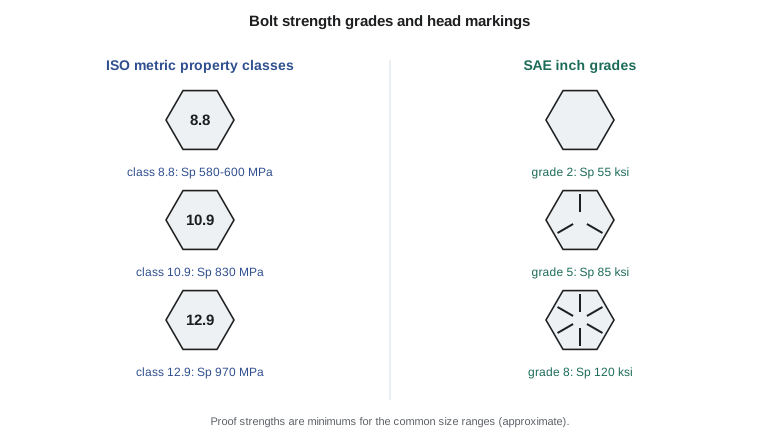
The strength of a bolt is given by its proof strength \(S_p\), the stress it can carry without measurable permanent set, typically about 90 percent of the yield strength. For a property class such as 8.8, the first number is one-hundredth of the nominal tensile strength in MPa (800 MPa) and the second is ten times the ratio of yield to tensile strength (0.8), so the nominal yield is 640 MPa; the minimum proof stress is 580 MPa up to M16 and 600 MPa above. SAE grade 5 bolts up to 1 in have a proof strength of 85 ksi and a tensile strength of 120 ksi; grade 8 have 120 and 150 ksi.
How a preloaded joint works
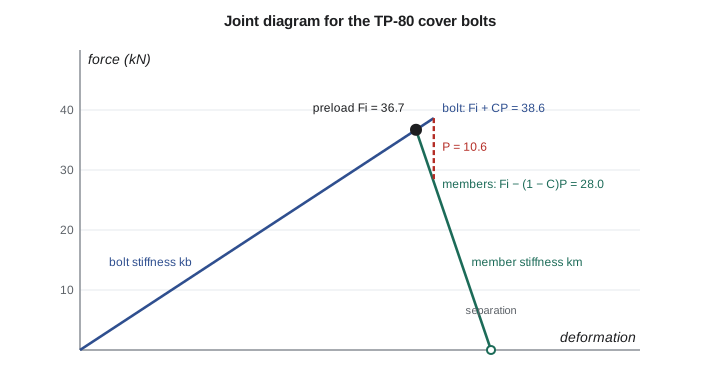
When a bolt is tightened, it stretches and the clamped parts, called the members, compress. The tension in the bolt, the preload \(F_i\), equals the compression in the members. When an external load P tries to pull the joint apart, the bolt stretches further and the members decompress. Because bolt and members move together while the joint stays closed, the load divides between them in proportion to their stiffnesses:
where \(k_b\) is the bolt stiffness, \(k_m\) the member stiffness and C the joint constant. Members are usually much stiffer than the bolt, because the compressed volume around the bolt is large, so C is typically 0.15 to 0.35 for steel joints. That means only a small fraction of the external load reaches the bolt; most of it simply reduces the clamping force on the members. This is the key benefit of preload: the bolt sees a much smaller change in stress than the external load would suggest, which is why preloaded bolts survive fatigue loading that would quickly break a loose one. The joint separates when \(F_m\) falls to zero, after which the bolt carries the whole load.
Bolt and member stiffness
A bolt is two springs in series: the unthreaded shank of area \(A_d\) and length \(l_d\), and the threaded part in the grip of area \(A_t\) and length \(l_t\):
Member stiffness is harder to find, because the compressed region spreads out from under the bolt head and nut in a roughly conical zone. A widely used approximation models it as two cones with a half-angle of 30°; for two members of the same material with total grip l and bolt diameter d,
Finite element studies and an exponential fit by Wileman and others give similar results. Gaskets change the picture completely: a soft gasket is the least stiff element in the member stack and controls \(k_m\), which raises the joint constant and the share of load reaching the bolt. The TP-80 cover uses an O-ring in a groove with a metal-to-metal joint, so the member stiffness is that of the steel flanges.
Choosing the preload
Preload should be high: high enough to prevent separation and slipping with a margin, and to keep the alternating bolt stress small. Typical recommendations are 75 percent of the proof load for reusable connections and 90 percent for permanent ones. The higher the preload, the better the joint resists loosening by vibration and fatigue. The limits are the bolt's own strength, including the torsion added during tightening, and the strength of the members under the head.
Preload is usually set by tightening torque, using the approximate relation
where K is the nut factor, about 0.2 for dry, plain-finish steel bolts and about 0.15 to 0.18 for lubricated or plated bolts. Because most of the torque goes into friction under the head and in the threads, small changes in friction cause large changes in preload: torque control alone typically gives a scatter of about ±25 percent in preload. Better methods include torque-turn tightening, direct tension indicators, ultrasonic measurement of bolt stretch and hydraulic tensioners. For the TP-80 cover, Tidewater specifies a lubricated thread with a stated nut factor and a torque value on the assembly drawing, with a tightening sequence that brings the bolts up in stages around the circle.
# Casing cover joint of the TP-80: eight M12 x 1.75 property class 8.8 bolts, both flanges steel
import math
E = 207e3                                   # MPa
p, Dg, nb = 1.6, 260.0, 8                   # MPa (16 bar), effective sealing diameter mm, bolts
P = p * math.pi / 4 * Dg**2 / nb / 1000     # kN per bolt, cycles 0 -> P with every start and stop
d, At, Sp, Sut, Se = 12.0, 84.3, 580.0, 800.0, 129.0   # mm, mm2, MPa (proof, ultimate, endurance of rolled threads)
l, L = 40.0, 50.0                           # grip and bolt length, mm
LT = 2 * d + 6; ld = L - LT; lt = l - ld    # thread length, unthreaded and threaded lengths in the grip
Ad = math.pi * d**2 / 4
kb = Ad * At * E / (Ad * lt + At * ld) / 1000          # kN/mm
km = 0.5774 * math.pi * E * d / (2 * math.log(5 * (0.5774 * l + 0.5 * d) / (0.5774 * l + 2.5 * d))) / 1000
Cj = kb / (kb + km)
Fi = 0.75 * At * Sp / 1000                  # kN, preload for a reusable joint
Tq = 0.2 * Fi * d                           # N.m, with nut factor K = 0.2 (dry, plain finish)
print(f"external load per bolt P = {P:.2f} kN")
print(f"kb = {kb:.0f} kN/mm, km = {km:.0f} kN/mm, joint constant C = {Cj:.3f}")
print(f"preload Fi = {Fi:.1f} kN, tightening torque about {Tq:.0f} N.m (K = 0.2)")
Fb = Fi + Cj * P; Fm = Fi - (1 - Cj) * P
print(f"bolt load at full pressure {Fb:.2f} kN; clamp left on the joint {Fm:.2f} kN")
n_proof = Sp * At / 1000 / Fb
n_load = (Sp * At / 1000 - Fi) / (Cj * P)
n_sep = Fi / (P * (1 - Cj))
print(f"yield factor n_p = {n_proof:.2f}, load factor n_L = {n_load:.1f}, separation factor n_0 = {n_sep:.1f}")
sa = Cj * P * 1000 / (2 * At); sm = sa + Fi * 1000 / At; si = Fi * 1000 / At
nf = Se * (Sut - si) / (Sut * sa + Se * (sm - si))     # Goodman, load line starting at the preload
print(f"bolt fatigue: sigma_a = {sa:.1f} MPa, sigma_m = {sm:.0f} MPa, Goodman n_f = {nf:.1f}")
for frac in (0.75, 0.5, 0.3):
    F0 = frac * At * Sp / 1000
print(f" preload at {frac:.0%} of proof load: separation factor {F0/(P*(1-Cj)):.1f}")external load per bolt P = 10.62 kN kb = 500 kN/mm, km = 2235 kN/mm, joint constant C = 0.183 preload Fi = 36.7 kN, tightening torque about 88 N.m (K = 0.2) bolt load at full pressure 38.61 kN; clamp left on the joint 27.99 kN yield factor n_p = 1.27, load factor n_L = 6.3, separation factor n_0 = 4.2 bolt fatigue: sigma_a = 11.5 MPa, sigma_m = 447 MPa, Goodman n_f = 4.4 preload at 75% of proof load: separation factor 4.2 preload at 50% of proof load: separation factor 2.8 preload at 30% of proof load: separation factor 1.7
Worked problem
The TP-80 casing cover with M12 class 8.8 bolts
Eight M12 × 1.75 class 8.8 bolts, 50 mm long, clamp two steel flanges with a total grip of 40 mm. The pressure of 1.6 MPa acts over a 260 mm sealing diameter. Find the joint constant, the preload at 75 percent of proof load, and the factors of safety.
Show solution
- Load per bolt: \(P = 1.6 \times \pi(260)^2/4/8 = 10.6\) kN.
- Thread length \(L_T = 2d + 6 = 30\) mm; unthreaded length 20 mm; threaded length in the grip 20 mm. \(k_b = 500\) kN/mm; \(k_m = 2235\) kN/mm; C = 0.183.
- \(F_i = 0.75 \times 84.3 \times 580 = 36.7\) kN; torque \(T = 0.2 \times 36.7 \times 12 = 88\) N·m.
- Yield factor \(n_p = S_p A_t/(F_i + CP) = 48.9/38.6 = 1.27\); load factor \(n_L = (S_pA_t - F_i)/(CP) = 6.3\); separation factor \(n_0 = F_i/(P(1 - C)) = 4.2\).
Answer: The yield factor of 1.27 simply reflects the preload choice. What matters is that the external load would have to rise 6.3 times to yield the bolts and 4.2 times to open the joint. The bolt's alternating stress is only 11.5 MPa, against an endurance strength of about 129 MPa for rolled threads, so the Goodman fatigue factor is 4.4. The competitor's broken bolt almost certainly had too little preload: at 30 percent of proof load, the separation factor falls to 1.7, and any shortfall in tightening would let the joint open.
Fatigue of bolts
Bolts in fatigue fail at the first engaged thread in the nut, the thread runout, or under the head, where stress concentration is highest. Fatigue factors for threads are large, about 2.2 to 3.0 for rolled threads and 2.8 to 3.8 for cut threads, so fatigue data for complete bolts are used rather than calculations from \(K_f\). Endurance strengths for rolled threads are tabulated by grade and already include the thread concentration. Because the preload sets a high mean stress, the load line for a bolt starts at the preload stress and rises with slope C, and the Goodman criterion is applied along that line:
Rolled threads, formed after heat treatment, have compressive residual stresses at the roots and are considerably stronger in fatigue than cut threads. Other ways to improve bolt fatigue life include reducing C by using a longer, thinner bolt or a reduced shank, using a nut that spreads load over more threads, and above all ensuring a high, consistent preload.
Shear joints and loosening
Joints loaded in shear, such as a motor bolted to a baseplate, can work in two ways. In a friction-grip joint, the preload clamps the parts so firmly that friction carries the shear, and the bolts themselves see no shear: the slip resistance is \(\mu F_i\) per bolt per friction surface. In a bearing-type joint, the parts slip until the bolts bear against the hole walls, and the bolts are checked for shear and the plates for bearing. Structural steel codes treat the two cases separately. Machine joints that must hold alignment, such as a pump and motor on a baseplate, rely on friction and dowel pins, because any slip spoils the alignment.
Vibration loosens bolts mainly by transverse slip, which lets the nut rotate a little at each cycle. High preload is the best defence. Locking devices that work include prevailing-torque nuts, chemical thread lockers and wedge-locking washers; plain spring washers and split lock washers do little in high-preload joints.
In Canada, metric property class bolts to ISO 898-1 are common in machinery, while structural steel connections use ASTM F3125 grades A325 and A490 (and their metric versions) under CSA S16. Both metric and inch fasteners are sold widely, so drawings must state the thread system and grade clearly. The CSA B18 series covers some inch fastener dimensions, and Canadian industry generally follows the corresponding ASME B18 standards.
Common mistakes
MistakeUsing the nominal diameter area instead of the tensile stress area.
InsteadUse A_t from the thread tables for strength calculations.
MistakeAssuming the bolt carries the whole external load.
InsteadIn a preloaded joint the bolt carries only CP until separation.
MistakeSetting a low preload to be safe.
InsteadLow preload invites separation, loosening and fatigue; use about 75 percent of proof load for reusable joints.
MistakeTreating torque as an accurate measure of preload.
InsteadFriction scatter gives about ±25 percent; specify lubrication and the nut factor, or use a better method.
MistakePutting a soft gasket in a joint designed as metal-to-metal.
InsteadA gasket controls member stiffness; recalculate C or use an O-ring in a groove.
Summary and key terms
- Metric threads (M12 × 1.75) and unified threads (1/2-13 UNC) use tensile stress areas for strength; grades set proof strength.
- In a preloaded joint, F_b = F_i + CP and F_m = F_i − (1 − C)P, with C = k_b/(k_b + k_m), typically 0.15 to 0.35.
- Members are stiffer than the bolt, so most external load reduces clamping force rather than raising bolt tension.
- Preload of about 75 percent of proof load for reusable joints; torque T = KF_i d with K ≈ 0.2 dry.
- The TP-80 cover bolts have C ≈ 0.18 to 0.19, separation factors above 4 and fatigue factors above 4.
- Bolt fatigue is checked along a load line starting at the preload; rolled threads and high preload improve life.
- Tensile stress area
- The effective area of a threaded rod used for strength calculations.
- Proof strength
- The stress a bolt can carry without measurable permanent set.
- Property class
- The ISO strength designation of a metric bolt, such as 8.8.
- Preload
- The tension in a bolt after tightening, before external load.
- Joint constant
- C = k_b/(k_b + k_m), the fraction of external load carried by the bolt.
- Member stiffness
- The stiffness of the clamped parts in compression.
- Nut factor
- The constant K in the torque-preload relation T = KF_i d.
- Separation
- Loss of contact between clamped members when the external load overcomes the preload.
- Friction-grip joint
- A shear joint in which preload and friction carry the load without bolt shear.
Practice problems
Work each problem on paper first, then reveal the answer to check.
Find the proof load of an M16 × 2 class 10.9 bolt (A_t = 157 mm², S_p = 830 MPa).
Show answer
130 kN.
A joint has k_b = 400 kN/mm and k_m = 1,600 kN/mm. Find C.
Show answer
0.20.
With F_i = 30 kN, C = 0.2 and P = 12 kN, find the bolt load and the member force.
Show answer
F_b = 32.4 kN; F_m = 20.4 kN.
Find the torque for F_i = 30 kN on an M12 bolt with K = 0.15.
Show answer
54 N·m.
In the program, change the bolts to class 10.9 (S_p = 830 MPa, S_ut = 1,040 MPa, S_e = 162 MPa). Find the new preload and separation factor.
Show answer
F_i = 52.5 kN; n_0 = 6.0.
Why does a soft gasket increase the load in a bolt?
Show answer
It lowers the member stiffness, raising C and the share of external load reaching the bolt.
Lesson quiz · 5 questions
Score 60% or more to complete this lesson.
Create a free account to save your progress, take quizzes and earn a certificate.