
MEC-330 · Lesson 9 of 12 · 26 min
Gas refrigeration and absorption cycles
Vapour compression dominates refrigeration, but two other families matter in practice and in Northgate's study. Gas refrigeration cycles, the Brayton cycle run backward, cool aircraft cabins and produce the very low temperatures used to liquefy gases. Absorption cycles replace the compressor with a heat-driven chemical loop, so they can make chilled water from steam or hot water instead of electricity. Several district energy systems run steam-fired absorption chillers in summer, when their boilers would otherwise idle. Graham remembers that Northgate once had one, scrapped twenty years ago. Kofi wants to know whether bringing the idea back makes sense now.
The reversed Brayton cycle
In the gas refrigeration cycle, a gas, usually air, is compressed, cooled at high pressure toward the temperature of the surroundings, expanded in a turbine to a low temperature, and then warmed at low pressure as it absorbs heat from the refrigerated space. The turbine recovers part of the compression work. With constant specific heats,
where state 1 is the compressor inlet (gas leaving the refrigerated space), 2 the compressor exit, 3 the turbine inlet after the high-pressure heat exchanger, and 4 the turbine exit. Unlike a vapour cycle, the gas absorbs and rejects heat over a range of temperatures, not at constant temperature, so even the ideal gas cycle falls well short of the Carnot COP between the same space and surroundings temperatures.
# Gas refrigeration (reversed Brayton) and steam-driven absorption chillers
cp, k = 1.005, 1.4
e = (k - 1) / k

def gas_refrigeration(T1, T3, rp, eta_c=1.0, eta_t=1.0):
    """T1 compressor inlet (from the cold space), T3 turbine inlet (after the warm heat exchanger)."""
    T2 = T1 * (1 + (rp ** e - 1) / eta_c)
    T4 = T3 - eta_t * (T3 - T3 / rp ** e)
    wc, wt = cp * (T2 - T1), cp * (T3 - T4)
    qL = cp * (T1 - T4)
    return T2, T4, qL, wc - wt, qL / (wc - wt)

print("reversed Brayton: cold space side 253 K in, warm side cooled to 303 K, pressure ratio 4")
for label, ec, et in (("ideal", 1, 1), ("actual", 0.85, 0.88)):
    T2, T4, qL, w, cop = gas_refrigeration(253.0, 303.0, 4, ec, et)
    print(f"  {label:6s}: T2 = {T2:.0f} K, T4 = {T4:.0f} K, qL = {qL:.1f} kJ/kg, w = {w:.1f} kJ/kg, COP_R = {cop:.2f}")
print(f"  Carnot COP_R between 253 K and 303 K = {253 / 50:.2f}")

# Absorption chillers driven by Northgate steam: 3500 kW of cooling
Q = 3500.0
dh = 2943.1 - 377.0                      # 1 MPa, 250 C steam condensed and cooled to about 90 C
for name, cop in (("single-effect", 0.70), ("double-effect", 1.20)):
    Qgen = Q / cop
    print(f"\n{name}: heat to generator {Qgen:.0f} kW, steam {Qgen / dh:.2f} kg/s, heat rejected {Q + Qgen:.0f} kW")

# Upper limit on absorption COP: a Carnot engine driving a Carnot refrigerator
Ts, T0, TL = 180 + 273.15, 30 + 273.15, 5 + 273.15
print(f"\nmaximum COP for heat at 180 C, surroundings 30 C, cold side 5 C: {(1 - T0 / Ts) * TL / (T0 - TL):.2f}")

# Fuel comparison for 3500 kW of cooling (COP 5.84 electric chiller from Lesson 8)
boiler, plant = 0.85, 0.45
print(f"fuel, double-effect on boiler steam:       {Q / 1.2 / boiler:6.0f} kW")
print(f"fuel, electric chiller on a 45 % gas plant: {Q / 5.84 / plant:6.0f} kW")reversed Brayton: cold space side 253 K in, warm side cooled to 303 K, pressure ratio 4 ideal : T2 = 376 K, T4 = 204 K, qL = 49.3 kJ/kg, w = 24.0 kJ/kg, COP_R = 2.06 actual: T2 = 398 K, T4 = 216 K, qL = 37.4 kJ/kg, w = 57.7 kJ/kg, COP_R = 0.65 Carnot COP_R between 253 K and 303 K = 5.06 single-effect: heat to generator 5000 kW, steam 1.95 kg/s, heat rejected 8500 kW double-effect: heat to generator 2917 kW, steam 1.14 kg/s, heat rejected 6417 kW maximum COP for heat at 180 C, surroundings 30 C, cold side 5 C: 3.68 fuel, double-effect on boiler steam: 3431 kW fuel, electric chiller on a 45 % gas plant: 1332 kW
Worked problem
A gas refrigeration cycle
Air leaves a refrigerated space and enters a compressor at 253 K. The pressure ratio is 4, and after compression the air is cooled to 303 K before the turbine. Find the ideal COP, then the COP with a compressor efficiency of 0.85 and a turbine efficiency of 0.88.
Show solution
- \(4^{0.2857} = 1.486\). Ideal: \(T_2 = 253(1.486) = 376\) K; \(T_4 = 303/1.486 = 204\) K.
- \(q_L = 1.005(253 - 204) = 49.3\) kJ/kg; \(w_c = 1.005(376 - 253) = 123.6\); \(w_t = 1.005(303 - 204) = 99.6\); \(w_{\text{net}} = 24.0\) kJ/kg.
- Ideal \(\text{COP}_R = 49.3/24.0 = 2.06\).
- Actual: \(T_2 = 398\) K, \(T_4 = 216\) K; \(q_L = 37.4\), \(w_{\text{net}} = 57.7\) kJ/kg.
- \[\text{COP}_R = \frac{37.4}{57.7} = 0.65\]
Answer: Component losses cut the COP by a factor of three. Because the compressor and turbine work are each several times the net work, a few percent of inefficiency in each wipes out most of the cooling effect, the same back-work problem that hurts gas turbines. The Carnot COP between 253 K and 303 K is 5.06.
Gas refrigeration survives where its advantages outweigh its low COP. Aircraft use air-cycle machines: compressed air bled from the engines is cooled in heat exchangers by outside air, expanded in a small turbine and delivered to the cabin, so the refrigerant is the air the passengers breathe and the equipment is light and simple. With a regenerator that uses the cold gas returning from the space to precool the gas entering the turbine, gas cycles can reach very low temperatures, which is the basis of gas liquefaction plants. The Linde-Hampson process, which compresses gas, precools it in a regenerative heat exchanger and expands it through a throttling valve so that part of it liquefies, produces the liquid nitrogen and oxygen used in hospitals and industry. Liquefied natural gas plants use cascades of vapour-compression cycles and turbo-expanders on the same principles.
The absorption refrigeration cycle
An absorption system keeps the condenser, expansion valve and evaporator of a vapour-compression system but replaces the compressor with an absorber, a pump and a generator. Refrigerant vapour leaving the evaporator is absorbed into a liquid solution in the absorber, which releases heat that must be removed. A small pump raises the pressure of the solution, which takes very little work because it is a liquid. In the generator, heat from steam, hot water or a flame drives the refrigerant back out of the solution at high pressure; the refrigerant vapour goes on to the condenser, and the weakened solution returns through a valve to the absorber. A solution heat exchanger between the generator and absorber recovers much of the heat in the returning solution.
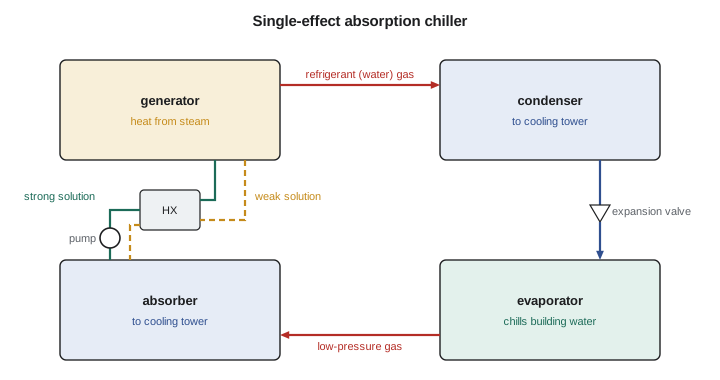
Two working pairs dominate. In water-lithium bromide machines, water is the refrigerant and the salt solution absorbs it. Water must evaporate at about 4 to 5 °C to make chilled water, so the evaporator and absorber operate under a deep vacuum, near 0.8 to 0.9 kPa. These machines cannot cool below about 0 °C, because the refrigerant would freeze, and the solution can crystallize if it becomes too concentrated, so their controls watch the generator temperature and concentration carefully. They are the usual choice for air conditioning. In ammonia-water machines, ammonia is the refrigerant and water the absorbent; they can reach temperatures well below 0 °C and are used in industrial refrigeration and some heat-driven heat pumps, but water vapour carried with the ammonia must be removed in a rectifier.
The performance measure is the ratio of cooling to the heat supplied to the generator (pump work is small and often ignored):
Single-effect water-lithium bromide chillers reach about 0.65 to 0.75 with low-pressure steam or hot water near 90 to 120 °C. Double-effect machines add a second, higher-pressure generator whose refrigerant vapour heats the first generator, which uses the driving heat twice; they need steam at roughly 0.7 to 1 MPa and reach COPs of about 1.1 to 1.3. Triple-effect machines exist but are rare.
The limit on absorption COP
An absorption chiller converts heat at a high temperature \(T_s\) into cooling at \(T_L\) while rejecting heat at \(T_0\). The best possible device would use a Carnot heat engine between \(T_s\) and \(T_0\) to drive a Carnot refrigerator between \(T_L\) and \(T_0\), which gives
Worked problem
The maximum COP for Northgate steam
Steam from the district main condenses at about 180 °C. Cooling water from the tower is at about 30 °C, and the chiller produces cooling at 5 °C. Find the maximum possible COP and compare it with a double-effect machine's 1.2.
Show solution
- \(T_s = 453.15\) K, \(T_0 = 303.15\) K, \(T_L = 278.15\) K.
- Carnot engine: \(1 - 303.15/453.15 = 0.331\).
- Carnot refrigerator: \(278.15/(303.15 - 278.15) = 11.13\).
- \[\text{COP}_{\text{abs,max}} = 0.331 \times 11.13 = 3.68\]
Answer: A real double-effect machine reaches about a third of this limit. Absorption COPs look small because they divide by heat rather than work, and the first factor shows that heat at 180 °C is worth only about a third of its value as work when the surroundings are at 30 °C.
Should Northgate build an absorption plant?
The program sizes both kinds of steam chiller for 3500 kW of cooling. A single-effect machine would need 5.0 MW of heat, about 1.95 kg/s of district steam, and would reject 8.5 MW to its cooling tower; a double-effect machine would need 2.9 MW of heat, 1.14 kg/s of steam, and would reject 6.4 MW. The larger heat rejection is a real cost: absorption plants need cooling towers roughly 1.5 to 2 times the size of those for electric chillers.
Worked problem
Fuel for cooling: absorption against electric
Compare the fuel needed for 3500 kW of cooling by a double-effect absorption chiller (COP 1.2) on steam from an 85 percent efficient boiler, and by an electric chiller (COP 5.84) on electricity from a 45 percent efficient gas-fired power plant.
Show solution
- Absorption: \(3500/1.2 = 2917\) kW of steam heat; fuel \(= 2917/0.85 = 3431\) kW.
- Electric: \(3500/5.84 = 599\) kW of electricity; fuel \(= 599/0.45 = 1332\) kW.
Answer: Making steam in a boiler just to run an absorption chiller uses about two and a half times as much fuel as running an electric chiller on electricity from a good gas-fired plant. In exergy terms the reason is clear: the boiler destroys most of the fuel's exergy before the steam reaches the chiller. Absorption makes sense only when the driving heat is free or nearly so, for example heat that a CHP plant would otherwise reject in summer, solar heat, or industrial waste heat.
That condition points straight back to Lesson 7. In summer, the CHP scheme's gas turbine would still produce exhaust heat, but the district heat load would be small. Using that heat in absorption chillers, a configuration called trigeneration or combined cooling, heat and power, would let the gas turbine run longer hours at full output. The fuel comparison then changes: the absorption chiller's heat is a by-product, and the electric chiller's electricity would come from the same gas turbine.
On Manitoba's hydroelectric grid, electric chillers have very low emissions, so the team concludes that absorption chillers make sense at Northgate only if the CHP plant runs anyway and its summer exhaust would otherwise be wasted. Graham notes the practical side as well: absorption machines need careful vacuum and solution management, and the plant's staff would need training.
Other heat-driven and unusual cycles
Two more ideas round out the picture. Thermoelectric coolers use the Peltier effect in semiconductor junctions to pump heat with no moving parts; their COP is low, but they suit small, precise jobs such as cooling electronics and laboratory samples. Magnetic refrigeration and elastocaloric devices, which exploit temperature changes in certain materials when a magnetic field or stress is applied and removed, are research topics that may one day avoid refrigerant gases entirely. Adsorption chillers, using a solid such as silica gel instead of a liquid absorbent, can run on hot water as low as 55 to 60 °C, which makes them interesting for solar and low-grade waste heat.
In SI practice, absorption chiller steam consumption is quoted in kg/h per kW of cooling: the double-effect machine uses 1.14 × 3600/3500 = 1.17 kg/h per kW.
Common mistakes
MistakeComparing absorption and electric COPs directly.
InsteadAbsorption COP divides by heat; electric COP divides by work. Compare fuel or exergy.
MistakeAssuming a gas refrigeration cycle can approach Carnot.
InsteadHeat is exchanged over a temperature range, and its high back work ratio magnifies losses.
MistakeUsing water-lithium bromide machines below 0 °C.
InsteadWater is the refrigerant and would freeze; use ammonia-water for low temperatures.
MistakeForgetting the larger cooling tower of an absorption plant.
InsteadIt rejects the cooling load plus the driving heat.
MistakeRunning an absorption chiller on boiler steam to save energy.
InsteadIt saves energy only if the driving heat would otherwise be wasted.
Summary and key terms
- The reversed Brayton cycle cools by expanding a gas in a turbine; its COP is low and very sensitive to component losses.
- Gas cycles suit aircraft cabin cooling and, with regeneration, gas liquefaction.
- Absorption systems replace the compressor with an absorber, pump and generator; they run on heat.
- Water-lithium bromide machines suit air conditioning; ammonia-water machines reach below 0 °C.
- Single-effect COP is about 0.7, double-effect about 1.2; the theoretical limit is (1 − T₀/T_s)T_L/(T₀ − T_L).
- Absorption saves fuel only when the driving heat is waste heat, as in trigeneration.
- Gas refrigeration cycle
- A refrigeration cycle in which a gas is compressed, cooled and expanded in a turbine; the reversed Brayton cycle.
- Air-cycle machine
- The compressor-turbine unit that cools aircraft cabin air.
- Linde-Hampson process
- A gas liquefaction process using compression, regenerative cooling and throttling.
- Absorption refrigeration
- A refrigeration cycle that uses an absorber and heat-driven generator instead of a compressor.
- Generator
- The component of an absorption system where heat drives refrigerant out of the solution.
- Absorber
- The component where refrigerant vapour is absorbed into the solution, releasing heat.
- Double-effect chiller
- An absorption chiller with two generators that uses the driving heat twice.
- Crystallization
- Solidification of lithium bromide when the solution becomes too concentrated.
- Trigeneration
- Combined production of electricity, heat and cooling from one fuel.
Practice problems
Work each problem on paper first, then reveal the answer to check.
An ideal gas refrigeration cycle has T₁ = 260 K, T₃ = 300 K and r_p = 3. Find T₄ and the COP.
Show answer
T₄ = 219 K; COP ≈ 2.71.
In the program, raise the pressure ratio to 6 for the actual cycle. Does the COP rise or fall?
Show answer
It falls, to about 0.62: the cooling effect per kilogram grows, but the net work grows faster because the larger compressor and turbine works magnify their losses.
A single-effect absorption chiller with COP 0.72 makes 2000 kW of cooling. How much heat must the cooling tower reject?
Show answer
About 4778 kW.
Find the maximum absorption COP for heat at 120 °C, surroundings at 30 °C and cooling at 5 °C.
Show answer
About 2.55.
Why must a water-lithium bromide evaporator run under vacuum?
Show answer
Water must boil near 4 to 5 °C, where its saturation pressure is under 1 kPa.
When does an absorption chiller save fuel compared with an electric one?
Show answer
When its driving heat would otherwise be wasted.
Lesson quiz · 5 questions
Score 60% or more to complete this lesson.
Create a free account to save your progress, take quizzes and earn a certificate.