
MEC-330 · Lesson 5 of 12 · 24 min
The Rankine vapour power cycle
Lessons 2 to 4 covered gas cycles, in which the working fluid stays a gas. Most of the world's electricity, from coal, nuclear, biomass, geothermal, concentrated solar and the steam half of combined-cycle plants, comes instead from vapour power cycles, in which water is boiled, expanded through a turbine, condensed and pumped back. Thermodynamics I introduced the ideal Rankine cycle at the end of the course. This lesson develops it properly: how real plants depart from it, how each design variable affects efficiency, and how an exergy balance shows where the losses really are. Northgate's study gives us a concrete case.
A condensing turbine for summer
In summer Northgate's heat load falls to a fraction of its winter peak, and the back-pressure turbine, which needs a steam demand at 1 MPa to run, sits mostly idle. Graham Okoro has long suggested a second turbine that could exhaust to a condenser cooled by water from the Red River, so the plant could generate electricity in summer when the boilers are lightly loaded. Elena asks Tomás to evaluate it as a Rankine cycle using the plant's existing steam conditions, 4 MPa and 400 °C, and a condenser pressure of 7.5 kPa, which corresponds to a saturation temperature of 40.3 °C and is achievable with summer river water at 20 to 25 °C.
The ideal Rankine cycle reviewed
The ideal Rankine cycle has four internally reversible steady-flow processes: (1-2) isentropic pumping of saturated liquid to boiler pressure, (2-3) constant-pressure heat addition in the boiler and superheater, (3-4) isentropic expansion in the turbine, and (4-1) constant-pressure heat rejection in the condenser to saturated liquid. Neglecting kinetic and potential energy changes,
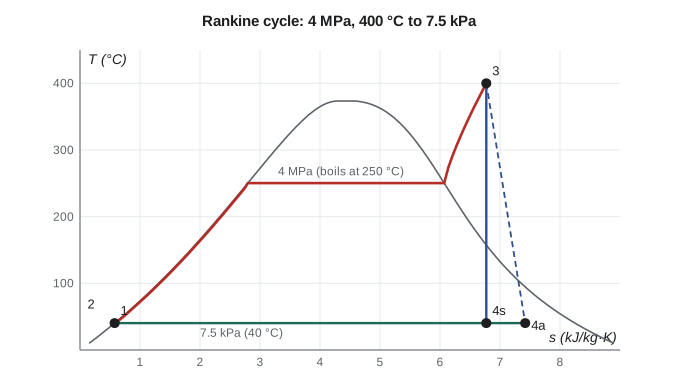
On the T-s diagram the area enclosed by the cycle is the net work, and the area under the heat-addition line 2-3 is the heat input. The average temperature of heat addition, \(\bar T_H = q_{\text{in}}/(s_3 - s_2)\), and the condensing temperature \(T_L\) act like the reservoir temperatures of a Carnot engine:
This form shows at a glance how to improve the cycle: raise the average temperature at which heat is added or lower the temperature at which it is rejected. Because so much of the heat in a Rankine cycle goes into warming and boiling water at temperatures well below the turbine inlet temperature, \(\bar T_H\) is much lower than \(T_3\), and the Rankine efficiency falls well short of the Carnot efficiency between the same extremes.
Deviations from the ideal cycle
Real plants depart from the ideal in several ways. Fluid friction causes pressure drops in the boiler, condenser and piping, so the pump must deliver more than the turbine inlet pressure and the turbine exhausts to slightly more than the condenser pressure. Heat is lost from hot pipes and components. Most important, the turbine and pump are not isentropic:
Large utility turbines reach isentropic efficiencies of about 0.88 to 0.92; a small condensing turbine of Northgate's size might reach about 0.80 to 0.85. The condensate leaving the condenser is also usually subcooled a few degrees below saturation, which wastes a little heat and must be supplied again in the boiler, but protects the pump against cavitation. Air leaking into the low-pressure condenser must be removed continuously, because it raises the condenser pressure and blankets the tubes.
# Rankine cycle for a summer condensing turbine at Northgate: ideal, actual and parametric studies
# Saturation data (P kPa: T C, hf, hfg, sf, sfg, vf), rounded from standard steam tables
SAT = {5: (32.87, 137.75, 2423.0, 0.4762, 7.9176, 0.001005),
       7.5: (40.29, 168.75, 2405.3, 0.5763, 7.6738, 0.001008),
       10: (45.81, 191.81, 2392.1, 0.6492, 7.4996, 0.001010),
       20: (60.06, 251.42, 2357.5, 0.8320, 7.0752, 0.001017)}
# Superheated steam (P kPa, T C): (h, s)
SUP = {(4000, 400): (3214.5, 6.7714), (4000, 500): (3445.8, 7.0919),
       (4000, 600): (3674.9, 7.3706), (8000, 500): (3399.5, 6.7266)}

def rankine(Pb, Tb, Pc, eta_t=1.0, eta_p=1.0):
    Tsat, hf, hfg, sf, sfg, vf = SAT[Pc]
    h3, s3 = SUP[(Pb, Tb)]
    wp = vf * (Pb - Pc) / eta_p
    h1, h2 = hf, hf + wp
    x4s = (s3 - sf) / sfg
    h4s = hf + x4s * hfg
    h4 = h3 - eta_t * (h3 - h4s)
    x4 = (h4 - hf) / hfg
    wt, qin = h3 - h4, h3 - h2
    return dict(wp=wp, wt=wt, qin=qin, qout=h4 - h1, eta=(wt - wp) / qin, x4=x4, h4=h4, Tsat=Tsat)

print("summer condensing: 4 MPa, 400 C to 7.5 kPa")
for label, et, ep in (("ideal", 1, 1), ("actual", 0.82, 0.75)):
    r = rankine(4000, 400, 7.5, et, ep)
    print(f"  {label:6s} wp = {r['wp']:4.2f}  wt = {r['wt']:6.1f}  qin = {r['qin']:6.1f}  eta = {r['eta']:.3f}  exit x = {r['x4']:.3f}")
r = rankine(4000, 400, 7.5, 0.82, 0.75)
m = 12.0
print(f"  12 kg/s gives {m * (r['wt'] - r['wp']) * 0.96:.0f} kW of electricity (generator 0.96) and rejects {m * r['qout']:.0f} kW to the river")

print("\ncondenser pressure (actual, 4 MPa 400 C)")
for Pc in (5, 7.5, 10, 20):
    r = rankine(4000, 400, Pc, 0.82, 0.75)
    print(f"  {Pc:4} kPa (Tsat {r['Tsat']:5.1f} C): eta = {r['eta']:.3f}, exit quality = {r['x4']:.3f}")

print("\nsuperheat and boiler pressure (ideal, 10 kPa)")
for Pb, Tb in ((4000, 400), (4000, 500), (4000, 600), (8000, 500)):
    r = rankine(Pb, Tb, 10)
    print(f"  {Pb / 1000:.0f} MPa, {Tb} C: eta = {r['eta']:.3f}, exit quality = {r['x4']:.3f}, wnet = {r['wt'] - r['wp']:6.1f} kJ/kg")

# Exergy accounting for the actual summer cycle, per kg of steam, T0 = 298.15 K
T0 = 298.15
Tsat, hf, hfg, sf, sfg, vf = SAT[7.5]
h3, s3 = SUP[(4000, 400)]
r = rankine(4000, 400, 7.5, 0.82, 0.75)
s4 = sf + r['x4'] * sfg
s2 = sf + 0.0005                      # small entropy rise in the real pump (estimate)
q_fuel_exergy = 1.04 * r['qin'] / 0.85
x_boiler = q_fuel_exergy - ((h3 - (hf + r['wp'])) - T0 * (s3 - s2))
x_turb = T0 * (s4 - s3)
x_cond = (r['h4'] - hf) - T0 * (s4 - sf)        # exergy of the steam rejected to the river
wnet = r['wt'] - r['wp']
print(f"\nexergy per kg (fuel exergy {q_fuel_exergy:.0f}): net work {wnet:.0f}, boiler loss {x_boiler:.0f},"
f" turbine {x_turb:.0f}, condenser {x_cond:.0f}")summer condensing: 4 MPa, 400 C to 7.5 kPa
ideal wp = 4.02 wt = 1103.9 qin = 3041.7 eta = 0.362 exit x = 0.807
actual wp = 5.37 wt = 905.2 qin = 3040.4 eta = 0.296 exit x = 0.890
12 kg/s gives 10366 kW of electricity (generator 0.96) and rejects 25686 kW to the river
condenser pressure (actual, 4 MPa 400 C)
5 kPa (Tsat 32.9 C): eta = 0.305, exit quality = 0.881
7.5 kPa (Tsat 40.3 C): eta = 0.296, exit quality = 0.890
10 kPa (Tsat 45.8 C): eta = 0.289, exit quality = 0.897
20 kPa (Tsat 60.1 C): eta = 0.271, exit quality = 0.915
superheat and boiler pressure (ideal, 10 kPa)
4 MPa, 400 C: eta = 0.353, exit quality = 0.816, wnet = 1065.9 kJ/kg
4 MPa, 500 C: eta = 0.368, exit quality = 0.859, wnet = 1195.0 kJ/kg
4 MPa, 600 C: eta = 0.384, exit quality = 0.896, wnet = 1335.2 kJ/kg
8 MPa, 500 C: eta = 0.394, exit quality = 0.810, wnet = 1261.2 kJ/kg
exergy per kg (fuel exergy 3720): net work 900, boiler loss 2527, turbine 189, condenser 104Worked problem
Northgate summer condensing cycle
Steam at 4 MPa and 400 °C (\(h_3 = 3214.5\), \(s_3 = 6.7714\)) expands to 7.5 kPa (\(T_{sat} = 40.29\) °C, \(h_f = 168.75\), \(h_{fg} = 2405.3\), \(s_f = 0.5763\), \(s_{fg} = 7.6738\), \(v_f = 0.001008\)). The turbine efficiency is 0.82 and the pump efficiency 0.75. Find the thermal efficiency of the actual cycle, the turbine exit quality, and the electricity and heat rejected for 12 kg/s of steam with a 96 percent efficient generator.
Show solution
- Pump: \(w_p = 0.001008(4000 - 7.5)/0.75 = 5.37\) kJ/kg; \(h_2 = 174.1\) kJ/kg.
- Isentropic exit: \(x_{4s} = (6.7714 - 0.5763)/7.6738 = 0.807\); \(h_{4s} = 168.75 + 0.807(2405.3) = 2110.6\) kJ/kg.
- Actual exit: \(h_{4a} = 3214.5 - 0.82(3214.5 - 2110.6) = 2309.3\) kJ/kg; \(x_{4a} = (2309.3 - 168.75)/2405.3 = 0.890\).
- \(w_t = 905.2\) kJ/kg; \(q_{\text{in}} = 3214.5 - 174.1 = 3040.4\) kJ/kg.
- \[\eta_{th} = \frac{905.2 - 5.4}{3040.4} = 0.296\]
- Electricity: \(12(899.8)(0.96) = 10{,}370\) kW. Heat to the river: \(12(2309.3 - 168.75) = 25{,}690\) kW.
Answer: About 30 percent of the heat added becomes net work, and the condenser rejects about 25.7 MW to the river, two and a half times the electricity produced. With 85 percent boiler efficiency, only about 25 percent of the fuel energy reaches the grid. The ideal cycle would give 36.2 percent; the gap is almost entirely the turbine's inefficiency.
How the design variables matter
The program's parametric blocks show the three classic levers.
Lowering the condenser pressure lowers \(T_L\). For the actual cycle, dropping from 20 kPa (60 °C) to 5 kPa (33 °C) raises efficiency from 0.271 to 0.305. The condenser pressure is set by the cooling water temperature plus the temperature rise of the water and the approach in the condenser, so plants on cold northern rivers and lakes enjoy a natural advantage. Lower condenser pressure also lowers the exit quality and raises the volume flow at the turbine exit enormously, which calls for longer last-stage blades.
Raising the superheat temperature raises \(\bar T_H\) and also dries the turbine exhaust. At 4 MPa, raising the turbine inlet from 400 to 600 °C raises the ideal efficiency from 0.353 to 0.384 and the exit quality from 0.816 to 0.896. The limit is metallurgical: superheater tubes and turbine inlet parts must withstand creep at high temperature and pressure for decades.
Raising the boiler pressure raises the boiling temperature and hence \(\bar T_H\). At 500 °C, going from 4 to 8 MPa raises the ideal efficiency from 0.368 to 0.394. But it lowers the exit quality, from 0.859 to 0.810, because the expansion line starts further to the left on the T-s diagram. Exit quality below about 0.88 to 0.90 causes droplet erosion of the last-stage blades and a loss of efficiency, roughly one percent of stage efficiency for each percent of moisture. Higher pressure therefore needs higher superheat or reheat (Lesson 6) to keep the exhaust dry enough.
| Change (ideal, 10 kPa condenser) | Thermal efficiency | Exit quality | Net work (kJ/kg) |
|---|---|---|---|
| 4 MPa, 400 °C (base) | 0.353 | 0.816 | 1066 |
| 4 MPa, 500 °C | 0.368 | 0.859 | 1195 |
| 4 MPa, 600 °C | 0.384 | 0.896 | 1335 |
| 8 MPa, 500 °C | 0.394 | 0.810 | 1261 |
Worked problem
Average temperature of heat addition
For the ideal cycle at 4 MPa and 400 °C with a 10 kPa condenser, the program gives \(q_{\text{in}} = 3018.7\) kJ/kg. With \(s_2 \approx s_1 = 0.6492\) and \(s_3 = 6.7714\), find \(\bar T_H\) and check the efficiency with the Carnot-like formula.
Show solution
- \(\bar T_H = 3018.7/(6.7714 - 0.6492) = 493.1\) K, about 220 °C.
- \(T_L = 45.81 + 273.15 = 318.96\) K.
- \[\eta = 1 - \frac{318.96}{493.1} = 0.353\]
Answer: The match with the energy-balance result is exact, because both methods describe the same internally reversible cycle. Although the steam reaches 400 °C, heat is added on average at only 220 °C. That is the Rankine cycle's central weakness, and every improvement in Lesson 6 attacks it.
Energy and exergy views of the same plant
An energy balance on the summer cycle says the condenser is the big loss: it rejects about 70 percent of the heat added. An exergy balance tells a different story. The last line of the program's output divides the fuel's exergy, about 3720 kJ per kilogram of steam, into net work (900), exergy destroyed or lost in the boiler including the stack (about 2530), exergy destroyed in the turbine (189) and exergy carried to the river with the exhaust steam (about 104). The condenser rejects a huge amount of energy but very little exergy, because the heat is released at 40 °C, close to the dead state. The boiler, again, is where most of the work potential disappears.
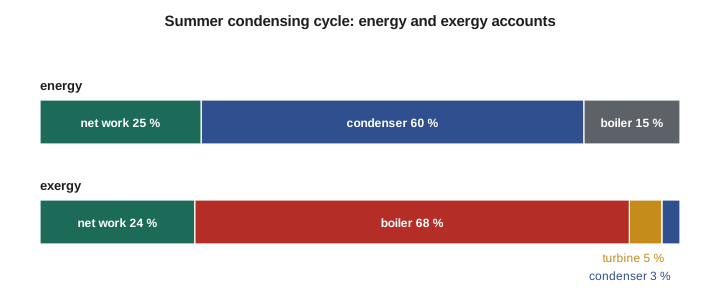
The practical lesson is that improving a power plant means attacking the exergy losses. A better condenser can lower the condensing temperature a few degrees and gain a percent or two, worthwhile but limited. Raising the temperature at which the steam receives heat, or putting a gas turbine above the steam cycle so that the steam is raised by exhaust rather than by a flame, attacks the dominant loss. Lessons 6 and 7 do both.
Is the summer turbine worth it?
Tomás's numbers settle Graham's question in an unexpected way. A condensing turbine would turn only about a quarter of the gas's energy into electricity, and in Manitoba the electricity it displaced would be hydroelectric. Burning gas at 25 percent efficiency to displace low-carbon electricity would raise emissions and would rarely pay. Elena's team keeps the idea only as a backup source of power during grid emergencies, with the gas turbine of Lesson 3 as the better way to make electricity at Northgate.
The study also records why large central steam plants do far better: they raise steam at 16 to 30 MPa and 540 to 600 °C, reheat it, preheat the feedwater with extraction steam and run turbines with efficiencies near 90 percent, reaching 38 to 47 percent overall. Lesson 6 develops those improvements.
In SI practice, condenser performance is described by the condenser pressure in kPa absolute and the terminal temperature difference between the condensing steam and the outlet cooling water, usually 3 to 6 K.
Common mistakes
MistakeUsing the isentropic exit enthalpy as the actual exit enthalpy.
Insteadh₄a = h₃ − η_t(h₃ − h₄s); the actual exit has higher enthalpy and quality.
MistakeNeglecting pump work entirely in efficiency calculations.
InsteadPump work is small but should be included; it also raises h₂.
MistakeLowering condenser pressure without checking the cooling water.
InsteadThe condensing temperature must stay above the cooling-water outlet temperature.
MistakeRaising boiler pressure without checking exit quality.
InsteadHigher pressure at fixed superheat lowers exit quality and causes blade erosion.
MistakeCalling the condenser the plant's biggest loss.
InsteadIt is the biggest energy loss but a small exergy loss; the boiler destroys the most exergy.
Summary and key terms
- The ideal Rankine cycle: isentropic pumping, constant-pressure heating, isentropic expansion and constant-pressure condensation.
- η = (w_t − w_p)/q_in = 1 − T_L/T̄_H, where T̄_H is the average temperature of heat addition.
- Real cycles lose efficiency mainly through turbine irreversibility, plus pressure drops and heat losses.
- Lower condenser pressure, higher superheat and higher boiler pressure raise efficiency.
- Higher boiler pressure lowers exit quality; exhaust moisture above about 10 to 12 percent harms the turbine.
- The condenser rejects most of the energy but little exergy; the boiler destroys most of the exergy.
- Rankine cycle
- The ideal cycle for vapour power plants: pump, boiler, turbine and condenser.
- Superheat
- Heating steam above its saturation temperature at the boiler pressure.
- Condenser pressure
- The pressure at which turbine exhaust is condensed, set by the cooling-water temperature.
- Exit quality
- The vapour mass fraction of the turbine exhaust; low values cause blade erosion.
- Average temperature of heat addition
- The heat added divided by the entropy rise of the working fluid during heat addition.
- Isentropic turbine efficiency
- The actual turbine work divided by the work of an isentropic expansion to the same exit pressure.
- Subcooling
- Cooling condensate below its saturation temperature.
- Back-pressure turbine
- A turbine that exhausts to a process or district steam main instead of a condenser.
Practice problems
Work each problem on paper first, then reveal the answer to check.
In the ideal summer cycle, what is the heat rejected per kilogram?
Show answer
About 1942 kJ/kg.
Find the actual efficiency with a turbine efficiency of 0.88 (other data unchanged).
Show answer
About 0.318.
With 12 kg/s and the actual cycle, how much cooling water is needed for a 10 K rise?
Show answer
About 614 kg/s.
Using T̄_H, explain why superheating raises efficiency.
Show answer
Heat added at higher temperature raises the average temperature of heat addition.
In the program, what condenser pressure gives an actual efficiency above 0.30?
Show answer
5 kPa (0.305).
Why must air be removed from a condenser continuously?
Show answer
It raises the condenser pressure and insulates the tubes, lowering efficiency.
Lesson quiz · 5 questions
Score 60% or more to complete this lesson.
Create a free account to save your progress, take quizzes and earn a certificate.