
MEC-330 · Lesson 3 of 12 · 26 min
Gas turbines: the Brayton cycle with regeneration, intercooling and reheat
Kofi Mensah's second option for the top of Northgate's plant is a single gas turbine of about 6 MW. A gas turbine compresses air, burns fuel in it at constant pressure and expands the hot gas through a turbine that drives both the compressor and a generator. It is compact, runs for long periods between overhauls, and rejects nearly all its waste heat in one hot exhaust stream, which is ideal for raising steam. Its weaknesses are a lower efficiency than the best engines at this size and a strong sensitivity to the temperature of the air it breathes. The Brayton cycle, the air-standard model of the gas turbine, explains both.
The ideal Brayton cycle
In the open-cycle gas turbine, fresh air enters the compressor and exhaust leaves the turbine. The air-standard model closes the loop with a heat exchanger that rejects heat at constant pressure. The ideal Brayton cycle then has four internally reversible processes: (1-2) isentropic compression, (2-3) heat addition at constant pressure, (3-4) isentropic expansion, and (4-1) heat rejection at constant pressure. Each component is a steady-flow device, so with constant specific heats
With the pressure ratio \(r_p = P_2/P_1\), the isentropic relations give \(T_2/T_1 = T_3/T_4 = r_p^{(k-1)/k}\), and the thermal efficiency becomes
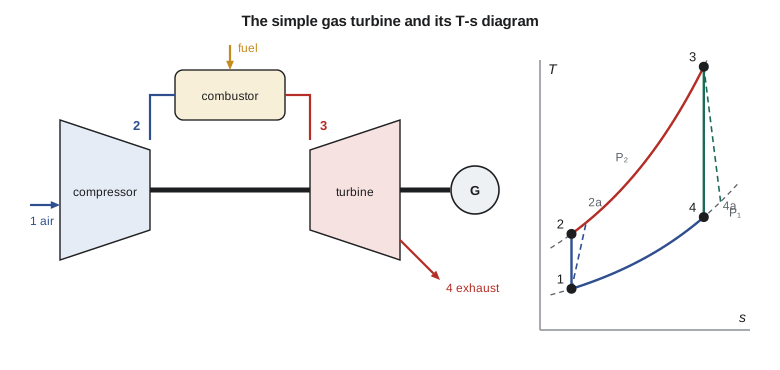
As in the Otto cycle, efficiency depends only on a ratio and on \(k\). Raising the pressure ratio raises the average temperature at which heat is added and lowers the average temperature at which it is rejected. But the turbine inlet temperature \(T_3\) is fixed by what the turbine's first-stage blades can survive, and that sets a limit on the net work. For fixed \(T_1\) and \(T_3\), the ideal net work per kilogram of air is greatest when
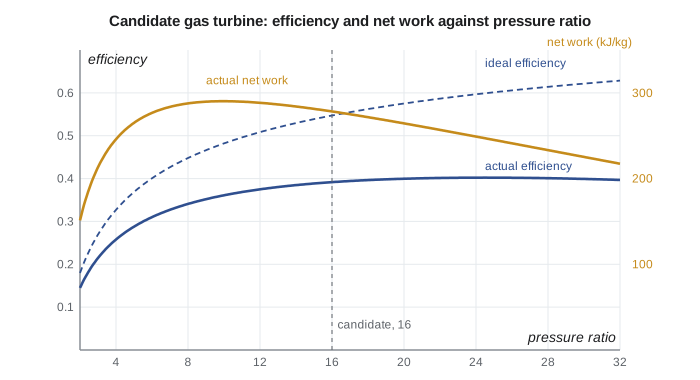
At very high pressure ratios the compressor work approaches the turbine work and the net work shrinks toward zero, even though the efficiency keeps rising. A gas turbine designer chooses the pressure ratio between the value for maximum work, which gives the smallest machine for a given power, and the higher value for maximum efficiency.
The back work ratio and real components
The feature that sets gas turbines apart from steam plants is the back work ratio, the fraction of the turbine's work used to drive the compressor. Compressing a gas takes far more work than pumping a liquid, and in a gas turbine the back work ratio is typically 0.4 to 0.6. Every percent of compressor or turbine inefficiency therefore costs several percent of net output. With isentropic efficiencies \(\eta_c\) and \(\eta_t\),
Early gas turbines of the 1930s and 1940s, with component efficiencies near 70 percent, barely produced net work. Modern machines reach polytropic efficiencies of about 90 percent in both compressor and turbine and turbine inlet temperatures far above the melting point of the blade alloys, made possible by internal air cooling, thermal-barrier coatings and single-crystal superalloys. The cooling air is bled from the compressor and bypasses part of the expansion, which is one reason real machines fall short of the simple cycle prediction.
Northgate's candidate turbine
The candidate machine has a pressure ratio of 16, a turbine inlet temperature of 1400 K, a compressor efficiency of 0.86 and a turbine efficiency of 0.89. The program models it with cold-air-standard properties at three inlet temperatures: the ISO rating condition of 15 °C, a Winnipeg winter day at −30 °C and a summer day at 30 °C. It then sweeps the pressure ratio and tests regeneration.
# Brayton cycle: Northgate's candidate gas turbine, pressure ratio, ambient temperature and regeneration
cp, k = 1.005, 1.4
e = (k - 1) / k

def brayton(rp, T1, T3, eta_c=1.0, eta_t=1.0, regen=0.0):
    T2 = T1 * (1 + (rp ** e - 1) / eta_c)
    T4 = T3 * (1 - eta_t * (1 - rp ** -e))
    wc, wt = cp * (T2 - T1), cp * (T3 - T4)
    T5 = T2 + regen * (T4 - T2)          # air leaving the regenerator (regen = effectiveness)
    qin = cp * (T3 - T5)
    return dict(T2=T2, T4=T4, wc=wc, wt=wt, wnet=wt - wc, bwr=wc / wt, eta=(wt - wc) / qin, T5=T5)

rp, T3 = 16, 1400.0
print("pressure ratio 16, turbine inlet 1400 K, compressor 0.86, turbine 0.89")
for T1, label in ((288.15, "ISO day 15 C"), (243.15, "winter -30 C"), (303.15, "summer 30 C")):
    c = brayton(rp, T1, T3, 0.86, 0.89)
    m = 6000 / c['wnet']
    print(f"  {label:13s} T2 = {c['T2']:5.0f} K  T4 = {c['T4']:5.0f} K  wnet = {c['wnet']:5.1f} kJ/kg"
          f"  bwr = {c['bwr']:.2f}  eta = {c['eta']:.3f}  air for 6 MW = {m:4.1f} kg/s")

print("\neffect of pressure ratio at 15 C (ideal and actual)")
for r in (4, 8, 12, 16, 20, 24, 30):
    i, a = brayton(r, 288.15, T3), brayton(r, 288.15, T3, 0.86, 0.89)
    print(f"  rp = {r:2d}: ideal eta = {i['eta']:.3f} wnet = {i['wnet']:5.1f}   actual eta = {a['eta']:.3f} wnet = {a['wnet']:5.1f}")
print(f"  pressure ratio for maximum ideal net work = {(T3 / 288.15) ** (k / (2 * (k - 1))):.1f}")

print("\nregeneration (effectiveness 0.80) at 15 C")
for r in (4, 6, 8, 16):
    plain, reg = brayton(r, 288.15, T3, 0.86, 0.89), brayton(r, 288.15, T3, 0.86, 0.89, 0.80)
    gain = "helps" if reg['eta'] > plain['eta'] else "no gain: T4 < T2"
    print(f"  rp = {r:2d}: T2 = {plain['T2']:4.0f} K, T4 = {plain['T4']:4.0f} K, eta {plain['eta']:.3f} -> {reg['eta']:.3f} ({gain})")

# Ideal two-stage intercooling and reheat with perfect regeneration, overall pressure ratio 16
ri = 16 ** 0.5
wc = 2 * cp * 288.15 * (ri ** e - 1); wt = 2 * cp * T3 * (1 - ri ** -e)
qin_noregen = cp * (T3 - 288.15 * ri ** e) + cp * (T3 - T3 * ri ** -e)
print(f"\nideal intercool + reheat, rp = 16: wnet = {wt - wc:.1f} kJ/kg, eta without regenerator = {(wt - wc) / qin_noregen:.3f},"
f" with ideal regenerator = {1 - 288.15 / T3 * ri ** e:.3f}")pressure ratio 16, turbine inlet 1400 K, compressor 0.86, turbine 0.89 ISO day 15 C T2 = 693 K T4 = 718 K wnet = 278.3 kJ/kg bwr = 0.59 eta = 0.392 air for 6 MW = 21.6 kg/s winter -30 C T2 = 585 K T4 = 718 K wnet = 341.8 kJ/kg bwr = 0.50 eta = 0.417 air for 6 MW = 17.6 kg/s summer 30 C T2 = 729 K T4 = 718 K wnet = 257.1 kJ/kg bwr = 0.62 eta = 0.381 air for 6 MW = 23.3 kg/s effect of pressure ratio at 15 C (ideal and actual) rp = 4: ideal eta = 0.327 wnet = 319.4 actual eta = 0.258 wnet = 245.9 rp = 8: ideal eta = 0.448 wnet = 395.3 actual eta = 0.341 wnet = 287.7 rp = 12: ideal eta = 0.508 wnet = 415.8 actual eta = 0.375 wnet = 288.4 rp = 16: ideal eta = 0.547 wnet = 419.9 actual eta = 0.392 wnet = 278.3 rp = 20: ideal eta = 0.575 wnet = 417.2 actual eta = 0.400 wnet = 264.4 rp = 24: ideal eta = 0.597 wnet = 411.1 actual eta = 0.402 wnet = 249.0 rp = 30: ideal eta = 0.622 wnet = 398.9 actual eta = 0.399 wnet = 225.2 pressure ratio for maximum ideal net work = 15.9 regeneration (effectiveness 0.80) at 15 C rp = 4: T2 = 451 K, T4 = 992 K, eta 0.258 -> 0.474 (helps) rp = 6: T2 = 512 K, T4 = 901 K, eta 0.310 -> 0.477 (helps) rp = 8: T2 = 560 K, T4 = 842 K, eta 0.341 -> 0.466 (helps) rp = 16: T2 = 693 K, T4 = 718 K, eta 0.392 -> 0.403 (helps) ideal intercool + reheat, rp = 16: wnet = 638.8 kJ/kg, eta without regenerator = 0.445, with ideal regenerator = 0.694
Worked problem
The gas turbine at its rating condition
Air enters the compressor at 15 °C (288.15 K). The pressure ratio is 16, the turbine inlet temperature 1400 K, \(\eta_c = 0.86\) and \(\eta_t = 0.89\). Using \(c_p = 1.005\) kJ/kg·K and \(k = 1.4\), find the net work, the back work ratio, the thermal efficiency, and the air flow for 6 MW of net power.
Show solution
- \(r_p^{(k-1)/k} = 16^{0.2857} = 2.208\).
- Compressor: \(T_{2s} = 288.15(2.208) = 636.3\) K; \(T_2 = 288.15 + (636.3 - 288.15)/0.86 = 693.0\) K; \(w_c = 1.005(693.0 - 288.15) = 406.9\) kJ/kg.
- Turbine: \(T_{4s} = 1400/2.208 = 634.0\) K; \(T_4 = 1400 - 0.89(1400 - 634.0) = 718.3\) K; \(w_t = 1.005(1400 - 718.3) = 685.1\) kJ/kg.
- \(w_{\text{net}} = 278.2\) kJ/kg; back work ratio \(= 406.9/685.1 = 0.59\); \(q_{\text{in}} = 1.005(1400 - 693.0) = 710.5\) kJ/kg.
- \[\eta = \frac{278.2}{710.5} = 0.392 \qquad \dot m = \frac{6000}{278.2} = 21.6\ \text{kg/s}\]
Answer: The cycle model gives 39 percent; machines of this size actually reach roughly 30 to 36 percent, because of cooling air, pressure losses in the inlet, combustor and exhaust, and the higher specific heat of the combustion gases. The exhaust leaves at about 718 K (445 °C) and carries roughly 60 percent of the fuel energy, which a heat-recovery steam generator can turn into Northgate steam (Lesson 7).
The effect of air temperature
The program's first block shows why gas turbines love cold weather. At −30 °C the compressor needs much less work, because work per kilogram is proportional to the inlet temperature, and the denser air means more mass flows through the same machine. The net work per kilogram rises from 278 to 342 kJ/kg and the efficiency from 0.392 to 0.417. At 30 °C both fall. Because a real turbine's compressor swallows a nearly fixed volume of air per second, the mass flow also changes with density, and the power output swings even more than the work per kilogram. Manufacturers publish curves showing output falling by roughly 0.5 to 0.8 percent for every degree Celsius above the rating temperature.
For Northgate this is good news: the district heating load peaks in a Winnipeg winter, exactly when the turbine is most capable. In summer, when output sags, the plant's heat load is small anyway. Plants in hot climates often cool the inlet air with evaporative coolers or chillers to recover summer output; Lesson 11 analyzes evaporative cooling.
Pressure ratio
The second block of output sweeps the pressure ratio. For the ideal cycle, efficiency rises steadily and net work peaks near \(r_p = 16\), matching the formula \((1400/288.15)^{1.75} = 15.9\). For the actual cycle, both curves are flatter and peak earlier: the net work is greatest near a pressure ratio of 10 to 12, and the efficiency peaks near 24 and then falls, because component losses grow with the work they handle. The candidate machine's ratio of 16 sits between the two peaks.
Regeneration
In a simple-cycle gas turbine with a low pressure ratio, the exhaust leaves hotter than the compressed air. A regenerator, or recuperator, is a heat exchanger that uses the exhaust to preheat the compressed air before the combustor, so less fuel is needed for the same turbine inlet temperature. Its effectiveness compares the actual temperature rise of the air with the largest possible rise:
Regeneration helps only when \(T_4 > T_2\). The program shows the effect for an effectiveness of 0.80: at a pressure ratio of 4 the efficiency jumps from 0.258 to 0.474, at 6 it rises from 0.310 to 0.477, and at 16 it barely moves, because the exhaust (718 K) is only slightly hotter than the compressed air (693 K). This is why recuperated gas turbines, such as microturbines of 30 to 300 kW, use low pressure ratios of about 3 to 5. A recuperator adds cost, weight and pressure loss, and it lowers the exhaust temperature, which is a disadvantage when the exhaust heat is wanted for cogeneration. For Northgate, Elena's team concludes that a recuperator makes no sense: the exhaust heat is the point.
Intercooling and reheat
The work to compress a gas between two pressures falls if the gas is cooled during compression, and the work from a turbine rises if heat is added during expansion. Practical machines approximate these ideas by compressing in stages with intercoolers between them and expanding in stages with reheat combustors between them. For two stages with perfect intercooling back to \(T_1\) and reheating back to \(T_3\), the net work is greatest when each stage has the same pressure ratio, \(\sqrt{r_p}\).
Intercooling and reheat greatly increase the net work, by about half again in the program's example, but on their own they lower the efficiency, because the extra heat is added at a lower average temperature and the exhaust leaves hotter. Combined with regeneration, the picture changes: the hotter exhaust preheats the air, and as the number of stages grows the cycle approaches the Ericsson cycle, with isothermal compression and expansion and an efficiency approaching Carnot. The program finds 0.445 without a regenerator and 0.694 with an ideal one for two stages. Aeroderivative turbines with intercooling exist, and some large heavy-duty turbines use sequential (reheat) combustion, but most machines in Northgate's size range are simple cycle.
Worked problem
Optimum pressure ratio and the limits of regeneration
For the ideal Brayton cycle with \(T_1 = 288.15\) K and \(T_3 = 1400\) K, find the pressure ratio for maximum net work, and show that regeneration cannot help an ideal cycle operating at that ratio.
Show solution
- \(r_p = (1400/288.15)^{1.4/0.8} = 4.859^{1.75} = 15.9\).
- At that ratio, \(T_2 = 288.15(15.9)^{0.2857} = 635\) K and \(T_4 = 1400/(15.9)^{0.2857} = 635\) K.
- With \(T_4 = T_2\), the exhaust is no hotter than the compressed air, so there is no temperature difference to drive a regenerator.
Answer: At maximum net work the compressor exit and turbine exit temperatures are equal, both \(\sqrt{T_1 T_3}\). Regeneration helps only below this ratio, and the gain grows as the ratio falls. Real machines, with their losses, reach the crossover at a somewhat higher ratio (about 17 for the candidate turbine), consistent with the small gain the program found at 16.
Deviations from the ideal cycle
Beyond component inefficiencies, real gas turbines differ from the air-standard model in several ways. The working fluid after the combustor is a mixture of nitrogen, carbon dioxide, water vapour and excess oxygen with a higher specific heat than air; its \(c_p\) also rises with temperature. The fuel adds about 2 percent to the mass flow through the turbine. Pressure drops in the inlet filter, the combustor and the exhaust system reduce the expansion ratio available to the turbine; an exhaust back-pressure of a few kilopascals, typical of a heat-recovery steam generator, costs about a percent of output. And cooling air bled from the compressor bypasses part of the turbine. Lesson 12's combustion analysis will let us replace the air-standard heat addition with an actual fuel flow.
The air-standard model still earns its place. It shows which variables matter, gives correct trends with ambient temperature and pressure ratio, and lets the team check a manufacturer's performance figures for reasonableness. Tomás builds the candidate machine's predicted output against outdoor temperature from the program and finds that it agrees with the vendor's published curve within a few percent after he applies the vendor's stated efficiency at the rating point.
In SI work, gas turbine performance is quoted at ISO conditions: 15 °C, 101.325 kPa and 60 percent relative humidity. Heat rate, the fuel energy per unit of electricity, is often quoted in kJ/kWh: a 34 percent efficient machine has a heat rate of 3600/0.34 = 10,600 kJ/kWh.
Common mistakes
MistakeThinking that a higher pressure ratio always gives more power.
InsteadNet work peaks at an intermediate ratio; efficiency peaks at a higher one.
MistakeAdding a regenerator to a high-pressure-ratio machine.
InsteadRegeneration helps only when T₄ > T₂.
MistakeIgnoring the back work ratio when judging component losses.
InsteadWith a back work ratio near 0.5, small component losses cost large fractions of net work.
MistakeApplying intercooling and reheat without regeneration and expecting higher efficiency.
InsteadIntercooling and reheat raise work but lower efficiency unless a regenerator is added.
MistakeAssuming output is independent of weather.
InsteadHot inlet air reduces both the work per kilogram and the mass flow.
Summary and key terms
- The ideal Brayton cycle: isentropic compression, constant-pressure heat addition, isentropic expansion, constant-pressure heat rejection.
- η = 1 − 1/r_p^((k−1)/k); net work is greatest at r_p = (T₃/T₁)^(k/(2(k−1))).
- Gas turbines have high back work ratios, so component efficiency is critical.
- Cold inlet air raises both efficiency and output; hot air lowers them.
- Regeneration preheats compressed air with exhaust and helps only when T₄ > T₂, mostly at low pressure ratios.
- Intercooling and reheat raise net work; with regeneration they move the cycle toward the Ericsson cycle.
- For cogeneration, a simple cycle with hot exhaust is usually preferred over a recuperated one.
- Brayton cycle
- The ideal cycle for gas turbines, with constant-pressure heat addition and rejection.
- Pressure ratio
- The ratio of compressor exit to inlet pressure.
- Turbine inlet temperature
- The temperature of the gas entering the first turbine stage, limited by blade materials and cooling.
- Back work ratio
- The fraction of turbine work used to drive the compressor.
- Regenerator
- A heat exchanger that preheats compressed air with turbine exhaust; also called a recuperator.
- Effectiveness
- The ratio of the actual heat transferred in a heat exchanger to the maximum possible.
- Intercooling
- Cooling a gas between compression stages to reduce compressor work.
- Reheat
- Adding heat between turbine stages to increase turbine work.
- Heat rate
- Fuel energy supplied per unit of electricity generated, the inverse of efficiency.
- ISO conditions
- The standard rating conditions for gas turbines: 15 °C, 101.325 kPa and 60 percent relative humidity.
Practice problems
Work each problem on paper first, then reveal the answer to check.
Find the ideal Brayton efficiency at r_p = 10.
Show answer
0.482.
For T₁ = 300 K and T₃ = 1300 K, what pressure ratio gives the greatest ideal net work?
Show answer
About 13.0.
In the candidate machine, what is the compressor exit temperature on a −30 °C day?
Show answer
About 585 K.
A regenerator with ε = 0.75 receives air at 500 K and exhaust at 900 K. What is the air exit temperature?
Show answer
800 K.
In the program, raise the turbine inlet temperature to 1500 K. What are the efficiency and net work at 15 °C?
Show answer
About 0.403 and 327 kJ/kg.
A gas turbine has a heat rate of 11,000 kJ/kWh. What is its efficiency?
Show answer
0.327.
Lesson quiz · 5 questions
Score 60% or more to complete this lesson.
Create a free account to save your progress, take quizzes and earn a certificate.