
MATH-322 · Lesson 9 of 12 · 23 min
Normal subgroups and quotient groups
Lesson 8 showed that a homomorphism collapses each coset of its kernel to a single point. This suggests running the process backwards: start with a subgroup \(N\), treat each coset of \(N\) as a single object, and try to multiply the cosets. That works only for special subgroups, the normal ones. When it works, the cosets form a new and smaller group, the quotient group \(G/N\). Quotients are how we simplify a group by deliberately ignoring part of its structure, much as arithmetic modulo \(n\) ignores multiples of \(n\).
Conjugation and normal subgroups
Recall from lesson 5 that \(gag^{-1}\) is the conjugate of \(a\) by \(g\). For a subgroup \(H\), write \(gHg^{-1} = \{ghg^{-1} : h \in H\}\). It is again a subgroup, the image of \(H\) under the inner automorphism \(c_g\), and has the same order as \(H\).
Definition. A subgroup \(N\) of \(G\) is normal, written \(N \trianglelefteq G\), if \(gNg^{-1} = N\) for every \(g \in G\).
Theorem. For a subgroup \(N \le G\), the following are equivalent: (i) \(gng^{-1} \in N\) for all \(g \in G\), \(n \in N\); (ii) \(gNg^{-1} = N\) for all \(g\); (iii) \(gN = Ng\) for all \(g\), that is, every left coset is a right coset.
Proof: (i) says \(gNg^{-1} \subseteq N\) for every \(g\). Applying it to \(g^{-1}\) gives \(g^{-1}Ng \subseteq N\), hence \(N \subseteq gNg^{-1}\), which with (i) gives (ii). From (ii), \(gN = gNg^{-1}g = Ng\), giving (iii). From (iii), for \(n \in N\), \(gn \in gN = Ng\), so \(gn = n'g\) for some \(n' \in N\), and \(gng^{-1} = n' \in N\), giving (i).
Condition (i) is the one to check in practice: a subgroup is normal when it is closed under conjugation by every element of the group. Condition (iii) explains the connection with lesson 7: normal subgroups are exactly those whose left and right cosets agree.
Examples and non-examples
- Every subgroup of an abelian group is normal, since \(gng^{-1} = n\).
- The centre \(Z(G)\) is normal, for the same reason.
- Every kernel is normal: if \(\varphi(n) = e\) then \(\varphi(gng^{-1}) = \varphi(g)\,e\,\varphi(g)^{-1} = e\). So \(A_n \trianglelefteq S_n\) and \(SL_n(\mathbb{R}) \trianglelefteq GL_n(\mathbb{R})\).
- Every subgroup of index 2 is normal. If \([G:N] = 2\), the left cosets are \(N\) and its complement \(G \setminus N\), and so are the right cosets; hence \(gN = Ng\) for every \(g\). So the rotation subgroup of \(D_n\) is normal.
- In \(D_4\), the subgroup \(\langle r^2 \rangle = Z(D_4)\) is normal, and so are the three subgroups of order 4, all of index 2.
- In \(S_3\), \(H = \langle (1\,2) \rangle\) is not normal: \((1\,3)(1\,2)(1\,3)^{-1} = (2\,3) \notin H\), matching the unequal left and right cosets found in lesson 7.
- In \(D_4\), \(\langle s \rangle = \{e, s\}\) is not normal: \(r s r^{-1} = r^2 s \notin \langle s \rangle\).
The last example shows that normality is not transitive. The chain \(\langle s \rangle \le \{e, r^2, s, r^2s\} \le D_4\) has each subgroup of index 2 in the next, hence normal in the next, yet \(\langle s \rangle\) is not normal in \(D_4\).
Conjugation in \(S_n\) has a clean description that makes normality easy to test: \(\sigma (a_1\,a_2\,\cdots\,a_k) \sigma^{-1} = (\sigma(a_1)\,\sigma(a_2)\,\cdots\,\sigma(a_k))\). Relabel the entries of each cycle by \(\sigma\). So two permutations are conjugate in \(S_n\) exactly when they have the same cycle type, and a subgroup of \(S_n\) is normal exactly when it is a union of whole cycle types. For instance \(V = \{e, (1\,2)(3\,4), (1\,3)(2\,4), (1\,4)(2\,3)\}\) contains every permutation of type \((2, 2)\) and is therefore normal in \(S_4\).
Quotient groups
Let \(N \trianglelefteq G\) and let \(G/N\) be the set of left cosets of \(N\). Define
\[ (aN)(bN) = (ab)N. \]
Since a coset has many names, we must check that the product depends only on the cosets and not on the names chosen. Suppose \(aN = a'N\) and \(bN = b'N\), so \(a' = an_1\) and \(b' = bn_2\) with \(n_1, n_2 \in N\). Then
\[ a'b' = a n_1 b n_2 = ab\,(b^{-1} n_1 b)\, n_2, \]
and \(b^{-1}n_1b \in N\) by normality, so \(a'b' \in abN\) and \((a'b')N = (ab)N\). The operation is well defined. It is associative because multiplication in \(G\) is, the identity is \(eN = N\), and the inverse of \(aN\) is \(a^{-1}N\). So:
Theorem. If \(N \trianglelefteq G\), then \(G/N\) is a group under \((aN)(bN) = abN\), called the quotient group or factor group of \(G\) by \(N\). If \(G\) is finite, \(|G/N| = |G|/|N|\). The map \(\pi : G \to G/N\), \(\pi(a) = aN\), is a homomorphism onto \(G/N\) with kernel \(N\).
The last statement completes a circle: kernels are normal, and every normal subgroup is a kernel, namely of \(\pi\). Normality is not a technicality. For the non-normal \(H = \langle (1\,2) \rangle\) in \(S_3\), the names \(e\) and \((1\,2)\) give the same coset \(H\), and the names \((1\,3)\) and \((1\,3)(1\,2) = (1\,2\,3)\) give the same coset \((1\,3)H\); but \(e(1\,3) = (1\,3)\) and \((1\,2)(1\,2\,3) = (2\,3)\) lie in different cosets, since \((1\,3)^{-1}(2\,3) = (1\,3)(2\,3) = (1\,3\,2) \notin H\). The proposed product is not well defined.
Examples of quotient groups
- \(\mathbb{Z}/n\mathbb{Z} \cong \mathbb{Z}_n\): the cosets are the residue classes, added as in lesson 3. This is the model for every quotient.
- \(D_n/\langle r \rangle \cong \mathbb{Z}_2\): the two cosets are 'rotations' and 'reflections', which multiply by the rule of signs. More generally every group of order 2 is \(\mathbb{Z}_2\).
- \(S_n/A_n \cong \mathbb{Z}_2\): the quotient records only whether a permutation is even or odd.
- \(\mathbb{R}/\mathbb{Z}\) is the circle group: real numbers modulo 1, with addition of fractional parts. The map \(x \mapsto e^{2\pi i x}\) identifies it with the unit circle in \(\mathbb{C}\).
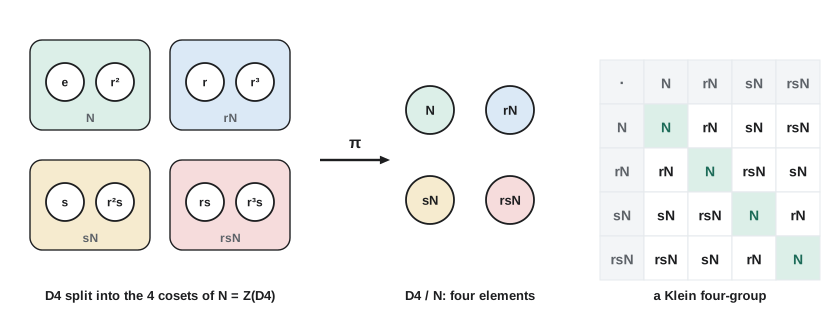
- \(D_4/Z(D_4)\), where \(Z(D_4) = \{e, r^2\}\), has order 4. Its cosets are \(N, rN, sN, rsN\), and every coset squares to the identity coset: \((rN)^2 = r^2N = N\), \((sN)^2 = N\), \((rsN)^2 = N\). So \(D_4/Z(D_4)\) is a Klein four-group.
Worked problem
Working in a quotient
Let \(G = \mathbb{Z}_4 \times \mathbb{Z}_2\) and \(N = \langle (2, 0) \rangle = \{(0,0), (2,0)\}\). Find the order of \((1, 1) + N\) in \(G/N\), and identify \(G/N\).
Show solution
- \(G\) is abelian, so \(N\) is normal, and \(|G/N| = 8/2 = 4\).
- \(2\big((1,1) + N\big) = (2, 0) + N = N\), since \((2,0) \in N\). And \((1,1) \notin N\). So the order is 2.
- In fact every element doubles into \(N\): \(2(a, b) = (2a, 0) \in N\). So every nonidentity element of \(G/N\) has order 2.
Answer: The coset has order 2, and \(G/N \cong \mathbb{Z}_2 \times \mathbb{Z}_2\).
Recognizing direct products
Normal subgroups also tell us when a group splits as a direct product of two smaller groups, without our having to construct the product from outside.
Theorem. Suppose \(N\) and \(M\) are normal subgroups of \(G\) with \(N \cap M = \{e\}\) and \(NM = G\). Then \(G \cong N \times M\), via \((n, m) \mapsto nm\).
Proof: first, elements of \(N\) commute with elements of \(M\). For \(n \in N\) and \(m \in M\), consider the commutator \(c = nmn^{-1}m^{-1}\). Grouping it as \(n(mn^{-1}m^{-1})\), it lies in \(N\), since \(mn^{-1}m^{-1} \in N\) by normality of \(N\). Grouping it as \((nmn^{-1})m^{-1}\), it lies in \(M\) by normality of \(M\). So \(c \in N \cap M = \{e\}\), and \(nm = mn\). Now the map \(\psi(n, m) = nm\) is a homomorphism: \(\psi(n_1n_2, m_1m_2) = n_1n_2m_1m_2 = n_1m_1n_2m_2 = \psi(n_1, m_1)\psi(n_2, m_2)\), using \(n_2m_1 = m_1n_2\). It is onto because \(NM = G\). Its kernel consists of pairs with \(nm = e\), so \(n = m^{-1} \in N \cap M\), giving \(n = m = e\). So \(\psi\) is an isomorphism.
Examples: in \(\mathbb{Z}_6\), \(N = \{0, 3\}\) and \(M = \{0, 2, 4\}\) satisfy the conditions, recovering \(\mathbb{Z}_6 \cong \mathbb{Z}_2 \times \mathbb{Z}_3\). In \(D_6\), the subgroup \(\{e, r^3\}\) (the centre) and the subgroup \(\{e, r^2, r^4, s, r^2s, r^4s\}\) (a copy of \(D_3\), of index 2) are both normal, meet trivially and together give 12 products, so \(D_6 \cong \mathbb{Z}_2 \times D_3\). The geometric meaning: the symmetries of a regular hexagon are the symmetries of one of its two inscribed equilateral triangles, possibly followed by the half turn that swaps the two triangles.
Both normality conditions matter. In \(S_3\), \(A_3\) is normal and \(\langle (1\,2) \rangle\) is not; they meet trivially and their product is all of \(S_3\), yet \(S_3\) is not \(\mathbb{Z}_3 \times \mathbb{Z}_2\), which is abelian. Such a situation, with only one factor normal, is called a semidirect product, and it describes \(D_n\) as built from its rotations and one reflection.
A theorem about centres
Quotients give short proofs of facts that are awkward to prove directly.
Theorem. If \(G/Z(G)\) is cyclic, then \(G\) is abelian.
Proof: write \(Z = Z(G)\) and suppose \(G/Z = \langle gZ \rangle\). Every element of \(G\) lies in some coset \(g^kZ\), so has the form \(g^k z\) with \(z \in Z\). Two such elements commute: \(g^i z_1 \cdot g^j z_2 = g^{i+j} z_1 z_2 = g^j z_2 \cdot g^i z_1\), because \(z_1, z_2\) commute with everything and powers of \(g\) commute with each other.
Combined with a result of lesson 11, that a group of prime power order has a nontrivial centre, this shows that every group of order \(p^2\) is abelian. The centre has order \(p\) or \(p^2\). If it had order \(p\), then \(G/Z(G)\) would have prime order \(p\), so it would be cyclic, so \(G\) would be abelian and \(Z(G) = G\), contradicting \(|Z(G)| = p\). Hence \(Z(G) = G\).
Simple groups
A group is simple if its only normal subgroups are \(\{e\}\) and itself. Simple groups cannot be simplified by taking quotients, and they play the role among groups that primes play among integers. The abelian simple groups are exactly the \(\mathbb{Z}_p\) with \(p\) prime, since in an abelian group every subgroup is normal and Lagrange then requires prime order.
Galois, in the letter he wrote in 1832 on the eve of his fatal duel, distinguished decompositions of a group by what we now call normal subgroups, and saw that whether a polynomial equation is solvable by radicals depends on whether its symmetry group can be broken down through a chain of normal subgroups with abelian quotients. The obstruction for degree 5 is that \(A_5\) is simple and nonabelian.
Theorem. \(A_5\) is simple.
Proof: a normal subgroup is closed under conjugation, so it is a union of conjugacy classes of \(A_5\), one of which is \(\{e\}\). The 60 elements of \(A_5\) fall into conjugacy classes of sizes 1, 12, 12, 15 and 20: the identity, two classes of 5-cycles, the products of two disjoint transpositions, and the 3-cycles. (The code below computes these.) A normal subgroup \(N\) has order equal to 1 plus a sum of some of 12, 12, 15, 20, and by Lagrange this order must divide 60. Checking the possibilities, the only such sums dividing 60 are 1 and 60. So \(N\) is trivial or all of \(A_5\).
In fact \(A_n\) is simple for every \(n \ge 5\). The classification of finite simple groups, the work of many mathematicians from the 1950s to the 1980s, with the last gap closed in 2004, says every finite simple group is cyclic of prime order, an alternating group \(A_n\) with \(n \ge 5\), a group of Lie type from one of 16 infinite families, or one of 26 sporadic exceptions, the largest being the Monster, of order about \(8 \times 10^{53}\).
from itertools import permutations

def compose(a, b):
    return tuple(a[b[i]] for i in range(len(b)))

def inverse(a):
    inv = [0] * len(a)
    for i, x in enumerate(a):
        inv[x] = i
    return tuple(inv)

def sign(p):
    return (-1) ** sum(p[i] > p[j] for i in range(len(p)) for j in range(i + 1, len(p)))

A5 = [p for p in permutations(range(5)) if sign(p) == 1]
seen, classes = set(), []
for a in A5:
    if a not in seen:
        cls = {compose(compose(g, a), inverse(g)) for g in A5}
        seen |= cls
        classes.append(len(cls))
print("A5 order:", len(A5), " class sizes:", sorted(classes))

from itertools import combinations
others = sorted(classes)[1:]
orders = {1 + sum(c) for k in range(len(others) + 1) for c in combinations(others, k)}
print("possible normal subgroup orders dividing 60:", sorted(o for o in orders if 60 % o == 0))

S4 = list(permutations(range(4)))
V = {(0, 1, 2, 3), (1, 0, 3, 2), (2, 3, 0, 1), (3, 2, 1, 0)}
normal = all(compose(compose(g, v), inverse(g)) in V for g in S4 for v in V)
print("Klein four-group V normal in S4:", normal)A5 order: 60 class sizes: [1, 12, 12, 15, 20] possible normal subgroup orders dividing 60: [1, 60] Klein four-group V normal in S4: True
Common mistakes
MistakeChecking \(gng^{-1} \in N\) only for \(g \in N\).
InsteadNormality requires closure under conjugation by every \(g \in G\); conjugating by elements of \(N\) proves nothing.
MistakeAssuming \(gN = Ng\) means \(gn = ng\) for each \(n\).
InsteadIt is an equality of sets: \(gn = n'g\) for some possibly different \(n' \in N\).
MistakeForming \(G/H\) for a subgroup that is not normal.
InsteadThe coset product is then not well defined, as \(\langle (1\,2) \rangle\) in \(S_3\) shows.
MistakeThinking a normal subgroup of a normal subgroup is normal in \(G\).
InsteadNormality is not transitive; \(\langle s \rangle\) in \(D_4\) is a counterexample.
MistakeConfusing \(|G/N|\) with \(|N|\).
InsteadThe quotient has \(|G|/|N|\) elements, one per coset.
Summary and key terms
- \(N \trianglelefteq G\) means \(gNg^{-1} = N\) for all \(g\), equivalently \(gN = Ng\); test with \(gng^{-1} \in N\).
- Subgroups of abelian groups, centres, kernels and subgroups of index 2 are normal.
- If \(N\) is normal, the cosets form the quotient group \(G/N\) with \((aN)(bN) = abN\) and \(|G/N| = |G|/|N|\).
- Normal subgroups are exactly the kernels of homomorphisms; \(\pi : G \to G/N\) has kernel \(N\).
- If \(G/Z(G)\) is cyclic then \(G\) is abelian.
- Simple groups have no proper nontrivial normal subgroups; \(A_5\) is simple and nonabelian.
- normal subgroup
- \(N \trianglelefteq G\): closed under conjugation by all of \(G\).
- conjugacy class
- The set \(\{gag^{-1} : g \in G\}\) of conjugates of \(a\).
- quotient group
- \(G/N\), the cosets of a normal subgroup with \((aN)(bN) = abN\).
- natural projection
- \(\pi(a) = aN\), the homomorphism \(G \to G/N\).
- well defined
- Independent of the names chosen for the inputs.
- simple group
- A nontrivial group whose only normal subgroups are \(\{e\}\) and itself.
- cycle type
- The list of cycle lengths of a permutation; it determines its conjugacy class in the symmetric group.
- Monster group
- The largest of the 26 sporadic finite simple groups.
Practice problems
Work each problem on paper first, then reveal the answer to check.
Is \(\langle r^2 \rangle\) normal in \(D_6\)?
Show answer
Yes: it is the rotations by multiples of \(120^\circ\), and \(s r^2 s^{-1} = r^{-2}\) lies in it, as does every rotation conjugate.
Find the order of \(5 + \langle 4 \rangle\) in \(\mathbb{Z}_{12}/\langle 4 \rangle\).
Show answer
The quotient has order 4 and is cyclic, generated by \(1 + \langle 4 \rangle\); \(5 + \langle 4 \rangle = 1 + \langle 4 \rangle\) has order 4.
Compute \((1\,2\,3)(1\,4)(1\,2\,3)^{-1}\) in \(S_4\) by the relabelling rule.
Show answer
Relabel 1 and 4 by \((1\,2\,3)\): \((2\,4)\).
Why is \(\{e, (1\,2)(3\,4)\}\) not normal in \(S_4\)?
Show answer
Its conjugates include \((1\,3)(2\,4)\), which is not in it.
Show that \(Q = \mathbb{Q}/\mathbb{Z}\) has an element of every order \(n\).
Show answer
\(\tfrac1n + \mathbb{Z}\) has order \(n\).
If \(|G| = 30\) and \(N \trianglelefteq G\) has order 5, what is \(|G/N|\)?
Show answer
6.
Lesson quiz · 5 questions
Score 60% or more to complete this lesson.
Create a free account to save your progress, take quizzes and earn a certificate.