
LVT-230 · Lesson 7 of 12 · 21 min
Electric locks, door hardware and life-safety egress
The most important rule on an access control job is not about security at all: nobody may be trapped. Every door that Maya fits with an electric lock is also, at some moment, a door that someone will need to get out of quickly, in smoke or in the dark, without a card and without knowing how the system works. The building and fire codes set exactly how such doors must release, and the fire officials inspect them. Getting the lock and its release right is the part of the job where a mistake can kill. This lesson covers the electric locking devices, fail-safe and fail-secure operation, the other door hardware the lock must work with, the egress rules, power transfers and lock wiring, and the testing every controlled door gets.
The door is a system
A door opening is a frame, one or two door leaves, hinges, a closer, a latch or lock, and often an exit device, a door position switch, a reader and an automatic operator. The door hardware supplier provides a hardware set for each opening, listing every part, and the access control installer's devices must fit with it. Most problems on security jobs come from a lock that does not suit the door: a strike that does not fit the frame, a maglock on a door that swings the wrong way, or a lock with no way to get power through the hinge. That is why Hollis reviews the door hardware schedule with the supplier before anything is ordered, and why every door in the schedule has a drawing showing which parts are electrified and how they are wired.
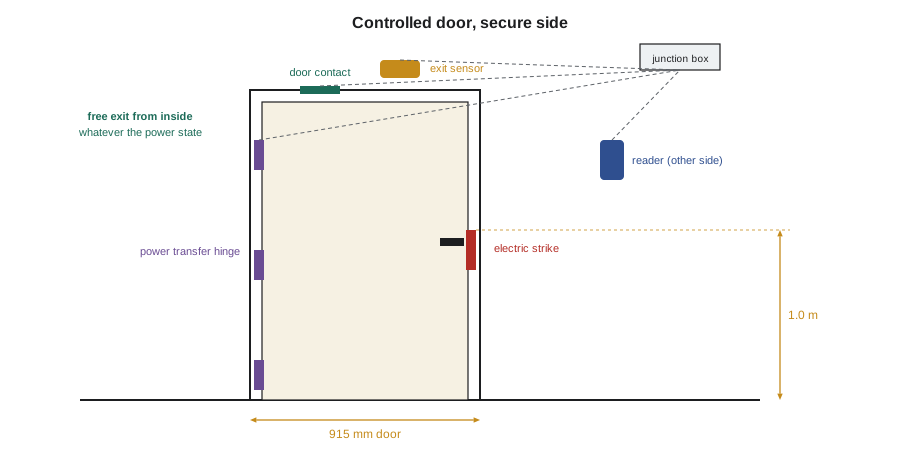
Electric locking devices
Electric strikes replace the strike plate in the frame. When energized, or de-energized depending on type, the strike's keeper swings free, so the door's ordinary latch can pass out of the frame when the door is pulled or pushed. The door's own lever still works from the inside, so free egress is kept mechanically, which makes strikes simple and safe. They must match the latch and the frame, and on fire-rated doors they must be listed for fire doors.
Electrified locksets and mortise locks put the electric control inside the lock in the door. When energized or de-energized, the outside lever is locked or freed; the inside lever always opens the door. They need power carried to the door leaf, through a power transfer hinge or a door loop.
Electrified exit devices, also called panic hardware, are push bars with an electric latch retraction or an electrified outside trim. Pushing the bar always opens the door from inside. They are used on exit doors in assembly occupancies, schools and hospitals, where codes require panic hardware.
Electromagnetic locks, or maglocks, are a magnet on the frame and a steel armature plate on the door. While energized, they hold the door shut with a rated force, often 5,300 N (1,200 lbf). They have no moving parts and are reliable, but they hold the door shut against anyone inside unless their power is cut, so they need extra release devices, and the codes put strict conditions on them. Many jurisdictions and owners prefer other locks on exit doors for this reason.
| Device | Where it mounts | Free egress | Typical use |
|---|---|---|---|
| Electric strike | In the frame | Mechanical, through the door's latch | Offices, interior doors |
| Electrified lockset | In the door | Mechanical, inside lever | Classrooms, offices |
| Electrified exit device | On the door | Mechanical, push bar | Exit doors, schools, assembly |
| Electromagnetic lock | Frame head and door | Only when power is cut | Glass doors, retrofits, with conditions |
Fail-safe and fail-secure
Every electric lock has a behaviour when it loses power. A fail-safe lock unlocks when power is removed: it needs power to stay locked. A fail-secure lock stays locked from the outside when power is removed: it needs power to unlock. Maglocks are always fail-safe. Strikes, locksets and exit devices can be either. The terms describe the outside of the door; from inside, a properly specified door is always free to open, whatever the power state, except for the special cases of delayed egress and maglocks that the codes control.
The choice is made by the designer and the code. Doors in the path of exit, and stair doors that the fire code requires to unlock for firefighters and for re-entry, are generally fail-safe or released by the fire alarm. Doors that protect valuables, such as the pharmacy at St. Brendan's or the IT rooms, are fail-secure, so that a power failure does not leave them open. A fail-secure door still lets people out from inside, because its inside lever or push bar works mechanically. The installer fits what the hardware schedule says and checks, at every door, that the lock's actual setting matches it, because many strikes and locks are field-selectable and arrive set the wrong way.
Egress rules for electrically locked doors
The building and fire codes set the conditions under which a door in a means of egress may be electrically locked. In Canada, the National Building Code and the provincial codes based on it, including Ontario's, allow electromagnetic locks on exit doors only when the lock releases on a signal from the fire alarm system, on loss of power, by a manual switch near the door on the egress side, and within a short delay, 15 seconds, of someone pushing on the door, with a sign telling people the door will open. Doors may also have other conditions in hospitals and care occupancies. The local building and fire officials interpret and inspect these rules, and their approval of the door release design comes before installation.
The point of all these conditions is the same: a person who does not know the system, in an emergency, must be able to get out by doing what comes naturally, which is pushing the door or the bar. Request-to-exit motion sensors are convenient and stop the access system reporting forced doors, but on their own they are not an approved release, because a sensor can fail to see someone. Where the code requires a manual release, it must cut power to the lock directly, not through the controller's software.
Fire alarm release is wired from a relay in the fire alarm system, through the lock power supply's fire alarm input, so that the fire alarm cuts lock power regardless of what the access controller is doing. The installer wires to the fire alarm contractor's relay, with the interface shown on the drawings; the access system must never be wired into the fire alarm's own circuits. Lesson 10 shows the supply's fire alarm input.
Getting power to the door
Locks in the door leaf need power carried across the hinge. A power transfer hinge has conductors running through it, a door loop is an armoured flexible conduit on the hinge side, and an electric power transfer is a concealed device in the edge of the door and frame. Each has a limited number of conductors and a current rating, so the hardware schedule must count the wires every device in the door needs: the lock, its request-to-exit switch, its latch bolt monitor and any signal wires. Running out of conductors in a power transfer is one of the commonest door problems, and the fix after the door is hung is expensive.
Lock cables are sized for voltage drop. Locks are rated for a voltage, often 12 or 24 V DC, with a tolerance, and an inrush current for solenoid locks and exit devices that can be several times the holding current. A lock that buzzes, chatters or fails to retract usually has too little voltage at the door. The calculation is the one from LVT-110: drop equals current times the resistance of the out-and-back conductors.
# Voltage at the lock for a long run, and the wire size needed
OHMS = {18: 0.0210, 16: 0.0132, 14: 0.00829}   # ohms per m of one conductor
def at_lock(volts, amps, run, awg):
    return volts - amps * 2 * OHMS[awg] * run
doors = [  # door, supply volts, lock amps (inrush for exit devices), run in m, minimum volts at lock
    ("Lobby maglock pair", 12.0, 1.0, 85, 10.2),
    ("P1 stair exit device", 24.0, 1.6, 60, 20.4),
    ("Mail room strike", 12.0, 0.45, 30, 10.2),
]
for door, v, a, run, vmin in doors:
    for awg in (18, 16, 14):
        vl = at_lock(v, a, run, awg)
        if vl >= vmin:
            print(f"{door:22s} {run:4d} m: {awg} AWG gives {vl:5.2f} V (minimum {vmin} V)")
            break
    else:
print(f"{door:22s} {run:4d} m: even 14 AWG gives {at_lock(v, a, run, 14):5.2f} V; add a local supply")Lobby maglock pair 85 m: 14 AWG gives 10.59 V (minimum 10.2 V) P1 stair exit device 60 m: 16 AWG gives 21.47 V (minimum 20.4 V) Mail room strike 30 m: 18 AWG gives 11.43 V (minimum 10.2 V)
The lobby maglock pair is the case from LVT-110, two locks of 0.5 A each at 85 m (280 ft), and the result is the same: 14 AWG. The exit device's inrush current sets its wire size, not its holding current. A supply closer to the door is often the better answer on long runs.
Request-to-exit, door position and lock monitoring
The request-to-exit device tells the controller someone is leaving. It may be a motion sensor above the door on the secure side, a switch in the exit device or lever, or a push button. On a strike or lockset door, the request-to-exit only shunts the forced-door alarm; the person opens the door mechanically. On a maglock door, the request-to-exit sensor also cuts lock power, and the code-required manual release cuts it independently. The door position switch, mounted in the frame head, is the contact from lesson 3. Some locks also have a latch bolt monitor or lock status switch that reports whether the door is actually locked, which is useful for doors that must be proven secure, such as the pharmacy.
Request-to-exit motion sensors must be aimed and adjusted so they see a person approaching to leave but not someone outside, through a glass door, waving at it. A sensor that can be triggered from outside defeats the door, so the installer adjusts its pattern and tests from both sides. The same care goes into the gap between double doors and the gaps under doors, which the hardware supplier addresses with astragals and door sweeps.
Testing every controlled door
Each controlled door is tested against a written sequence of operation before the fire officials and the owner see it. The tests cover every way the door can be used and every way the system can fail: a valid card unlocks it for the unlock time; an invalid card does not; the door opened without a card reports forced; the door held open reports held; the request-to-exit works and does not see from outside; the manual release, where fitted, unlocks it directly; the fire alarm signal releases it; removing lock power leaves a fail-safe door unlocked and a fail-secure door locked from outside but free from inside; and the door closes and latches every time. Each test is recorded on the door's test sheet.
# Door test sheet: expected results for one door's sequence of operation
door = {"name": "P1 stair door", "lock": "fail-safe exit device", "manual_release": False,
        "fire_release": True, "rex_unlocks": False}
tests = [
    ("valid card", "unlocks for 5 s, logs granted"),
    ("invalid card", "stays locked, logs denied"),
    ("open without card or exit", "logs forced door"),
    ("hold open 30 s", "local sounder, then logs held door"),
    ("push bar from inside", "opens mechanically, logs exit"),
    ("fire alarm relay opens", "lock power off, door free both sides"),
    ("remove lock power", "unlocked (fail-safe)" if "fail-safe" in door["lock"] else "locked outside, free inside"),
    ("close door", "latches, door contact reads closed"),
]
if door["manual_release"]:
    tests.append(("press manual release", "lock power cut directly, held at least 30 s"))
print(f"{door['name']} ({door['lock']}): {len(tests)} tests")
for k, (act, expect) in enumerate(tests, 1):
print(f"{k:2d}. {act:28s} -> {expect}")P1 stair door (fail-safe exit device): 8 tests 1. valid card -> unlocks for 5 s, logs granted 2. invalid card -> stays locked, logs denied 3. open without card or exit -> logs forced door 4. hold open 30 s -> local sounder, then logs held door 5. push bar from inside -> opens mechanically, logs exit 6. fire alarm relay opens -> lock power off, door free both sides 7. remove lock power -> unlocked (fail-safe) 8. close door -> latches, door contact reads closed
Worked problem
A stair door that will not release
During the fire alarm interface test at Juniper Point, the fire alarm contractor opens the release relay. All doors unlock except the P1 stair door, whose exit device stays locked from the garage side. The access controller log shows nothing unusual. What should Maya check?
Show solution
- The fire alarm release should cut lock power at the supply, regardless of the controller.
- The stair door's exit device is powered from a different supply from the other doors.
- That supply, installed with the exit device, has no connection to the fire alarm relay.
- She wires that supply's fire alarm input to the relay through the interface module shown on the drawing, and asks the fire alarm contractor to repeat the test.
Answer: On the retest, the stair door releases with the others. Maya marks the supply's fire alarm input on the as-built drawing.
Common mistakes
MistakeOrdering locks before reviewing the door hardware schedule.
InsteadReview each opening with the hardware supplier first.
MistakeAssuming a field-selectable lock is set correctly.
InsteadCheck every lock's fail-safe or fail-secure setting against the schedule.
MistakeRelying on a motion request-to-exit as the only release of a maglock.
InsteadFit the code-required manual release and fire alarm release.
MistakeWiring the access system into the fire alarm's circuits.
InsteadConnect only to the fire alarm contractor's relay, as drawn.
MistakeSizing lock wire for holding current.
InsteadSize for inrush current and the lock's minimum voltage.
Summary and key terms
- No security device may trap anyone; the codes set how electrically locked doors release.
- Strikes, electrified locksets and exit devices keep mechanical free egress; maglocks release only when power is cut.
- Fail-safe locks unlock on power loss; fail-secure locks stay locked outside but free inside.
- Exit doors with electric locks need fire alarm release, power-loss release and the manual releases the code requires.
- Power transfers have limited conductors; count every wire before the door is hung.
- Lock wiring is sized for inrush current and minimum voltage.
- Every controlled door is tested against its sequence of operation and recorded.
- Electric strike
- A frame device that releases the door's latch electrically.
- Electromagnetic lock
- A magnet and armature that hold a door shut while energized.
- Fail-safe
- A lock that unlocks when power is removed.
- Fail-secure
- A lock that stays locked from outside when power is removed.
- Power transfer hinge
- A hinge with conductors that carry power into the door leaf.
- Delayed egress
- A locking arrangement that releases a short time after someone pushes the door.
- Sequence of operation
- The written description of how a door behaves in each situation.
Practice problems
Work each problem on paper first, then reveal the answer to check.
Which electric lock always releases when power is cut?
Show answer
The electromagnetic lock.
A pharmacy door must stay locked in a power failure. Which lock behaviour is needed?
Show answer
Fail-secure, with free egress from inside.
Why is a request-to-exit motion sensor not enough on its own on a maglock door?
Show answer
It can fail to see someone; the code requires direct releases.
What should lock wire be sized for on an exit device?
Show answer
Its inrush current and minimum voltage.
Lesson quiz · 5 questions
Score 60% or more to complete this lesson.
Create a free account to save your progress, take quizzes and earn a certificate.