
LVT-230 · Lesson 12 of 12 · 21 min
Capstone: commissioning and handing over a building's security systems
Twelve weeks after Maya's first walk through the Juniper Point garage, the security systems are installed. There are 22 reader doors, including the six wireless storage room locks, 48 cameras, the 24-zone locker intrusion panel, three intercom stations and six power supply cabinets. What is left is the part that turns installed equipment into a working system the board can rely on: testing every device and link against the documents, fixing what fails, proving the systems with the owner, the fire officials and the monitoring station, training the staff, and handing over a complete record. Dev Malhotra will sign the commissioning; Hollis Tran runs it; Maya and Teo Barros do the testing. This capstone follows the two weeks from the start of commissioning to the handover meeting, using everything in the course.
The commissioning plan
Hollis's plan has five stages, in order, because each depends on the one before. First, device verification: every device is checked for correct installation, wiring, labelling and power, against the drawings. Second, system testing by the crew: every zone, door, camera and power supply is tested against its sequence of operation, and every cell of the cause-and-effect matrix is tested. Third, owner witness testing: the owner's representative watches a sample of the tests, chosen by the owner, and all the life-safety tests. Fourth, the fire alarm interface test with the fire alarm contractor and the fire inspector, and the monitoring station tests. Fifth, training and handover. A failure at any stage is fixed and retested before the next stage begins for that device.
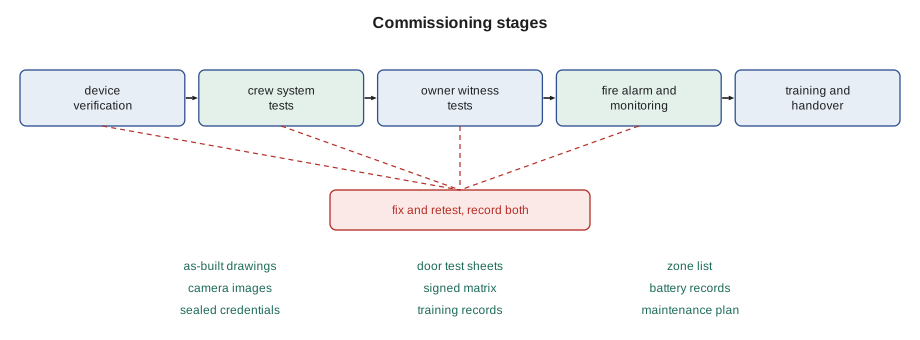
Stage 1: device verification
Device verification is a walk with the drawings. For each door, Maya and Teo check the reader height and mounting, the lock type and its fail-safe or fail-secure setting against the hardware schedule, the door position switch alignment, the request-to-exit sensor pattern, the labels and the cable terminations at the controller. For each camera, they check the mounting, the label, the network port and PoE draw. For each power supply, they check the AC circuit label, the output assignments, the fuses, the batteries' date labels and the fire alarm input wiring. For the intrusion panel, they check every zone's EOL resistor at the device and record the zone resistance. Each check is ticked on a sheet for that device.
The walk finds 31 items, which is normal for a building this size. Most are small: labels missing on two cameras, a reader 40 mm (1.5 in) lower than the drawing, a door position switch magnet loose. Three matter more. The mail room strike is set fail-safe, but the hardware schedule says fail-secure, because the mail room holds parcels. One garage camera's view, as aimed, takes in the windows of the house across the lane. And the amenity-floor supply's batteries were dated from the building's opening, which Maya had replaced after the storm in lesson 10, but the second cabinet on that floor still has the old ones.
# Commissioning punch list status
items = [  # (number, system, severity, description, fixed)
    (1, "access", "major", "mail room strike set fail-safe; schedule says fail-secure", True),
    (2, "video", "major", "CAM-P1-09 view includes windows across the lane", True),
    (3, "power", "major", "amenity cabinet 2 batteries over five years old", True),
    (4, "video", "minor", "labels missing on CAM-P2-03 and CAM-P2-04", True),
    (5, "access", "minor", "gym reader below drawing height", True),
    (6, "access", "minor", "P1 stair door contact magnet loose", True),
] + [(n, "various", "minor", "small item", n % 9 != 0) for n in range(7, 32)]
open_items = [i for i in items if not i[4]]
majors = [i for i in items if i[2] == "major"]
print(f"{len(items)} items, {len(items) - len(open_items)} fixed, {len(open_items)} open")
print(f"major items: {len(majors)}, all fixed: {all(i[4] for i in majors)}")
for n, sysname, sev, desc, done in open_items:
print(f" open #{n}: {sysname}, {sev}")31 items, 28 fixed, 3 open major items: 3, all fixed: True open #9: various, minor open #18: various, minor open #27: various, minor
The three major items are fixed first: the strike is reset to fail-secure and its free egress checked from inside, the garage camera is re-aimed and given a privacy mask over the lane, and the second amenity cabinet gets new batteries. The remaining open items are small and scheduled for the next morning. Stage 2 starts only on the devices whose items are closed.
Stage 2: crew system tests
System testing follows the sequences of operation from lessons 2 to 11. For the intrusion panel, Maya calls the monitoring station, has the account put in test, and trips every zone, presses the panic button in the gym, removes AC power, disconnects the battery and fails each communication path, confirming each event at the station. For every reader door, Teo runs the door test sheet from lesson 7: valid and invalid cards, forced, held, request-to-exit from inside and from outside through the glass, lock power removed, and closing and latching. For every camera, Maya checks the image against its DORI target with a person at the target position by day, and again after dark. For every supply, they remove mains power and measure battery voltage under load. Then they work through the cause-and-effect matrix cell by cell, as in lesson 11.
The tests turn up the faults the course has prepared for. The P1 stair door's local supply was missing its fire alarm input, found in lesson 7. The garage reader still had its factory configuration, found in lesson 6. Two dock-style cameras on P2 were at factory frame rate and quality, like the Hartwell cameras in lesson 9, which Maya now checks on every camera with the VMS's stream report. The forced-garage-door report to the monitoring station failed, from lesson 11, because the access controller's output had been wired to zone 17 but the zone was programmed in the office partition rather than the locker partition. Each is fixed and retested, and the retest is recorded next to the failure on the sheet.
# Camera acceptance against DORI targets, day and night
import math
NEED = {"identify": 250, "recognize": 125, "observe": 62, "detect": 25}    # pixels per m
cams = [  # name, target level, horizontal pixels, angle in degrees, distance in m, night factor
    ("CAM-G-01 gate in", "identify", 2688, 30, 6.5, 1.0),
    ("CAM-L-02 vestibule", "identify", 2688, 74, 4.0, 1.0),
    ("CAM-P1-09 lane side", "observe", 1920, 95, 12.0, 0.9),
    ("CAM-P2-05 aisle", "detect", 1920, 100, 22.0, 0.8),
]
for name, level, px, ang, dist, night in cams:
    pd = px / (2 * dist * math.tan(math.radians(ang) / 2))
    usable_night = pd * night      # usable detail falls at night with noise and infrared
    day_ok = pd >= NEED[level]; night_ok = usable_night >= NEED[level]
print(f"{name:22s} {level:9s} day {pd:5.0f} {'pass' if day_ok else 'FAIL'}, night {usable_night:5.0f} {'pass' if night_ok else 'FAIL'}")CAM-G-01 gate in identify day 772 pass, night 772 pass CAM-L-02 vestibule identify day 446 pass, night 446 pass CAM-P1-09 lane side observe day 73 pass, night 66 pass CAM-P2-05 aisle detect day 37 pass, night 29 pass
The night factor is illustrative, a reminder that a camera that only just passes by day may fail after dark, when noise and infrared lighting reduce usable detail. The real check is the night test image, and every camera's day and night images go into the record.
Stage 3: owner witness tests
The owner's representative for Juniper Point is the board's security chair, with Harriet Kwan, the property manager, and the designer. They choose a sample: ten doors, ten cameras, five zones and every intercom. Every life-safety test is witnessed, not sampled: each exit door's release on loss of power, each manual release, and each door that the fire alarm releases. Maya runs the tests while Teo records, and the witnesses initial each result. One witness test fails: the security chair asks to see the lobby door released from the concierge desk during an intercom call and finds the release button on the desk station had not been assigned to the lobby door. It is assigned and retested in front of the witnesses.
Stage 4: fire alarm interface and monitoring
The fire alarm interface test is scheduled with the fire alarm contractor, the fire inspector and the elevator contractor, because the same alarm also recalls the elevators. The fire alarm contractor operates the release relays; Maya and Teo stand at doors on each floor with radios. Every door in the release design unlocks; the garage gates open; the doors that the design leaves locked, such as the mail room and the storage rooms, stay locked outside and free inside. When the fire alarm is reset, the doors return to normal. The inspector signs the release test, which is a condition of the building's occupancy permit for the new door work.
The monitoring station test was done in stage 2; in stage 4, the station confirms the account is out of test mode, the call list and passwords are current, and the supervision interval for each communication path is being received. Because the locker panel is not certificated, there is no certificate to issue, but the station's acceptance letter and the zone list go into the handover package, and the panel is registered with the police service's alarm program as the city requires.
Stage 5: training and handover
Training follows the plan from lesson 11: the concierge sessions twice, the property manager, and the board administrator, all hands-on, all signed. Then comes the handover meeting, with the board's security chair, Harriet, the designer, Hollis and Dev. Cobalt Line hands over the package, page by page.
| Document | Contents |
|---|---|
| As-built drawings | Every device's location, label, cable and controller or panel connection |
| Door schedule and test sheets | Each door's hardware, settings, fail mode and signed tests |
| Zone list | Each zone's device, type, partition, measured resistance and test result |
| Camera list | Each camera's purpose, settings, firmware and day and night images |
| Cause-and-effect matrix | Every link, signed as tested |
| Power and battery records | Calculations, battery dates, discharge test results |
| Network records | IP plan entries, ports and VLANs, confirmed by the owner's IT team |
| Credentials | Sealed record of every administrator password, handed to the named contact |
| Training records | Who was trained on what, signed |
| Monitoring and fire records | Station acceptance, fire alarm interface test signed by the inspector |
| Maintenance plan | Inspection schedule, battery replacement dates, firmware review |
Two items at the meeting are the board's decisions, and Hollis makes sure they are raised. The first is the old proximity fobs: the changeover to secure fobs is complete, and the readers can now stop accepting the old format, which the board approves on the spot, so Maya turns it off that afternoon and confirms no old fob works. The second is the privacy review: the designer confirms that every camera view matches the approved list, the lane-side camera has its mask, audio is off on every camera, and the signs are posted at every entrance. The board's privacy officer accepts the review and sets the retention at 30 days, which the recorders have been measured to meet.
# Handover package completeness check
required = ["as-built drawings", "door schedule and test sheets", "zone list", "camera list",
            "cause-and-effect matrix", "power and battery records", "network records",
            "sealed credentials", "training records", "monitoring and fire records", "maintenance plan"]
package = {"as-built drawings": "rev C", "door schedule and test sheets": "22 doors", "zone list": "24 zones",
           "camera list": "48 cameras, 96 images", "cause-and-effect matrix": "signed",
           "power and battery records": "6 cabinets", "network records": "confirmed by owner IT",
           "sealed credentials": "handed to board administrator", "training records": "11 people",
           "monitoring and fire records": "station letter, inspector signature"}
missing = [r for r in required if r not in package]
for r in required:
    print(f"{r:30s} {package.get(r, 'MISSING')}")
print("complete" if not missing else f"missing: {', '.join(missing)}")as-built drawings rev C door schedule and test sheets 22 doors zone list 24 zones camera list 48 cameras, 96 images cause-and-effect matrix signed power and battery records 6 cabinets network records confirmed by owner IT sealed credentials handed to board administrator training records 11 people monitoring and fire records station letter, inspector signature maintenance plan MISSING missing: maintenance plan
The check finds the maintenance plan missing from the binder, though it had been written. Hollis adds it before the board signs. The plan sets inspections twice a year: every zone tested with the station, every door's operation and egress checked, every camera's image reviewed, batteries load-tested and replaced every four years, firmware reviewed with the owner's IT team, and the access list audited with the administrator so that former residents' fobs are removed.
What the capstone brings together
Looking back over the twelve weeks, almost every fault the crew found traced to a lesson in this course: a detector aimed at a heater, a cellular antenna in a steel cabinet, a reader with its factory configuration, a strike set the wrong way, a supply missing its fire alarm input, cameras at factory settings, an untested link in the matrix, and aged batteries. None was found by the owner or a resident, because each was caught by a test that was planned, recorded and repeated after the fix. That is the difference between installing security equipment and delivering a security system.
Worked problem
The final sign-off
At the end of the handover meeting, the board's security chair asks Dev whether Cobalt Line will keep the administrator password, so that the crew can help if something goes wrong at night. How should Dev answer, and what should Cobalt Line do instead?
Show solution
- The owner owns the system and its credentials; the installer should not hold administrator access by default.
- If the board wants service access, it can create a named service account with only the rights the service work needs, under a service contract, and remove it if the contract ends.
- Cobalt Line keeps no copy of the sealed credential record, and its temporary commissioning accounts are deleted that afternoon.
- The after-hours number for service calls is on the laminated sheet at the concierge desk.
Answer: Dev thanks the chair and explains that the board holds the keys; if the board wants Cobalt Line to help remotely, it can create a limited service account under the service contract. The chair agrees, and the board signs the acceptance.
Common mistakes
MistakeStarting system tests on devices with open verification items.
InsteadClose each device's items before testing it.
MistakeSampling life-safety tests.
InsteadWitness every exit release and fire alarm release.
MistakeLeaving the account in test mode after commissioning.
InsteadConfirm with the station that it is live and supervised.
MistakeKeeping administrator credentials after handover.
InsteadHand over all credentials and delete temporary accounts.
MistakeTreating the handover meeting as a formality.
InsteadRaise the owner's decisions, such as old formats and privacy review.
Summary and key terms
- Commissioning runs in stages: device verification, crew tests, owner witness, fire and monitoring tests, training and handover.
- Every failure is fixed and retested, and the retest is recorded.
- Doors, zones, cameras, supplies and every matrix link are tested against their documents.
- Life-safety releases are all witnessed, and the fire inspector signs the release test.
- Cameras are accepted against their DORI targets by day and by night.
- The handover package is complete, credentials are sealed and handed to the owner, and temporary accounts are removed.
- A maintenance plan keeps the system working: inspections, battery replacement, firmware and access audits.
- Commissioning
- The planned testing that proves a system works as designed.
- Witness test
- A test observed and initialled by the owner's representative.
- Punch list
- The list of items found during verification that must be fixed.
- Handover package
- The documents and credentials given to the owner at completion.
- Service account
- A limited account the owner creates for a service provider.
- Acceptance
- The owner's formal agreement that the system is complete.
- Maintenance plan
- The schedule of inspections and replacements after handover.
Practice problems
Work each problem on paper first, then reveal the answer to check.
Why are life-safety tests never sampled?
Show answer
A single failed release could trap someone.
What happens to the installer's temporary accounts at handover?
Show answer
They are deleted.
Who decides to stop accepting the old proximity fobs?
Show answer
The owner's board.
Why is each camera tested at night as well as by day?
Show answer
Usable detail falls after dark, so a camera can pass by day and fail at night.
Lesson quiz · 5 questions
Score 60% or more to complete this lesson.
Create a free account to save your progress, take quizzes and earn a certificate.