
HSE-402 · Lesson 9 of 12 · 21 min
Criminal liability after Westray
During a break at a supervisors' training day, one of the day-shift supervisors asked Aisha the question everyone was thinking. 'Could one of us go to jail if someone dies on our shift?' The room went quiet. Aisha did not dodge it. 'In Canada, yes, it is possible,' she said. 'It's rare, and it takes much more than an honest mistake. But since Westray, the Criminal Code puts a legal duty on anyone who directs work, and people have been convicted. You need to understand what that duty is.' This lesson explains it.
Westray
At 5:18 a.m. on May 9, 1992, a methane and coal dust explosion tore through the Westray coal mine in Plymouth, Nova Scotia, killing all 26 miners underground. The mine had opened only eight months earlier. The public inquiry led by Justice K. Peter Richard, whose 1997 report was titled The Westray Story: A Predictable Path to Disaster, found that the explosion was the result of management that ignored basic safety practices in the drive for production, a provincial regulator that failed to enforce the law, and a culture in which miners who raised concerns feared for their jobs. Coal dust had been allowed to build up, methane monitors had been tampered with, and workers had not been properly trained.
Criminal charges of manslaughter and criminal negligence causing death were laid against the company and two mine managers, but the prosecution collapsed for procedural reasons and the charges were eventually stayed. Nobody was convicted. The families of the miners, the United Steelworkers union and others campaigned for more than a decade to change the law so that those responsible for workplace deaths could be held criminally accountable. The result was Bill C-45, often called the Westray bill, which amended the Criminal Code with effect from March 31, 2004.
Section 217.1: the duty to take reasonable steps
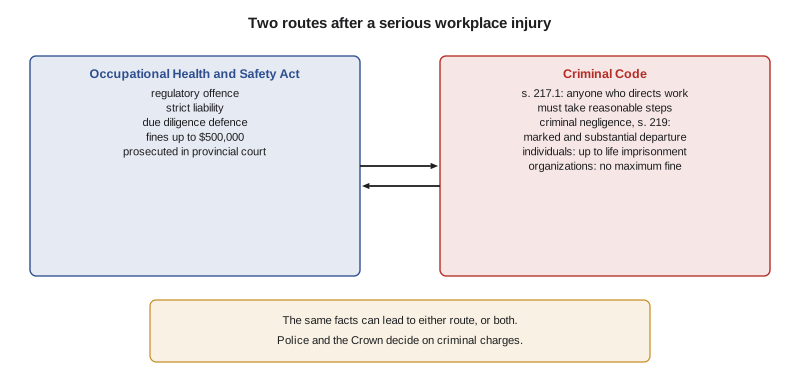
The heart of the Westray amendments is section 217.1 of the Criminal Code. In plain words, it says that everyone who undertakes, or has the authority, to direct how another person does work or performs a task is under a legal duty to take reasonable steps to prevent bodily harm to that person, or to any other person, arising from that work or task. The duty applies to anyone who directs work: supervisors, managers, lead hands, contractors, owners and executives. It does not depend on job title, and it applies whether or not the person is an employer.
Section 217.1 does not create a new offence by itself. It creates a legal duty, and breaching a legal duty can be the basis of the existing offence of criminal negligence. Under section 219, a person is criminally negligent if, in doing anything or in failing to do anything that it is their legal duty to do, they show wanton or reckless disregard for the lives or safety of other persons. Criminal negligence causing death, under section 220, carries a maximum sentence of life imprisonment. Criminal negligence causing bodily harm, under section 221, carries a maximum of ten years. Manslaughter can also be charged.
How high is the bar?
Criminal negligence is much harder to prove than a regulatory offence. The Crown must prove every element beyond a reasonable doubt, and the conduct must be a marked and substantial departure from what a reasonably prudent person would do in the circumstances. Carelessness, an error of judgment or a failure that would breach the Occupational Health and Safety Act is not enough on its own. Courts look for something more: knowingly exposing workers to a serious danger, ignoring repeated warnings, directing work to continue in conditions the person knew were deadly, or disabling safety systems. The due diligence defence does not apply as such, but evidence that the accused took reasonable steps is the answer to the charge, because it shows there was no marked departure.
Organizations and senior officers
Bill C-45 also changed how organizations, including corporations, can be found guilty. Under section 22.1, an organization is a party to a criminal negligence offence if one or more of its representatives commits the act, and the senior officer responsible for that aspect of the organization's activities departs markedly from the standard of care that could reasonably be expected to prevent the representative from doing it. A senior officer is anyone who plays an important role in setting the organization's policies or managing an important aspect of its activities, which can include plant managers and other managers below the executive level. The organization's liability can be built from the combined conduct of several people.
Organizations convicted of criminal negligence face fines with no maximum for indictable offences. Under section 718.21, courts must consider factors such as the advantage gained from the offence, the degree of planning, attempts to conceal, the impact on the organization and its employees, the cost of investigation, any regulatory penalties already imposed, previous convictions, and the steps the organization has taken to reduce the chance of it happening again. Courts can also impose probation orders requiring organizations to adopt policies, communicate them to employees, report on their implementation and publicize the offence.
Convictions since 2004
Prosecutions under the Westray amendments have been relatively rare, and convictions rarer still, which has frustrated families and unions. But there have been convictions, and they show what courts consider criminal. In 2008, the Quebec paving stone manufacturer Transpavé became the first organization convicted of criminal negligence causing death under the amendments, after a young worker was crushed by a machine whose safety device had been disabled; it was fined $110,000. After four workers died when a swing stage collapsed on Christmas Eve 2009 at a Toronto high-rise, the contractor Metron Construction pleaded guilty and the Ontario Court of Appeal raised its fine to $750,000, and the project manager, Vadim Kazenelson, was convicted of criminal negligence causing death and sentenced to three and a half years in prison. In 2017, Detour Gold pleaded guilty to criminal negligence after a worker's death at its northern Ontario mine and was ordered to pay about $1.4 million in total.
Prosecutions continue. In December 2025, the Supreme Court of British Columbia convicted an excavation company of criminal negligence causing death and causing bodily harm, after a retaining wall collapsed into a trench in Burnaby in 2012, killing one worker and injuring another. The court relied on systemic failures in the company's safety manual, training, supervision and hazard assessment. The site supervisor was acquitted on all counts. Charges in that case had taken more than a decade to be laid, which shows how long the shadow of a serious incident can be.
What this means for supervisors
Aisha's message to the supervisors was reassuring and sobering at the same time. Reassuring, because criminal liability requires far more than an honest mistake or a gap in a program: it requires a marked and substantial departure from what a reasonable person in the supervisor's position would do. Sobering, because the duty in section 217.1 applies directly to anyone who directs work, and the conduct that crosses the line is not exotic. Telling a worker to go into a trench you know is unsafe, directing a crew to skip lockout to meet a deadline, removing a guard and running the machine anyway, or ignoring a refusal and sending someone else in can all be the kind of conduct that leads to criminal charges if someone dies.
The protection is the same as in every other lesson: know the hazards, put controls in place, supervise, enforce, respond to concerns, and record what you do. A supervisor who does those things is taking reasonable steps. And if a supervisor is ever told to do something that would put workers in serious danger, the right response is to refuse, to escalate in writing, and to stop the work.
A short self-check
Elena turned the factors courts consider into a self-check that supervisors could use when facing pressure to cut a corner on a high-risk task.
# Self-check before allowing high-risk work to proceed under pressure.
questions = [
    ("Could this task kill or seriously injure someone if a control fails?", True),
    ("Is a required control missing, bypassed or not verified?", True),
    ("Has anyone raised a concern or refused this task?", False),
    ("Am I being asked to skip a step to save time or money?", True),
    ("Would I be comfortable explaining this decision to an investigator?", True),
]
red_flags = 0
for q, ans in questions:
    bad = ans if "comfortable" not in q else not ans
    red_flags += bad
    print(f"{'RED ' if bad else 'ok  '} {q}")
print("decision:", "STOP the work and escalate in writing" if red_flags >= 2 else "proceed with controls verified")RED Could this task kill or seriously injure someone if a control fails? RED Is a required control missing, bypassed or not verified? ok Has anyone raised a concern or refused this task? RED Am I being asked to skip a step to save time or money? ok Would I be comfortable explaining this decision to an investigator? decision: STOP the work and escalate in writing
In the example, three red flags appear: a serious hazard, a missing control and pressure to skip a step. The self-check's answer is to stop the work and escalate. Elena told supervisors that if they ever answered 'no' to the last question, that alone was a reason to stop.
Worked problem
Where is the line?
Show solution
- Scenario A: a supervisor misses that a new worker's training did not cover a machine; the worker is injured. This is a gap that may breach the Occupational Health and Safety Act, but is unlikely to be a marked and substantial departure.
- Scenario B: a supervisor is told by two workers that a trench wall is cracking, says the job must finish today, and sends a worker in; the wall collapses and kills him.
- In B, the supervisor directed the work, knew of a serious danger and chose to expose the worker: a strong candidate for criminal negligence under sections 217.1 and 219.
- If senior managers set the deadline knowing the trench was unsafe, the organization could also be liable under section 22.1.
- The difference is knowledge of serious danger plus a decision to proceed.
Answer: Honest mistakes are handled by regulators; knowingly exposing workers to deadly danger can be criminal.
Investigations: police and the regulator
After a workplace death, two investigations may run at the same time: the Department's investigation under the Occupational Health and Safety Act, and a police investigation into possible criminal charges. Unions and families of workers killed on the job have pushed for police to be involved in every serious workplace incident, and some jurisdictions have adopted protocols so that police, prosecutors and safety regulators coordinate and police can decide early whether a criminal investigation is warranted. Evidence gathered by one investigation may be relevant to the other, and the scene and records must be preserved for both. Supervisors involved in a serious incident may be interviewed by both. The same advice applies: tell the truth, stick to what you know, and consider getting legal advice if you may personally be at risk.
Why the duty matters even without prosecutions
Some people point to the small number of Westray convictions and conclude that section 217.1 has little practical effect. Aisha disagreed. The duty shapes how prosecutors, regulators and courts think about anyone who directs work, it has made senior leaders pay closer attention to how their organizations manage serious hazards, and every conviction has been widely reported and studied. More importantly, the duty states in the Criminal Code what good supervisors already know: if you direct someone's work, you are responsible for taking reasonable steps to keep them from being hurt by it.
Common mistakes
MistakeBelieving only executives can face criminal charges.
InsteadSection 217.1 applies to anyone who directs work, including supervisors.
MistakeThinking any regulatory breach is a crime.
InsteadCriminal negligence needs a marked and substantial departure from reasonable conduct.
MistakeDirecting work to continue despite a known serious danger.
InsteadStop the work, fix the hazard and escalate in writing.
MistakeAssuming an organization is liable only if its CEO is involved.
InsteadSenior officers include managers of important activities, such as plant managers.
MistakeTreating a refusal as an obstacle to work around.
InsteadA refusal is a warning; ignoring it can be evidence of reckless disregard.
Summary and key terms
- The 1992 Westray explosion killed 26 miners; nobody was convicted, which led to the Westray amendments in 2004.
- Section 217.1 imposes a legal duty on anyone who directs work to take reasonable steps to prevent bodily harm.
- Breaching that duty with wanton or reckless disregard can be criminal negligence, with up to life imprisonment if death results.
- Organizations can be liable through representatives and senior officers, with unlimited fines and probation orders.
- Convictions include Transpavé, Metron and Kazenelson, Detour Gold and a 2025 British Columbia excavation case.
- Honest mistakes are not criminal; knowingly exposing workers to deadly danger can be.
- Westray amendments
- The 2004 Criminal Code changes (Bill C-45) on workplace safety and organizational liability.
- Section 217.1
- The Criminal Code duty of anyone who directs work to take reasonable steps to prevent bodily harm.
- Criminal negligence
- Wanton or reckless disregard for the lives or safety of others in doing, or failing to do, a legal duty.
- Marked and substantial departure
- The level of fault needed for criminal negligence, well beyond ordinary carelessness.
- Senior officer
- A person who sets an organization's policies or manages an important aspect of its activities.
- Section 22.1
- The Criminal Code provision on how organizations become parties to negligence offences.
Practice problems
Work each problem on paper first, then reveal the answer to check.
What did the Westray inquiry conclude?
Show answer
The explosion was a predictable result of management ignoring safety for production, regulatory failure and a culture of fear.
State the section 217.1 duty in your own words.
Show answer
Anyone who directs how others work must take reasonable steps to prevent bodily harm arising from that work.
What level of fault does criminal negligence require?
Show answer
A marked and substantial departure from what a reasonable person would do, showing wanton or reckless disregard.
What happened in the Metron case?
Show answer
Four workers died in a swing stage collapse; the company was fined $750,000 on appeal and the project manager got three and a half years.
How can an organization be liable under section 22.1?
Show answer
Through a representative's act combined with a senior officer's marked departure from the expected standard of care.
Lesson quiz · 5 questions
Score 60% or more to complete this lesson.
Create a free account to save your progress, take quizzes and earn a certificate.