
HSE-402 · Lesson 8 of 12 · 20 min
Building and proving due diligence
After the guilty plea and fine, Rachel asked Aisha a different question. 'Suppose another worker on another shift skips a step tomorrow, despite everything we have done. Could we defend that charge?' Aisha said yes, possibly, if the company could prove what it had done. 'Due diligence isn't something you assemble after an incident,' she said. 'It's something you build every day and record as you go. By the time you need it, it either exists or it doesn't.' This lesson is about building it.
Due diligence is a system, not a file
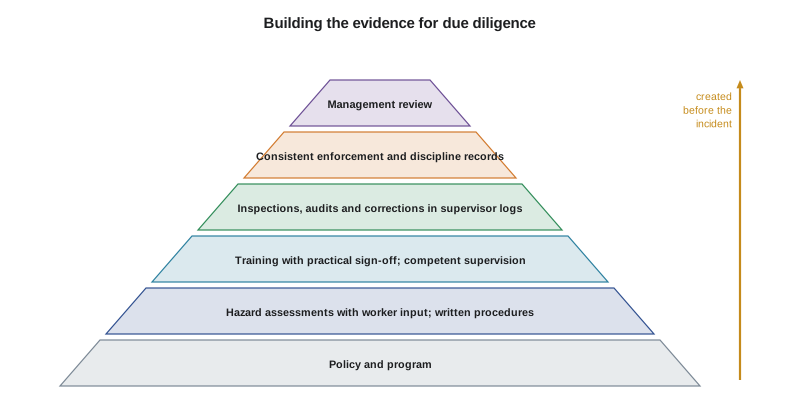
Lesson 6 described due diligence as three duties: foresight, efficiency and authority. To prove them, a company needs a safety management system that does each of them routinely, and records that show the system was working at the time of the incident. Courts are rarely impressed by a large binder produced after the event. They are impressed by ordinary records created in the normal course of business: a hazard assessment signed and dated before the incident, a training record with a practical sign-off for the specific machine, an inspection checklist completed the week before, a supervisor's note of a correction, a disciplinary letter for an earlier breach, a committee recommendation and the company's response.
Aisha listed the elements she would look for in any due diligence defence: a written health and safety policy and program that the company actually follows; hazard identification and assessment for each job, done with workers and kept current; controls chosen using the hierarchy, with engineering controls for serious hazards; written safe work procedures for high-risk tasks; training specific to the job and equipment, with checks of competence; competent supervisors who know their duties and have the authority and time to supervise; regular inspections and audits, with findings followed through; consistent enforcement, including fair discipline for repeated or deliberate breaches; incident and near-miss reporting and investigation, with corrective actions closed; an active joint occupational health and safety committee whose recommendations get answers; and management review, where senior leaders look at the system's performance and fix what is not working.
Records that prove each duty
Elena turned Aisha's list into a records map, showing for each duty which records proved it, who created them, how often and where they were kept. The map made gaps visible. For example, the hazard assessments existed but did not show who from the crew had taken part. Training records proved attendance but not competence. Supervisors were correcting unsafe acts but rarely writing it down, so the company's best evidence of exercising its authority existed only in people's memories.
The fixes were small but deliberate. Hazard assessments gained a box for the names of workers consulted. Training records gained a practical sign-off: the worker performing the task, observed by a competent person, for each machine. Supervisors gained a simple log with columns for inspections, coaching and corrections, hazards found and fixed, and concerns raised. The committee's minutes began to record the company's response to each recommendation and the date. None of these was a new program. Each turned something the company already did into something it could prove.
Consistent enforcement
The duty of authority requires enforcement, and enforcement must be fair and consistent to be credible in court. Inconsistent discipline, where some workers are disciplined and others are not for the same breach, or where workers are disciplined but supervisors are not, undermines a due diligence defence because it suggests the rules are not really enforced. At the same time, discipline must never be used against workers for raising concerns, refusing unsafe work or reporting injuries, which would be discriminatory action.
Harrowgate Foods Ltd. adopted the just culture framework described in HSE-401: consoling and fixing the system for honest errors, coaching for at-risk behaviour driven by the system, and progressive discipline for knowing or reckless breaches, applied the same way to every role. Every safety-related performance conversation was recorded, and the joint occupational health and safety committee reviewed anonymized outcomes each quarter. That record served two purposes. It made the culture fairer, and it was exactly the evidence of consistent enforcement that a court would look for.
Audits that find problems before regulators do
An audit that never finds anything is a warning sign, not a comfort. Elena designed the lockout audits to catch the kind of drift that had caused the spiral injury. Auditors observed real cleaning on real shifts, including nights and weekends, rather than checking paperwork in the day. They asked workers to walk them through the procedure on the machine. They compared the time the procedure took with the time the schedule allowed. And they recorded what they found, including problems that were fixed on the spot, because a record of finding and fixing problems is strong evidence of the duty of authority.
Testing the evidence
Elena ran a quarterly check of the supervisor logs at each site, looking for signs that the duty of authority was being exercised and recorded.
# Quarterly check of supervisor logs (invented data): entries per 100 shifts supervised.
logs = {
    # site: (shifts, inspections logged, corrections logged, hazards logged and closed)
    "main night": (180, 176, 41, 22),
    "main day": (180, 150, 12, 15),
    "dc": (180, 95, 4, 6),
    "sauces": (120, 118, 9, 7),
}
for site, (shifts, insp, corr, haz) in logs.items():
    print(f"{site:<11} inspections {100*insp/shifts:5.1f}  corrections {100*corr/shifts:5.1f}  hazards closed {100*haz/shifts:5.1f}  per 100 shifts")
weak = [s for s, v in logs.items() if v[1] / v[0] < 0.8 or v[2] / v[0] < 0.05]
print("follow up with:", weak)main night inspections 97.8 corrections 22.8 hazards closed 12.2 per 100 shifts main day inspections 83.3 corrections 6.7 hazards closed 8.3 per 100 shifts dc inspections 52.8 corrections 2.2 hazards closed 3.3 per 100 shifts sauces inspections 98.3 corrections 7.5 hazards closed 5.8 per 100 shifts follow up with: ['dc']
The distribution centre logged far fewer corrections and inspections per shift than the plants. Elena did not assume the warehouse was safer. She spent two nights there and found that supervisors were correcting problems but not writing them down, and that one supervisor was skipping the start-of-shift forklift check because of short staffing. Both were fixed, and the warehouse's numbers rose the next quarter.
Worked problem
Would the company have a defence?
Show solution
- Eight months later, a worker at the sauces plant reaches into a filler to clear a jam without locking out, and cuts a finger.
- Foresight: the filler's hazard assessment names jam clearing and was reviewed with the crew three months earlier.
- Efficiency: the filler has an interlocked guard; jam clearing requires lockout under a posted procedure; the worker was trained and signed off on that filler.
- Authority: the supervisor's log shows lockout checks most shifts and a coaching note to this worker two weeks earlier for the same shortcut; an audit a month before found no breaches on the filler.
- Assessment: a due diligence defence would have a reasonable prospect, because each duty is supported by records created before the incident.
Answer: Records created before the incident, covering all three duties, are what make due diligence provable.
Due diligence for contractors and agency workers
Due diligence extends to the people a company brings in. If an agency worker or a contractor is hurt at Harrowgate Foods Ltd.'s plant, the company will be asked what it did to make sure they were competent, oriented to the site's hazards, properly supervised and following the rules. Elena added contractors and agency workers to the records map. Contractors were prequalified on their safety record and program, signed in and received a site orientation, worked under permits for high-risk tasks such as hot work and confined space entry, and were checked by a Harrowgate Foods Ltd. coordinator during the job. Agency workers received the same orientation and machine-specific training as employees, with the same practical sign-off, and the agency received a copy of the records.
This mattered most at the distribution centre during the autumn rush, when agency workers could make up a third of the night shift. Grace Whitfield, the distribution manager, had once treated agency staff as the agency's problem. After seeing the records map, she assigned an experienced Harrowgate Foods Ltd. employee as a buddy for each new agency worker for their first three shifts and made the supervisor's sign-off a condition of driving any powered equipment.
Directors, officers and senior managers
Due diligence also applies at the top. Directors and officers of a corporation can be charged under provincial safety laws if they directed, authorized or took part in an offence, and courts look at whether senior leaders had a system for knowing about and dealing with safety risks. For senior leaders, due diligence means setting a clear policy, providing resources, receiving regular reports on safety performance, including leading indicators and serious incidents, asking hard questions about them, and making sure problems they hear about are fixed. Rachel set up a quarterly safety review with Harrowgate Foods Ltd.'s board, where Elena presented the records map, audit findings, open hazards and the status of committee recommendations.
A year later
A year after the guilty plea, Elena repeated the due diligence scorecard from lesson 6. The spiral clean, which had scored 1, 1 and 0, now scored 3, 3 and 3, with evidence for each point: a hazard assessment reviewed with the crew that month, the floor-level disconnect and interlocked gate, machine-specific training with practical sign-off, and Dev's verification log showing lockout checked on every spiral clean. The company's average for authority across all high-risk tasks had risen from just over 1 to 2.6. More importantly, there had been no lockout-related injuries in the year, and the number of hazards reported by workers had doubled.
Aisha reviewed the records and gave her honest view: no defence is ever certain, but if a similar charge were laid now, the company would have a credible due diligence defence. Rachel cared less about that than about the doubled hazard reports. 'That,' she said, 'is what due diligence is supposed to produce: people finding problems before they hurt someone.'
What due diligence is not
Aisha finished her session with the leadership team by listing things that look like due diligence but are not. A thick binder that nobody on the floor has read is not due diligence. Training that tells workers what the rule is without showing them how to follow it on their machine is not. Signatures on a form saying a worker 'understands the hazards' are not, unless something shows the worker actually does. Discipline used mainly after injuries, rather than when breaches are found, is not, because it punishes bad luck rather than enforcing rules. And a safety program run by the safety department alone, without supervisors exercising their authority every shift, is not, because the duty of authority belongs to the people who direct the work. Each of these can make a company feel protected. None of them would survive a court's questions.
For supervisors, Aisha's advice reduced to three habits. Check the work, not just the paperwork. When you find a problem, fix it and write down what you found and did. And when you cannot fix it, put it in writing to someone who can, and follow up. A supervisor who keeps those three habits builds due diligence for the company, and for himself, one shift at a time.
Dev tested the habits against his own log at the end of his first year. He found three entries where he had written 'reported to maintenance' without recording whether the problem was fixed. He went back, confirmed each had been fixed, and added the dates. It took ten minutes. It turned three loose ends into complete records.
Common mistakes
MistakeAssembling a due diligence file after an incident.
InsteadBuild and record due diligence every day; it must exist before the incident.
MistakeRecording training attendance only.
InsteadRecord practical sign-off for each task and machine.
MistakeCorrecting unsafe acts without writing it down.
InsteadLog corrections; they are the main evidence of the duty of authority.
MistakeDisciplining workers but never supervisors.
InsteadApply the same fair framework to every role.
MistakeCelebrating audits that never find anything.
InsteadDesign audits to find drift, on real shifts, and record what they find.
Summary and key terms
- Due diligence must be built and recorded every day; it cannot be assembled after an incident.
- Courts value ordinary records created in the normal course of business.
- Key elements: program, hazard assessment with workers, strong controls, specific training, competent supervision, inspections, enforcement, investigation, committee responses, management review.
- Map each duty to the records that prove it, and fix the gaps.
- Enforcement must be fair and consistent across roles, and never used against workers who raise concerns.
- Audits should be designed to find drift, on real shifts, and their findings recorded.
- Safety management system
- A coordinated set of policies, processes and records for managing health and safety.
- Practical sign-off
- A record that a worker performed a task correctly while observed by a competent person.
- Records map
- A list of the records that prove each element of due diligence, with owners and frequency.
- Progressive discipline
- Increasingly serious responses to repeated breaches, applied fairly and consistently.
- Management review
- Senior leaders' regular review of the safety system's performance and fixes.
Practice problems
Work each problem on paper first, then reveal the answer to check.
Why are records created before an incident so important?
Show answer
Due diligence is judged on what was done before the incident, and courts trust ordinary records made at the time.
Name four elements Aisha looks for in a due diligence defence.
Show answer
Any four of: program, hazard assessment, controls, procedures, training, supervision, inspections, enforcement, investigation, committee, management review.
What did the records map reveal about supervisors?
Show answer
They corrected unsafe acts but rarely recorded it.
Why must discipline be consistent across roles?
Show answer
Inconsistency suggests rules are not really enforced, weakening the duty of authority.
What makes an audit useful for due diligence?
Show answer
It observes real work on real shifts, looks for drift and records what it finds and fixes.
Lesson quiz · 5 questions
Score 60% or more to complete this lesson.
Create a free account to save your progress, take quizzes and earn a certificate.