
HSE-402 · Lesson 7 of 12 · 20 min
Inspections, orders, penalties and appeals
The officer who investigated the spiral conveyor injury was at the Truro plant within hours of Elena's call. She spent two days on site: photographing the spiral and its disconnect, taking statements from the crew, the previous supervisor and Marcus, copying the lockout procedure, training records and the hazard assessment, and walking the rest of the sanitation area. Before she left she issued three written orders. Weeks later came the charge described in lesson 6. Dev, who had started just after the injury, had never seen the regulator's process up close. This lesson walks through it, from the officer's powers to the courtroom.
The officer's powers
Nova Scotia's Act gives occupational health and safety officers broad powers, because they need to find out quickly what happened and whether workers are at risk. An officer may enter any workplace at any reasonable time without a warrant, and at any time if there is reason to believe there is an immediate danger. Once there, the officer can inspect anything, take photographs, measurements and samples, require equipment to be operated or tested, require documents and records to be produced and copied, question any person, privately if the officer chooses, and require that the scene of an accident be left undisturbed. People at the workplace must cooperate and must not obstruct the officer or give false information.
Officers also respond to work refusals that cannot be resolved internally, to complaints of discriminatory action, and to complaints from workers or the public about hazards. And they carry out planned inspections, often targeted at sectors with high injury rates or particular hazards. Food manufacturing, with its machinery, chemicals and manual handling, gets regular attention.
Orders
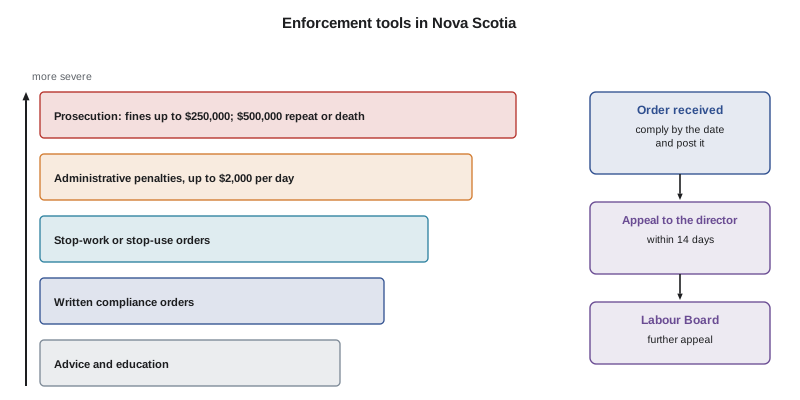
When an officer finds a contravention of the Act or regulations, the usual first tool is a written order requiring the employer, or another responsible party, to comply by a set date. Orders describe the contravention and what must be done. Where there is a danger to health or safety that must be dealt with immediately, the officer can order work to stop, or equipment or an area not to be used, until the danger is removed. Orders must be posted in the workplace where affected workers can see them, and given to the joint occupational health and safety committee or health and safety representative. Under amendments that came into force in 2025, orders must be posted for at least seven days.
The orders issued after the spiral conveyor injury required Harrowgate Foods Ltd. to ensure machinery was locked out before cleaning and maintenance, to provide machine-specific lockout training to the sanitation crew and their supervisors, and to review the hazard assessment for night sanitation with worker involvement. Each order had a compliance date, and the company had to report back in writing on what it had done. Dev kept copies of the orders in his binder and made sure the crew had seen them.
Administrative penalties
Nova Scotia also uses administrative penalties, which are fines issued by the Department itself without going to court. The amounts are set in a schedule and depend on who committed the contravention and whether it is a first, second or third offence within three years. For employers, contractors, constructors and suppliers, the amounts are $500, $1,000 and then $2,000. For supervisors, owners and self-employed persons they are $250, $500 and then $1,000. For employees they are $100, $200 and then $500. A penalty can be issued for each day a contravention continues. Once a person has received an administrative penalty for a contravention, they generally cannot also be prosecuted for the same contravention.
The fact that supervisors appear in the schedule is a reminder that supervisors can be penalized personally. Administrative penalties are typically used for clear, provable contraventions, such as a missing guard or a worker without fall protection, where a quick financial consequence is more useful than a long prosecution.
Prosecution
The most serious tool is prosecution. The Department investigates, and if it believes an offence has been committed and a prosecution is in the public interest, charges are laid in provincial court, usually by the Crown prosecutor's office. Charges can be laid against the employer, supervisors, workers, owners, suppliers or other parties, depending on who committed the offence. Nova Scotia's maximum fines, last increased in 2011, are up to $250,000 for a first offence and up to $500,000 for a subsequent offence within five years or for an offence that causes a death. Directors and officers of a corporation can also be charged if they directed, authorized or took part in the offence.
The decision whether to charge an individual supervisor depends on the evidence and on the supervisor's role. In the spiral case, the Department charged the company but not the previous night supervisor. Aisha explained the likely reasons: he had raised the time pressure with management, even if only verbally; he had not been trained as a supervisor; and the root causes, the schedule and the disconnect placement, were decisions made above him. A supervisor who had directed workers to skip lockout, or ignored a refusal, would have been far more exposed.
Sentencing
If an accused is convicted or pleads guilty, the court decides the sentence. Courts across Canada apply similar principles to safety offences. The main purpose is deterrence: the fine must be large enough that this company and others take safety seriously, without being so large that it puts the company out of business. Aggravating factors include the seriousness of the harm, a history of similar contraventions or warnings, a profit motive, and ignoring known risks. Mitigating factors include a guilty plea, cooperation with the investigation, prompt corrective action, genuine remorse and a good safety record. Some provinces' laws also let courts make other orders, such as requiring the offender to publicize the offence or fund training.
Harrowgate Foods Ltd. decided, on Aisha's advice, to plead guilty to the charge. The evidence of tolerated non-compliance made a full due diligence defence unlikely, and a guilty plea, together with the strong corrective action, would weigh in the company's favour at sentencing. The Crown and defence made a joint submission, which the court accepted, for a fine of $85,000. The judge's reasons noted the seriousness of the injury and the evidence that the shortcut had become routine, and gave credit for the plea, the engineering fixes and the company's cooperation.
Appeals
A person who disagrees with an officer's order or decision can appeal. Under Nova Scotia's system, the appeal goes first to the director, within 14 days of receiving the order, and then, if the person is still not satisfied, to the Labour Board. Workers and committees can appeal too, for example if they think an order does not go far enough. Filing an appeal does not usually suspend the order unless the director or the Board says so, so the safe approach is to comply while appealing. Administrative penalties can also be appealed. Convictions in court can be appealed to a higher court on questions of law or sentence, like any other provincial offence.
Harrowgate Foods Ltd. did not appeal any of the orders. Elena's view was that the orders required things the company should have done anyway. Appealing them would have sent the wrong message to the crew about what the company had learned.
Calculating exposure to penalties
Elena wanted the leadership team to understand how quickly daily administrative penalties could add up if a contravention was left uncorrected, compared with a single prosecution fine.
# Nova Scotia administrative penalty schedule (amounts per contravention, per day it continues).
schedule = {
    "employer": (500, 1000, 2000),
    "supervisor": (250, 500, 1000),
    "employee": (100, 200, 500),
}
def penalty(party, nth, days=1):
    # nth = 1 for a first contravention within three years, 2 for a second, 3 for third or later
    return schedule[party][min(nth, 3) - 1] * days

print("employer, first contravention, corrected same day:", penalty("employer", 1))
print("employer, third contravention, 30 days uncorrected:", penalty("employer", 3, 30))
print("supervisor, second contravention:", penalty("supervisor", 2))
print("maximum court fine, first offence: 250000; repeat or death: 500000")employer, first contravention, corrected same day: 500 employer, third contravention, 30 days uncorrected: 60000 supervisor, second contravention: 500 maximum court fine, first offence: 250000; repeat or death: 500000
The same tool was used for the Nova Scotia comparison. Elena showed that leaving an employer-level contravention uncorrected for a month after a third penalty in three years could reach tens of thousands of dollars at $2,000 a day, but that the real cost of any contravention was the risk it left in place.
Worked problem
Choosing a response to an order
Show solution
- An officer at the distribution centre orders Harrowgate Foods Ltd. to install guardrails on a mezzanine within 14 days.
- The company agrees the hazard is real but cannot get guardrails fabricated in 14 days.
- It installs temporary barriers and restricts access to the mezzanine immediately.
- It writes to the officer explaining the interim controls and asking for an extension, rather than appealing the order itself.
- The officer grants the extension; the permanent guardrails are installed in 30 days and the company reports compliance.
Answer: Comply, protect workers in the meantime and ask for more time, rather than fighting a valid order.
What a supervisor should do when an officer arrives
Officers often arrive without warning, and on night or weekend shifts the supervisor may be the most senior person present. Elena gave every supervisor a short guide. Greet the officer, ask to see identification and ask the reason for the visit. Call the plant manager and the health and safety manager, but do not keep the officer waiting for them. Accompany the officer, answer questions truthfully and within your knowledge, and say so when you do not know. Take your own notes and photographs of what the officer looks at. Fix anything that can be fixed on the spot. Do not move or alter anything at an accident scene unless it is needed to rescue someone or prevent further harm. Never discourage a worker from speaking to the officer, and never ask afterwards what they said.
Workers and committee members have their own role during an inspection. The worker co-chair of the joint occupational health and safety committee, or another worker member, is entitled to accompany the officer, and officers often ask to speak with workers privately. A supervisor who tries to sit in on those conversations, or who tells workers what to say, risks an obstruction charge and destroys the trust the internal responsibility system depends on.
Statements and interviews
Officers investigating serious incidents take statements from witnesses, including supervisors and managers. People are generally required to answer an officer's questions and must not give false information. A person facing possible charges personally may want legal advice before giving a statement, and in serious cases companies often arrange for counsel to be available to employees who want it. The best preparation is simple: tell the truth, stick to what you saw and did, use your notes and records to refresh your memory, and do not guess. Dev's predecessor told investigators honestly that he had known lockout was being skipped. That honesty did not help the company's defence, but it was the right thing to do, and lying would have made everything worse.
Learning from enforcement elsewhere
Elena also used other companies' enforcement cases as teaching material. The Department and the courts publish summaries of convictions, and safety associations share lessons from serious incidents. Each month she picked one case from a similar industry and asked supervisors at each site: could this happen here, and what would stop it? The questions were often uncomfortable. A conviction elsewhere for a worker caught in an unguarded conveyor led the sauces plant to find two similar gaps of its own.
Common mistakes
MistakeObstructing or delaying an officer.
InsteadCooperate fully; obstruction is itself an offence.
MistakeIgnoring a compliance date.
InsteadComply on time, or ask for an extension with interim protection in place.
MistakeAssuming an appeal suspends an order.
InsteadComply while appealing unless told otherwise.
MistakeThinking supervisors cannot be penalized personally.
InsteadSupervisors appear in the penalty schedule and can be prosecuted.
MistakeTreating fines as the main cost.
InsteadThe real cost of a contravention is the risk it leaves in place.
Summary and key terms
- Officers can enter without a warrant, inspect, question, require documents and preserve accident scenes.
- Written orders require compliance by a date; stop-work or stop-use orders deal with immediate danger; orders must be posted.
- Administrative penalties range from $100 to $2,000 per contravention, can accrue daily and generally rule out prosecution for the same contravention.
- Prosecutions can lead to fines up to $250,000 for a first offence and $500,000 for a repeat or an offence causing death.
- Sentencing aims at deterrence and weighs aggravating and mitigating factors, including guilty pleas and corrective action.
- Orders can be appealed to the director within 14 days and then to the Labour Board; comply while appealing.
- Compliance order
- A written order from an officer requiring a contravention to be corrected by a set date.
- Stop-work order
- An order that work stop, or equipment not be used, until an immediate danger is removed.
- Administrative penalty
- A fine issued by the Department under a schedule, without going to court.
- Prosecution
- A charge laid in court for an offence under the Act.
- Joint submission
- An agreed sentencing recommendation presented to the court by the Crown and the defence.
- Labour Board
- The tribunal that hears appeals of directors' decisions under the Act.
Practice problems
Work each problem on paper first, then reveal the answer to check.
Name four powers of an officer.
Show answer
Enter without a warrant, inspect, take samples and photos, require documents, question people, preserve the scene.
What are the administrative penalty amounts for supervisors?
Show answer
$250, $500 and then $1,000 for first, second and third or later contraventions within three years.
What are the maximum prosecution fines in Nova Scotia?
Show answer
Up to $250,000 for a first offence, up to $500,000 for a repeat within five years or an offence causing death.
Why was the previous supervisor not charged?
Show answer
He raised the issue, was untrained and the root causes were decisions above him.
Where does an appeal of an order go?
Show answer
To the director within 14 days, then to the Labour Board.
Lesson quiz · 5 questions
Score 60% or more to complete this lesson.
Create a free account to save your progress, take quizzes and earn a certificate.