
HSE-402 · Lesson 2 of 12 · 21 min
The internal responsibility system and shared duties
In his second week, Dev found a worn guard on the bread slicer at the start of night shift. The day crew had taped a piece of cardboard over a gap in the guard and left a note: 'Maintenance knows.' The day supervisor had gone home, maintenance had no work order, and the slicer was scheduled to be cleaned at 1 a.m. Dev's question to Elena the next morning was simple: 'Whose problem was that?' Her answer was the core idea of Canadian safety law: 'Everyone's, in proportion to what they could do about it. And at 1 a.m., the person who could do the most was you.'
The internal responsibility system
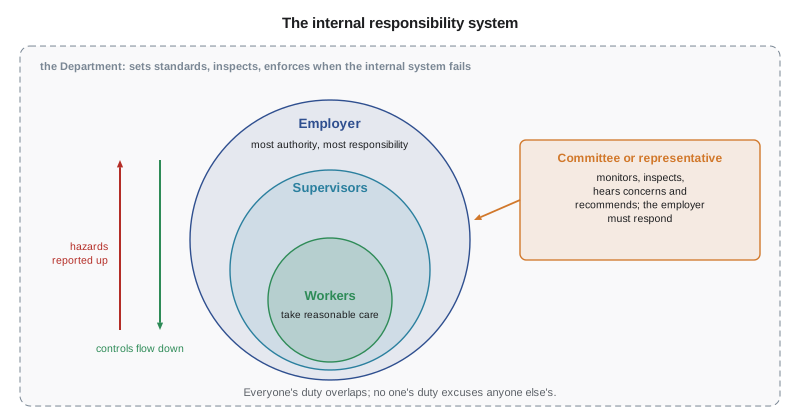
Canadian safety law rests on a principle called the internal responsibility system, often shortened to IRS. The idea, which grew out of the 1976 Ham Royal Commission in Ontario, is that the people inside a workplace are in the best position to find and fix hazards, because they know the work. Government inspectors cannot be everywhere. So the law makes everyone in the workplace responsible for health and safety, according to their authority and ability, and gives workers rights that let them take part. The regulator stays in the background as a backstop: setting minimum standards, checking that the system works, and stepping in when it fails.
Nova Scotia's Act states the principle directly in its opening sections: it says that the foundation of the Act is the internal responsibility system, which is based on the principle that employers, contractors, constructors, employees and self-employed persons share responsibility for workplace health and safety, and that the degree of responsibility of each depends on their authority and ability to act. The Department's own guidance puts it simply: everyone shares responsibility, but the employer ordinarily has more than anyone else.
How the IRS works day to day
A healthy internal responsibility system has a few recognizable features. Hazards are reported up quickly and fixed at the lowest level that has the authority to fix them. Each level checks that the level below is working: managers check that supervisors are inspecting and coaching, supervisors check that workers are following procedures and raising concerns. Workers take part through the joint occupational health and safety committee or health and safety representative, and through their own right to know, participate and refuse. When the internal system cannot solve a problem, there is a clear path out: to the committee, and finally to the Department.
Elena compared it to a set of nested checks. The worker who sees a frayed cord tags it out and tells the supervisor. The supervisor arranges a replacement and checks the other cords on the line. The manager makes sure there is a budget and a process for inspecting cords. The committee looks at whether cord damage is a pattern and recommends a fix. If the company ignored the recommendation, the worker or the committee could go to the Department. At every step, responsibility sits with the person who can act.
Where the IRS breaks down
The internal responsibility system is only as strong as its weakest link, and investigations of serious incidents often find the same failure points. Responsibility is assumed to be someone else's: 'maintenance knows', 'the day shift will deal with it', 'that's the safety department's job'. Supervisors lack the authority, time or budget to fix what they find, so they stop reporting. Workers fear that raising concerns will mark them as troublemakers. Committees meet but cannot get answers. Senior managers measure production closely and safety only by injury counts. At Westray, the inquiry found an internal responsibility system that existed on paper but had collapsed in practice.
The slicer guard was a small example of the same pattern. The day crew had noticed the hazard and done something, but had passed responsibility to maintenance without making sure anyone with authority acted. Dev locked out the slicer, tagged it, reported it to the maintenance manager by email with a photo, and told Marcus at the morning meeting. The guard was fixed by noon. 'That,' Elena said, 'is the internal responsibility system working.'
Contractors, suppliers and others
The Act also gives duties to other parties in the workplace. Contractors and constructors must ensure their work is done safely and coordinate with others. Suppliers must provide equipment and products that are safe when used as directed, with the information needed to use them safely. Owners of workplaces must maintain the parts they control. Professional engineers and architects must make sure their designs can be built and used safely. Self-employed people must protect themselves and others affected by their work. On a busy site, several of these duties overlap, which is why coordination matters.
For Harrowgate Foods Ltd., the overlapping duties showed up most with temporary workers at the distribution centre and with contractors in the plants. A temporary help agency remains the legal employer of its workers, but Harrowgate Foods Ltd. controls the workplace and directs the work, so both have duties. When Dev's sanitation crew was short-staffed, the plant used agency workers for the night clean. Dev, as the supervisor directing their work, was responsible for making sure they received the same orientation, lockout and chemical training as Harrowgate Foods Ltd.'s own employees before they started.
Measuring whether shared responsibility works
Elena wanted a quick way to see whether responsibility was really being shared at each site, or whether problems were piling up waiting for someone else. She suggested tracking how quickly reported hazards were closed, and at what level they were closed. A hazard that sits open for weeks, or that can only be fixed by the plant manager, is a sign that the system below has stalled.
# Hazard reports closed last quarter at each site: (site, level that fixed it, days open).
reports = [
    ("main", "worker", 0), ("main", "supervisor", 1), ("main", "supervisor", 2), ("main", "manager", 21),
    ("main", "manager", 34), ("main", "supervisor", 1), ("main", "maintenance", 6), ("main", "maintenance", 15),
    ("dc", "supervisor", 1), ("dc", "worker", 0), ("dc", "manager", 40), ("dc", "maintenance", 9),
    ("sauces", "supervisor", 2), ("sauces", "worker", 0), ("sauces", "maintenance", 4),
]
from statistics import median
for site in ("main", "dc", "sauces"):
    rs = [r for r in reports if r[0] == site]
    days = [r[2] for r in rs]
    low = sum(1 for r in rs if r[1] in ("worker", "supervisor"))
    slow = sum(1 for d in days if d > 14)
print(f"{site:<7} reports {len(rs):>2} median days {median(days):>4} fixed on the floor {low / len(rs):4.0%} open > 14 days {slow}")main reports 8 median days 4.0 fixed on the floor 50% open > 14 days 3 dc reports 4 median days 5.0 fixed on the floor 50% open > 14 days 1 sauces reports 3 median days 2 fixed on the floor 67% open > 14 days 0
The numbers showed that at the main plant and the distribution centre, items that had to go up to a manager stayed open for weeks. When Elena looked at those items, most needed a small amount of money or a decision about staffing. The fix was not to tell people to try harder, but to give supervisors a small budget and a clear way to escalate. Within two months, the median time open for manager-level items fell to under a week.
Worked problem
Who is responsible for the slicer guard?
Show solution
- The day crew noticed the damaged guard and taped it: they acted, but did not make sure it was fixed or the machine was taken out of service.
- The day supervisor knew and went home without arranging a repair or removing the machine from use.
- Maintenance had no work order, so had no chance to act.
- Dev, as the supervisor directing the night crew, had the authority to lock out the machine and the duty to protect his crew.
- The employer is responsible for having a system that gets damaged guards repaired quickly.
Answer: Responsibility was shared, but the person who could act most directly that night was Dev, and he did.
The committee as part of the system
The joint occupational health and safety committee is the most visible piece of the internal responsibility system. In Nova Scotia, employers with 20 or more regularly employed workers must have one, and at least half its members must be workers who do not exercise managerial functions, chosen by the workers or their union. Committees receive complaints and concerns, take part in identifying hazards, inspect the workplace, keep records, make recommendations to the employer and help investigate serious incidents and refusals. They are advisory: the committee does not run safety, and it does not take responsibility away from the employer or supervisors. Its value lies in giving workers a formal voice and in giving managers information they would not otherwise get.
Dev's crew had never had a member on the main plant committee, because meetings were held at 2 p.m. and night workers would have had to come in on their own time. After the injury, Rachel changed the rule so night workers could attend on paid time, and the committee began holding every third meeting at 6 a.m., at shift change. The first night member, a sanitation worker named Priya, brought three items to her first meeting: the spiral disconnect, the shortage of lockout locks, and the lack of lighting on the mezzanine stairs. All three were fixed within a month. 'Nobody on days had ever seen the mezzanine at night,' she said.
Responsibility goes up as well as down
Shared responsibility is often described as flowing downward: managers set rules, supervisors enforce them, workers follow them. But the most important flow is upward. A supervisor who discovers that a rule cannot be followed in the time allowed has a duty to say so to the people who set the schedule. A manager who learns that supervisors lack the authority to fix hazards has a duty to change that. Investigations of serious incidents regularly find that the people at the bottom knew about the problem and the people at the top did not, because nothing in the system carried the information up.
Dev's first upward report was about the sanitation window. He timed three spiral cleans with full lockout and found they took 45 minutes longer than the schedule allowed. He wrote a short note to Marcus with the times, the risk and two options: start sanitation 45 minutes earlier, or move the spiral clean to the weekend shutdown. Marcus chose the first option and adjusted the bread schedule. The decision cost a little production flexibility. It removed the pressure that had made skipped lockout normal.
A short test for shared responsibility
Elena gave Dev a three-question test he could use whenever he found a hazard. Who can make it safe right now? Who needs to know so it gets fixed properly? Who will check that it stays fixed? If he could name a person for each answer, responsibility was being shared. If any answer was 'someone' or 'they', the hazard was at risk of falling through the cracks.
Dev tried the test on the slicer guard. Who could make it safe right now? He could, by locking it out. Who needed to know so it got fixed properly? The maintenance manager, by a work order with a photo, and Marcus, at the morning meeting. Who would check that it stayed fixed? The day supervisor, at the start of each shift, and the committee on its monthly inspection. Every answer had a name. A month later, when another guard on a packaging line was found damaged, the day crew used the same three questions without being asked, and the line was locked out, reported and repaired within the shift.
Elena pointed out that the test also protects supervisors. A supervisor who can show that he made the area safe, told the right people in writing and checked back has done what the law expects of someone in his position, even if the final repair is slow for reasons outside his control. A supervisor who only told someone in passing, and never followed up, has nothing to show.
Common mistakes
MistakeTreating the internal responsibility system as 'the workers are responsible'.
InsteadResponsibility follows authority: the employer has the most, then supervisors, then workers.
MistakePassing a hazard on without checking that someone with authority acted.
InsteadReport it, make the situation safe in the meantime, and follow up until it is fixed.
MistakeAssuming temporary workers are the agency's responsibility alone.
InsteadThe host employer directing the work has duties for site-specific hazards and training.
MistakeIgnoring the company's own rules because they go beyond the legal minimum.
InsteadThe company's own rules are evidence of what it recognized and promised.
MistakeMeasuring only injuries.
InsteadTrack how quickly hazards are closed and at what level, to see whether shared responsibility is working.
Summary and key terms
- The internal responsibility system makes everyone responsible for safety in proportion to their authority and ability to act.
- The employer has the most responsibility; supervisors carry much of it on the floor; workers have duties and rights.
- The committee and the Department are backstops when the internal system cannot solve a problem.
- Contractors, suppliers, owners and others have duties for what they control.
- Host employers have duties to temporary workers they direct, including site-specific training.
- Track how fast hazards are closed and at what level to see whether responsibility is really shared.
- Internal responsibility system
- The principle that everyone in the workplace shares responsibility for safety, according to their authority and ability to act.
- Joint occupational health and safety committee
- A committee of worker and employer members that monitors safety and makes recommendations.
- Health and safety representative
- A worker representative in smaller workplaces, with similar functions to a committee.
- Supplier
- A party that provides equipment or products to a workplace, with duties to make them safe when used as directed.
- Temporary help agency
- An employer that assigns its workers to perform work for client businesses.
Practice problems
Work each problem on paper first, then reveal the answer to check.
State the internal responsibility system in one sentence.
Show answer
Everyone in the workplace shares responsibility for safety according to their authority and ability to act.
Who ordinarily has the most responsibility?
Show answer
The employer.
What should Dev have done if he could not reach maintenance about the guard?
Show answer
Keep the slicer locked out and tagged, report in writing, and escalate to the manager in the morning.
Name two signs that the internal system is breaking down.
Show answer
Hazards passed on without action, supervisors without authority or budget, fear of reporting, slow responses to recommendations.
Who must train agency workers on site-specific hazards?
Show answer
The host employer directing the work, such as Harrowgate Foods Ltd. through its supervisor.
Lesson quiz · 5 questions
Score 60% or more to complete this lesson.
Create a free account to save your progress, take quizzes and earn a certificate.