
HSE-402 · Lesson 12 of 12 · 21 min
Capstone: the supervisor's legal toolkit
Two years after the spiral conveyor injury, Rachel asked Dev to take on a new role: sanitation and night operations lead across all three sites, with responsibility for coaching every new supervisor through their first months. Elena asked him to build something he wished he had been given on his first night: a short, practical toolkit that turned the law covered in this course into things a supervisor does, checks and writes down. This capstone walks through that toolkit, then tests it against a new incident.
The toolkit had to work for any supervisor at Harrowgate Foods Ltd., not just sanitation leads: production supervisors on the lines, shift leads at the distribution centre, maintenance planners and the warehouse team at the sauces plant in Kentville. It had to be honest about the law, without turning supervisors into amateur lawyers. And it had to fit on a few pages, because Dev knew that nobody reads a binder at three in the morning.
Supervisors in construction face the same core law with extra layers: constructors, prime contractors, multi-employer sites and specific construction regulations. Those are covered in CON-355, Safety Leadership for Site Supervisors, and HSE-375, Constructor and Supervisor Responsibilities on Construction Projects. This toolkit is built for fixed workplaces such as plants, warehouses, shops, offices and service operations, but its core works anywhere.
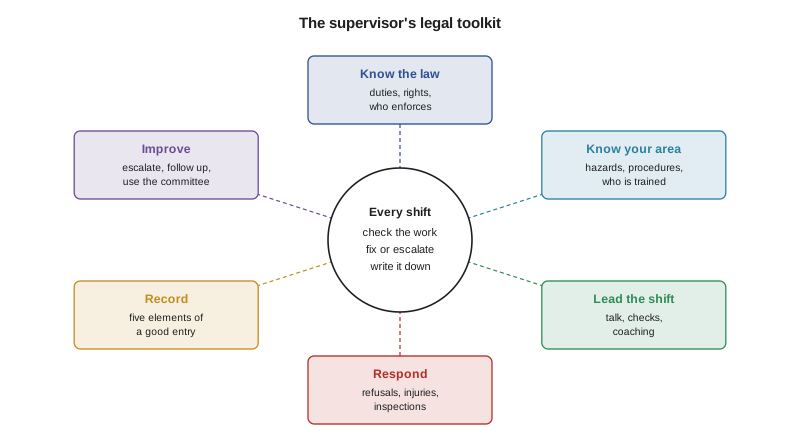
Part 1: know the law in one page
The first page of the toolkit summarized what the law expects, in plain words, with the lesson in this course where each point is explained. Employers must take every reasonable precaution to protect workers, provide a safe workplace, equipment and systems of work, and give workers the information, instruction, training and supervision they need. Supervisors must be competent, know the hazards and the law that applies to the work they direct, tell workers about the hazards, make sure workers follow the rules and use their protective equipment, and take every reasonable precaution in the circumstances. Workers must take reasonable care, follow the rules and report hazards, and have three rights: to know, to participate and to refuse unsafe work. Everyone shares responsibility under the internal responsibility system, and nobody's duty excuses anyone else's.
The page ended with the three duties from due diligence, which Dev called the supervisor's three questions: did I foresee the hazard, did I act efficiently to control it, and did I use my authority to make sure the controls were followed?
Part 2: know your area
The second part was a one-page area sheet that each supervisor kept current for the work they direct. It listed the top hazards in the area, with the procedure and the control for each; the high-risk tasks that need a permit or a sign-off; who on each crew is trained and signed off on what, linked to the training matrix; where the safety data sheets, eyewash stations, first aid kits, lockout stations and emergency exits are; who the joint occupational health and safety committee members or health and safety representative for the area are; and who to call, day and night, for a serious injury, a refusal or a regulator visit.
Dev required each new supervisor to walk their area with an experienced supervisor or Elena in their first week and fill in the sheet themselves. The walk took two hours. It was the quickest way he had found to meet the duty to know the hazards of the work, and the sheet became the supervisor's first piece of evidence that they did.
Part 3: lead the shift
The third part described the routine of a shift. At the start, a five-minute talk covering the work planned, the hazards that matter most tonight, any changes since the last shift, and an open question: what worries you about tonight's work? During the shift, at least two planned checks of high-risk tasks, such as lockout on cleans, forklift traffic or chemical dilution, where the supervisor watches the work being done and talks to the crew about it. Coaching on the spot when something is wrong, with the work stopped if the risk is serious. At the end, a handover to the next shift that includes open hazards and unfinished fixes, not just production numbers.
The routine took about forty minutes of an eight-hour shift. Dev's experience was that it saved more time than it took, because problems were caught before they stopped a line. More importantly, it was what a competent supervisor does: knowing the work, telling workers about the hazards and making sure the rules are followed.
| When | Do | Write down |
|---|---|---|
| Start of shift | Five-minute talk: work, hazards, changes, open question | Topics and any concerns raised |
| During shift | Two planned checks of high-risk tasks; coach on the spot | What was checked, found and corrected |
| Any time | Stop work if the risk is serious; fix or escalate hazards | Hazard, action, work order, escalation |
| End of shift | Handover of open hazards and unfinished fixes | Open items with owners |
Part 4: respond
The fourth part covered the moments when things go wrong. For a work refusal: listen, do not argue, investigate with the worker, fix the hazard if you can, involve the joint occupational health and safety committee member or health and safety representative if it is not resolved, call Elena, and know that an officer may be called. Do not assign the work to someone else without telling them about the refusal and the reason. Never take or threaten any action against the worker. For an injury: get help, make the area safe, preserve the scene if the injury is serious, call the on-call manager, and write your report before the end of the shift. For an officer's visit: be courteous, call Elena or the on-call manager, accompany the officer, answer factual questions truthfully, provide records that are asked for, and never obstruct, hide or alter anything.
Part 5: record
The fifth part was lesson 11 on half a page: the five elements of a good entry (who; what; when and where; action; follow-up), facts not judgements, no alterations or backdating, written escalation for anything you cannot fix, and medical details kept out of the shift log. Dev added three examples of weak and strong entries taken from real logs at Harrowgate Foods Ltd., with names changed.
Part 6: improve
The last part reminded supervisors that the law expects more than reacting. Supervisors should bring hazards they cannot fix to the person who can, in writing, and follow up. They should use the joint occupational health and safety committee, by raising issues, attending inspections when invited and responding to recommendations affecting their area. And they should treat near misses and minor injuries as free lessons, investigating them with the same care as serious ones.
The self-audit
Dev built a short self-audit into the toolkit, with twelve statements a supervisor scores from 0 (not in place) to 2 (in place with records to show it). New supervisors completed it at the end of their first month and again at three months, with Elena or Dev. The script below shows the scoring for one new supervisor at the sauces plant.
# Supervisor self-audit: 12 items scored 0-2 at one and three months (invented data).
items = [
    "area sheet complete and current", "know top hazards and controls",
    "crew training checked against tasks", "start-of-shift talks held",
    "planned checks of high-risk tasks", "coaching and corrections recorded",
    "hazards fixed or escalated in writing", "follow-up recorded",
    "know refusal steps", "know injury reporting steps",
    "know what to do in an inspection", "committee issues raised and tracked",
]
month1 = [2, 1, 1, 2, 1, 0, 1, 0, 1, 2, 1, 0]
month3 = [2, 2, 2, 2, 2, 1, 2, 1, 2, 2, 2, 1]
for label, s in (("month 1", month1), ("month 3", month3)):
    print(f"{label}: {sum(s)}/{2 * len(s)} ({100 * sum(s) / (2 * len(s)):.0f}%)")
gaps = [items[i] for i, v in enumerate(month3) if v < 2]
print("still to strengthen:", "; ".join(gaps))month 1: 12/24 (50%) month 3: 21/24 (88%) still to strengthen: coaching and corrections recorded; follow-up recorded; committee issues raised and tracked
The pattern was typical. New supervisors did well on the visible habits, like start-of-shift talks, and poorly on the written ones: recording coaching, follow-up and committee issues. The audit made the gap visible and gave the coaching conversation a focus.
Testing the toolkit: the ammonia alarm
Six months after the toolkit was introduced, it was tested. At 01:50 one Sunday, an ammonia detector in the refrigeration machine room at the main plant in Truro alarmed at its first set point. The night supervisor that weekend was Tomas, the former new hire from lesson 11, who had been promoted to sanitation lead three months earlier. Ammonia is toxic and, at high concentrations, flammable; the plant had an emergency response plan for releases, with trained responders and an arrangement with the local fire department.
Tomas followed the emergency plan: he cleared the area near the machine room, called the on-call refrigeration technician and the on-call manager, and kept everyone upwind at the muster point. A sanitation worker said she had smelled ammonia near the machine room door an hour earlier but had not thought it serious. When the technician arrived in full protective equipment, she found a leaking valve packing and isolated it. Readings fell. Nobody was hurt.
Then the second half of the toolkit came into play. Tomas wrote his report before the end of the shift, using the five elements, including the worker's earlier observation, stated as a fact without blame. Elena checked the Department's reporting requirements for an uncontrolled release and made the reports required, and the company investigated the incident as a near miss with serious potential. The investigation found that the detector's first set point was working, but that workers did not know that an ammonia smell should be reported immediately. Tomas's area sheet already listed ammonia as a top hazard, but the start-of-shift talks had never covered it. The fix was a short briefing for every crew and a line on the area sheet: any ammonia smell, report it at once and move away.
When Dev reviewed the incident with Tomas, he asked the supervisor's questions from Part 1. Had the hazard been foreseen? Yes, it was on the area sheet. Had the response been efficient? Yes, the emergency plan worked. Had authority been used to make sure workers knew what to do? Not fully: the worker who smelled ammonia had not known to report it. 'That's the gap,' Dev said. 'Not the alarm, not the response. The briefing.' Tomas recorded the fix and the follow-up, and checked at each crew's next talk that it had been delivered.
What the course adds up to
This course began with how health and safety law works in Canada and ended with a supervisor's toolkit. In between, it covered the internal responsibility system, the duties of employers and supervisors, workers' rights, due diligence, enforcement and appeals, the evidence that proves diligence, criminal liability after Westray, reporting and records, and documentation. Each part comes back to the same idea. The law does not ask supervisors to be perfect. It asks them to know the hazards of the work they direct, to act on what they know, to use their authority to make sure the rules are followed, and to be able to show it.
Dev put it more simply when he handed the toolkit to each new supervisor. 'Check the work, not just the paperwork. Fix it or escalate it. Write it down.' He had learned those habits the hard way, on a night when a worker was hurt on equipment he was responsible for. The point of the toolkit was that nobody else should have to learn them that way.
Worked problem
Apply the toolkit to a new hazard
Show solution
- A shift lead at the distribution centre notices that a new pallet wrapper's safety light curtain has been bypassed with tape.
- Know the law: guarding and safe equipment are employer duties; the supervisor must make sure controls are used.
- Lead the shift: stop the machine, remove the tape, tag out the wrapper until maintenance confirms the light curtain works.
- Record: who found it, when, what was found and done, the work order, and that the crew was briefed on why bypassing is not allowed.
- Improve: find out why it was bypassed (nuisance trips), escalate the root cause in writing to maintenance and Elena, and follow up until it is fixed.
Answer: Each part of the toolkit turns a legal duty into an action and a record.
Common mistakes
MistakeTreating the toolkit as a binder to keep on a shelf.
InsteadUse it every shift: check, fix or escalate, write it down.
MistakeDoing the visible habits but skipping the records.
InsteadRecord coaching, follow-up and committee issues, which are the usual gaps.
MistakeAssuming that a working alarm means nothing needs fixing.
InsteadAsk all three questions: foresight, efficient action and authority.
MistakeCopying construction rules into a fixed workplace without checking.
InsteadUse CON-355 and HSE-375 for construction; use the general rules here for fixed workplaces.
MistakeLearning the law but not the area.
InsteadWalk the area and complete the area sheet in the first week.
Summary and key terms
- The toolkit has six parts: know the law, know your area, lead the shift, respond, record and improve.
- One habit sits at its centre: check the work, fix or escalate, write it down.
- The area sheet is the quickest way to meet the duty to know the hazards.
- A shift routine of talks, planned checks, coaching and handover takes about forty minutes and prevents more lost time than it costs.
- Self-audits show that written habits are usually the weakest; coaching should focus there.
- Testing the toolkit against a near miss shows where foresight, action or authority fell short.
- Area sheet
- A one-page summary of the hazards, procedures, trained people and contacts for a supervisor's area.
- Planned check
- A scheduled observation of a high-risk task being done.
- Handover
- The transfer of open hazards and unfinished fixes to the next shift.
- Self-audit
- A supervisor's scoring of their own practices against a checklist, with evidence.
- Near miss with serious potential
- An event that caused no injury but could have caused a serious one.
Practice problems
Work each problem on paper first, then reveal the answer to check.
Name the six parts of the toolkit.
Show answer
Know the law, know your area, lead the shift, respond, record, improve.
What goes on an area sheet?
Show answer
Top hazards and controls, high-risk tasks, who is trained, locations of safety equipment, committee contacts and who to call.
What was the gap in the ammonia incident?
Show answer
Workers had not been briefed to report an ammonia smell immediately.
Which self-audit items are usually weakest?
Show answer
The written ones: recording coaching, follow-up and committee issues.
Where should a construction supervisor look for the extra layers of law?
Show answer
CON-355 and HSE-375.
Lesson quiz · 5 questions
Score 60% or more to complete this lesson.
Create a free account to save your progress, take quizzes and earn a certificate.