
HSE-109 · Lesson 5 of 12 · 25 min
Stress, burnout and the demands of work
Stress is the most familiar word in workplace mental health, and also one of the most misunderstood. People use it to mean the pressure itself ("there's a lot of stress this month"), their reaction to it ("I'm stressed") and the health effects that follow ("stress made me ill"). This lesson separates those ideas, explains how stress becomes harmful, describes burnout as the World Health Organization defines it, and shows how workplaces can manage the demands of work so that pressure stays productive rather than damaging.
Stressors, stress and strain
It helps to use three different words. A stressor is a demand or event that requires a person to adapt: a deadline, a difficult customer, a reorganization, a traumatic call. Stress is the person's response to that demand, involving thoughts, emotions and body changes. Strain is the result over time when stress is intense or prolonged: exhaustion, anxiety, low mood, physical symptoms, poorer performance. The same stressor can produce very different levels of stress and strain in different people, depending on how they appraise it, what resources they have and what else is happening in their lives. But that does not make stress purely an individual matter. When many people in the same job show signs of strain, the most likely cause is the job.
Psychologists Richard Lazarus and Susan Folkman described stress as arising from appraisal: a person asks, consciously or not, "Is this a threat?" and "Do I have what I need to cope?" When the answer to the first is yes and the second is no, stress follows. This is why control, support and clarity are so protective. They change the answer to the second question. A worker facing a tight deadline who has the authority to drop lower-priority tasks, a supportive manager and the right tools experiences far less stress than one facing the same deadline alone, with no say and unclear expectations.
Healthy pressure and harmful stress
Not all pressure is bad. A certain level of challenge keeps work interesting, helps people focus and gives a sense of achievement. The relationship between pressure and performance is often drawn as an inverted U. At low pressure people may feel bored and disengaged. As pressure rises, performance improves up to a point. Beyond that point, further pressure causes performance and health to decline: attention narrows, mistakes increase, sleep suffers and exhaustion sets in. The curve is a simplification, and the peak sits in a different place for different people and tasks, but it captures an important idea: the goal is not to remove all pressure but to keep it in a range people can sustain, with time to recover.
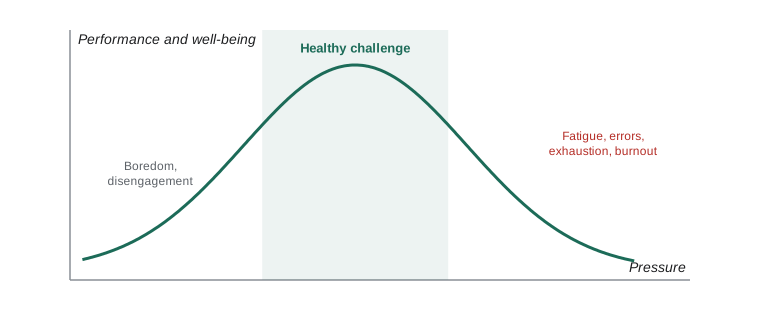
Recovery is the key. Short bursts of high demand, followed by genuine rest, are usually manageable. Problems arise when high demand becomes the permanent state: when every week is a crunch week, when evenings and weekends are taken over by email, when vacation is postponed again and again. Research on recovery shows that people need time when they are psychologically detached from work, not just physically absent. A worker who is at home but checking messages until midnight is not recovering.
How chronic stress affects health
Prolonged stress affects almost every system in the body. Short-term effects include headaches, muscle tension, stomach upset, trouble sleeping, irritability and difficulty concentrating. Over months and years, chronic stress is associated with anxiety and depressive disorders, burnout, high blood pressure, cardiovascular disease, weakened immune function, musculoskeletal disorders and unhealthy coping such as increased alcohol use. Long working hours are a well-documented example: a joint WHO and ILO analysis published in 2021 estimated that working 55 hours or more a week was associated with a substantially higher risk of stroke and heart disease than working 35 to 40 hours, and attributed hundreds of thousands of deaths a year worldwide to long working hours.
Burnout
Burnout is a term many people use loosely, but it has a specific meaning. The World Health Organization's International Classification of Diseases, 11th revision (ICD-11), describes burnout as an occupational phenomenon, not a medical condition. It defines burnout as a syndrome resulting from chronic workplace stress that has not been successfully managed, characterized by three dimensions:
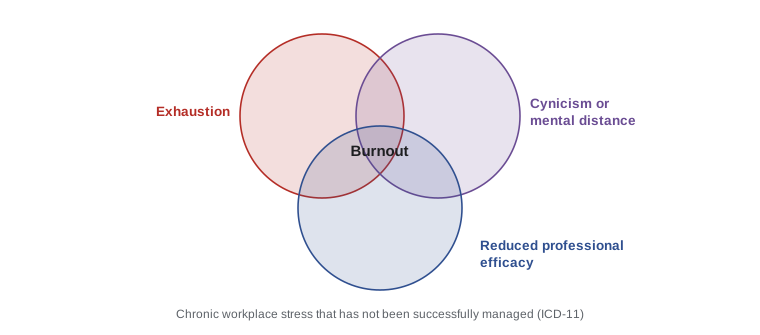
- Feelings of energy depletion or exhaustion.
- Increased mental distance from one's job, or feelings of negativism or cynicism related to one's job.
- Reduced professional efficacy: a sense of ineffectiveness and lack of accomplishment.
ICD-11 states that burnout refers specifically to phenomena in the occupational context and should not be applied to describe experiences in other areas of life. Placing it in the chapter on factors influencing health status, rather than among mental disorders, sends a clear message: burnout is a problem of work, not a flaw in the person. The research of Christina Maslach and Michael Leiter, which shaped this definition, identifies six areas of work life that drive burnout: workload, control, reward, community, fairness and values. When there are chronic mismatches between people and their jobs in these areas, burnout becomes more likely. Burnout can overlap with depression, and a person who feels burned out should be encouraged to speak with a health professional, especially if they have persistent low mood, hopelessness or thoughts of self-harm.
Role clarity and role conflict
Two often overlooked demands are role ambiguity and role conflict. Role ambiguity means not knowing clearly what is expected: what the priorities are, what decisions one is allowed to make, or how performance will be judged. Role conflict means facing incompatible demands, for example two managers who each want their work done first, or a job that requires both cutting costs and improving service with no guidance on the trade-off. Both are consistently linked to stress, anxiety and burnout, and both are largely within management's control. Clear job descriptions, agreed priorities, a single point of direction where possible, and regular conversations about what matters most this week or month are simple, effective controls. When priorities genuinely conflict, a good supervisor makes the call and takes responsibility for it rather than leaving workers to absorb the tension.
The job demands-resources model
A useful framework for managing stress and burnout is the job demands-resources (JD-R) model developed by Arnold Bakker and Evangelia Demerouti. It divides features of work into two groups. Job demands are aspects of work that require sustained physical, mental or emotional effort, such as workload, time pressure, emotional demands, role conflict and difficult customers. Job resources are aspects of work that help achieve goals, reduce demands or support growth, such as autonomy, social support, feedback, recognition, training and good leadership. High demands drive a health-impairment process leading to exhaustion; low resources weaken motivation and engagement. The practical lesson is that organizations can act on both sides: reduce excessive demands and increase resources.
| Demands to manage | Resources to build |
|---|---|
| Excessive workload and unrealistic deadlines | Realistic staffing and workload planning |
| Unclear or conflicting roles | Clear expectations and priorities from leaders |
| High emotional demands and abusive customers | Peer support, debriefing and the right to end abusive interactions |
| Constant interruptions and always-on communication | Focus time and clear norms about after-hours contact |
| Frequent, poorly explained change | Involvement in decisions and honest communication |
| Lack of control over pace and methods | Autonomy over how and when work is done, where feasible |
Managing workload
Workload is the most common source of work-related stress reported by workers in both countries, so it deserves particular attention. Effective workload management usually involves several steps. First, measure demand realistically: how many tasks, cases, calls or projects arrive, and how long each actually takes, including the hidden work of email, meetings, documentation and interruptions. Second, compare demand with capacity: the hours people actually have available after leave, training, meetings and breaks. Third, act on gaps through staffing, prioritization, removing low-value work, redistributing tasks, adjusting deadlines or improving processes. Fourth, check in regularly, because workloads drift.
Worked problem
Comparing workload with capacity
A team of 6 case workers receives about 90 new cases a month. Each case needs about 6 hours of direct work. Each worker is paid for 150 hours a month but spends about 30 hours on meetings, training, travel and administration, and the team averages 10 per cent of time on leave. Is the workload sustainable?
Show solution
- Demand: \(90 \times 6 = 540\) hours of case work a month.
- Gross capacity: \(6 \times 150 = 900\) paid hours.
- Subtract leave: \(900 \times 0.90 = 810\) hours available.
- Subtract non-case time: \(6 \times 30 \times 0.90 = 162\) hours, leaving \(810 - 162 = 648\) hours for cases.
- Utilization: \(540 \div 648 \approx 0.83\), or 83 per cent of available case time.
- Interpretation: many workload models aim for about 80 to 85 per cent utilization of available time, leaving a buffer for complex cases, crises and recovery. The team is at the upper edge. A 15 per cent rise in cases (to about 103.5 a month on average) would push demand to about 621 hours, or 96 per cent, leaving almost no buffer.
Answer: The workload is currently at the upper limit of sustainable (about 83 per cent utilization). Any growth in cases, a vacancy or a long absence would push it into overload, so managers should plan staffing and prioritization now rather than wait for burnout.
What individuals can do
Individual strategies cannot fix overloaded or badly designed jobs, but they do help people manage normal pressures and recover. Evidence supports regular physical activity, adequate sleep, time with friends and family, limiting alcohol, time in nature, relaxation and mindfulness practices for some people, and setting boundaries around work time where possible. Talking to a supervisor early about workload, rather than waiting until things are unmanageable, gives the organization a chance to help. Using the EAP or seeing a health professional is a sign of good judgement, not weakness. Supervisors can model these behaviours by taking breaks and leave themselves and not sending non-urgent messages late at night.
Some jurisdictions now support boundaries in law. Ontario requires employers with 25 or more employees to have a written policy on disconnecting from work, and federal labour standards changes have also addressed the right to disconnect for federally regulated workers. Even where it is not required, a clear team agreement about after-hours contact is a simple, effective control.
Common mistakes
MistakeTreating stress as purely an individual problem.
InsteadLook for patterns across a team, which usually point to job demands, resources or management.
MistakeTrying to remove all pressure.
InsteadKeep pressure within a sustainable range and protect time for recovery.
MistakeCalling burnout a mental illness or a personal failing.
InsteadUse the ICD-11 definition: an occupational phenomenon resulting from unmanaged chronic workplace stress.
MistakeMeasuring workload only by the number of tasks.
InsteadMeasure time per task, hidden work and actual available capacity.
MistakeOffering only mindfulness sessions to an overloaded team.
InsteadReduce excessive demands and add resources first, then support individual coping.
Summary and key terms
- A stressor is a demand, stress is the response and strain is the longer-term effect.
- Stress depends on appraisal of threat and of available resources, so control, support and clarity are protective.
- Moderate pressure can support performance, but sustained excessive pressure without recovery causes harm.
- Chronic stress and long working hours are linked to mental and physical illness.
- ICD-11 defines burnout as an occupational phenomenon with exhaustion, cynicism and reduced efficacy.
- The job demands-resources model guides action on both excessive demands and missing resources.
- Workload management compares realistic demand with actual capacity and leaves a buffer.
- Stressor
- A demand or event that requires adaptation.
- Strain
- The physical and psychological effects of prolonged stress.
- Appraisal
- A person's judgement of whether a demand is threatening and whether they can cope.
- Recovery
- Time in which a person detaches from work and restores energy.
- Burnout
- An occupational phenomenon of exhaustion, cynicism and reduced efficacy from unmanaged chronic workplace stress.
- Job demands
- Aspects of work requiring sustained effort, such as workload and emotional demands.
- Job resources
- Aspects of work that help achieve goals or reduce demands, such as support and autonomy.
- Utilization
- The share of available working time taken up by required work.
- Psychological detachment
- Mentally switching off from work during non-work time.
- Right to disconnect
- A policy or legal right not to engage in work communications outside working hours.
Practice problems
Work each problem on paper first, then reveal the answer to check.
Distinguish a stressor from strain.
Show answer
A stressor is the demand; strain is the longer-term effect of prolonged stress.
Why does control over work reduce stress?
Show answer
It increases a person's resources to cope, changing their appraisal of the demand.
Name the three dimensions of burnout in ICD-11.
Show answer
Exhaustion, mental distance or cynicism, and reduced professional efficacy.
Is burnout classified as a mental illness in ICD-11?
Show answer
No, it is classified as an occupational phenomenon.
Name the six areas of work life linked to burnout.
Show answer
Workload, control, reward, community, fairness and values.
Give two job resources.
Show answer
For example, autonomy and social support.
A team has 500 available hours and 450 hours of work. What is its utilization?
Show answer
90 per cent, which leaves little buffer.
Why is checking email at midnight a problem for recovery?
Show answer
It prevents psychological detachment from work.
What did the WHO and ILO find about working 55 or more hours a week?
Show answer
It is associated with a higher risk of stroke and heart disease.
What should come first when a team shows signs of burnout?
Show answer
Reducing excessive demands and increasing resources in the work itself.
Lesson quiz · 5 questions
Score 60% or more to complete this lesson.
Create a free account to save your progress, take quizzes and earn a certificate.