
ENGG-130 · Lesson 4 of 5 · 41 min
Rigid-body equilibrium
A beam resting on two walls, a crane boom held by a cable, a ladder leaning against a building, a truck bed being tipped by a hydraulic cylinder: these bodies have size, and the forces on them act at different points. Balancing the forces is no longer enough. The moments must balance too, or the body would start to rotate.
This chapter puts together everything from the first three lessons. You will learn what force each type of support exerts, draw free-body diagrams of rigid bodies, handle distributed loads, and solve for the reactions that keep a body in place. You will also meet two shortcuts (two-force and three-force members), learn to tell whether a structure can be solved by statics at all, and extend the method to three dimensions. Support reactions are the starting point for nearly every structural and machine design calculation you will do.
The equations of equilibrium
A rigid body is in equilibrium when the resultant force and the resultant moment about any point are both zero:
In two dimensions this gives three independent scalar equations:
So a planar rigid body allows you to solve for three unknowns. The moment equation can be taken about any point, on the body or off it, and that freedom is your most powerful tool. Taking moments about a point where two unknown forces act removes both from the equation, often leaving a single unknown that you can find directly.
You may replace one or both force equations with extra moment equations (for example, \(\sum M_A = 0\), \(\sum M_B = 0\) and \(\sum F_x = 0\)), provided the moment points are not on a line perpendicular to the remaining force direction. In practice, two moment equations and one force equation is often the cleanest set.
Supports and their reactions
Supports prevent motion, and each kind of support prevents particular motions. The rule is simple: a support exerts a force in any direction in which it prevents translation, and a couple about any axis about which it prevents rotation.
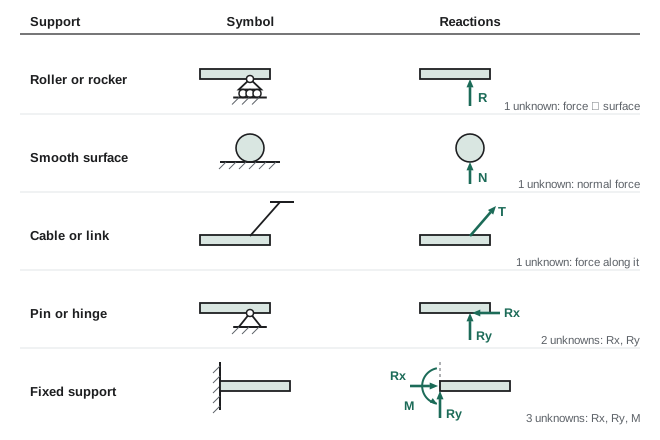
- Roller, rocker or smooth surface: one unknown, a force perpendicular to the surface. Bridges sit on rollers or sliding bearings at one end so they can expand and contract with temperature without building up large horizontal forces.
- Cable or short link: one unknown, a force along the cable or link. A cable can only pull.
- Pin or hinge: two unknowns, usually written as horizontal and vertical components. A pin prevents translation in any direction but lets the body rotate.
- Fixed support (built-in end): three unknowns, two force components and a couple. It prevents both translation and rotation, like the wall end of a balcony slab or a flagpole set in a concrete base.
If you do not know the direction of a reaction, assume one. If the answer comes out negative, the reaction acts the other way. Leave the sign in your equations; do not redraw the diagram halfway through.
Free-body diagrams of rigid bodies
The procedure is the same as for a particle, with two additions: forces are drawn where they actually act, and couples are included.
- Sketch the body's outline, cut free from its supports and surroundings.
- Replace each support with its reactions, from the table above.
- Add the applied loads at their points of application, including the body's own weight at its centre of gravity if it is significant.
- Replace distributed loads with their resultants (but keep the original on the sketch for later use in beam analysis).
- Mark dimensions, angles and a coordinate system.
Distributed loads
Many loads are spread out: the weight of a floor slab on a beam, snow on a roof, wind on a wall, water pressure on a dam. They are described by a load intensity \(w\), in kN/m. For equilibrium, a distributed load is equivalent to a single force equal to the area under the load diagram, acting through the centroid of that area.
- Uniform load \(w\) over length \(L\): resultant \(wL\) at the middle of the loaded length.
- Triangular load rising from zero to \(w\) over length \(L\): resultant \(\tfrac{1}{2}wL\) at \(L/3\) from the tall end (\(2L/3\) from the zero end).
- Trapezoidal load: split it into a rectangle and a triangle and treat each separately.
Worked solutions
Worked problem
Beam with an overhang
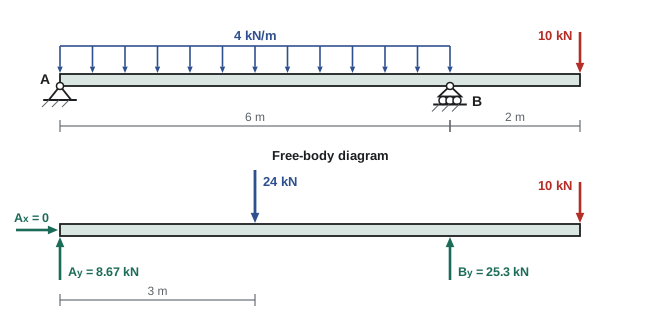
An 8 m beam is pinned at A and supported on a roller at B, 6 m from A. It carries a uniform load of 4 kN/m from A to B and a 10 kN point load at the free end, 8 m from A. Find the reactions.
Show solution
- Free-body diagram: \(A_x\) and \(A_y\) at A, \(B_y\) at B. Replace the uniform load by \(4 \times 6 = 24\) kN at 3 m from A.
- \(\sum F_x = 0\): \(A_x = 0\) (no horizontal loads).
- Moments about A eliminate \(A_x\) and \(A_y\). Counterclockwise positive:
- \[\sum M_A = 6B_y - 24(3) - 10(8) = 0 \;\Rightarrow\; B_y = \frac{152}{6} = 25.33 \text{ kN}\]
- \(\sum F_y = 0\): \(A_y = 24 + 10 - 25.33 = 8.67\) kN.
- Check with moments about B: \(-6A_y + 24(3) - 10(2) = -52.0 + 72 - 20 = 0\). ✓
Answer: A_x = 0, A_y = 8.67 kN up, B_y = 25.3 kN up. The overhang load pushes B harder and lifts weight off A
Notice what the overhang does. If the end load grew to 36 kN, \(A_y\) would drop to zero, and beyond that A would have to hold the beam down. A pin can do that if it is anchored; a beam simply resting on a wall at A would lift off. Checking for uplift at supports is a routine part of design.
Worked problem
Cantilever with a triangular load
A 3 m cantilever is fixed to a wall at A. It carries a triangular load that falls from 6 kN/m at the wall to zero at the tip, plus a 5 kN force at the tip that pushes toward the wall and down along a 3-4-5 slope (3 horizontal, 4 vertical). Find the reactions at the wall.
Show solution
- Triangular load resultant: \(\tfrac{1}{2}(6)(3) = 9\) kN, acting \(3/3 = 1\) m from the wall.
- Tip force components: horizontal \(\tfrac{3}{5}(5) = 3\) kN toward the wall, vertical \(\tfrac{4}{5}(5) = 4\) kN down.
- \(\sum F_x = 0\): the wall pushes back with \(A_x = 3\) kN, directed away from the wall, so the beam is squeezed in compression.
- \(\sum F_y = 0\): \(A_y = 9 + 4 = 13\) kN up.
- \(\sum M_A = 0\): \(M_A - 9(1) - 4(3) = 0\), so \(M_A = 21\) kN·m counterclockwise. The horizontal 3 kN acts along the beam's axis and has no moment about A.
Answer: A_x = 3 kN, A_y = 13 kN up, M_A = 21 kN·m counterclockwise. The fixed-end moment is what the wall connection must be designed for
Bodies with cables and inclined forces
Worked problem
Cable-stayed boom
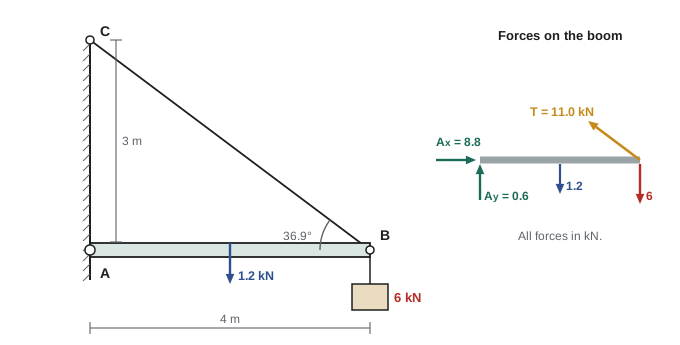
A horizontal boom AB, 4 m long and weighing 1.2 kN, is pinned to a wall at A. A cable runs from the tip B to point C on the wall, 3 m above A. A 6 kN load hangs from B. Find the cable tension and the pin reactions.
Show solution
- Cable direction from B to C: \((-4, 3)\), length 5, so the tension on the boom is \(T(-0.8, 0.6)\).
- Moments about A eliminate the pin. Only the vertical part of \(T\) has a moment arm (4 m); the horizontal part passes through A.
- \[\sum M_A = 0.6T(4) - 1.2(2) - 6(4) = 0 \;\Rightarrow\; T = \frac{26.4}{2.4} = 11.0 \text{ kN}\]
- \(\sum F_x = 0\): \(A_x - 0.8(11.0) = 0\), so \(A_x = 8.8\) kN (the wall pushes the boom outward).
- \(\sum F_y = 0\): \(A_y + 0.6(11.0) - 1.2 - 6 = 0\), so \(A_y = 0.6\) kN up.
Answer: T = 11.0 kN, A_x = 8.8 kN, A_y = 0.6 kN. The cable tension is nearly twice the load, and the boom is squeezed by 8.8 kN against the wall
This shows a theme from Lesson 2 in a new setting. The cable rises at only 36.9°, so most of its tension goes into horizontal force that does nothing to hold up the load. A steeper cable (attached higher on the wall) would cut both the tension and the compression in the boom.
Contact and friction
Rigid-body problems often involve contact with surfaces. A smooth surface provides only a normal force. A rough surface also provides friction, which can be as large as \(\mu_s N\) before slipping starts (from PHYS-130). In equilibrium problems, find the friction force needed from the equations, then compare it with \(\mu_s N\).
Worked problem
Will the ladder slip?
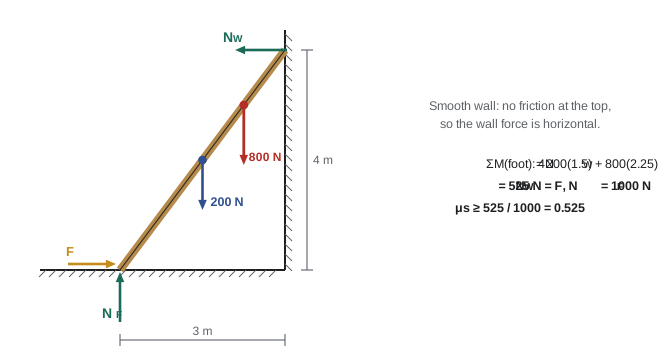
A uniform 5 m ladder weighing 200 N leans against a smooth wall with its foot 3 m from the wall (top 4 m up). An 800 N person stands three quarters of the way up. Find the reactions and the smallest coefficient of static friction at the floor that prevents slipping.
Show solution
- Unknowns: wall reaction \(N_W\) (horizontal, since the wall is smooth), floor normal \(N_F\) and floor friction \(F\). Three unknowns, three equations.
- Horizontal distances from the foot: ladder weight at 1.5 m, person at \(0.75 \times 3 = 2.25\) m. The wall reaction acts 4 m above the foot.
- \[\sum M_{\text{foot}} = N_W(4) - 200(1.5) - 800(2.25) = 0 \;\Rightarrow\; N_W = 525 \text{ N}\]
- \(\sum F_x = 0\): \(F = 525\) N toward the wall. \(\sum F_y = 0\): \(N_F = 1000\) N.
- Required \(\mu_s = F/N_F = 525/1000 = 0.525\).
Answer: N_W = 525 N, N_F = 1000 N, F = 525 N; μs must be at least 0.53. As the person climbs higher, the required friction rises, which is why ladders tend to slip when the climber is near the top
Safety guidance on ladder angle follows directly from this kind of analysis. The common "4 to 1" rule (foot one unit out for every four units up) gives a steeper ladder than the example, which reduces the friction needed at the foot.
Two-force and three-force members
Two observations save a lot of algebra.
A two-force member has forces applied at only two points and no couples. For it to be in equilibrium, the two forces must be equal, opposite and collinear: both act along the line joining the two points. Links, struts, hydraulic cylinders (ignoring their weight) and the members of a pin-jointed truss are two-force members. You know the direction of the force immediately, so each one adds only one unknown, its magnitude.
A three-force member has forces at three points. For moment equilibrium, the three lines of action must meet at a single point (or all be parallel). If you know two of the lines, the third must pass through their intersection, which fixes its direction.
Worked problem
Tipping a truck bed
A truck bed, modelled as a horizontal bar, is hinged at A and weighs 30 kN acting 2.5 m from A. A hydraulic cylinder pushes on the bed at B, 1.5 m from A. Its other end is pinned to the chassis at C, 1.0 m to the right of B and 1.0 m below it. Find the cylinder force and the hinge reaction at the moment lifting starts.
Show solution
- The cylinder is a two-force member, so its force acts along CB: from C toward B, direction \((-1, 1)/\sqrt{2}\).
- Moments about A: the cylinder force has components \((-0.7071F, 0.7071F)\) at B. Only the vertical part has a moment arm (1.5 m).
- \[\sum M_A = 0.7071F(1.5) - 30(2.5) = 0 \;\Rightarrow\; F = 70.7 \text{ kN}\]
- \(\sum F_x = 0\): \(A_x - 0.7071(70.7) = 0\), so \(A_x = 50.0\) kN.
- \(\sum F_y = 0\): \(A_y + 50.0 - 30 = 0\), so \(A_y = -20.0\) kN.
Answer: The cylinder pushes with 70.7 kN. The hinge must provide 50.0 kN horizontally and hold the bed down with 20.0 kN. The negative sign shows the assumed upward direction was wrong
The large cylinder force comes from its short lever arm: it acts close to the hinge to lift a load much farther out. That is a typical trade-off in machine design: a short stroke near the hinge gives a large rotation, at the price of a large force.
Can statics solve it? Determinacy and constraints
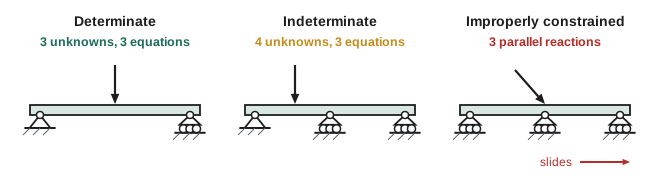
Count the unknown reactions and compare them with the three equilibrium equations.
- Statically determinate: exactly three unknowns, properly arranged. Statics alone gives every reaction. The examples above are all determinate.
- Statically indeterminate: more unknowns than equations, such as a beam on three supports or a cantilever with an extra prop at its tip. The extra supports are called redundants. Equilibrium alone cannot find the reactions; you need the deformation of the members, which is covered in mechanics of materials and structural analysis. Indeterminate structures are common in practice because the extra supports add safety and stiffness.
- Improperly constrained: enough unknowns, but arranged so they cannot prevent some motion. If all reactions are parallel (a beam on three rollers with an inclined load) the body can slide. If all reaction lines pass through one point, the body can rotate about it. Such a body is not stable, whatever the numbers say.
Rigid bodies in three dimensions
In 3D, equilibrium requires six scalar equations:
so up to six unknowns can be found. Supports add more possible reactions: a ball-and-socket joint gives three force components, a journal bearing gives forces perpendicular to its shaft, and a fixed support gives three forces and three couples. The strategy stays the same: choose moment axes that pass through as many unknowns as possible. A force parallel to an axis, or crossing it, has no moment about it, so a well-chosen axis can isolate one unknown.
Worked problem
A slab on three legs
A rectangular slab is supported by three vertical legs at A(0, 0), B(4, 0) and C(0, 3), in metres, on the x-y plane. It carries a 12 kN load at (2, 1.5) and a 6 kN load at (3, 2). Find the leg forces.
Show solution
- All forces are vertical, so only three equations remain: \(\sum F_z\), \(\sum M_x\) and \(\sum M_y\).
- Moments about the x-axis (line AB) eliminate A and B. A vertical force at \((x, y)\) has moment \(yF\) about the x-axis: \(3C - 12(1.5) - 6(2) = 0\), so \(C = 10.0\) kN.
- Moments about the y-axis (line AC) eliminate A and C, with arm \(x\): \(4B - 12(2) - 6(3) = 0\), so \(B = 10.5\) kN.
- \(\sum F_z = 0\): \(A = 18 - 10.0 - 10.5 = -2.5\) kN.
Answer: B = 10.5 kN, C = 10.0 kN, and A = −2.5 kN: leg A must pull down. The resultant of the loads falls outside the triangle ABC, so if leg A is not anchored, the slab tips over the line BC
That result is a general rule worth remembering. A body supported at three points is stable only if the resultant of its loads falls inside the triangle formed by the supports. The same rule explains why a tripod is steady on uneven ground, why a loaded shelf bracket can tip forward, and why mobile cranes put their outriggers out as wide as possible.
Common mistakes
MistakeGiving a roller or smooth surface a horizontal reaction, or a pin only a vertical one.
InsteadUse the support table: roller, one force perpendicular to the surface; pin, two components; fixed, two components and a couple.
MistakeForgetting the couple at a fixed support.
InsteadA fixed support prevents rotation, so it always has a reaction moment.
MistakePlacing the resultant of a triangular load at its midpoint.
InsteadIt acts at the centroid, one third of the length from the tall end.
MistakeTaking moments about a point that leaves several unknowns in the equation.
InsteadTake moments where two unknown forces meet, so only one unknown remains.
MistakeRedrawing a reaction in the opposite direction when its value comes out negative.
InsteadKeep the original diagram and the negative sign; interpret it as acting the other way in your final answer.
MistakeSolving a problem with four unknown reactions as if statics alone were enough.
InsteadCount unknowns first. More than three in 2D means the structure is indeterminate and needs deformation analysis.
Summary and key terms
- A rigid body is in equilibrium when ΣF = 0 and ΣM = 0: three equations in 2D, six in 3D.
- Supports exert forces where they prevent translation and couples where they prevent rotation: roller 1, pin 2, fixed 3 unknowns.
- Distributed loads are replaced by their area acting at the centroid: wL at the middle for uniform, ½wL at L/3 from the tall end for triangular.
- Take moments about a point where unknowns meet to solve for one reaction at a time, and check with a second moment equation.
- Two-force members carry forces along the line joining their two pins; three-force members have concurrent or parallel forces.
- Determinate bodies have exactly as many properly arranged unknowns as equations. Indeterminate bodies need deformation analysis; improperly constrained ones are unstable.
- In 3D, a body on three supports is stable only if the load resultant falls inside the support triangle.
- Rigid body
- An idealized body whose shape does not change under load.
- Reaction
- A force or couple exerted on a body by a support.
- Pin support
- A support that prevents translation but allows rotation; two reaction components.
- Roller support
- A support that prevents motion only perpendicular to the surface; one reaction.
- Fixed support
- A support that prevents translation and rotation; two forces and a couple in 2D.
- Distributed load
- A load spread over a length or area, described by an intensity such as kN/m.
- Two-force member
- A member loaded at only two points, whose forces act along the line between them.
- Statically determinate
- Solvable by equilibrium equations alone.
- Statically indeterminate
- Having more unknown reactions than equilibrium equations.
- Redundant
- A support or member beyond those needed for stability.
Practice problems
Work each problem on paper first, then reveal the answer to check.
A 5 m simply supported beam (pin at A, roller at B) carries 15 kN at 2 m from A. Find the reactions.
Show answer
ΣM_A: 5B = 30, B = 6 kN. A_y = 9 kN, A_x = 0.
A 6 m simply supported beam carries 3 kN/m over its full length and 12 kN at 4 m from A. Find the reactions.
Show answer
ΣM_A: 6B = 18(3) + 12(4) = 102, B = 17 kN. A_y = 30 − 17 = 13 kN.
A 2.5 m cantilever carries a uniform load of 8 kN/m. Find the wall reactions.
Show answer
Resultant 20 kN at 1.25 m. A_y = 20 kN up, M_A = 25 kN·m.
A simply supported 9 m beam carries a triangular load rising from zero at A to 6 kN/m at B. Find the reactions.
Show answer
Resultant ½(6)(9) = 27 kN at 6 m from A. ΣM_A: 9B = 162, B = 18 kN; A = 9 kN.
In the overhang example, what end load would make A_y zero?
Show answer
ΣM_B with A_y = 0: 24(3) = P(2), so P = 36 kN.
In the boom example, the cable is moved to a point 4 m above A. Find the new tension and pin reactions.
Show answer
Cable direction (−4, 4)/5.657 = (−0.7071, 0.7071). 0.7071T(4) = 26.4, T = 9.33 kN. A_x = 6.60 kN, A_y = 7.2 − 6.60 = 0.60 kN.
A 4 m ladder weighing 150 N rests against a smooth wall at 60° to the floor. With μs = 0.30 at the floor, how far up the ladder (along its length) can a 700 N person climb?
Show answer
Foot friction max = 0.30 × 850 = 255 N = N_W. ΣM_foot: N_W(4 sin 60°) = 150(2 cos 60°) + 700(s cos 60°). 883.3 = 150 + 350s, s = 2.10 m.
A bar AB is pinned at A and held horizontal by a vertical link at B (2 m from A). A 400 N load acts 3 m from A, on an overhang. Find the link force and the pin reaction.
Show answer
ΣM_A: 2F = 400 × 3, so the link pushes up on the bar with F = 600 N. A_y = 400 − 600 = −200 N, so the pin holds the bar down with 200 N.
Classify: (a) a beam with a fixed end and a roller at the other end; (b) a beam on two pins; (c) a beam on a single pin.
Show answer
(a) 4 unknowns: indeterminate to the first degree. (b) 4 unknowns: indeterminate. (c) 2 unknowns: unstable, it rotates about the pin.
A table top has legs at (0, 0), (2, 0) and (0, 1) m. A 900 N load sits at (0.5, 0.25). Find the leg forces.
Show answer
M about x-axis: 1(C) = 900(0.25), C = 225 N. M about y-axis: 2B = 900(0.5), B = 225 N. A = 450 N. All positive: the load is inside the triangle.
Lesson quiz · 5 questions
Score 60% or more to complete this lesson.
Create a free account to save your progress, take quizzes and earn a certificate.