
ELE-490 · Lesson 12 of 12 · 22 min
Microgrids, aggregation and the interconnection study
The term is ending, and Leo's system impact study is almost complete. Two ideas from the community and from the developer still need answers before he can make a recommendation. The rural municipality served by F2 beyond recloser R2 has asked whether Birch Hill's battery could keep its fire hall, water pumps, clinic and warming shelter running during the long winter outages that ice storms bring. And Birch Hill Energy has asked whether its battery could be combined with customer batteries in the area and offered as a single resource to the system. This lesson covers microgrids and aggregation, then assembles the study and its recommendation.
Microgrids
A microgrid is a group of loads and distributed resources within clearly defined electrical boundaries that acts as a single controllable entity with respect to the grid and can connect and disconnect from it to operate either grid-connected or islanded. The definition, used by the US Department of Energy and widely adopted, captures the three essentials: boundaries, a controller that coordinates the resources, and the ability to island on purpose. A planned, intentional island is the opposite of the unintentional island that lesson 9 sought to prevent; everything about it, from protection to safety procedures, must be designed and agreed in advance.
Microgrids range from a single building with a battery and solar to a campus, a military base or a section of a utility feeder. A utility microgrid, like the one the municipality proposes, would use a switching device, here recloser R2, as the point of common coupling. When the grid fails, R2 opens, the microgrid controller sheds or restores load blocks, a grid-forming resource establishes voltage and frequency, and other resources synchronize to it. When the grid returns, the controller synchronizes the island to it and closes R2 again.
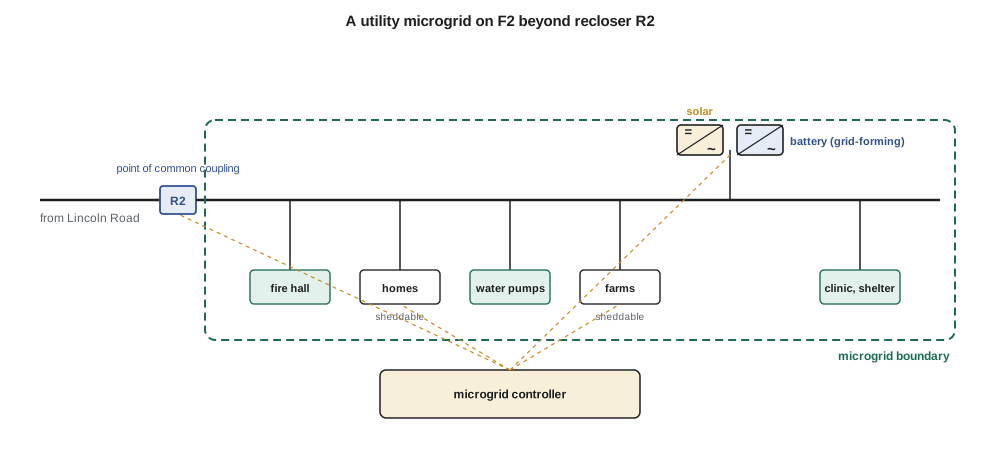
The microgrid controller performs functions now described in IEEE 2030.7-2017, which specifies the controller's core functions, and tested under IEEE 2030.8-2018. Its two core functions are dispatch, deciding the setpoints of each resource and load in each mode, and transition, managing planned and unplanned changes between grid-connected and islanded operation. Around them sit functions for forecasting, protection coordination, black start and resynchronization.
Running the island
An island needs at least one grid-forming source, because grid-following inverters cannot operate without a voltage to follow. Birch Hill's battery inverter supports grid-forming mode, so it would become the island's master source. The solar plant could continue to operate in grid-following mode, but its output must stay below what the island's load and the battery's charging capability can absorb, or frequency and voltage will rise; the controller curtails it as needed. Load must also be managed, because the battery's power and energy are limited.
import math
# 1. Islanded night for a Birch Hill microgrid: F2 beyond recloser R2 during a 138 kV outage (winter storm)
load = [3.6, 3.8, 3.5, 3.1, 2.6, 2.2, 1.9, 1.8, 1.8, 1.9, 2.3, 2.9]   # MW, 18:00 to 05:00
CRIT = 1.1                                                            # MW: fire hall, water pumps, clinic, shelter
soc, E_MIN, ETA = 19.0, 2.0, 0.94      # battery charged to 95 % when the storm warning arrived
for k, p in enumerate(load):
    hours_left = len(load) - k - 1
    reserve = CRIT*hours_left/ETA     # energy needed to carry critical load to 06:00 after this hour
    serve = p if (soc - E_MIN) - p/ETA >= reserve else CRIT
    soc -= serve/ETA
    print(f"{18 + k if 18 + k < 24 else 18 + k - 24:02d}:00 load {p:.1f} MW, served {serve:.1f} MW, SOC {soc:5.2f} MWh")
print(f"at 06:00 the battery still holds {soc - E_MIN:.2f} MWh above its reserve; solar resumes after sunrise")
# 2. Comparing interconnection options for Birch Hill (costs in thousand dollars, illustrative)
options = {
    'A: tap F2 at 9 km + 2 km line': {'line': 2*400, 'POI recloser and metering': 380, 'transfer trip': 250,
                                      'F2 directional relaying': 60, 'LTC control change': 40, 'R2 settings and supervision': 30},
    'B: new 11 km express feeder':    {'line': 11*420, 'new 25 kV breaker bay': 650, 'POI recloser and metering': 380,
                                      'transfer trip': 120, 'LTC control change': 40},
}
for name, items in options.items():
    print(f"{name:32s} total {sum(items.values()):5,.0f} thousand dollars")
checks = [('voltage at POI, light load (volt-var)', 1.030, 1.04, 'max'), ('voltage step on trip', 1.36, 3.0, 'max'),
          ('TDD at POI (%)', 2.37, 5.0, 'max'), ('T1 reverse flow, holiday (MW)', 11.9, 25*0.8, 'max'),
          ('end-of-F2 fault current reduction (%)', 5.3, 10.0, 'max')]
for name, val, lim, kind in checks:
    ok = val <= lim if kind == 'max' else val > lim
print(f"option A {name:44s} {val:7.2f} limit {lim:6.2f} {'pass' if ok else 'FAIL'}")18:00 load 3.6 MW, served 3.6 MW, SOC 15.17 MWh 19:00 load 3.8 MW, served 1.1 MW, SOC 14.00 MWh 20:00 load 3.5 MW, served 1.1 MW, SOC 12.83 MWh 21:00 load 3.1 MW, served 1.1 MW, SOC 11.66 MWh 22:00 load 2.6 MW, served 1.1 MW, SOC 10.49 MWh 23:00 load 2.2 MW, served 1.1 MW, SOC 9.32 MWh 00:00 load 1.9 MW, served 1.1 MW, SOC 8.15 MWh 01:00 load 1.8 MW, served 1.1 MW, SOC 6.98 MWh 02:00 load 1.8 MW, served 1.1 MW, SOC 5.81 MWh 03:00 load 1.9 MW, served 1.1 MW, SOC 4.64 MWh 04:00 load 2.3 MW, served 1.1 MW, SOC 3.47 MWh 05:00 load 2.9 MW, served 1.1 MW, SOC 2.30 MWh at 06:00 the battery still holds 0.30 MWh above its reserve; solar resumes after sunrise A: tap F2 at 9 km + 2 km line total 1,560 thousand dollars B: new 11 km express feeder total 5,810 thousand dollars option A voltage at POI, light load (volt-var) 1.03 limit 1.04 pass option A voltage step on trip 1.36 limit 3.00 pass option A TDD at POI (%) 2.37 limit 5.00 pass option A T1 reverse flow, holiday (MW) 11.90 limit 20.00 pass option A end-of-F2 fault current reduction (%) 5.30 limit 10.00 pass
Leo models a winter-storm outage beginning at 18:00, when the solar plant produces nothing. The battery was charged to 95 % when the storm warning arrived, and the controller follows a simple rule: serve the full load only if enough energy remains afterward to carry the 1.1 MW of critical load until 06:00. At 18:00 it can serve all 3.6 MW, but from 19:00 it must shed the non-critical blocks. Critical loads stay on all night, and at 06:00 the battery still holds a small margin above its reserve. A smarter rule would rotate non-critical blocks so that homes get a few hours each, a policy question for the municipality as much as an engineering one.
Protection is the hardest technical problem in an island. On the grid, F2's relays and fuses rely on thousands of amperes of fault current from the substation. In the island, the only source is a 5 MW battery inverter that limits its fault current to a few hundred amperes. Overcurrent devices set for grid-connected faults would never operate. Islanded protection therefore uses a separate settings group, switched in automatically when R2 opens, based on undervoltage, negative-sequence quantities or communication-assisted schemes, and some fuses must be replaced by electronic reclosers or sectionalizers that can be set for the low fault level. Safety procedures must also change, because line crews must know that a de-energized section beyond R2 can be re-energized from the island.
Worked problem
Can the battery carry the critical load?
The battery holds 17 MWh above its reserve at the start of an outage, its discharge efficiency is 94 %, and the critical load is 1.1 MW. How long can it carry critical load alone with no solar input?
Show solution
- \[t = \dfrac{0.94 \times 17\ \text{MWh}}{1.1\ \text{MW}} \approx 14.5\ \text{h}\]
Answer: About 14.5 hours, enough for a winter night; solar output the next day extends it further if the island lasts longer.
Aggregation and virtual power plants
Aggregation is the other way to make many small resources act as one. A distributed energy resource management system (DERMS), operated by the utility, monitors and dispatches resources on its feeders while respecting local limits such as voltage and thermal ratings. An aggregator, which may be the utility or a third party, combines resources across many sites into a virtual power plant that can offer energy, capacity or ancillary services. Customer batteries, smart thermostats, water heaters and electric vehicle chargers can all be aggregated.
In Canada, the rules for aggregated distributed resources are set province by province. Some provincial system operators have run programs and pilots that allow aggregated demand response and storage to provide capacity or other services. In New Brunswick, where a vertically integrated utility plans and operates the system, aggregation would generally take the form of utility programs or contracts rather than an open wholesale market, so Birch Hill's proposal would need an agreement with Larchmont and the provincial operator on what services it could provide.
Aggregation creates a coordination problem for the distribution utility. A market signal might tell all the batteries behind Lincoln Road to discharge at once, while the feeder is already at its voltage or thermal limit. Utilities therefore insist on a review of each aggregation's sites, on the right to override dispatch when local limits are at risk, and on telemetry from the aggregated resources. The DERMS is the tool that lets the utility enforce those limits in real time.
Assembling the study
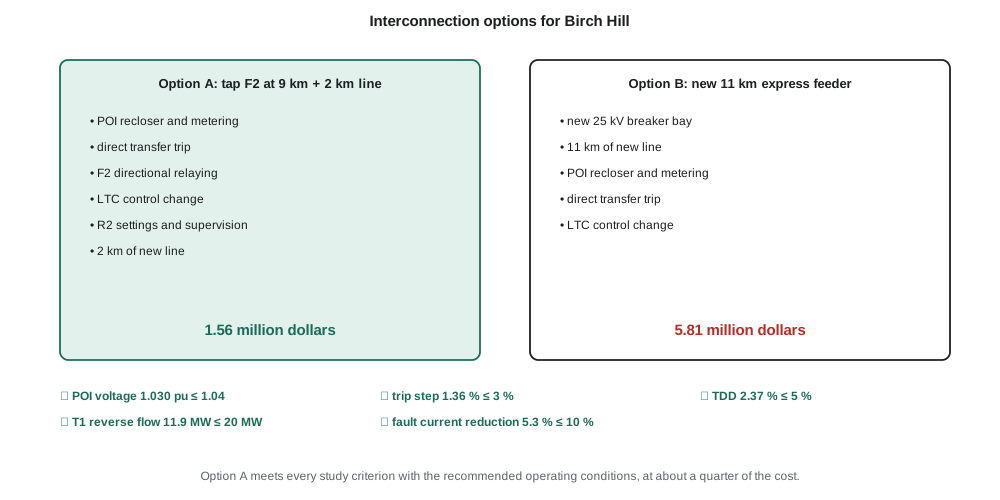
Leo's report pulls together the results of every lesson. It compares two ways of connecting Birch Hill. Option A taps F2 at 9 km and builds 2 km of new line to the plant's substation, with the point of interconnection effectively 11 km from Lincoln Road. Option B builds a new 11 km express feeder from a new breaker position at Lincoln Road. The program totals the estimated costs, which are illustrative planning figures: about 1.56 million dollars for option A and 5.81 million dollars for option B, most of the difference being the new line and breaker bay.
Option A passes every check in the study when the plant operates as recommended: light-load voltage at the POI of 1.030 pu with volt-var control, below the 1.04 pu limit; a voltage step of 1.36 % if the plant trips; current distortion of 2.37 % against 5 %; reverse flow through T1 of about 12 MW on a light-load holiday, within the transformer's rating and the 80 % planning limit; and an end-of-feeder fault-current reduction of about 5 %, which F2's protection tolerates. Option B would give more margin on voltage and avoid any effect on F2's customers, but at nearly four times the cost, and the study finds no limit that requires it.
The recommendation
Leo recommends option A with a set of conditions, each traced to a lesson. The plant operates in volt-var mode with the default Category B curve, settling within about ten seconds (lesson 8). Its total export at the POI is capped at 10 MW by the plant controller and backed up by a protective relay (lesson 5). F2's feeder relaying gets directional elements to prevent sympathetic tripping (lesson 9). R2's first reclose is extended to about three seconds, supervised by line-side voltage, and both R2 and F2's breaker send direct transfer trip to the plant (lessons 6 and 9). Lincoln Road's LTC disables line-drop compensation during reverse flow (lesson 8). The plant provides validated models and event recording (lesson 11), and its ride-through and trip settings are agreed with Larchmont (lesson 6).
Two further items are recommended for follow-up rather than as conditions. The microgrid proposal is technically feasible with Birch Hill's grid-forming battery, but it needs an islanded protection settings group, replacement of some fuses beyond R2, revised crew procedures and an agreement with the developer on battery reserve during storm warnings; Leo suggests a separate feasibility study. And Birch Hill's aggregation proposal should wait until the provincial or market rules are clear, with any agreement giving Larchmont the right to override dispatch when local limits are at risk.
Marguerite reads the draft, asks for two clarifications on the cost estimate and signs off the report for review. As the engineer of record she will seal the final version under her P.Eng.; Leo's name appears on it as the engineer-in-training who performed the analysis. \"Next term,\" she says, \"you'll do the facilities study, and you'll find out how many of these assumptions survive contact with the construction crews.\"
Common mistakes
MistakeTreating a planned microgrid as just another island to be prevented.
InsteadAn intentional island needs its own controller, protection settings, grid-forming source and safety procedures.
MistakeUsing grid-connected overcurrent settings in an island.
InsteadInverter fault current is far lower; islanded protection needs a separate settings group and different devices.
MistakeLetting an aggregator dispatch distributed resources without local limits.
InsteadThe distribution utility must be able to review sites and override dispatch to protect feeders.
MistakeChoosing the most robust option without checking whether any criterion requires it.
InsteadA study should recommend the least-cost option that meets every limit, with conditions that make it so.
Summary and key terms
- A microgrid has defined boundaries, a controller and the ability to operate grid-connected or islanded on purpose.
- IEEE 2030.7 specifies microgrid controller functions, centred on dispatch and transition; IEEE 2030.8 covers testing.
- An island needs a grid-forming source, load management within the battery's power and energy, and curtailment of excess generation.
- Islanded protection must work with inverter-limited fault current and needs separate settings and procedures.
- DERMS and aggregators combine distributed resources into virtual power plants; the utility must protect local limits.
- Market access for aggregations differs by jurisdiction.
- An interconnection study recommends the least-cost option that meets every criterion, with operating conditions that ensure it.
- Microgrid
- A group of loads and resources within defined boundaries that acts as one controllable entity and can island intentionally.
- Point of common coupling (microgrid)
- The switching point where a microgrid connects to and separates from the wider grid.
- Microgrid controller
- The controller that dispatches resources and manages transitions between modes.
- Black start
- Restarting part of a system from a de-energized state without support from the wider grid.
- DERMS
- A distributed energy resource management system used by a utility to monitor and dispatch DER.
- Virtual power plant
- An aggregation of distributed resources operated as a single resource.
- Settings group
- An alternative set of relay settings selected automatically for a different operating condition.
Practice problems
Work each problem on paper first, then reveal the answer to check.
A battery holds 10 MWh above reserve with 95 % discharge efficiency. How long can it carry 0.8 MW?
Show answer
0.95 × 10/0.8 ≈ 11.9 h.
Why can't Birch Hill's solar inverters alone run the island?
Show answer
They are grid-following and need a voltage to follow.
Why must some fuses beyond R2 be replaced for islanded operation?
Show answer
The island's fault current may be too low to melt them.
Option B costs 5.81 million dollars and option A 1.56 million. What is the ratio?
Show answer
About 3.7.
Name three conditions in Leo's recommendation for option A.
Show answer
For example volt-var operation, an enforced 10 MW export cap and directional relaying on F2.
Why must the utility be able to override an aggregator's dispatch?
Show answer
Simultaneous dispatch could overload or over-voltage a feeder.
Lesson quiz · 5 questions
Score 60% or more to complete this lesson.
Create a free account to save your progress, take quizzes and earn a certificate.