
CRE-460 · Lesson 11 of 12 · 30 min
International law and compliance
A creator's home laws do not stop at the border, and other countries' laws do not stop at theirs. When content is aimed at audiences abroad, when products are sold to customers in other countries, or when a creator works with foreign brands, the laws of those countries can apply too. No creator can be expert in every legal system, and most foreign rules are enforced mainly against platforms and large companies. But some rules, especially on advertising disclosure, privacy, consumer rights and children, reach individual creators who target a market. This lesson surveys the international rules most relevant to creators, as they stood at the time of writing (October 2026), and offers a practical approach to managing compliance.
When does a foreign law apply to you?
Laws apply in different ways. Some apply because of where you are (your home country's laws always apply to you). Some apply because of where your audience or customers are, especially when you target them: by producing content in their language, mentioning their country, pricing in their currency, shipping to them or working with brands to reach them. Some apply because of where a platform or partner is based. A useful working rule is that the more deliberately you target a market, the more its laws are likely to apply, and the more it makes sense to know the main rules.
| Signal of targeting | Example | Effect |
|---|---|---|
| Language and localization | A German audio track and German titles | Suggests you are addressing German viewers |
| Sales and shipping | An online store that ships to France and prices in euros | Consumer, VAT and product rules of France likely apply |
| Sponsored content for a market | A campaign for a UK brand aimed at UK viewers | UK advertising rules likely apply |
| Data collection | A newsletter that collects emails from EU residents | The EU General Data Protection Regulation may apply |
| Local presence | An office, staff or long stays in the country | Broader obligations, including tax and employment |
Canadian creators remain subject to Canadian law when targeting foreign audiences: the Competition Act and Ad Standards rules on disclosure (CRE-320), PIPEDA and provincial privacy laws including Quebec's Law 25, Canada's Anti-Spam Legislation (CASL) for commercial emails and messages, and Quebec's Consumer Protection Act and Charter of the French Language for Quebec consumers (lesson 7). Foreign rules usually add to these rather than replace them.
Privacy: the GDPR and beyond
The European Union's General Data Protection Regulation (GDPR) is the most influential privacy law in the world. It can apply to organizations outside the EU that offer goods or services to people in the EU or monitor their behaviour, which can include creators who sell to EU customers or run newsletters, memberships or analytics aimed at EU audiences. Its key requirements include a lawful basis for processing personal data (such as consent or the performance of a contract), clear privacy notices, data minimization, security, respecting individuals' rights to access and delete their data, rules on transferring data outside the EU, and breach notification. Non-EU organizations covered by the GDPR may also need to appoint a representative in the EU, though there are exceptions for occasional, low-risk processing. The UK has its own version, the UK GDPR, with similar rules.
For most creators, practical GDPR compliance means using reputable email, membership and store platforms that offer GDPR features, getting clear consent for marketing emails, publishing a plain-language privacy notice, collecting only the data you need, and honouring requests to unsubscribe or delete data promptly. Data transfers between the EU and the US rely in part on the EU–US Data Privacy Framework adopted in 2023 for certified US companies, and the EU has recognized Canada as providing adequate protection for data covered by PIPEDA, which eases transfers to Canadian businesses.
Worked problem
Scoring privacy readiness for an EU launch
A creator plans a paid membership for EU fans and checks six items: privacy notice (done), consent for marketing emails (done), platform with data-export and deletion tools (done), records of where data is stored (not done), process for access and deletion requests (not done), and an assessment of whether an EU representative is needed (not done). What share is complete, and which items come first?
Show solution
- Complete: 3 of 6, or 50 %.
- Outstanding: data map, request process, EU representative assessment.
- The request process and data map are quick to do and needed from day one; the representative question needs a short check of the exceptions.
Answer: The creator is 50 % ready. Writing down where member data is stored and how requests will be handled should come before launch, with a check of whether the occasional-processing exception removes the need for an EU representative.
Advertising disclosure around the world
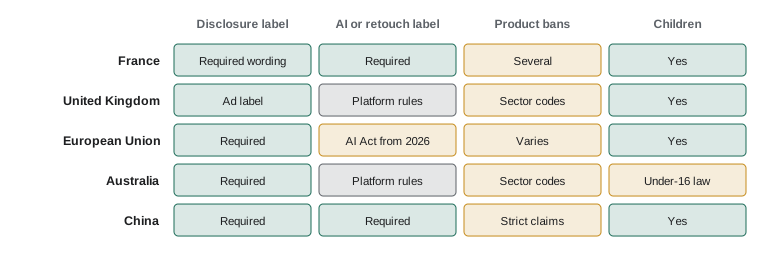
Most countries require sponsored content to be clearly identified, but the details differ, and some go much further than Canada or the US.
| Market | Main rules for influencer advertising | Notable requirements |
|---|---|---|
| United Kingdom | Advertising codes (CAP Code) enforced by the Advertising Standards Authority, plus consumer law enforced by the Competition and Markets Authority | A clear, prominent label such as "Ad" at the start; brand and creator both responsible |
| European Union | Unfair Commercial Practices Directive; the Digital Services Act requires platforms to let users declare commercial content | Disclosure required in all member states; national rules add detail |
| France | Law of 9 June 2023 regulating commercial influence | "Publicité" or "Collaboration commerciale" label; "Image retouchée" and "Image virtuelle" labels; bans on promoting certain products; written contracts above a threshold; non-EU influencers targeting France must appoint an EU legal representative and hold insurance |
| Australia | Australian Consumer Law and the AANA Code of Ethics | Clear disclosure; regulator focus on influencer marketing |
| China | Advertising Law and rules on online hosts and influencers | Strict content rules, real-name systems and responsibility for product claims |
France's law is a good example of how far rules can go. It bans influencers from promoting cosmetic surgery, nicotine products, certain financial products and crypto-asset offers that lack regulatory approval, among others, and restricts promotion of gambling and alcohol. It requires labels on retouched images and images created with AI. It also makes brands and influencers jointly responsible, and requires influencers based outside the EU who target the French market to have a legal representative in the EU. A North American creator running sponsored content aimed at French viewers should follow these rules.
Platforms, online safety and children
Several countries now regulate platforms' duties to protect users, especially children, and these laws change what creators can do on the platforms. The UK's Online Safety Act 2023 imposes duties on platforms to tackle illegal content and protect children, with codes phased in during 2025; platforms have responded with stronger age checks and content restrictions for UK users. The EU's Digital Services Act imposes transparency and safety duties on platforms, including tools for declaring commercial content. Australia's Social Media Minimum Age law took effect on 10 December 2025, requiring major platforms, including TikTok, Instagram, Facebook, Snapchat, YouTube, X and others, to take reasonable steps to prevent Australians under 16 from having accounts, with large fines for platforms that fail; in 2026 the government moved to strengthen enforcement and raise the maximum fines.
For creators, these laws mean that young audiences in some markets may shrink or disappear from logged-in platforms, that age checks may change audience data, and that content aimed at children or teens faces stricter platform rules. Creators who make family or youth content should review CRE-450 and check the rules in each market where they have significant young audiences. Children's privacy rules also vary: the UK's Age Appropriate Design Code sets standards for services likely to be used by children, and US COPPA and Quebec's rules apply as CRE-450 described.
Worked problem
Effect of an under-16 restriction on an audience
A creator has 200,000 monthly viewers in Australia, of whom (illustratively) 18 % were logged-in users aged 13 to 15. If those accounts are removed and half of those viewers keep watching logged out, with no personalized recommendations, how many logged-in Australian viewers remain, and how many viewers are lost entirely?
Show solution
- Under-16 viewers: \( 200{,}000 \times 0.18 = 36{,}000 \).
- Logged-in viewers remaining: \( 200{,}000 - 36{,}000 = 164{,}000 \).
- Viewers lost entirely: \( 36{,}000 \times 0.5 = 18{,}000 \).
Answer: About 164,000 logged-in Australian viewers remain, and about 18,000 viewers are lost entirely, with another 18,000 watching logged out. A creator heavily dependent on young Australian viewers should adjust expectations and content plans.
AI-generated content and labelling
Rules on AI-generated content are spreading. The EU AI Act's transparency obligations in Article 50, which apply from 2 August 2026, require providers of AI systems to mark synthetic content in machine-readable ways and require those who deploy AI to create deepfakes to disclose that the content is artificially generated or manipulated, with lighter rules for clearly artistic, satirical or fictional work. France's influencer law requires an "Image virtuelle" label on AI-generated images in commercial content. China requires labelling of AI-generated content under rules that took effect in 2025. Platforms such as YouTube, TikTok and Meta have their own AI disclosure labels, as CRE-410 described. Creators who use AI voices, avatars or generated images in content aimed at these markets should disclose clearly and use platform labels.
Consumer rights for international sales
Selling products to customers abroad brings consumer protection rules. In the EU and UK, consumers buying online generally have a 14-day right to withdraw from many contracts; for digital content such as downloads and online courses, the right can be lost once delivery starts, but only if the consumer expressly agrees and acknowledges this before purchase. Sellers must give clear pre-contract information, including the seller's identity and address, total price including taxes, and complaint and return procedures. Germany and some other countries also require websites aimed at their users to show a legal notice with the operator's contact details. Physical products face product safety, labelling and import rules, and customs duties may surprise customers if not explained at checkout.
Worked problem
Refund exposure under a withdrawal right
A creator sells 400 copies of a €50 printable planner to EU consumers in a quarter without collecting the express consent needed to end the 14-day withdrawal right on download. If 3 % of buyers exercise the right after downloading, how much must be refunded, and how could the creator avoid this?
Show solution
- Refunds: \( 400 \times 0.03 = 12 \) buyers.
- Amount: \( 12 \times 50 = €600 \).
- Avoidance: add a checkout step where buyers expressly agree to immediate delivery and acknowledge losing the withdrawal right.
Answer: About €600 in refunds would be owed that quarter. A properly designed checkout consent step, which many digital-product platforms provide, removes this exposure for downloaded content.
Content restrictions and local law
Some content that is lawful in Canada and the US is restricted elsewhere: material criticizing governments or religions, content about sexuality and gender, gambling and alcohol promotion, maps showing disputed borders, and certain historical topics. Platforms may geo-restrict content to comply with local law, and some countries prosecute individuals, including foreigners who visit. Creators should know the main restrictions in markets they target or visit, make deliberate choices about what they will publish, and consider personal safety when travelling to countries whose laws their content may breach. Lesson 6 covered cultural sensitivity; this is the legal side of the same question.
A practical compliance approach
Compliance across many countries can seem overwhelming. A proportionate approach focuses effort where risk is greatest.
- Map your exposure: list the markets you target, how (content, sales, data, sponsorships) and how much revenue each brings.
- Prioritize: focus on markets with significant revenue, sales or data collection, and on high-risk areas such as advertising, children, health and finance.
- Use compliant tools: platforms, stores and email services that handle VAT, privacy and consumer features reduce the work.
- Follow the strictest common rule: disclosing clearly at the start in the local language, labelling AI and retouching, and getting express consent often satisfies several markets at once.
- Get advice where it counts: for significant sales, campaigns or any presence in a market, consult a lawyer familiar with that market.
- Review regularly: rules change often; set a yearly review and track announcements in your main markets.
Common mistakes
MistakeAssuming only home-country law applies.
InsteadLaws of targeted markets can apply, especially on advertising, privacy, consumer rights and children.
MistakeCollecting emails from EU residents without GDPR basics.
InsteadGet clear consent, publish a privacy notice, minimize data and honour deletion requests.
MistakeUsing only home-market disclosure for a French campaign.
InsteadUse the labels French law requires, including for retouched and AI images.
MistakeIgnoring withdrawal rights for EU digital sales.
InsteadCollect express consent and acknowledgement before immediate delivery.
MistakeTrying to master every country's law equally.
InsteadMap exposure, prioritize high-revenue and high-risk markets, and get targeted advice.
Summary and key terms
- Foreign laws are more likely to apply the more deliberately a creator targets a market.
- Home-country rules still apply; foreign rules usually add to them.
- The GDPR can apply to non-EU creators who sell to or monitor people in the EU.
- Influencer disclosure rules vary; France's 2023 law requires specific labels, bans some promotions and imposes duties on non-EU influencers.
- Online safety laws such as the UK Online Safety Act, the EU Digital Services Act and Australia's under-16 law change platforms and audiences.
- AI labelling rules are spreading, including EU AI Act Article 50 from 2 August 2026.
- A proportionate approach maps exposure, prioritizes high-risk markets and uses compliant tools.
- GDPR
- The EU General Data Protection Regulation, governing personal data of people in the EU.
- Lawful basis
- A legal ground for processing personal data under the GDPR, such as consent.
- EU representative
- A person in the EU appointed by some non-EU organizations covered by the GDPR.
- CAP Code
- The UK Code of Non-broadcast Advertising, enforced by the Advertising Standards Authority.
- Digital Services Act
- The EU law imposing safety and transparency duties on online platforms.
- Online Safety Act
- The UK law imposing duties on platforms to tackle illegal content and protect children.
- Withdrawal right
- An EU and UK consumer right to cancel many online purchases within 14 days.
- Article 50
- The EU AI Act provision on transparency for AI-generated and manipulated content.
- Geo-restriction
- Limiting access to content in particular countries.
- Targeting
- Deliberately directing content, sales or advertising at a particular market.
Practice problems
Work each problem on paper first, then reveal the answer to check.
Name three signals that a creator is targeting a foreign market.
Show answer
Localized language, pricing or shipping to the market, sponsored campaigns for it, collecting data from its residents.
When can the GDPR apply to a non-EU creator?
Show answer
When offering goods or services to people in the EU or monitoring their behaviour.
Name three GDPR basics for creators.
Show answer
Clear consent for marketing, a privacy notice, data minimization, honouring access and deletion requests.
Which labels does France require on sponsored posts?
Show answer
"Publicité" or "Collaboration commerciale".
Which labels does France require for edited or AI images in commercial content?
Show answer
"Image retouchée" and "Image virtuelle".
What must non-EU influencers targeting France have?
Show answer
A legal representative in the EU and insurance.
When did Australia's under-16 social media law take effect?
Show answer
10 December 2025.
From when does EU AI Act Article 50 apply?
Show answer
2 August 2026.
600 EU digital sales at €40, 2 % withdrawals. Refunds?
Show answer
12 refunds, €480.
Name two steps in a proportionate compliance approach.
Show answer
Map exposure, prioritize, use compliant tools, follow the strictest common rule, get targeted advice, review regularly.
Lesson quiz · 5 questions
Score 60% or more to complete this lesson.
Create a free account to save your progress, take quizzes and earn a certificate.