
CON-330 · Lesson 8 of 12 · 28 min
Supply chain risk, tariffs and escalation
A stipulated-price contract fixes the contractor's revenue, but not the prices of the steel, copper, lumber, glass and equipment it must buy. Between bid and purchase, and between purchase order and delivery, those prices can move sharply, and supply can disappear altogether. Recent years have provided plenty of examples: the lumber price spike of 2021, pandemic-era shipping disruptions, long waits for electrical equipment driven by data centre and grid demand, and repeated changes to tariffs on steel, aluminum and other goods traded between Canada and the United States in 2025 and 2026. This lesson looks at how contractors identify these risks, share them through escalation clauses, and manage them through buying strategy. BUS-230 covers supply chain management in general and the broader trade picture; this lesson applies it to construction buyout.
Identifying supply chain risk
Supply chain risks fall into a few families. The procurement plan (Lesson 2) should flag the packages exposed to each, and the project risk register (CON-350) should carry the significant ones.
| Risk | Typical exposure | Early warning signs |
|---|---|---|
| Price volatility | Steel, copper wire and pipe, aluminum, lumber, asphalt, fuel | Rising commodity indices, short quote validity, suppliers adding escalation clauses |
| Long or uncertain lead times | Switchgear, transformers, generators, elevators, custom glazing | Lead times quoted as ranges, production slots not confirmed |
| Single or limited sources | Specified proprietary products, specialty fabricators | One bidder, no approved alternates |
| Geographic concentration | Imported components from one country or region | Port congestion, sanctions, border measures |
| Trade measures | Goods crossing borders: steel, aluminum, copper, lumber, equipment | Announced or threatened tariffs, surtaxes, quotas |
| Supplier financial distress | Small fabricators, distributors in a downturn | Requests for larger deposits, late deliveries, staff turnover |
| Logistics | Oversize equipment, remote sites, winter roads | Permit delays, carrier shortages |
# Simple materials risk register for Larch Street (illustrative scores 1-5)
risks = [
    # (item, value exposed, probability 1-5, impact 1-5)
    ("Switchgear lead time",      410_000, 4, 5),
    ("Rebar price escalation",    865_500, 3, 3),
    ("Lumber price escalation", 1_250_000, 3, 4),
    ("Copper wire and pipe",      690_000, 3, 3),
    ("Imported glass tariff",     455_000, 2, 4),
    ("Elevator lead time",        702_000, 3, 4),
]
ranked = sorted(risks, key=lambda r: r[2] * r[3], reverse=True)
for item, val, p, i in ranked:
print(f"{item:26} score {p * i:2} value exposed {val:>10,}")Switchgear lead time score 20 value exposed 410,000 Lumber price escalation score 12 value exposed 1,250,000 Elevator lead time score 12 value exposed 702,000 Rebar price escalation score 9 value exposed 865,500 Copper wire and pipe score 9 value exposed 690,000 Imported glass tariff score 8 value exposed 455,000
The ranking is crude, as all such matrices are, but it focuses attention. Switchgear lead time ranks highest, with lumber, elevators and an imported glass tariff close behind. Each high-scoring item should have an owner on the project team and a planned response.
How escalation risk is allocated
Who carries the risk of a price increase depends on the contracts at each level. Under a stipulated-price prime contract with no adjustment clause, the general contractor carries it toward the owner. Whether the contractor in turn carries it toward its subcontractors and suppliers depends on their terms: a firm subcontract price passes the risk down; a supplier quote valid for 30 days, or a purchase order with an escalation clause, does not.
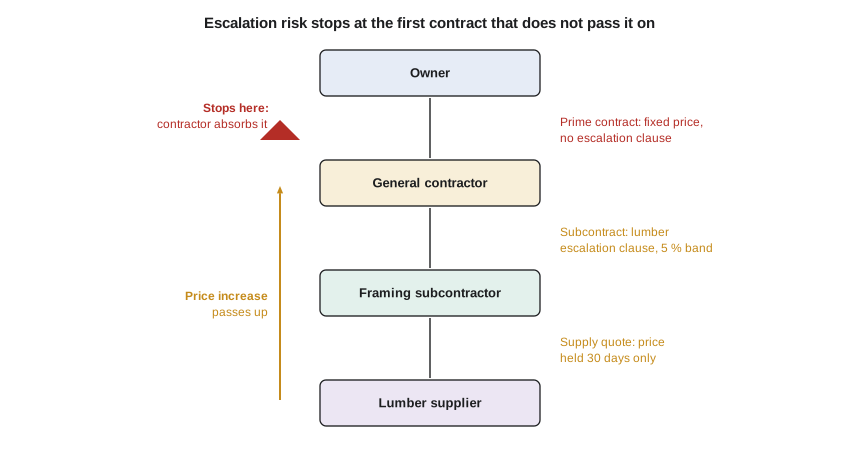
The danger is a mismatch. Halyard bid Larch Street on lumber prices quoted by its framer, whose own lumber supplier held prices for only 30 days. If the framing subcontract is firm but the framer's supply is not, a lumber spike may leave the framer unable to perform, which puts the risk back on Halyard. If Halyard accepts an escalation clause from the framer but has no matching clause with the owner, Halyard carries the increase itself.
Escalation clauses
An escalation clause (also called a price adjustment clause) adjusts the price of a defined material when a published index or a documented supplier price moves. A well-drafted clause defines the material and quantity, the base price and date, the index or evidence, a band within which no adjustment is made, how changes beyond the band are shared, any cap, and the documentation required.
Here Q is the quantity, P₀ the base unit price, I₀ the base index, I_t the index at purchase and b the band. Decreases are usually treated symmetrically, so the owner benefits if prices fall beyond the band.
Useful public indices include Statistics Canada's Industrial Product Price Index (by product group, such as steel and lumber) and its building construction price indexes. Supplier price lists and published commodity prices are also used, provided the clause states exactly which series and date.
# Rebar escalation clause: 5 % band, changes beyond the band adjusted in full, cap 15 %
Q_tonnes = 520
P0 = 1_664.0            # base installed price per metric ton in the subcontract (illustrative)
I0 = 100.0              # index at bid date
band, cap = 0.05, 0.15
for It in (103.0, 109.0, 121.0, 92.0):
    change = (It - I0) / I0
    if abs(change) <= band:
        adj_pct = 0.0
    else:
        adj_pct = (abs(change) - band) * (1 if change > 0 else -1)
    adj_pct = max(-cap, min(cap, adj_pct))
    adj = Q_tonnes * P0 * adj_pct
print(f"index {It:5.1f} change {change:+6.1%} adjustment {adj_pct:+6.1%} = {adj:+11,.0f}")index 103.0 change +3.0% adjustment +0.0% = +0 index 109.0 change +9.0% adjustment +4.0% = +34,611 index 121.0 change +21.0% adjustment +15.0% = +129,792 index 92.0 change -8.0% adjustment -3.0% = -25,958
At an index of 103 the change is within the band and the price stands. At 109, the 4 % beyond the band is paid. At 121, the change beyond the band is 16 %, but the cap limits the adjustment to 15 %. At 92, prices fell by 8 %, and the 3 % beyond the band is credited back. The band leaves normal fluctuation with the seller; the cap limits the buyer's exposure; the symmetric treatment keeps the clause fair.
Standard documents exist for this. In the US, ConsensusDocs publishes a 'time and price impacted materials' amendment (ConsensusDocs 200.1) that lets the parties list volatile materials, base prices and an adjustment method in the prime contract, and similar wording can be carried into subcontracts. In Canada, owners and contractors increasingly negotiate price adjustment clauses for volatile materials, and some industry associations have published model wording; there is no single standard form clause.
Worked problem
Passing escalation through the chain
Halyard's framing subcontract includes a lumber escalation clause with a 5 % band. Halyard's prime contract with the owner has no escalation clause. Lumber rises 14 % before the framer buys. The lumber in the framing package is worth $1,250,000. What does Halyard pay, and what could it have done differently?
Show solution
- Change beyond the band: 14 % − 5 % = 9 %.
- Adjustment owed to the framer: 0.09 × 1,250,000 = $112,500.
- Recoverable from the owner: $0, because the prime contract has no matching clause.
Answer: Halyard absorbs $112,500. It could have negotiated a matching clause with the owner at bid time, bought lumber early through the framer and paid a deposit to lock the price, or refused the clause and paid more for a firm price. Escalation clauses work only when they are matched up the chain or deliberately priced.
Tariffs and trade measures
Tariffs are taxes on imported goods, and they can change faster than any construction schedule. Between 2025 and 2026, the United States imposed and restructured tariffs on steel, aluminum, copper and their derivative products under Section 232 of the Trade Expansion Act, at rates of up to 50 %, without exemption for goods qualifying under CUSMA, and in August 2026 applied an additional 50 % duty to many other Canadian goods under Section 338 of the Tariff Act. Canada responded with surtaxes on certain US steel and aluminum products, raised from 25 % to 50 % for most of those goods on 8 September 2026, with remission available for some uses, and kept quota limits on steel imports from countries other than the US and Mexico. These measures were still changing as this lesson was written in October 2026; anyone pricing work should check the current measures with a customs broker or trade adviser.
| Measure (as of October 2026) | Applies to | Construction relevance |
|---|---|---|
| US Section 232 tariffs (10 % to 50 %) | Steel, aluminum, copper and derivative goods imported into the US, including from Canada | Structural steel, rebar, aluminum curtain wall and windows, copper wire and pipe on US projects |
| US Section 338 duty (50 %, from August 2026) | Many other Canadian goods imported into the US (not those under Section 232) | Canadian-made equipment and building products bought for US projects |
| Canadian surtaxes on US steel and aluminum (25 %, rising to 50 % for most goods on 8 September 2026) | Listed US-origin steel, aluminum and derivative products imported into Canada | US-made steel products, fasteners, aluminum components on Canadian projects; remission for some uses |
| Canadian steel tariff-rate quotas | Steel from countries other than the US and Mexico above quota | Imported steel from overseas on Canadian projects |
For a contractor, three questions matter. First, which packages contain goods that cross the border, directly or as components? Second, who carries a new or increased tariff under each contract? Third, what can be done now to reduce exposure?
Many Canadian prime contracts, including CCDC 2, contain a taxes and duties provision under which changes in certain taxes and duties after bid closing adjust the contract price. Whether a new tariff or surtax falls within such a clause depends on its wording, and lawyers have debated it; courts have read 'all taxes and duties' language broadly in some cases. Tariffs generally do not qualify as force majeure, because they make performance more expensive rather than impossible. Contracts signed during a period of trade uncertainty should address tariffs expressly.
# Tariff exposure by package for a project buying cross-border goods (illustrative)
packages = {
    # package: (value of imported content subject to the measure, applicable rate)
    "Structural steel and joists": (620_000, 0.50),
    "Aluminum storefront":         (310_000, 0.50),
    "Copper wire":                 (240_000, 0.25),
    "Fasteners and anchors":       ( 85_000, 0.25),
}
total = 0
for p, (v, r) in packages.items():
    t = v * r
    total += t
    print(f"{p:28} imported content {v:>9,}  rate {r:4.0%}  tariff {t:>9,.0f}")
print(f"Total potential tariff cost: {total:,.0f}")Structural steel and joists imported content 620,000 rate 50% tariff 310,000 Aluminum storefront imported content 310,000 rate 50% tariff 155,000 Copper wire imported content 240,000 rate 25% tariff 60,000 Fasteners and anchors imported content 85,000 rate 25% tariff 21,250 Total potential tariff cost: 546,250
The potential exposure on these illustrative figures is about $546,000, far more than the margin on most packages. Responses include sourcing from domestic mills or fabricators (often at a higher base price, but without tariff), buying early before a measure takes effect, checking eligibility for remission or exemption, substituting materials with the design team's approval, and negotiating tariff clauses with the owner.
Buying strategies that reduce risk
| Strategy | How it helps | Cost or risk |
|---|---|---|
| Buy early and lock prices | Fixes the price before expected increases | Deposits, storage, insurance, risk of design changes |
| Owner pre-purchase or owner-supplied materials | Owner carries price and supply risk directly | Interface and warranty complexity |
| Dual sourcing and approved alternates | Reduces single-source risk | Design team must approve alternates in advance |
| Matched escalation clauses | Passes risk up and down consistently | Owner may resist; needs indices and documentation |
| Allowances in the prime contract | Owner pays the actual cost of a volatile item | Less price certainty for the owner |
| Stockpiling and off-site storage | Secures supply of critical materials | Cash tied up; title and insurance must be secured (Lesson 6) |
| Design flexibility | Specifies performance rather than one product | Requires design-team cooperation early |
Worked problem
Buy now or wait?
Halyard can lock its rebar price now by paying the supplier a 25 % deposit on $865,500 of rebar, with delivery in 10 weeks. Halyard's credit line costs 7.5 % a year. The rebar is expected to rise by 4 %, with a one-in-four chance of 12 %. Is locking the price worth it?
Show solution
- Expected increase if waiting: 0.75 × 4 % + 0.25 × 12 % = 6 %, or about $51,900.
- Cost of the deposit: 0.25 × 865,500 × 7.5 % × 10 ÷ 52 ≈ $3,120.
- Storage and handling are minimal because delivery is on the original schedule.
Answer: Locking the price costs about $3,100 against an expected increase of about $51,900, so it is clearly worth it, provided the supplier is sound (Lesson 3) and the deposit is secured (Lesson 6).
Common mistakes
MistakeAssuming a firm subcontract price means the risk has passed down.
InsteadCheck whether the subcontractor's own supply is firm; if it is not, the risk may come back.
MistakeAccepting supplier escalation clauses with no matching prime clause.
InsteadMatch clauses up the chain, or price the risk deliberately.
MistakeWriting escalation clauses with no band, cap or named index.
InsteadDefine the material, quantity, base, index, band, sharing, cap and documentation.
MistakeTreating tariffs as force majeure.
InsteadTariffs usually make work more expensive, not impossible; address them expressly in the contract.
MistakeRelying on last month's tariff information.
InsteadCheck current measures with a broker or adviser before pricing and buying.
MistakeBuying early without securing the deposit.
InsteadUse refund guarantees, title transfer and insurance for prepaid materials.
Summary and key terms
- Supply chain risks include price volatility, long lead times, single sources, geographic concentration, trade measures, supplier distress and logistics.
- Escalation risk stops at the first contract that does not pass it on; mismatched terms leave the contractor exposed.
- Escalation clauses adjust prices by a named index beyond a band, with symmetric treatment and a cap.
- Standard tools include ConsensusDocs 200.1 in the US and negotiated price adjustment clauses in Canada.
- US tariffs on steel, aluminum, copper and many Canadian goods, and Canadian surtaxes on US steel and aluminum, changed repeatedly in 2025 and 2026.
- Whether tariffs adjust a contract price depends on its wording; they are rarely force majeure.
- Early buying, owner pre-purchase, dual sourcing, allowances, stockpiling and design flexibility reduce exposure at a cost.
- Escalation
- An increase in the price of materials, equipment or labour over time.
- Escalation clause
- A contract term adjusting a price for changes in a defined cost, usually by index.
- Band
- The range of price change within which no adjustment is made.
- Price index
- A published series tracking price changes for a product or group of products.
- Tariff
- A tax imposed on imported goods.
- Surtax
- An additional tax on top of normal duties, used by Canada for retaliatory measures.
- Tariff-rate quota
- A limit above which imports pay a higher tariff.
- Remission
- Relief from a duty or surtax for specified goods or uses.
- Force majeure
- An event beyond the parties' control that excuses or suspends performance.
- Change in law
- A clause adjusting the contract when laws or regulations change after signing.
Practice problems
Work each problem on paper first, then reveal the answer to check.
Name four families of supply chain risk.
Show answer
Price volatility, long lead times, single sources, geographic concentration, trade measures, supplier distress, logistics.
Why can a firm subcontract price still leave the contractor exposed to escalation?
Show answer
If the subcontractor's own suppliers are not firm, a spike can make it unable to perform.
An index rises from 100 to 112; the band is 5 % and the cap 10 %. What adjustment is paid?
Show answer
7 % (12 % − 5 %), within the cap.
Same clause; the index falls to 90. What happens?
Show answer
A credit of 5 % (10 % − 5 %) to the buyer.
A $900,000 material package has an escalation clause with a 4 % band. The index rises 11 %. What is the adjustment?
Show answer
0.07 × 900,000 = $63,000.
Why are tariffs rarely force majeure?
Show answer
They make performance more expensive, not impossible.
Imported content of $400,000 faces a 25 % tariff. What is the exposure?
Show answer
$100,000.
List three ways to reduce tariff exposure.
Show answer
Domestic sourcing, early buying, remission or exemption, design substitution, tariff clauses with the owner.
A 20 % deposit on $500,000 held for 12 weeks at 8 % a year costs how much?
Show answer
0.2 × 500,000 × 0.08 × 12 ÷ 52 ≈ $1,850.
What should an escalation clause define?
Show answer
Material and quantity, base price and date, index, band, sharing, cap, and documentation.
Lesson quiz · 5 questions
Score 60% or more to complete this lesson.
Create a free account to save your progress, take quizzes and earn a certificate.