
CMPUT-274 · Lesson 9 of 12 · 28 min
Concurrency I: threads, processes and shared state
A concurrent program has several activities in progress at the same time. Concurrency lets a server handle many clients at once, keeps a user interface responsive while work happens in the background, and uses the several cores of a modern processor. It also introduces a new class of bugs, because the order in which the activities' steps interleave is no longer fixed by the program text. This lesson introduces the vocabulary of concurrency and parallelism, the two basic units of concurrent execution, threads and processes, and the central difficulty of shared mutable state: the race condition. Lesson 10 covers the tools for controlling races. How an operating system schedules threads and implements these mechanisms is the subject of CMPUT-379; here we take the programmer's view.
Concurrency and parallelism
Concurrency and parallelism are related but different. Concurrency is about structure: a program is concurrent if it is organized as several independent activities whose lifetimes overlap. Parallelism is about execution: steps literally run at the same instant on different processors. A concurrent program on a single core is not parallel, because the core switches between activities, interleaving their steps. A parallel program is always concurrent. Rob Pike's summary is useful: concurrency is dealing with many things at once; parallelism is doing many things at once.
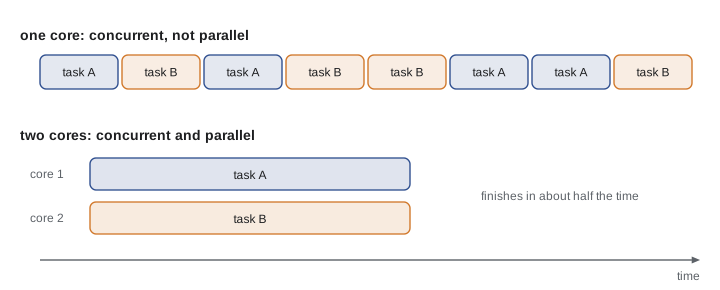
Work is also either CPU-bound or I/O-bound. A CPU-bound task, such as compressing a video or multiplying matrices, keeps a processor busy computing; it benefits from parallelism across cores. An I/O-bound task, such as downloading web pages or querying a database, spends most of its time waiting for a device or network; it benefits from concurrency, because while one task waits, another can run, even on one core. Matching the tool to the kind of work is the first design decision in any concurrent program.
Threads and processes
A process is a running program with its own address space: its own memory, open files and resources, isolated from other processes by the operating system. A thread is a flow of control inside a process. All threads in a process share the same memory, so they can communicate cheaply by reading and writing the same objects, but they can also interfere with each other. Creating a process costs more than creating a thread, and processes communicate only through explicit channels such as pipes, sockets or shared memory segments, but a crash or memory corruption in one process cannot directly damage another.
| Property | Thread | Process |
|---|---|---|
| Memory | Shared with other threads in the same process | Private address space |
| Creation cost | Low | Higher |
| Communication | Shared variables (fast, risky) | Messages, pipes, files, shared memory segments |
| Failure isolation | A crash can take down the whole process | Isolated by the operating system |
| Python parallelism for CPU work | Limited by the GIL in standard CPython | Full, one interpreter per process |
import threading

results = {}

def worker(name, n):
    total = sum(i * i for i in range(n))      # some work
    results[name] = total                      # each thread writes its own key

threads = [threading.Thread(target=worker, args=(f"t{k}", 10_000 * (k + 1))) for k in range(4)]
for t in threads:
    t.start()                                  # begin running concurrently
for t in threads:
    t.join()                                   # wait for each to finish
for name in sorted(results):
    print(name, results[name])
print("threads alive after join:", sum(t.is_alive() for t in threads))t0 333283335000 t1 2666466670000 t2 8999550005000 t3 21332533340000 threads alive after join: 0
`start` begins a thread and returns immediately; `join` waits for it to finish. The threads here avoid interference because each writes a different key, and the dictionary operations they use are atomic in CPython. Most real problems are not so tidy: threads need to update shared counters, append to shared lists or modify shared objects, and that is where races appear.
Race conditions
A race condition occurs when the result of a program depends on the timing or interleaving of operations in different threads. The classic example is incrementing a shared counter. The statement `count += 1` looks like one step but is really three: read the current value, add one, and write the result back. If two threads both read the value 5 before either writes, both write 6, and one increment is lost. Whether this happens depends on exactly when the scheduler switches threads, so the bug may appear once in a million runs, only under load, or only on a particular machine.
import itertools

def run(schedule):
    """Simulate two threads each doing count += 1 as read / add / write steps.
    schedule lists which thread takes the next step."""
    count = 0
    regs = {"A": None, "B": None}
    steps = {"A": iter(["read", "add", "write"]), "B": iter(["read", "add", "write"])}
    for who in schedule:
        op = next(steps[who])
        if op == "read":  regs[who] = count
        elif op == "add": regs[who] += 1
        else:             count = regs[who]
    return count

orders = sorted(set(itertools.permutations("AAABBB")))
outcomes = {}
for o in orders:
    outcomes.setdefault(run(o), []).append("".join(o))
for result, scheds in sorted(outcomes.items()):
print(f"final count {result}: {len(scheds):2d} of {len(orders)} interleavings, e.g. {scheds[0]}")final count 1: 18 of 20 interleavings, e.g. AABABB final count 2: 2 of 20 interleavings, e.g. AAABBB
The simulation enumerates all 20 ways to interleave the two threads' three steps. Only the interleavings in which one thread finishes its write before the other reads give the correct answer, 2; in all the others one update is lost. Real threads are not this tidy, because the scheduler decides the interleaving, but the possible outcomes are exactly these. A test that runs the real program a few times may see only the correct result and give false confidence. This is why reasoning about interleavings, rather than testing alone, is essential for concurrent code.
Worked problem
Counting interleavings
Two threads each execute 3 atomic steps. How many distinct interleavings are there? How many if each executes 10 steps?
Show solution
- An interleaving is a sequence of 6 steps in which 3 are labelled A and 3 are labelled B, with each thread's steps in its own order.
- Choosing which 3 of the 6 positions belong to A determines the interleaving: C(6, 3) = 20.
- With 10 steps each, the count is C(20, 10) = 184,756.
- The number grows exponentially with the number of steps, so exhaustive testing of interleavings is impossible for realistic code.
Answer: 20 interleavings for 3 steps each and 184,756 for 10 steps each. This explosion is why correctness must come from design, such as avoiding shared state or using locks, rather than from testing all schedules.
The global interpreter lock
Standard CPython has a global interpreter lock, the GIL, which allows only one thread at a time to execute Python bytecode. The GIL protects the interpreter's internal data, such as reference counts, and makes some operations, like appending to a list, atomic. It does not make your code thread-safe: a switch can still happen between the read and the write of `count += 1`. And it prevents threads from running Python code in parallel, so CPU-bound Python code gets no speed-up from threads on a multicore machine. Threads still help I/O-bound code, because the GIL is released while a thread waits for I/O, and many libraries written in C, such as NumPy, release it during long computations.
This is changing. PEP 703 introduced an optional free-threaded build of CPython without the GIL, available experimentally in Python 3.13 (October 2024), and PEP 779 made it an officially supported, though still optional, build from Python 3.14 (October 2025). In the free-threaded build, CPU-bound threads can run in parallel, at some cost in single-threaded speed and with some extension libraries not yet compatible. The default build still has the GIL as of 2026. Either way, races in your own code remain your responsibility: removing the GIL makes correct synchronization more important, not less.
Processes for CPU-bound parallelism
To use several cores for CPU-bound Python code in the standard build, use processes. The `multiprocessing` module and `concurrent.futures.ProcessPoolExecutor` start worker processes, each with its own interpreter and its own GIL, and send them work. Arguments and results travel between processes by pickling, Python's serialization format, so they must be picklable and should be reasonably small; sending large data structures back and forth can cost more than the computation saves.
from concurrent.futures import ProcessPoolExecutor, ThreadPoolExecutor

def count_primes(bounds):
    lo, hi = bounds
    def is_prime(n):
        if n < 2: return False
        i = 2
        while i * i <= n:
            if n % i == 0: return False
            i += 1
        return True
    return sum(1 for n in range(lo, hi) if is_prime(n))

chunks = [(k * 50_000, (k + 1) * 50_000) for k in range(4)]   # split 0..200,000 into 4 parts

with ProcessPoolExecutor(max_workers=4) as pool:               # one interpreter per worker
    parts = list(pool.map(count_primes, chunks))
print("per chunk:", parts, "total:", sum(parts))

with ThreadPoolExecutor(max_workers=4) as pool:                # same answer, but no CPU speed-up under the GIL
print("threads agree:", sum(pool.map(count_primes, chunks)) == sum(parts))per chunk: [5133, 4459, 4256, 4136] total: 17984 threads agree: True
`pool.map` returns results in the same order as the inputs, regardless of which worker finishes first, so the output is deterministic even though the work runs in parallel. Dividing work into independent chunks, processing them separately, and combining the results is the map–reduce pattern from lesson 2, applied to parallel execution. It works best when the chunks share no mutable state, which is exactly the property pure functions provide: a pure function can run anywhere, in any order, in any process.
Worked problem
Choosing threads, processes or neither
Pick an approach for each task in standard CPython: (a) download 300 web pages, (b) resize 300 large images with a pure-Python algorithm, (c) sum a list of 1,000 numbers.
Show solution
- (a) is I/O-bound: most time is spent waiting for the network. Threads, or the asynchronous approach in lesson 11, let many downloads wait at once.
- (b) is CPU-bound Python code: threads would be serialized by the GIL, so use a process pool with one worker per core.
- (c) takes microseconds: the cost of starting threads or processes would exceed the work. Do it sequentially.
- In every case, measure before and after; overheads and data transfer often decide the result.
Answer: (a) threads or async, (b) processes, (c) neither. Concurrency is a tool with a cost; it pays only when the work is large and the right kind.
Shared state is the root of the problem
Every race condition needs two ingredients: state that is shared between threads, and at least one thread that modifies it. Remove either ingredient and races disappear. Immutable data, from lesson 3, can be shared freely, because nobody can change it. Unshared mutable data, owned by one thread, is safe, because only its owner touches it. The remaining case, shared mutable state, needs synchronization, which lesson 10 covers. This is why the functional paradigm's emphasis on immutability and the actor model's emphasis on message passing are so valuable for concurrent programs: they design away the dangerous quadrant.
| Not shared | Shared | |
|---|---|---|
| Immutable | Safe | Safe: share freely between threads |
| Mutable | Safe: one owner | Dangerous: needs locks or other synchronization |
Rust enforces this table at compile time. Its ownership rules allow either one mutable reference to a value or any number of read-only references, never both. A value can be sent to another thread only if its type is marked `Send`, and shared between threads only if it is `Sync`. The program below shares a counter between threads safely by wrapping it in `Arc`, an atomically reference-counted pointer, and `Mutex`, a lock; trying to mutate a plain shared integer from several threads would not compile.
use std::sync::{Arc, Mutex};
use std::thread;

fn main() {
    let counter = Arc::new(Mutex::new(0u64));
    let mut handles = Vec::new();
    for _ in 0..4 {
        let c = Arc::clone(&counter);
        handles.push(thread::spawn(move || {
            for _ in 0..100_000 {
                *c.lock().unwrap() += 1;      // lock, increment, unlock automatically
            }
        }));
    }
    for h in handles {
        h.join().unwrap();
    }
    println!("count = {}", *counter.lock().unwrap());
}count = 400000
Common mistakes
MistakeUsing concurrency and parallelism as synonyms.
InsteadConcurrency is overlapping activities; parallelism is simultaneous execution. A single core can run a concurrent program without parallelism.
MistakeAssuming count += 1 is atomic.
InsteadIt is a read, an add and a write; another thread can run in between and an update can be lost.
MistakeTrusting a few successful test runs of concurrent code.
InsteadRaces depend on timing and may appear rarely; reason about interleavings and avoid shared mutable state.
MistakeUsing threads to speed up CPU-bound pure Python code in standard CPython.
InsteadThe GIL serializes Python bytecode; use processes, or the free-threaded build where appropriate.
MistakeSending huge objects to worker processes for tiny amounts of work.
InsteadPickling and transfer costs can exceed the computation; send compact work descriptions and batch work.
Summary and key terms
- Concurrency is a program structure of overlapping activities; parallelism is simultaneous execution on multiple cores.
- CPU-bound work benefits from parallelism; I/O-bound work benefits from concurrency even on one core.
- Threads share memory within a process; processes have separate memory and communicate explicitly.
- A race condition makes results depend on interleaving; unsynchronized read-modify-write operations can lose updates.
- The number of interleavings grows exponentially, so testing cannot cover them; correctness must come from design.
- CPython's GIL prevents parallel execution of Python bytecode in threads; processes or the optional free-threaded build provide CPU parallelism.
- Races require shared mutable state; immutability or single ownership removes them, and Rust enforces this at compile time.
- concurrency
- Structuring a program as multiple activities whose executions overlap in time.
- parallelism
- Executing multiple computations at the same instant on different processors.
- thread
- A flow of control within a process that shares the process's memory with other threads.
- process
- A running program with its own address space and resources.
- race condition
- A bug in which the outcome depends on the relative timing of operations in concurrent activities.
- interleaving
- One particular order in which the steps of concurrent activities are executed.
- atomic operation
- An operation that appears to happen in a single, indivisible step to other threads.
- global interpreter lock
- A lock in standard CPython that allows only one thread to execute Python bytecode at a time.
- CPU-bound
- Limited by processor speed; spends most of its time computing.
- I/O-bound
- Limited by input and output; spends most of its time waiting for devices or networks.
Practice problems
Work each problem on paper first, then reveal the answer to check.
Is a web server that handles many requests on a single-core machine concurrent, parallel or both?
Show answer
Concurrent but not parallel: requests overlap in time, but one core executes one step at a time.
Classify as CPU-bound or I/O-bound: (a) computing SHA-256 hashes of files already in memory, (b) waiting for database queries.
Show answer
(a) CPU-bound, (b) I/O-bound.
Name one advantage of processes over threads.
Show answer
Failure isolation: memory corruption or a crash in one process does not directly affect others; also true parallelism in standard CPython.
List the three steps hidden in `count += 1`.
Show answer
Read the current value, add one, and write the result back.
How many interleavings exist for two threads with 2 atomic steps each?
Show answer
C(4, 2) = 6.
Why doesn't the GIL make count += 1 safe?
Show answer
The interpreter can switch threads between the bytecodes that read and write the value, so updates can still be lost.
What does ProcessPoolExecutor.map guarantee about the order of results?
Show answer
Results come back in the same order as the inputs, regardless of completion order.
Which two conditions together are required for a race condition?
Show answer
Shared state, and at least one thread modifying it.
What changed with PEP 779 in Python 3.14?
Show answer
The free-threaded build without the GIL became an officially supported, though still optional, build.
Why can immutable objects be shared between threads without locks?
Show answer
No thread can change them, so every thread always sees the same consistent value.
Lesson quiz · 5 questions
Score 60% or more to complete this lesson.
Create a free account to save your progress, take quizzes and earn a certificate.