
CMP-330 · Lesson 11 of 12 · 34 min
Wireless and mobile networks
More devices now reach the internet over radio than over cables: phones, laptops, watches, cars, drones and countless sensors. Wireless links bring new problems that the wired protocols in earlier lessons did not have to face. Signal strength falls rapidly with distance and walls; interference and fading cause frequent errors; stations may not hear each other; and the spectrum is a shared, regulated and scarce resource. Mobility adds another layer: a device that moves between access points or cell towers wants to keep its connections alive even though its point of attachment, and perhaps its IP address, changes. This lesson covers the characteristics of wireless links, Wi-Fi's medium access protocol, cellular networks from 4G to 5G, and how networks handle mobility. CISSP-113 lesson 6 covers wireless security; ROB-460 covers communication links for field robots.
Characteristics of wireless links
A wireless link differs from a wire in several ways. Signal strength decreases with distance even in free space, and much faster through walls, floors and foliage; higher frequencies generally suffer more. Signals from other transmitters, including microwave ovens in the 2.4 GHz band and other networks on the same channel, interfere. And signals reach the receiver along several paths, reflecting off buildings and objects, so that copies arrive at slightly different times and can cancel each other out, multipath fading, which changes as people and devices move. The result is a bit error rate many orders of magnitude higher than on fibre, which varies from moment to moment.
What matters to the receiver is the signal-to-noise ratio (SNR), the ratio of received signal power to noise power, usually expressed in decibels. A higher SNR allows a denser modulation scheme that packs more bits into each symbol: modern Wi-Fi uses up to 4096-QAM, 12 bits per symbol, but only at very high SNR. Shannon's theorem sets the ultimate limit: a channel of bandwidth \(B\) hertz with signal-to-noise ratio SNR can carry at most \(B \log_2(1 + \text{SNR})\) bits per second. Wireless devices therefore adapt their rate continuously, dropping to more robust modulations as SNR falls. The program below combines free-space path loss with Shannon's limit to show how capacity falls with distance and frequency. Real indoor losses are much larger than free space.
import math
# Free-space path loss and Shannon capacity for a Wi-Fi link
def fspl_db(d_m, f_hz):
    c = 3e8
    return 20 * math.log10(4 * math.pi * d_m * f_hz / c)
tx_dbm, gains, noise_dbm, bw = 20, 4, -90, 80e6          # 100 mW, antenna gains, noise floor, 80 MHz channel
for f, name in ((2.4e9, "2.4 GHz"), (5.5e9, "5 GHz"), (6.5e9, "6 GHz")):
    for d in (5, 20, 50):
        rx = tx_dbm + gains - fspl_db(d, f)
        snr_db = rx - noise_dbm
        cap = bw * math.log2(1 + 10 ** (snr_db / 10))
print(f"{name:7s} {d:3d} m: loss {fspl_db(d, f):5.1f} dB, received {rx:6.1f} dBm, SNR {snr_db:5.1f} dB, Shannon limit {cap/1e6:6.0f} Mbit/s")2.4 GHz 5 m: loss 54.0 dB, received -30.0 dBm, SNR 60.0 dB, Shannon limit 1594 Mbit/s 2.4 GHz 20 m: loss 66.1 dB, received -42.1 dBm, SNR 47.9 dB, Shannon limit 1274 Mbit/s 2.4 GHz 50 m: loss 74.0 dB, received -50.0 dBm, SNR 40.0 dB, Shannon limit 1062 Mbit/s 5 GHz 5 m: loss 61.2 dB, received -37.2 dBm, SNR 52.8 dB, Shannon limit 1402 Mbit/s 5 GHz 20 m: loss 73.3 dB, received -49.3 dBm, SNR 40.7 dB, Shannon limit 1082 Mbit/s 5 GHz 50 m: loss 81.2 dB, received -57.2 dBm, SNR 32.8 dB, Shannon limit 871 Mbit/s 6 GHz 5 m: loss 62.7 dB, received -38.7 dBm, SNR 51.3 dB, Shannon limit 1364 Mbit/s 6 GHz 20 m: loss 74.7 dB, received -50.7 dBm, SNR 39.3 dB, Shannon limit 1044 Mbit/s 6 GHz 50 m: loss 82.7 dB, received -58.7 dBm, SNR 31.3 dB, Shannon limit 832 Mbit/s
Two more phenomena shape wireless protocol design. In the hidden terminal problem, stations A and C can both reach access point B, but an obstacle or distance prevents A and C from hearing each other, so carrier sensing fails and their transmissions collide at B. And collision detection is impractical: a radio's own transmission is millions of times stronger at its antenna than a faint distant signal, so it cannot listen for collisions while sending. Wi-Fi must therefore avoid collisions rather than detect them.
Spectrum and its regulation
Radio spectrum is a public resource managed by national regulators. In Canada, Innovation, Science and Economic Development Canada (ISED) assigns spectrum, auctions licences for cellular bands, and sets the rules for licence-exempt devices such as Wi-Fi under its Radio Standards Specifications. ISED opened 1,200 MHz of the 6 GHz band (5,925 to 7,125 MHz) to licence-exempt use in 2021, allowing Wi-Fi 6E and Wi-Fi 7 devices to use wide, uncrowded channels. Licensed bands for 4G and 5G, such as the 3,500 MHz band auctioned in 2021, cost operators billions of dollars, and ISED attaches conditions on deployment and, increasingly, on competition.
Licence-exempt bands are free to use but shared with everyone, subject to power limits; licensed bands give an operator exclusive use and therefore predictable performance. Some newer schemes share spectrum dynamically, letting commercial users access bands when incumbents such as radar are not using them.
Wi-Fi: IEEE 802.11
Wi-Fi is the family of IEEE 802.11 standards for wireless LANs. Successive generations, renamed by the Wi-Fi Alliance as Wi-Fi 4 (802.11n), Wi-Fi 5 (802.11ac), Wi-Fi 6 and 6E (802.11ax) and Wi-Fi 7 (802.11be, certified from 2024), have raised peak rates from tens of megabits to several gigabits per second through wider channels (up to 320 MHz in Wi-Fi 7), denser modulation, multiple antennas carrying several spatial streams at once (MIMO), and OFDMA, which divides a channel among several users in the same transmission. The basic architecture is unchanged: stations associate with an access point (AP), which is connected to a wired network, and a group of stations with their AP forms a basic service set identified by a network name (SSID). Stations discover APs by listening for beacon frames that APs broadcast about ten times a second, or by sending probe requests.
CSMA/CA: avoiding collisions
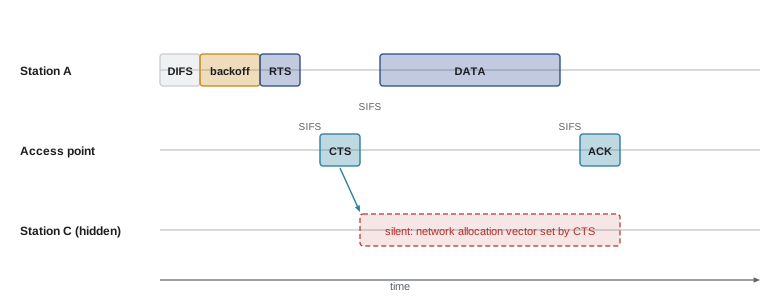
Since a Wi-Fi station cannot detect collisions, 802.11 uses carrier sense multiple access with collision avoidance (CSMA/CA) and link-layer acknowledgements. A station with a frame to send listens to the channel. If the channel is idle for a short period called the DIFS, the station counts down a random backoff, chosen from a contention window, pausing the countdown whenever the channel becomes busy; when the counter reaches zero, it transmits the whole frame. The receiver checks the CRC and, after a shorter interval called the SIFS, sends an ACK. Because the SIFS is shorter than the DIFS, the ACK always goes before any new transmission. If no ACK arrives, the sender assumes a collision or corruption, doubles its contention window, and tries again. Unlike Ethernet, Wi-Fi thus provides reliable delivery at the link layer, because losses on radio links are too frequent to leave to TCP.
To deal with hidden terminals, a station may first send a short request-to-send (RTS) frame; the AP replies with a clear-to-send (CTS) frame that every station in range of the AP hears, and all of them stay silent for the announced duration. Collisions can still happen, but only between short RTS frames, not between long data frames. RTS/CTS costs extra airtime, so it is usually used only for frames above a size threshold.
import random
# Hidden terminals: A and C both reach the access point B but cannot hear each other
def run(rts_cts, frames=20_000, p=0.04, frame_slots=10, seed=5):
    rnd = random.Random(seed)
    t = ok = lost = 0
    while ok + lost < frames:
        a, c = rnd.random() < p, rnd.random() < p      # does each station start in this slot?
        if a and c:
            if rts_cts:
                t += 1                                 # only short RTS frames collide; retry quickly
            else:
                lost += 2; t += frame_slots            # two whole data frames are wasted
        elif a or c:
            # without RTS/CTS the other station may start mid-frame because it cannot hear
            if not rts_cts and rnd.random() < 1 - (1 - p) ** (frame_slots - 1):
                lost += 2; t += frame_slots
            else:
                ok += 1; t += frame_slots + (2 if rts_cts else 0)   # RTS/CTS adds a little overhead
        else:
            t += 1
    return ok / (ok + lost), ok * frame_slots / t
for mode in (False, True):
    success, util = run(mode)
print(f"RTS/CTS {'on ' if mode else 'off'}: {success:5.1%} of frames delivered, channel carrying data {util:5.1%} of the time")RTS/CTS off: 51.5% of frames delivered, channel carrying data 31.3% of the time RTS/CTS on : 100.0% of frames delivered, channel carrying data 41.6% of the time
In this toy model, about half of all data frames are destroyed without RTS/CTS, because each station often starts transmitting in the middle of the other's frame. With RTS/CTS, only the short reservation frames ever collide, every data frame gets through, and the channel carries useful data a larger share of the time despite the extra control frames. Real behaviour depends on traffic load and frame sizes, which is why RTS/CTS is a configurable threshold rather than always on.
Even without collisions, all of these gaps, backoffs, preambles and acknowledgements mean that a Wi-Fi network delivers well below its advertised physical rate. The overhead is fixed per transmission, so small frames suffer most, which is why modern Wi-Fi aggregates many packets into one long transmission with a single block acknowledgement.
# Why Wi-Fi delivers well below its nominal rate: CSMA/CA overhead for one frame
slot, sifs = 9e-6, 16e-6
difs = sifs + 2 * slot                   # 34 microseconds
preamble = 40e-6                         # PHY preamble and header (order of magnitude, 802.11ax)
mean_backoff = 7.5 * slot                # contention window of 15 slots, on average half
rate = 600e6                             # nominal PHY data rate
for payload in (64, 1500, 64_000):       # bytes; the last one is an aggregated frame (A-MPDU)
    data = preamble + payload * 8 / rate
    ack = preamble + 14 * 8 / 24e6       # ACK sent at a basic rate
    cycle = difs + mean_backoff + data + sifs + ack
    print(f"payload {payload:6d} B: airtime {cycle*1e6:7.1f} us, throughput {payload*8/cycle/1e6:6.1f} Mbit/s "
f"({payload*8/cycle/rate:5.1%} of the PHY rate)")payload 64 B: airtime 203.0 us, throughput 2.5 Mbit/s ( 0.4% of the PHY rate) payload 1500 B: airtime 222.2 us, throughput 54.0 Mbit/s ( 9.0% of the PHY rate) payload 64000 B: airtime 1055.5 us, throughput 485.1 Mbit/s (80.8% of the PHY rate)
Worked problem
Why is my Wi-Fi slower than the box says?
A laptop shows a Wi-Fi link rate of 1,200 Mbit/s, but a speed test gives 450 Mbit/s with the laptop near the AP. Give four reasons the throughput is lower, using this lesson's ideas.
Show solution
- The link rate is the physical rate during a frame; preambles, interframe gaps, backoff and acknowledgements consume airtime between frames.
- Other stations and neighbouring networks on the same channel share the medium, so the laptop gets only part of the airtime.
- The rate adapts to SNR from moment to moment; movement, walls and interference cause retransmissions and lower rates.
- TCP and IP headers, TLS and the speed test server's own path add overhead and may themselves be the bottleneck (lesson 1).
Answer: Protocol overhead, sharing the channel, rate adaptation and retransmissions, and higher-layer overhead or bottlenecks together explain the gap.
Wi-Fi also handles mobility within a network. When a laptop moves from one AP to another in the same subnet, it reassociates with the new AP, which tells the switches where the laptop now is, often by sending a frame from the laptop's MAC address so the self-learning switches of lesson 10 update their tables. The IP address stays the same, so connections survive. Moving to a different subnet requires a new address, unless the network uses tunnelling or the application, like QUIC, can migrate.
Cellular networks
Cellular networks provide wide-area wireless access across whole countries. The area is divided into cells, each served by a base station (an eNodeB in 4G LTE, a gNodeB in 5G), and frequencies are reused in cells far enough apart. A device is identified by a subscriber identity stored on its SIM, and it authenticates to its home operator using keys shared with the SIM. The radio link in 4G and 5G uses OFDMA on the downlink: the base station schedules small blocks of frequency and time, resource blocks, among devices every millisecond or less, giving each device a share that depends on its signal quality and the operator's policy. Unlike Wi-Fi's random access, cellular access is centrally scheduled by the base station.
Behind the radio network is the core network. In 4G LTE, the Evolved Packet Core contains a mobility management entity that handles authentication and tracks which cell a device is in, and gateways that carry the device's IP traffic in tunnels to the operator's connection to the internet. Data from a phone is not routed by its IP address inside the operator's network; it travels in a tunnel from the base station to the gateway, which is why a phone keeps the same IP address as it moves between cells. 5G's core, standardized by 3GPP from Release 15 in 2018 onward, reorganizes these functions into software services running on general-purpose servers, supports network slicing, which gives different applications virtual networks with different guarantees, and can place gateways close to users for low-latency edge computing. 5G radios use wider channels, including millimetre-wave bands above 24 GHz with very high rates but short range, and promise latencies of a few milliseconds over the radio link.
| Generation | Era | Key technology | Typical peak rates |
|---|---|---|---|
| 2G (GSM) | 1990s | Digital voice, circuit-switched; SMS | Tens of kbit/s for data |
| 3G (UMTS, HSPA) | 2000s | Packet data with CDMA | A few Mbit/s |
| 4G (LTE) | 2010s | All-IP, OFDMA, MIMO | Tens to hundreds of Mbit/s |
| 5G (NR) | 2019 onward | Flexible numerology, mmWave, service-based core, slicing | Hundreds of Mbit/s to several Gbit/s |
Mobility management
Mobility raises a fundamental question: if a device's IP address identifies where it is attached, how can others reach it when it moves? One answer is to let routing handle it: the device keeps its address and advertises its new location to routers, which would require global routing tables to track millions of moving devices and does not scale. Practical answers use a home network and indirection. The device has a permanent home address in its home network, where a home agent keeps track of its current location. In indirect routing, a correspondent sends packets to the home address; the home agent intercepts them and tunnels them to the device's current location, from which replies can go directly back. This works without the correspondent knowing anything about mobility, but adds the detour through the home network, triangle routing. Direct routing lets the correspondent learn the current location and send there directly, at the cost of more complexity.
# Mobile IP style indirect routing versus direct routing
home_to_corr = 5          # ms one way between correspondent and home network
corr_to_visit = 40        # ms one way, correspondent directly to the visited network (Tokyo to Vancouver)
home_to_visit = 45        # ms one way, home agent (Toronto) to the visited network
indirect = home_to_corr + home_to_visit       # correspondent -> home agent -> mobile
direct = corr_to_visit
print(f"indirect (triangle) routing: {indirect} ms one way; direct routing: {direct} ms")
print(f"triangle routing adds {indirect - direct} ms each way ({(indirect - direct) * 2} ms per round trip)")indirect (triangle) routing: 50 ms one way; direct routing: 40 ms triangle routing adds 10 ms each way (20 ms per round trip)
Mobile IP (RFC 5944 for IPv4, RFC 6275 for IPv6) standardized this approach but saw little deployment. Cellular networks use the same ideas internally: when you travel abroad, your phone may connect through a visited network but tunnel its traffic back to your home operator's gateway, which is why roaming traffic often has noticeably higher delay. Within one operator, handovers between base stations are coordinated by the network and keep the tunnel endpoint fixed, so connections survive. Higher layers help too: QUIC's connection IDs let a connection move from Wi-Fi to cellular even though the device's IP address changes, and applications such as messaging and video calls simply reconnect quickly.
Worked problem
A handover during a video call
A passenger on a train is on a video call over 5G. The phone moves from one cell to the next. Describe what happens at the radio, core and transport levels, and when the user might notice.
Show solution
- The phone measures signals from neighbouring cells and reports them; when a neighbour becomes stronger, the serving base station prepares the target cell and commands a handover.
- Data in flight is forwarded from the old base station to the new one, and the core switches the tunnel endpoint to the new base station. The phone's IP address does not change.
- The interruption is typically tens of milliseconds; the call's jitter buffer and congestion control absorb it, though a burst of loss may briefly lower video quality.
- If the phone instead moved from cellular to a station's Wi-Fi, its IP address would change; a QUIC-based or WebRTC call would migrate or renegotiate, while an old TCP connection would break.
Answer: The network hands the phone to the next cell while keeping its IP address, so the call continues with at most a brief glitch; changing networks would require migration at higher layers.
Wireless links also confuse TCP. A loss caused by radio interference looks to TCP like congestion, so TCP slows down unnecessarily. Link-layer retransmission, as in Wi-Fi and cellular networks, hides most radio losses from TCP; congestion control algorithms such as BBR that do not treat every loss as congestion cope better; and large cellular buffers can cause bufferbloat (lesson 1) that hurts interactive traffic.
Common mistakes
MistakeExpecting Wi-Fi to deliver its advertised link rate.
InsteadOverhead, sharing, rate adaptation and retransmissions mean throughput is often half the link rate or less.
MistakeAssuming wireless stations can detect collisions as Ethernet does.
InsteadA radio cannot hear faint signals while it transmits; Wi-Fi avoids collisions and uses acknowledgements.
MistakeThinking carrier sensing prevents all collisions.
InsteadHidden terminals cannot hear each other; RTS/CTS reduces the damage.
MistakeBelieving a phone's IP address changes at every cell handover.
InsteadCellular networks tunnel traffic to a fixed gateway, so the address stays the same within the operator.
MistakeTreating wireless loss as congestion in protocol design.
InsteadRandom radio loss is not congestion; link-layer retransmission and model-based congestion control help.
MistakeAssuming higher frequencies are always better.
InsteadHigher bands offer more bandwidth but lose more signal with distance and obstacles.
Summary and key terms
- Wireless links suffer path loss, interference and multipath fading, so error rates are high and variable.
- SNR determines the usable modulation and rate; Shannon's limit is B log2(1 + SNR).
- Spectrum is regulated: licence-exempt bands host Wi-Fi, and licensed bands are auctioned to cellular operators.
- Wi-Fi uses CSMA/CA with random backoff and link-layer ACKs; RTS/CTS mitigates hidden terminals.
- Per-frame overhead keeps Wi-Fi throughput well below the physical rate, so modern Wi-Fi aggregates frames.
- Cellular networks schedule radio resources centrally and tunnel traffic through a core network; 5G adds a service-based core, slicing and mmWave.
- Mobility is handled by indirection through home networks or gateways, link-layer handovers, and transport-level migration such as QUIC's.
- Signal-to-noise ratio (SNR)
- The ratio of received signal power to noise power, usually in decibels.
- Multipath fading
- Signal variation caused by copies of the signal arriving along different paths.
- Hidden terminal
- A station that cannot hear another station transmitting to the same receiver.
- CSMA/CA
- Carrier sense multiple access with collision avoidance, used by Wi-Fi.
- RTS/CTS
- Request-to-send and clear-to-send frames that reserve the channel.
- Access point
- A base station that connects Wi-Fi stations to a wired network.
- OFDMA
- Dividing a channel into subcarriers and time slots shared among several users.
- Handover
- Moving a device's connection from one base station or access point to another.
- Home agent
- A node in a mobile device's home network that forwards traffic to its current location.
- Triangle routing
- The detour through the home network caused by indirect routing.
Practice problems
Work each problem on paper first, then reveal the answer to check.
By how many decibels does free-space path loss rise when distance doubles?
Show answer
About 6 dB.
What is the Shannon limit for 20 MHz at an SNR of 30 dB?
Show answer
20 x 10^6 x log2(1001), about 199 Mbit/s.
Why is the SIFS shorter than the DIFS?
Show answer
So acknowledgements and CTS frames go before any new transmission.
What does a station do when it receives no ACK?
Show answer
Doubles its contention window and retransmits after a new random backoff.
Why does RTS/CTS help with hidden terminals?
Show answer
The CTS from the AP is heard by stations that cannot hear the sender, so they stay silent.
Why do modern Wi-Fi standards aggregate frames?
Show answer
To spread fixed per-transmission overhead over more data.
How does an LTE network keep a phone's IP address constant across cells?
Show answer
Traffic is tunnelled to a gateway in the core network, and only the tunnel endpoint at the base station changes.
What is network slicing?
Show answer
Providing virtual networks with different performance guarantees over shared 5G infrastructure.
What causes triangle routing?
Show answer
Traffic for a mobile device goes through its home agent rather than directly to its current location.
Why can TCP perform poorly over lossy wireless links?
Show answer
It interprets random losses as congestion and reduces its window unnecessarily.
Lesson quiz · 5 questions
Score 60% or more to complete this lesson.
Create a free account to save your progress, take quizzes and earn a certificate.