
CIV-450 · Lesson 12 of 12 · 19 min
Capstone: the Ridgeway package construction management plan
This capstone pulls the course together in two parts. The first is the construction management plan that Kestrel Bay prepared for the city before Northline mobilized: the document that set out how the contract would be administered and how cost, time, quality, safety, environment and the community would be managed. The second is the end of the story: closing out the claim from lesson 9, completing the work, and reporting the final outcome against the budget and the plan. Together they show what construction management looks like from the engineer's chair on a real-sized public contract.
Part 1: the construction management plan
A construction management plan is the owner's playbook for the construction phase. It is not the contractor's plan for building the work, which belongs to Northline, but the plan for managing the contract. Kestrel Bay's plan for the Ridgeway package, approved by the city in April, had ten sections, each drawing on a lesson in this course.
| Section | Content | Lesson |
|---|---|---|
| Organization and authority | roles, delegated authority, communication paths, meeting schedule | 1, 8 |
| Contract and delivery | design-bid-build, unit-price with lump sums, key clauses and supplementary conditions | 2 |
| Procurement record | tender process, bid evaluation, award and post-award submissions | 3 |
| Cost management | budget, contingency rules, cost reporting, payment process | 1, 4, 7 |
| Time management | baseline review, updates, constraints, utility coordination | 5, 6 |
| Contract administration | submittals, RFIs, changes, records, inspection, testing | 8 |
| Risk and claims | risk register, notice handling, delay and quantum assessment, dispute steps | 9 |
| Safety | owner and engineer duties, plan review, inspection, reporting | 10 |
| Environment and community | permit compliance, monitoring, communication plan, complaints | 11 |
| Closeout | substantial completion, deficiencies, as-builts, warranty, lessons learned | 12 |
Three parts of the plan did most of the work during the season. The delegated authority table set out who could approve what: the resident inspector could accept quantities and issue site instructions with no cost effect; Priya could approve changes up to a set amount and time extensions up to five days; anything larger went to Carla Mendes and, above her limit, to council. Clear limits let small decisions happen on site the same day and kept large ones visible. The risk register listed eighteen risks with owners and responses; the top three, the utility relocations, the soft clay and the in-water window, were reviewed at every progress meeting. And the records protocol, which set what every diary, test report and photograph must contain, made the claim assessment in lesson 9 possible.
Risk register extract
| Risk | Likelihood | Impact | Response | Owner |
|---|---|---|---|---|
| Utility relocations late | medium | high, critical path | fortnightly coordination; commitment letters | city and Kestrel Bay |
| Soft clay beyond the geotechnical report | medium | high, wall on critical path | provisional subexcavation item; geotechnical engineer on call | city |
| Creek flows high during the in-water window | low | high | diversion sized for the permit flow; contingency days | Northline |
| Submittal reviews late | medium | medium | second structural reviewer; turnaround reported weekly | Kestrel Bay |
| Bid prices above budget | low | high | P80 contingency; market timing of the tender | city |
The register proved its worth. Two of the five risks above occurred: the soft clay, which became the claim, and the late submittal reviews, which the response had already started to fix. Neither surprised the city, and the contingency built from the Monte Carlo analysis in lesson 4 was sized for exactly this kind of event.
Part 2: closing out the claim
In lesson 9, Kestrel Bay assessed Northline's claim for the soft clay at CAD 254,515 and a 16-day extension, against the CAD 412,000 claimed. Northline accepted the time and the direct costs but disputed the rejected productivity costs. Under Ontario's Construction Act it could refer the valuation to adjudication; under the contract it could go to arbitration. The city had to decide how far to go to defend its position.
Sofia's last script frames the decision. If the dispute goes to an award, the city estimates a 60 % chance that the tribunal upholds the engineer's assessment, and a 40 % chance that it awards close to the full claim, about 90 % of it. Each side would spend heavily on lawyers and experts to get there. The expected cost of fighting is the probability-weighted award plus the city's own costs; any settlement below that figure is the better decision on expected value, before counting the staff time, the delay and the damage to a working relationship with a contractor the city will meet again.
# Capstone: final cost forecast for the Ridgeway package and the decision on the wall-footing claim
UNITS = "SI"
SI = UNITS == "SI"
CUR = "CAD" if SI else "USD"
contract = 7242426 if SI else 5998610
changes = {"subexcavation at the roundabout": 28880 if SI else 26500,
           "abandoned watermain (force account)": 10505 if SI else 8683,
           "added curb ramps (negotiated)": 44000 if SI else 36400,
           "quantity overruns at unit prices": 96500 if SI else 79800}
claim_assessed, claim_asked = (254515, 412000) if SI else (209180, 341000)
budget = 9877400 if SI else 8174400
other = (603200 + 377000 + 90480 + 263900 + 150800) * (1 if SI else 6.24 / 7.54)
extra_ca = 41000 if SI else 34000        # extra contract administration for the 16-day extension
final = contract + sum(changes.values()) + claim_assessed + other + extra_ca
print(f"Contract {contract:,.0f} + changes {sum(changes.values()):,.0f} + claim {claim_assessed:,.0f}")
print(f"Forecast final project cost {final:,.0f} {CUR} against budget {budget:,.0f}: {final / budget:.1%} of budget")
print(f"Contingency used: {(final - contract - other) / (budget - contract - other):.0%} of what was left above the contract and fees")
# the claim: settle near the engineer's assessment, or go to arbitration?
p_win = 0.60                               # chance the city's position (the assessment) is upheld
arb_cost = 95000 if SI else 80000          # each side's legal and expert costs to an award
award_if_lose = 0.9 * claim_asked
ev_arbitrate = p_win * claim_assessed + (1 - p_win) * award_if_lose + arb_cost
for offer in (claim_assessed, 290000 if SI else 240000, 320000 if SI else 265000):
    better = "settle" if offer < ev_arbitrate else "arbitrate"
print(f"Settlement at {offer:,.0f} vs expected cost of arbitration {ev_arbitrate:,.0f}: {better}")Contract 7,242,426 + changes 179,885 + claim 254,515 Forecast final project cost 9,203,206 CAD against budget 9,877,400: 93.2% of budget Contingency used: 41% of what was left above the contract and fees Settlement at 254,515 vs expected cost of arbitration 396,029: settle Settlement at 290,000 vs expected cost of arbitration 396,029: settle Settlement at 320,000 vs expected cost of arbitration 396,029: settle
The expected cost of arbitration is about CAD 396,000, well above any of the settlement figures discussed. The parties met with a mediator for one day and settled at the engineer's assessment of CAD 254,515. Northline dropped its productivity claim in exchange for payment within 14 days and the city's agreement that the dispute would not count against Northline in its contractor performance evaluation, terms that cost the city little. The settlement was recorded as a change order, with a release of the claim, so it would never return.
Worked problem
Expected cost of arbitration
The engineer's assessment is CAD 254,515, the claim CAD 412,000. The city estimates a 60 % chance of an award at the assessment and a 40 % chance of an award at 90 % of the claim, and would spend CAD 95,000 on its own costs. What is the expected cost?
Show solution
- \[E = 0.6(254{,}515) + 0.4(0.9 \times 412{,}000) + 95{,}000\]
- \[E = 152{,}709 + 148{,}320 + 95{,}000 = 396{,}029\]
Answer: Any settlement below about CAD 396,000 is better for the city on expected value.
Completing the work
Northline reached substantial performance on October 28, working day 149, the extended completion date, so no liquidated damages applied. Under Ontario's Construction Act, Kestrel Bay certified substantial performance and the certificate was published, which started the period after which the holdback could be released, provided no liens were preserved. A joint walk-through produced a deficiency list of 63 items, mostly minor: sod not yet established, a misaligned catch basin frame, touch-ups to the wall finish. The list was valued, a holdback for the deficiencies retained, and Northline completed them in the spring. Total performance followed in June 2028.
Closeout has its own checklist: as-built drawings marked up from Owen's records and the contractor's surveys, operation and maintenance manuals for the lighting and the bioretention cells, warranties, the final quantities agreed with the contractor, the final payment, the release of security, and the transfer of the asset to the city's operations staff with an inspection and maintenance schedule. The warranty period, typically one year from substantial completion, is the contractor's obligation to correct defects that appear; the city's inspectors walked the project again eleven months later and found two settlement cracks in the curb near the wall, which Northline repaired.
The final report
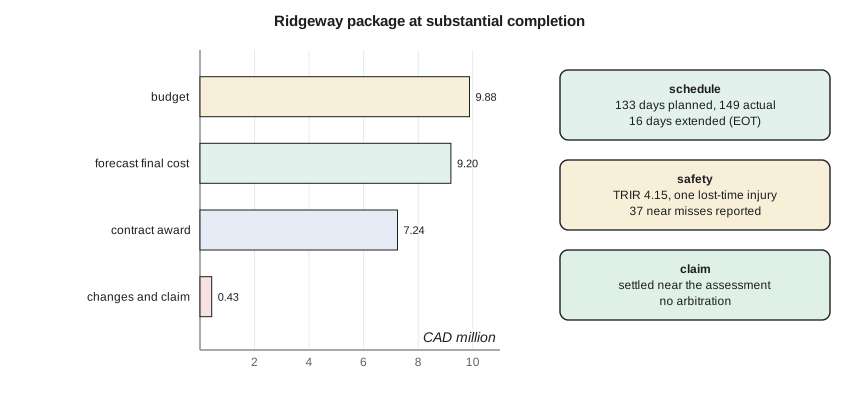
The final project cost was about CAD 9.2 million, 93 % of the CAD 9.88 million budget. Changes and the claim together added about CAD 434,000, or 6 % of the contract price, and used about 41 % of the money available above the contract and fees. The project finished 16 working days later than the original plan but on its extended date. Safety performance was reasonable but not outstanding, with one lost-time injury; the near-miss reporting rate was among the best in the city's recent contracts.
Performance evaluation closed the loop with the contractor. The city rates every contractor at the end of each contract on quality, schedule, safety, cooperation and administration, and the ratings feed its prequalification for future work. Northline was rated good overall: strong on quality and cooperation, average on schedule because of the late curb crew, and good on safety. The rating was discussed with Northline before it was filed, a step that makes the system fairer and more useful to both sides.
Kestrel Bay was rated too. The city's evaluation of its consultants looks at the quality of the documents, measured by the number and cost of changes caused by design errors and omissions, and at the administration of the contract. The Ridgeway documents produced two minor design-related changes, both small, and the city noted the late submittal reviews early in the season as the one area to improve.
Lessons learned
Kestrel Bay closed the project with a lessons-learned workshop including the city, Northline and the main subcontractors. The record listed what went well and what to change, each with an owner. Among the changes: include a geotechnical baseline report on soft-ground projects, so that the next differing site condition is judged against a number; staff structural submittal reviews before the season starts; ask utilities for binding relocation dates before tender; and adopt weekly work plans across the city's road program. Among what went well: the risk register, the records protocol and the decision to settle early.
These are the habits this course has tried to build. An engineer who can read a contract, estimate honestly, schedule with the risks in view, measure progress, price changes fairly, assess claims from records, keep people safe and close a project cleanly is as valuable to a public owner as one who can design the culvert in the first place. Most civil engineers will spend part of their careers doing exactly this work.
Practical points
- Write a construction management plan before construction starts, and use it.
- Set clear delegated authority so that small decisions are made on site and large ones are visible.
- Keep a live risk register with owners and responses, reviewed at every meeting.
- Compare the expected cost of a dispute with settlement before escalating.
- Close out completely: deficiencies, as-builts, warranties, final quantities, security and lessons learned.
Common mistakes
MistakeTreating the construction management plan as a formality.
InsteadIt is the owner's playbook; the records and authority it sets are what make claims manageable.
MistakeFighting every claim on principle.
InsteadCompare expected outcomes and costs; settle where the numbers and the relationship favour it.
MistakeForgetting closeout until the money has been paid.
InsteadFinal payment and release of security are the owner's leverage to complete deficiencies and documents.
MistakeHolding a lessons-learned session without owners for actions.
InsteadAssign each lesson to someone who will change the next project.
Summary and key terms
- The construction management plan sets out how the owner will manage cost, time, quality, safety, environment, community and closeout.
- Delegated authority, a live risk register and a records protocol did most of the work on the Ridgeway package.
- The expected cost of arbitrating the claim was about CAD 396,000; the parties settled near the assessment through mediation.
- The project finished on its extended date at about 93 % of budget.
- Substantial performance under the Construction Act started the holdback release period; deficiencies were held back and completed in the spring.
- Lessons learned with assigned owners carry improvements to the next project.
- Construction management plan
- The owner's plan for managing a construction contract.
- Delegated authority
- Defined limits on the decisions each person may make.
- Risk register
- A list of identified risks with likelihood, impact, response and owner.
- Substantial performance
- Under the Construction Act, the stage at which the work is ready for use and nearly complete by value.
- Deficiency list
- A list of minor incomplete or defective items to be corrected after substantial completion.
- Warranty period
- The period after completion during which the contractor must correct defects.
- Settlement
- An agreed resolution of a claim, recorded with a release.
- Lessons learned
- A structured review that records what to repeat and what to change.
Practice problems
Work each problem on paper first, then reveal the answer to check.
If the city's chance of having its assessment upheld fell to 40 %, would settlement at the assessment still be better?
Show answer
Yes: E = 0.4(254,515) + 0.6(370,800) + 95,000 = 419,286, well above any settlement discussed.
Name three items on a closeout checklist other than the final payment.
Show answer
As-built drawings, operation and maintenance manuals, warranties, final quantities, release of security, asset handover, lessons learned.
Why should a delegated authority table include time extensions as well as money?
Show answer
Time extensions change liquidated damages and the owner's plans; they need controlled approval like money.
Two risks in the Ridgeway register occurred. Name them and the responses that reduced their effect.
Show answer
Soft clay, met by the provisional subexcavation item and the geotechnical engineer on call; late submittal reviews, met by a second structural reviewer.
Lesson quiz · 5 questions
Score 60% or more to complete this lesson.
Create a free account to save your progress, take quizzes and earn a certificate.