
CIV-380 · Lesson 12 of 12 · 19 min
Capstone: checking a plant upgrade design
Every lesson in this course has contributed a piece of two designs. In the last weeks of preliminary design, Martin asks Nadia to assemble them into design basis reports, the documents that record what each plant must achieve, the numbers each unit was sized on and the reasons for each decision, and to check the wastewater upgrade against them. A design basis report is the bridge between the process engineer's calculations and the detailed design by civil, structural, mechanical and electrical engineers. It is also what the regulator reviews and what the operators will consult years later when they wonder why a tank is the size it is. This capstone works through that check.
The water plant design basis
The water plant was settled earlier in the course. Its design basis is summarized below, with the lesson in which each number was developed.
| Item | Design basis | Lesson |
|---|---|---|
| Capacity | 40,000 m³/d average, 60,000 m³/d peak | 1 |
| Treated water targets | Turbidity 0.1 NTU; THMs 60 µg/L running average; PFAS well below 30 ng/L | 1 |
| Coagulation | Alum 20 to 70 mg/L, 45 mg/L winter design; rapid mix G 1,000 s⁻¹ | 3 |
| Flocculation | Four trains, three tapered stages, 30 min at peak, G 60/40/20 s⁻¹ | 3 |
| Softening | Split-treatment lime softening to about 120 mg/L hardness, recarbonation | 7 |
| Clarification | Plate settlers, four basins, 0.6 m/h on projected plate area | 4 |
| Filtration | Eight dual-media filters, 10 m/h with one out of service, filter-to-waste | 5 |
| GAC contactors | 15 min EBCT at average flow, for organics, taste and odour and PFAS | 7 |
| Primary disinfection | UV at 40 mJ/cm² validated dose; free chlorine CT in baffled clearwell, baffling factor 0.6 | 6 |
| Corrosion control | pH and alkalinity adjustment; pipe loop testing; orthophosphate provision | 7 |
| Residuals | Alum and lime sludges thickened and dewatered; backwash water recovery | 4, 11 |
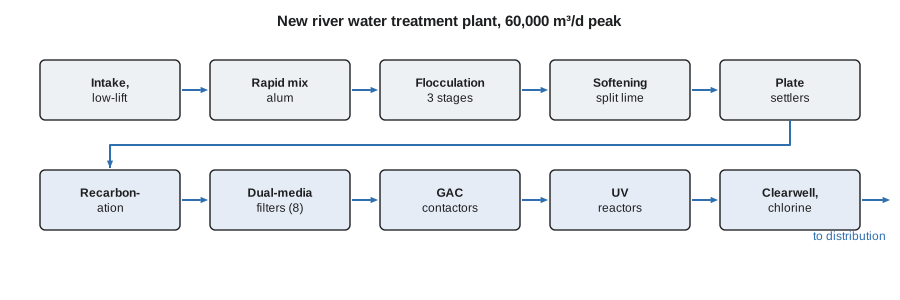
Two items remain open for the water plant and are listed as such: the tracer test at commissioning that must confirm the clearwell baffling factor, and the GAC pilot that must confirm the bed life before carbon is purchased. Recording open items is as important as recording decisions.
The wastewater upgrade: what must change
The city plant's amended licence will require a total phosphorus of 1 mg/L as a 30-day rolling average and a total nitrogen of 15 mg/L, with its existing secondary limits, disinfection from May to September and the WSER limits. The design targets agreed with the city are 0.5 mg/L total phosphorus and 10 mg/L total nitrogen in winter at 12 °C. The process selected in lesson 10 is A2O, with a primary sludge fermenter to supply volatile fatty acids, a trim alum dose for reliability, and side-stream treatment of the digester centrate.
The check must answer four questions. Is there enough aeration volume for the longer SRT that nitrification needs? Can the secondary clarifiers handle the larger solids inventory? Is there enough oxygen and alkalinity? And what does the upgrade do to the solids train?
Volume for the longer SRT
Lesson 10 set the aerobic SRT at 10 days. With 30 % of the biological volume unaerated (anaerobic and anoxic zones), the total SRT is
The solids inventory follows from the sludge production, which at this SRT, including inert solids, is about 0.75 g TSS per g BOD₅ removed, plus the chemical solids from the trim alum dose. Dividing the inventory by the design MLSS of 3,200 mg/L gives the volume needed.
# Capstone design check: nutrient removal upgrade of the city wastewater plant
UNITS = "SI"
SI = UNITS == "SI"
Q = 30000.0; Qp = 2.2 * Q                       # m3/d
BOD, TSS, TKN = 150.0, 96.0, 40.5              # primary effluent, mg/L
Y_obs = 0.75                                   # g TSS produced per g BOD removed at long SRT, incl. inerts (typical)
SRT_aer, anox_frac = 10.0, 0.30
SRT_tot = SRT_aer / (1 - anox_frac)
MLSS = 3200.0
Px = Y_obs * Q * BOD / 1000                    # kg TSS/d (before chemical solids)
alum = 80.0 * 0.5                              # mg/L after adding biological P removal (half the alum)
Px_chem = alum * 0.45 * Q / 1000              # kg/d of chemical solids, about 0.45 g solids per g alum
V_need = (Px + Px_chem) * SRT_tot * 1000 / MLSS
V_have = 9000.0
print(f"total SRT {SRT_tot:.1f} d; solids production {Px+Px_chem:,.0f} kg/d; basin volume needed {V_need:,.0f} m3 vs existing {V_have:,.0f} m3" if SI else
      f"total SRT {SRT_tot:.1f} d; solids production {(Px+Px_chem)*2.2046:,.0f} lb/d; basin volume needed {V_need*264.17/1e6:.2f} MG vs existing {V_have*264.17/1e6:.2f} MG")
# oxygen: carbon plus nitrification minus credit for denitrification
N_nit = TKN - 7.0 - 1.0 - 1.5
N_den = 24.4
Px_bio = 1700.0                               # kg VSS/d of biomass wasted (lesson 9 model at long SRT)
O2 = (Q * BOD / 0.68 / 1000 - 1.42 * Px_bio) + 4.57 * Q * N_nit / 1000 - 2.86 * Q * N_den / 1000
print(f"oxygen demand about {O2:,.0f} kg/d average; with a 1.5 peaking factor {1.5*O2:,.0f} kg/d" if SI else
      f"oxygen demand about {O2*2.2046:,.0f} lb/d average; with a 1.5 peaking factor {1.5*O2*2.2046:,.0f} lb/d")
# alkalinity: 7.14 used per g N nitrified, 3.57 recovered per g N denitrified, alum uses 0.5 per mg
alk_in = 320.0
alk_out = alk_in - 7.14 * N_nit + 3.57 * N_den - 0.5 * alum
print(f"effluent alkalinity {alk_out:.0f} mg/L as CaCO3 ({'adequate' if alk_out >= 70 else 'supplement needed'})")
# secondary clarifiers with the higher MLSS and return rate
A = 1650.0; R = 0.67
SLR = (Qp + R * Q) * MLSS / 1000 / A / 24
checks = [
    ("aeration volume", V_need <= V_have * 1.0, f"{V_need:,.0f} m3 needed" if SI else f"{V_need*264.17/1e6:.2f} MG needed"),
    ("peak overflow rate", Qp / A <= 40.0, f"{Qp/A:.0f} m3/(m2 d)" if SI else f"{Qp/A*24.54:,.0f} gpd/ft2"),
    ("peak solids loading", SLR <= 7.0, f"{SLR:.1f} kg/(m2 h)" if SI else f"{SLR*0.2048*24:.0f} lb/(ft2 d)"),
    ("effluent alkalinity", alk_out >= 70, f"{alk_out:.0f} mg/L"),
]
for name, ok, val in checks:
    print(f"{name:20s} {val:22s} {'passes' if ok else 'fails: action needed'}")
# option: add a fourth clarifier and two new basins
V_new = V_need - V_have
print(f"new basin volume {V_new:,.0f} m3 -> two basins of {V_new/2:,.0f} m3" if SI else f"new basin volume {V_new*264.17/1e6:.2f} MG -> two basins")total SRT 14.3 d; solids production 3,915 kg/d; basin volume needed 17,478 m3 vs existing 9,000 m3 oxygen demand about 6,360 kg/d average; with a 1.5 peaking factor 9,540 kg/d effluent alkalinity 166 mg/L as CaCO3 (adequate) aeration volume 17,478 m3 needed fails: action needed peak overflow rate 40 m3/(m2 d) passes peak solids loading 7.0 kg/(m2 h) passes effluent alkalinity 166 mg/L passes new basin volume 8,478 m3 -> two basins of 4,239 m3
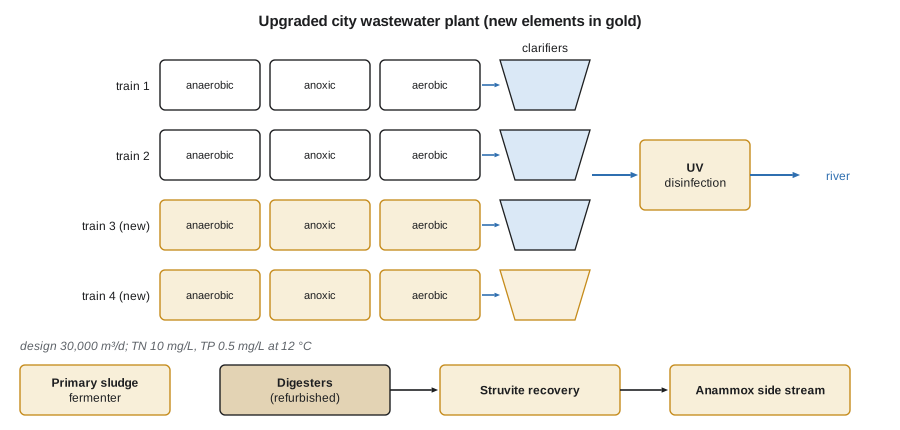
The check shows that the existing 9,000 m³ of aeration tanks is about half of the 17,500 m³ needed. The upgrade therefore needs about 8,500 m³ of new biological volume, which Nadia lays out as two new basins of about 4,250 m³ alongside the existing ones, so that the plant becomes four parallel trains of roughly equal size, each divided into anaerobic, anoxic and aerobic zones.
An alternative is to keep the existing tanks and add IFAS carriers to the aerobic zones, which would provide the nitrifying biomass on media without raising the MLSS. Nadia's comparison finds IFAS about 15 % cheaper in capital cost but higher in aeration energy, because the carriers need more air to stay suspended and the biofilm needs higher dissolved oxygen, and it would leave the plant with no spare tank for maintenance. The city's operators prefer the new basins, and the redundancy settles the choice. The IFAS option is kept as a future measure if loads grow faster than forecast.
Oxygen and alkalinity
The average oxygen demand rises to about 6,400 kg/d, with carbon removal and nitrification partly offset by the credit for denitrification. With a peaking factor of 1.5 for diurnal and seasonal load peaks, the blowers and diffusers must deliver about 9,500 kg/d of oxygen under process conditions, roughly twice the present demand. The existing blowers are 40 years old; new high-speed turbo blowers with dissolved oxygen and ammonia-based aeration control will meet the demand at lower energy than the existing units use today.
The effluent alkalinity, after nitrification consumes 7.14 mg/L per mg of nitrogen, denitrification returns 3.57 and the alum consumes about 0.5 per mg dosed, comes out at about 166 mg/L as CaCO₃, well above the 50 to 70 mg/L needed for stable nitrification. The hard prairie water is an advantage here; a plant on soft water would need to add alkalinity.
Secondary clarifiers
With the MLSS held at 3,200 mg/L, the peak overflow rate stays at the top of the normal range and the peak solids loading reaches the 7 kg/(m²·h) limit with no margin. State point analysis with the plant's measured settling data confirms that the clarifiers would just cope at peak flow when the sludge settles well, but fail when the SVI rises in spring. The design therefore adds a fourth clarifier of the same size, which lowers the peak loadings by a quarter and provides redundancy. The A2O configuration's anaerobic selector should also improve settleability, which is a benefit, not a design basis.
The solids train and side streams
The upgrade changes the solids. Biological phosphorus removal raises the phosphorus content of the WAS; the longer SRT reduces biomass production but the chemical trim adds solids; the fermenter converts part of the primary sludge's carbon to fatty acids before digestion. Nadia's mass balance, using the methods of lesson 11, shows a net solids production close to today's, about 7,600 kg/d to the digesters, so the two existing digesters, once refurbished, have enough capacity at 20 days. The phosphorus released in digestion would form struvite and cycle back in the centrate, so the design adds a struvite recovery unit on the centrate ahead of the anammox side-stream reactor, which together remove about 85 % of the centrate's ammonia and much of its phosphorus.
| Check | Result | Action |
|---|---|---|
| Aeration volume for 14.3 d total SRT | Needs about twice the existing volume | Two new basins; four A2O trains |
| Peak overflow rate | At top of range | Fourth clarifier |
| Peak solids loading | At limit, fails at high SVI | Fourth clarifier; selector benefit |
| Oxygen demand | About twice present demand | New blowers, DO and ammonia-based control |
| Effluent alkalinity | About 166 mg/L as CaCO₃ | No supplement needed |
| Solids to digesters | Similar to present | Refurbish two digesters |
| Centrate ammonia and phosphorus | About 15 to 20 % of plant N load | Struvite recovery and anammox side stream |
| Disinfection | Seasonal | UV system replaces chlorination and dechlorination |
Worked problem
Effect of the centrate on the nitrogen load
Before side-stream treatment, the centrate returns 250 kg/d of ammonia nitrogen to the head of the plant. The influent TKN load is 1,350 kg/d. By how much does the centrate raise the nitrogen load on the main process, and what is the load if side-stream treatment removes 85 % of it?
Show solution
- \[\frac{250}{1\,350} = 18.5\ \%\]
- \[\text{after treatment: } 250(1 - 0.85) = 38\ \text{kg/d} = 2.8\ \%\]
Answer: Side-stream treatment removes most of a load that would otherwise need almost a fifth more aeration and anoxic capacity in the main plant.
Risks, uncertainties and the operators
A design check is not complete without its risks. Nadia's register lists the main ones: industrial loads from the food processor, which could grow; cold winters below the 12 °C design temperature during long spring melts; the reliability of biological phosphorus removal during wet weather, when dilute influent carries little volatile fatty acid; the PFAS content of biosolids, which could restrict land application; and the construction sequence, since the plant must keep meeting its current limits while tanks are taken out of service. For each, the register gives the consequence, the mitigation in the design and the monitoring that will show whether the risk is materializing.
Finally, the design is reviewed with the plant's operators. Their comments change several details: access platforms to the new mixers, sampling taps at each zone boundary, a bypass so that the fermenter can be taken off line, and on-line ammonia, nitrate and phosphate analyzers so that they can see the process respond. The operators will run the plant for decades after Willowbend has moved on; designs that ignore them perform worse than their calculations predict.
The report is sealed by Martin as the engineer responsible and submitted to Manitoba's Environmental Approvals Branch with the application for the amended licence. Nadia records the hours toward her own professional registration and starts, as most engineers in training do, on the next project.
Common mistakes
MistakeChecking each unit only at average conditions.
InsteadCheck peak flows and loads, coldest temperatures and one unit out of service.
MistakeIgnoring return streams in the design of the main process.
InsteadInclude centrate, filtrate and backwash returns in the mass balances.
MistakeLeaving decisions and open items undocumented.
InsteadRecord each decision with its reasons, and list open items with how they will be closed.
Summary and key terms
- A design basis report records targets, design values, decisions, open items and risks for each plant.
- Total SRT equals aerobic SRT divided by the aerated fraction; the inventory and MLSS set the volume.
- Oxygen demand roughly doubles when a plant moves from carbon removal to full nutrient removal.
- Clarifiers, solids and side streams must be checked with the biological process, not after it.
- Design basis report
- A document recording the criteria, values and decisions on which a design rests.
- State point analysis
- A graphical check of clarifier capacity using the solids flux curve and operating lines.
- Side-stream treatment
- Treatment of a concentrated internal return stream before it rejoins the main process.
- Ammonia-based aeration control
- Adjusting aeration according to measured ammonia to save energy.
- Risk register
- A list of risks with their consequences, mitigation and monitoring.
- Redundancy
- Spare capacity that lets a plant meet its limits with a unit out of service.
- Open item
- A design question still to be resolved, with the action needed to close it.
Practice problems
Work each problem on paper first, then reveal the answer to check.
An A2O plant has an aerobic SRT of 8 days and 35 % unaerated volume. Find the total SRT.
Show answer
\(8/0.65 = 12.3\) d.
If sludge production is 4,000 kg TSS/d and the total SRT is 12 days at MLSS 3,000 mg/L, what biological volume is needed?
Show answer
\(4000 \times 12 \times 1000/3000 = 16\,000\) m³.
Why add a fourth clarifier when the peak solids loading only just reaches the limit?
Show answer
The check passes only with good settling and all units in service; the extra clarifier covers high SVI and maintenance.
Name two items that should appear in a risk register for a nutrient removal upgrade.
Show answer
For example, industrial load growth and loss of biological phosphorus removal in wet weather.
Lesson quiz · 5 questions
Score 60% or more to complete this lesson.
Create a free account to save your progress, take quizzes and earn a certificate.