
CIV-380 · Lesson 11 of 12 · 19 min
Sludge treatment and biosolids
Wastewater treatment concentrates the pollutants it removes into sludge. Although sludge is only about 1 % of the volume of the wastewater treated, its handling and disposal can account for a third to half of a plant's operating cost. It contains organic matter, nutrients, pathogens, metals and, as recent monitoring has shown, trace organic contaminants including PFAS. Treated to the right standard, it becomes biosolids, a valuable fertilizer and soil conditioner; handled poorly, it is a nuisance and a hazard. This lesson follows the city plant's solids from the clarifiers to their end use.
Sources and quantities
Primary sludge is the settled solids from primary clarifiers: grey, odorous, readily digestible and typically 2 to 6 % solids. Waste activated sludge (WAS) is the excess biomass from the activated sludge process: brown, flocculent, harder to thicken and digest, and typically 0.5 to 1.5 % solids as wasted. Chemical sludge from phosphorus precipitation adds metal phosphates and hydroxides. Scum, screenings and grit are handled separately and landfilled.
The basic tool is the solids mass balance. The dry mass of solids, in kg/d, is conserved through thickening and dewatering apart from the small amount lost to the returned liquid streams; the volume falls sharply as water is removed. Because a sludge's density is close to that of water, its volume is approximately
where \(M_s\) is the dry solids mass and \(P_s\) the solids fraction. Thickening WAS from 1 % to 6 % solids reduces its volume by a factor of six; dewatering digested sludge from 3 % to 22 % reduces it again by more than seven.
Thickening
Thickening is the first step, to reduce the volume sent to the digesters and so their size. Primary sludge thickens well by gravity, in circular thickeners similar to clarifiers designed on solids loading rates of about 100 to 150 kg/(m²·d), reaching 5 to 8 % solids. WAS thickens poorly by gravity and is usually thickened mechanically: by dissolved air flotation (lesson 4), gravity belt thickeners, rotary drum thickeners or centrifuges, with polymer conditioning, reaching 4 to 7 % solids. The liquid separated, called filtrate, centrate or overflow, returns to the head of the plant.
Stabilization
Stabilization reduces pathogens, odours and the potential for putrefaction. Anaerobic digestion is the most common method at plants of this size. In a heated, mixed, sealed tank, a sequence of microorganisms hydrolyses complex organic matter, ferments it to volatile fatty acids, converts these to acetate and hydrogen, and finally produces methane and carbon dioxide. The last step, methanogenesis, is the slowest and most sensitive, so digesters are operated to protect the methanogens: steady feeding, stable temperature, and enough alkalinity to buffer the fatty acids.
Mesophilic digesters operate at about 35 °C (95 °F) with an SRT of 15 to 20 days; in a digester without recycle the SRT equals the HRT. They destroy 40 to 60 % of the volatile solids and produce biogas of about 60 to 65 % methane, at about 0.75 to 1.1 m³ of biogas per kg of volatile solids destroyed (12 to 18 ft³ per lb). Thermophilic digesters at about 55 °C are faster and destroy more pathogens but are less stable and produce more odorous sludge. Temperature-phased systems combine the two.
Aerobic digestion, used at smaller plants, aerates the sludge for 40 to 60 days so that the organisms consume their own cell mass. It is simple but uses energy instead of producing it. Lime stabilization raises the pH above 12 to kill pathogens without reducing the organic content. Composting, mixing dewatered cake with wood chips and letting it heat to 55 °C or more for days, produces a high-quality product. Thermal drying produces pellets with more than 90 % solids.
# Solids balance: thickening, anaerobic digestion, biogas and dewatered cake
UNITS = "SI"
SI = UNITS == "SI"
prim = 4320.0                                  # kg TSS/d primary sludge (60 % of 7,200 kg/d)
was = 3300.0                                   # kg TSS/d waste activated sludge (biomass, inerts, alum P solids)
streams = [("primary", prim, 0.04, 0.80), ("waste activated", was, 0.06, 0.75)]   # thickened solids fraction, VS/TS
tot = vs = vol = 0.0
for name, m, frac, vsf in streams:
    v = m / (frac * 1000)                      # m3/d at density about 1000 kg/m3
    tot += m; vs += m * vsf; vol += v
    print(f"{name:16s} {m:6,.0f} kg/d at {100*frac:.0f} % solids -> {v:5.1f} m3/d" if SI else
          f"{name:16s} {m*2.2046:6,.0f} lb/d at {100*frac:.0f} % solids -> {v*264.17:6,.0f} gal/d")
print(f"digester feed {tot:,.0f} kg TS/d, {vs:,.0f} kg VS/d, {vol:.0f} m3/d" if SI else
      f"digester feed {tot*2.2046:,.0f} lb TS/d, {vs*2.2046:,.0f} lb VS/d, {vol*264.17:,.0f} gal/d")
# mesophilic digestion: 20 d SRT (no recycle, SRT = HRT), 50 % volatile solids destruction
SRT, VSR = 20, 0.50
Vd = vol * SRT
gas = 0.9 * VSR * vs                           # m3 biogas per kg VS destroyed, typical 0.75 to 1.1
CH4 = 0.64 * gas
energy = CH4 * 35.8 / 3.6                      # kWh/d at 35.8 MJ/m3 methane
print(f"digester volume {Vd:,.0f} m3 (two tanks of {Vd/2:,.0f} m3)" if SI else f"digester volume {Vd*264.17/1e6:.2f} MG (two tanks)")
print(f"VS destroyed {VSR*vs:,.0f} kg/d; biogas {gas:,.0f} m3/d; methane {CH4:,.0f} m3/d; energy {energy:,.0f} kWh/d" if SI else
      f"VS destroyed {VSR*vs*2.2046:,.0f} lb/d; biogas {gas*35.315:,.0f} ft3/d; methane {CH4*35.315:,.0f} ft3/d; energy {energy:,.0f} kWh/d")
digested = tot - VSR * vs
cake_frac = 0.22
cake = digested / cake_frac / 1000             # wet t/d (metric)
print(f"digested solids {digested:,.0f} kg/d; cake at {100*cake_frac:.0f} % solids {cake:.1f} wet t/d, {cake*7/25:.1f} truckloads of 25 t a week" if SI else
      f"digested solids {digested*2.2046:,.0f} lb/d; cake at {100*cake_frac:.0f} % solids {cake*1.1023:.1f} wet tons/d, {cake*1.1023*7/27.5:.1f} truckloads of 27.5 tons a week")
# time and temperature for a Class A batch process (US Part 503, solids 7 % or more): D = 131,700,000 / 10^(0.14 t)
for t in (50, 55, 60, 70):
    D = 131700000 / 10 ** (0.14 * t)
print(f"{t} C: {D:8.2f} days = {D*24:7.1f} h")primary 4,320 kg/d at 4 % solids -> 108.0 m3/d waste activated 3,300 kg/d at 6 % solids -> 55.0 m3/d digester feed 7,620 kg TS/d, 5,931 kg VS/d, 163 m3/d digester volume 3,260 m3 (two tanks of 1,630 m3) VS destroyed 2,966 kg/d; biogas 2,669 m3/d; methane 1,708 m3/d; energy 16,986 kWh/d digested solids 4,654 kg/d; cake at 22 % solids 21.2 wet t/d, 5.9 truckloads of 25 t a week 50 C: 13.17 days = 316.1 h 55 C: 2.63 days = 63.1 h 60 C: 0.52 days = 12.6 h 70 C: 0.02 days = 0.5 h
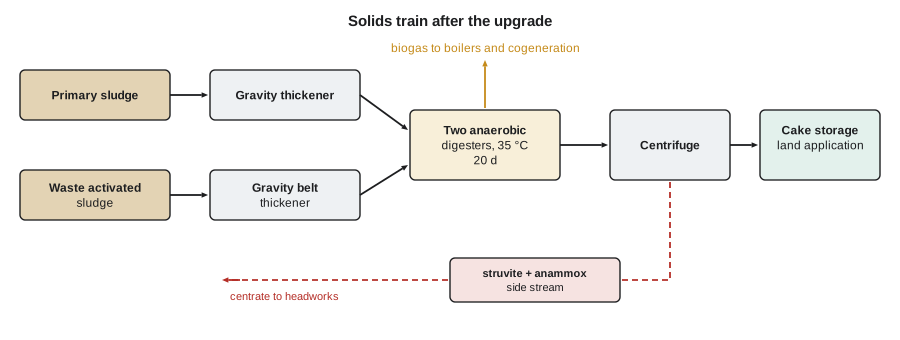
The city plant's thickened primary sludge and WAS together carry about 7,600 kg/d of dry solids and 5,900 kg/d of volatile solids in about 160 m³/d. At 20 days SRT the digesters need about 3,300 m³, matching the city's two existing 1,700 m³ tanks once they are cleaned of years of grit. Destroying half the volatile solids produces about 2,700 m³/d of biogas carrying about 17,000 kWh/d of energy, enough to heat the digesters and, with a cogeneration engine, generate a third or more of the plant's electricity. After digestion about 4,700 kg/d of solids remain; dewatered to 22 % solids they make about 21 tonnes of cake a day, roughly six truckloads a week.
Worked problem
Volatile solids reduction from analyses
Raw sludge fed to a digester is 78 % volatile; digested sludge is 63 % volatile. Assuming the fixed (inorganic) solids pass through unchanged, what fraction of the volatile solids was destroyed?
Show solution
- The Van Kleeck equation compares volatile fractions on the basis that fixed solids are conserved:
- \[VSR = \frac{VS_{in} - VS_{out}}{VS_{in} - VS_{in}\,VS_{out}} = \frac{0.78 - 0.63}{0.78 - 0.78 \times 0.63} = 0.52\]
Answer: About 52 % of the volatile solids were destroyed, within the expected mesophilic range.
Digester gas is a fuel but also a hazard: methane is explosive between about 5 and 15 % in air, and biogas contains hydrogen sulphide. Digester buildings and gas handling areas are classified hazardous locations with explosion-proof equipment, flame arresters, pressure relief and gas detection; digesters are confined spaces that must never be entered without isolation, ventilation, testing and a rescue plan. Willowbend's design includes a gas holder, a waste gas burner for excess gas, and hydrogen sulphide and siloxane removal ahead of the cogeneration engine.
Energy recovery and codigestion
Many digesters have spare capacity, and adding high-strength organic wastes such as food processing residues, fats, oils and grease from restaurant interceptors, or source-separated food waste, can double or triple biogas production. This practice, codigestion, earns tipping fees and turns a disposal problem into energy, but it must be managed carefully: the added wastes change the digester's loading, alkalinity and ammonia, can bring plastics and grit, and increase the nitrogen returned in the centrate. Biogas can be burned in boilers to heat the digesters, used in combined heat and power engines that generate electricity and recover heat, or cleaned to renewable natural gas and injected into the gas grid, where it qualifies for renewable fuel credits in both countries. The city's food processor already sends fat skimmed by its flotation unit to a landfill; Willowbend's energy study recommends receiving it at the plant instead.
Dewatering
Dewatering takes digested sludge from 2 to 4 % solids to a cake of 15 to 30 %, which can be handled with a loader and hauled by truck. Centrifuges and belt filter presses are most common; screw presses use less energy and are gaining ground; plate-and-frame filter presses reach higher solids at greater cost. All need polymer conditioning, typically 5 to 15 kg of active polymer per tonne of dry solids. Drying beds and reed beds serve small plants with land available.
The returned liquid from dewatering digested sludge, the centrate or filtrate, is rich in ammonia, often 800 to 1,500 mg/L as N, because digestion releases the nitrogen in the destroyed cells. It can add 15 to 25 % to the nitrogen load of the main process. At the city plant, Nadia's mass balance shows it adds about 250 kg/d of ammonia nitrogen, so the design includes a side-stream treatment unit, using anammox bacteria, that removes most of it before it returns.
Biosolids quality and use
In Canada, biosolids are regulated mainly by the provinces, which set standards for metals, pathogens and application rates for land application. Where biosolids are sold or distributed as fertilizer, they are also regulated by the Canadian Food Inspection Agency under the Fertilizers Act, which sets limits on metals and pathogens and, since October 2024, enforces an interim standard requiring less than 50 parts per billion (µg/kg) of PFOS, used as an indicator for PFAS in general. The CCME's guidance on beneficial use describes categories based on pathogen and metal levels. Manitoba approves land application of municipal biosolids through Environment Act licences that specify the sites, rates, soil testing and setback distances.
Pathogen reduction is achieved by time at temperature. For batch processes on sludge of 7 % solids or more, the US rule expresses the Class A requirement as a minimum time \(D\) in days at temperature \(t\) in °C:
so that 50 °C requires about 13 days and 60 °C about half a day. Mesophilic digestion at 15 days or more and 35 °C meets the Class B pathogen standard; Class A needs thermophilic digestion, composting, heat drying, high-pH and high-temperature treatment, or another equivalent process. Canadian provincial categories use similar time-temperature criteria.
Land application returns nitrogen, phosphorus and organic matter to farmland, replacing commercial fertilizer, and is the most common end use in both countries. Application rates are set by the crop's nitrogen need, or increasingly by its phosphorus need, which limits the rate more and needs more land. Other end uses include mine and gravel pit reclamation, forestry, composting for landscaping, incineration with energy recovery, and landfill as a last resort. PFAS concerns have made some farmers and municipalities cautious; the city's program will include PFAS testing of the biosolids and source control of industrial dischargers that may contribute them.
Common mistakes
MistakeIgnoring the return liquid from dewatering in the process design.
InsteadCentrate can add 15 to 25 % to the nitrogen load; include it in the mass balance.
MistakeEntering a digester or gas handling space like an ordinary room.
InsteadThese are confined spaces and hazardous locations; follow isolation, testing and entry procedures.
MistakeTreating biosolids rules as only a matter of metals.
InsteadPathogens, vector attraction, nutrient rates and now PFAS all govern beneficial use.
Summary and key terms
- Sludge volume is the dry solids mass divided by the solids fraction; thickening and dewatering cut volume many times.
- Mesophilic anaerobic digestion at 35 °C and 15 to 20 days destroys 40 to 60 % of volatile solids and yields 0.75 to 1.1 m³ of biogas per kg destroyed.
- Dewatering produces a cake of 15 to 30 % solids and an ammonia-rich return stream.
- Biosolids standards address metals, pathogens, vector attraction and, increasingly, PFAS.
- Waste activated sludge
- Excess biomass removed from the activated sludge process.
- Thickening
- Removing water to raise the solids content of a sludge to a few per cent.
- Anaerobic digestion
- Biological stabilization of sludge without oxygen, producing methane.
- Volatile solids reduction
- The fraction of volatile solids destroyed in stabilization.
- Centrate
- The liquid separated from sludge by a centrifuge.
- Biosolids
- Treated sewage sludge that meets standards for beneficial use.
- Vector attraction reduction
- Treatment that makes biosolids unattractive to flies, rodents and birds.
Practice problems
Work each problem on paper first, then reveal the answer to check.
A WAS flow of 400 m³/d at 0.8 % solids is thickened to 5 %. Find the dry solids mass and the thickened volume.
Show answer
\(400 \times 8 = 3\,200\) kg/d; \(3200/50 = 64\) m³/d.
How many days at 55 °C does the Class A batch time-temperature relation require?
Show answer
\(131\,700\,000/10^{7.7} = 2.6\) days.
A digester destroys 2,500 kg/d of volatile solids. Estimate the biogas and methane production.
Show answer
About \(0.9 \times 2500 = 2\,250\) m³/d of biogas, about 1,440 m³/d of methane at 64 %.
Why is phosphorus-limited land application more restrictive than nitrogen-limited application?
Show answer
Biosolids supply phosphorus in excess of crop needs relative to nitrogen, so a lower rate and more land are needed.
Lesson quiz · 5 questions
Score 60% or more to complete this lesson.
Create a free account to save your progress, take quizzes and earn a certificate.