
CISSP-160 · Lesson 9 of 12 · 23 min
Professional ethics and the ISC2 Code of Ethics
Ethics sits formally inside Domain 1, but it reaches across the whole exam. Every CISSP candidate agrees to follow the ISC2 Code of Ethics, and the exam tests whether candidates can apply it to real dilemmas: a manager who asks for evidence to be overlooked, a friend who wants help passing an exam, a client who wants a vulnerability kept quiet, a vendor who offers a gift. Ethics items are often short and feel easy, which makes them dangerous. The intuitive answer is not always the one the Code supports.
This lesson explains the structure of the Code, how its parts rank against each other when duties conflict, how organizational ethics and law relate to it, and how to approach ethics items. It finishes with practice items that combine ethics with legal and investigation topics from Domain 1, because the exam often puts them together.
The structure of the Code
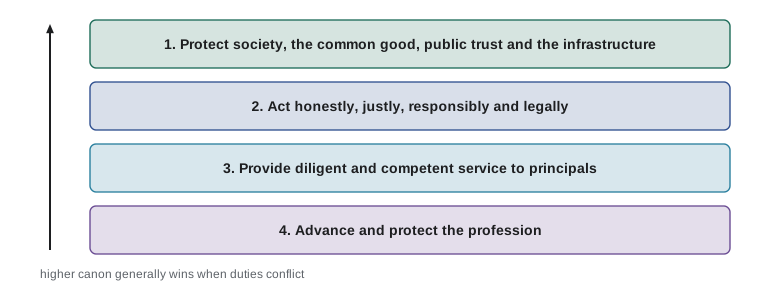
The ISC2 Code of Ethics is short. It has a preamble and four canons. The preamble says, in substance, that the safety and welfare of society and the common good, duty to principals and duty to each other require that members adhere, and be seen to adhere, to the highest ethical standards of behaviour. It adds that strict adherence to the Code is a condition of certification. The four canons then set out the duties in a fixed order. In paraphrase, members should:
- Protect society, the common good, the necessary public trust and confidence, and the infrastructure.
- Act honourably, honestly, justly, responsibly and legally.
- Provide diligent and competent service to principals, meaning employers, clients and others who rely on their work.
- Advance and protect the profession.
Read the full text on the ISC2 website before your exam; it fits on one page and is worth knowing closely. The order matters. When duties conflict, the earlier canon generally takes precedence over the later ones. Duty to society comes before duty to an employer or client, and duty to an employer comes before duty to the profession. Many ethics items are built around exactly this ranking.
Applying the ranking
Suppose a client asks a consultant to keep quiet about a serious safety flaw in a medical device so that a product launch is not delayed. Duty to the client is canon three; protecting society and the public is canon one. Canon one prevails, so the consultant should not simply stay silent. In practice, the consultant would raise the issue with the client first, through the agreed channels, and escalate appropriately if the client refuses to act on a genuine risk to the public. The answer is rarely 'go straight to the media', which can breach confidentiality and canon two's duty to act responsibly.
The ranking does not mean that the higher canon licenses any action. Every canon applies at once. A professional protecting society must still act legally and honestly, and must still respect legitimate confidentiality. The ranking helps decide which duty wins when they truly conflict; it does not cancel the others.
| Dilemma | Duties in conflict | Direction the Code points |
|---|---|---|
| Employer asks you to hide a breach from customers who must be notified by law | Canon 3 (employer) vs canons 1 and 2 (public, legality) | Do not conceal; advise that notification is required and escalate internally |
| A friend asks for real exam questions you remember | Personal loyalty vs canon 4 (profession) and the exam agreement | Refuse; disclosing exam content breaches the Code and the candidate agreement |
| A client asks you to test a system they do not own | Canon 3 (client) vs canon 2 (legality) | Refuse until the owner gives written authorization |
| You find that a colleague falsified a CPE claim | Collegiality vs canon 4 (profession) and canon 2 (honesty) | Report through the appropriate ISC2 or organizational channel |
| A vendor offers an expensive gift during a selection you lead | Personal benefit vs canons 2 and 3 | Decline or disclose under your organization's policy; avoid conflicts of interest |
Complaints and enforcement
ISC2 has a process for complaints about members who may have breached the Code. Published descriptions say that a complaint must be supported by an affidavit and that the complainant must have standing for the canon involved: broadly, anyone may complain under the first two canons, principals under the third, and other professionals under the fourth. A committee investigates, and outcomes can include revocation of certification. Candidates do not need the procedural details, but they should know that the Code is enforced and that members have a duty not to ignore serious breaches.
A related point appears in items about exam integrity. Candidates agree not to disclose exam content. Sharing remembered questions, buying so-called brain dumps or helping someone cheat breaches both the candidate agreement and the Code, and can lead to revocation. The ethical answer in such items is always to refuse and, where appropriate, report.
Organizational ethics and older codes
The ISC2 Code is not the only ethical framework on the exam. Organizations have their own codes of conduct, and the security professional is expected to support them, including through training, reporting channels and protection for people who report concerns in good faith. Where an organization's code is stricter than the law, staff should follow the stricter standard. Where an instruction from management conflicts with the law or the ISC2 Code, the professional should raise the conflict rather than comply silently.
Older study materials also mention the Internet Architecture Board's 1989 statement on ethics and the Internet, published as RFC 1087, which called unethical any activity that seeks unauthorized access, disrupts the intended use of the Internet, wastes resources, destroys the integrity of information or compromises users' privacy. The Computer Ethics Institute's Ten Commandments of Computer Ethics, from the early 1990s, express similar ideas. They appear less often today, but the principles are the same ones the canons protect.
Ethics, law and investigations
Ethics items frequently sit alongside legal topics. The exam expects candidates to recognize the main categories of law and how they affect investigations: criminal law, where the state prosecutes and the standard of proof is beyond reasonable doubt; civil law, where parties sue for remedies and the standard is the balance of probabilities, also called the preponderance of the evidence; administrative or regulatory law, where agencies enforce rules; and contract law, which governs obligations between parties. An investigation's type shapes how evidence must be handled.
| Type of investigation | Who usually leads | Standard or goal | Evidence handling |
|---|---|---|---|
| Administrative (internal) | The organization (HR, security, audit) | Resolve an internal issue, such as a policy breach | Documented, but may later need to meet a higher standard |
| Criminal | Law enforcement and prosecutors | Beyond reasonable doubt | Strict chain of custody, legal process for searches |
| Civil | The parties and their counsel | Balance of probabilities | Preservation duties and discovery rules |
| Regulatory | A regulator or agency | Compliance with rules | As required by the regulator |
A practical rule follows: treat any investigation as if it might end in court, because internal matters sometimes become criminal or civil cases. That means preserving evidence, documenting custody, involving legal counsel early and avoiding actions, such as accessing private accounts without authority, that could make evidence inadmissible or expose the organization to liability.
In Canada, privacy commissioners, both federal and provincial, oversee privacy law, and organizations that suffer a breach of security safeguards involving a real risk of significant harm must report it under PIPEDA or the applicable provincial law, such as Quebec's Law 25. Criminal offences involving computers are found in the Criminal Code, and police services lead criminal investigations. For exam purposes, the principles matter more than the statute names.
How to approach ethics items
Ethics items reward a short routine of their own. First, identify every party the decision affects: the public, the employer or client, colleagues, the profession. Second, ask whether any option breaks the law or requires dishonesty; if so, eliminate it. Third, if duties still conflict, apply the canon order. Fourth, prefer the option that raises the issue through proper channels before escalating outside them, unless there is immediate danger to people.
Worked problem
An ethics item with two tempting answers
Hannah, as a CISSP holder at Ridgeline, learns that the head of sales has told a prospective bank partner that Ridgeline completed a penetration test that never took place. What should Hannah do FIRST? (A) Email the bank to correct the record. (B) Raise the misstatement with the head of sales and, if it is not corrected, escalate to senior management under Ridgeline's reporting policy. (C) Say nothing, because sales is not her responsibility. (D) Post about it on a professional networking site to warn others.
Show solution
- Parties: the bank (public trust), Ridgeline (principal), the profession.
- C ignores dishonesty that undermines trust, contrary to canons one and two. D is irresponsible and breaches confidentiality.
- A goes outside the organization before giving it a chance to correct the record.
- B addresses the dishonesty through proper channels first and escalates if needed, which serves every canon.
Answer: B. Raise it internally and escalate if it is not corrected. External disclosure may become necessary only if the organization refuses to correct a misstatement that harms others.
Worked problem
An item about a colleague and the exam
Tomás passes the exam. A former colleague asks him to share the topics of the hardest questions he saw so that she can focus her study. What should Tomás do? (A) Share general topics but not exact wording. (B) Decline, because sharing exam content breaches the candidate agreement and the Code, and suggest legitimate study resources instead. (C) Share everything he remembers, because it helps a colleague. (D) Share only if she promises not to tell anyone.
Show solution
- Identify the duty: candidates agree not to disclose exam content in any form.
- A, C and D all disclose exam content to some degree.
- B refuses and offers legitimate help, consistent with advancing and protecting the profession.
Answer: B. Decline and point to legitimate resources such as the published outline.
A scoring exercise for ethics practice
Hannah and Tomás write their own ethics scenarios and score each option against the four canons, giving a large weight to the higher canons and treating any illegal or dishonest option as disqualified. The exercise is not how the exam is scored, but it builds the habit of checking every party and every canon before choosing.
# Score options in an ethics scenario against the canons (study aid, not exam scoring)
weights = {"society": 8, "honest_legal": 4, "principal": 2, "profession": 1}
options = {
    "Stay silent":            {"society": -1, "honest_legal": -1, "principal": 1,  "profession": -1, "illegal": False},
    "Raise internally first": {"society": 1,  "honest_legal": 1,  "principal": 1,  "profession": 1,  "illegal": False},
    "Leak to the press":      {"society": 1,  "honest_legal": -1, "principal": -1, "profession": -1, "illegal": False},
    "Alter the report":       {"society": -1, "honest_legal": -1, "principal": 1,  "profession": -1, "illegal": True},
}
for name, o in options.items():
    if o["illegal"]:
        print(f"{name:<24} disqualified (illegal or dishonest)")
        continue
    score = sum(weights[c] * o[c] for c in weights)
print(f"{name:<24} score {score:+d}")Stay silent score -11 Raise internally first score +15 Leak to the press score +1 Alter the report disqualified (illegal or dishonest)
Raising the issue internally first scores highest because it serves every canon. Leaking to the press scores better than staying silent, because it protects the public, but it loses points for breaching confidentiality and acting irresponsibly before using proper channels. Altering the report is disqualified outright. The weights are invented for practice; the real lesson is the order of the canons and the refusal to cross legal and ethical lines.
Common mistakes
MistakeTreating loyalty to an employer as the highest duty.
InsteadDuty to society and acting legally and honestly come before duty to principals.
MistakeGoing straight to the media or a regulator.
InsteadRaise concerns through proper internal channels first unless people are in immediate danger.
MistakeSharing exam topics with friends after passing.
InsteadExam content must not be disclosed in any form.
MistakeAssuming an internal investigation will never reach court.
InsteadPreserve evidence and custody as if it might.
MistakeReading the canon order as permission to break other canons.
InsteadAll canons apply; the order only settles genuine conflicts.
Summary and key terms
- The ISC2 Code of Ethics has a preamble and four canons; adherence is a condition of certification.
- In order, the canons are: protect society and infrastructure; act honourably, honestly, justly, responsibly and legally; serve principals diligently and competently; advance and protect the profession.
- When duties conflict, the earlier canon generally prevails, but all canons continue to apply.
- Exam content must never be disclosed; doing so breaches the candidate agreement and the Code.
- Ethics items often combine with law and investigations: criminal, civil, administrative and regulatory matters have different standards and evidence needs.
- Approach ethics items by identifying parties, eliminating illegal or dishonest options, applying the canon order and using proper channels first.
- Canon
- One of the four principal duties in the ISC2 Code of Ethics.
- Principal
- An employer, client or other party who relies on a professional's services.
- Standing
- The right to bring a complaint, which in the ISC2 process depends on the canon involved.
- Beyond reasonable doubt
- The standard of proof in criminal cases.
- Balance of probabilities
- The standard of proof in civil cases, also called the preponderance of the evidence.
Practice problems
Work each problem on paper first, then reveal the answer to check.
Which canon comes first in the ISC2 Code of Ethics?
Show answer
Protect society, the common good, necessary public trust and confidence, and the infrastructure.
Duty to a client conflicts with protecting the public. Which generally prevails?
Show answer
Protecting the public (canon one).
What should a CISSP do if asked to share real exam questions?
Show answer
Decline; disclosing exam content breaches the agreement and the Code.
What is the standard of proof in a civil case?
Show answer
The balance of probabilities, or preponderance of the evidence.
Why should internal investigations preserve evidence carefully?
Show answer
They may become criminal or civil cases, where evidence must be admissible.
What is usually the first step when you discover a colleague's dishonesty that affects a customer?
Show answer
Raise it through proper internal channels and escalate if it is not corrected.
Lesson quiz · 5 questions
Score 60% or more to complete this lesson.
Create a free account to save your progress, take quizzes and earn a certificate.