
CISSP-160 · Lesson 3 of 12 · 22 min
How computerized adaptive testing works
Most exams that candidates have taken before are fixed forms: everyone gets the same questions, or one of a few versions, and the score is the number correct. The English CISSP works differently. It is a computerized adaptive test, and understanding how the engine behaves removes a lot of anxiety and several bad habits. This lesson explains the ideas behind adaptive testing in plain terms, describes what ISC2 has said publicly about how its engine decides, and turns that into practical rules for pacing and mindset on the day.
None of this requires statistics beyond what the earlier courses used. The key ideas are a difficulty scale, an estimate of ability that is updated after every answer, and a confidence interval around that estimate. If those three are clear, the behaviour of the exam makes sense: why the questions feel hard, why you cannot go back, and why some candidates finish early.
Ability and difficulty on one scale
Adaptive tests are built on item response theory, a family of statistical models developed over the second half of the twentieth century and used today in many licensing, admissions and certification exams. The core idea is that candidates and items can be placed on the same scale. Each item has a difficulty, estimated from how thousands of earlier candidates answered it. Each candidate has an ability, which the exam is trying to measure. When a candidate's ability equals an item's difficulty, the model predicts about a 50 % chance of answering correctly. Harder items have lower chances and easier items higher.
In the simplest version of the model, often called the Rasch or one-parameter model, the probability of a correct answer depends only on the difference between ability and difficulty. More complex versions add a parameter for how sharply an item separates stronger and weaker candidates, and another for the chance of guessing correctly. ISC2 does not publish the exact model it uses, and candidates do not need to know it. What matters is the shape: the further an item sits below your ability, the more likely you are to get it right, and the further above, the less likely.
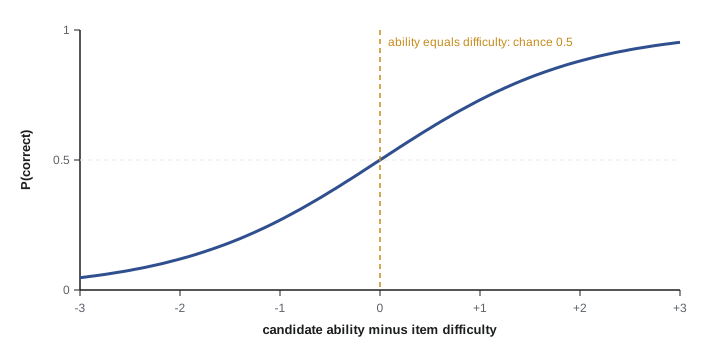
The model gives one probability formula for the simple case. If \(\theta\) is ability and \(b\) is item difficulty, the chance of a correct answer is shown below. When \(\theta = b\) the exponent is zero and the probability is one half.
How the engine chooses the next item
At the start, the engine knows nothing about you, so it begins with an estimate near the passing standard. After each answer it updates the estimate: a correct answer moves it up, a wrong answer moves it down, and the size of the move shrinks as evidence builds up. It then chooses the next item from the pool so that the item is close to your current estimate, because items near your ability give the most information about where you really are. It also balances content so that each domain is covered roughly in line with the outline weights.
This explains the most common complaint about the CISSP: it feels hard all the way through. If you are doing well, the engine keeps raising the difficulty until it finds items you get right about half the time. If you are struggling, it lowers the difficulty to the same point. Either way, most candidates feel unsure about a large share of their answers. That feeling is a sign the engine is working as designed, not a sign that you are failing.
| What you notice | What is happening | What to do |
|---|---|---|
| The questions feel hard throughout | The engine aims items near your current ability | Expect it and keep going; it is normal |
| A run of easy-feeling items | Possibly content balancing, pretest items, or a dip in the estimate | Do not read anything into it; answer each item on its merits |
| The exam stops at 100 items | The engine reached a confident decision early | Nothing; the result is already decided |
| The exam continues past 100 | Your estimate is close to the standard, so more evidence is needed | Stay calm and keep the same care on every item |
The stopping rule and the confidence interval
The engine needs a rule for when to stop. Published descriptions of the CISSP say it ends when it is 95 % confident that the candidate's ability is above or below the passing standard. Each estimate of ability comes with a margin of error, which narrows as more items are answered. When the whole interval sits above the standard, the candidate passes; when it sits wholly below, the candidate fails. If the interval still straddles the standard, the exam continues.
Two other rules can end the exam. If a candidate reaches the maximum of 150 items without a confident decision, the engine makes a final decision from the evidence it has. Published descriptions say this decision uses the final ability estimate compared with the standard, without needing 95 % confidence. If time runs out first, the result depends on whether the minimum number of items has been answered. A candidate who has not answered the minimum fails automatically; one who has answered more than the minimum is judged on the evidence so far, with guidance from training providers suggesting that the last part of the item stream can count against a candidate who was running short of time.
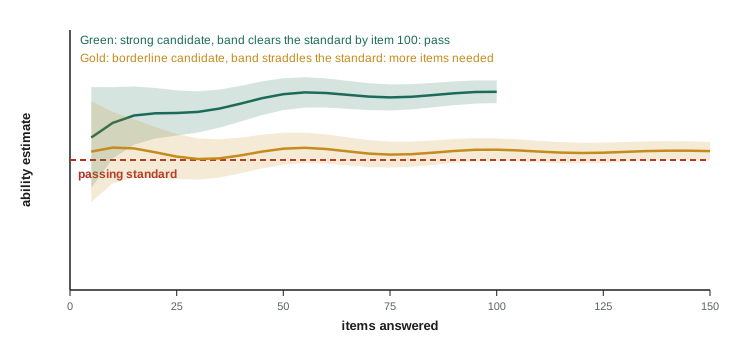
This explains why candidates who are clearly strong or clearly unprepared often finish at 100 items, while candidates near the standard see more items. It also explains why the number of items tells you nothing about the result. A candidate who finishes at 100 may have passed comfortably or failed clearly; a candidate who sees 150 may have passed by a narrow margin or missed by one.
Why there is no going back
Candidates often ask why the CISSP does not allow review. The answer lies in how the engine works. Each item is chosen because of the estimate formed by the answers before it. If a candidate could go back and change an earlier answer, the items that followed would have been chosen on false information, and the estimate would lose its meaning. Forward-only delivery is not a trap; it is how the measurement holds together.
The practical consequence is that every item gets one decision. There is no strategy of skipping hard items for later, no safety net of a final review, and no value in agonizing. Lesson 4 builds a routine for making each decision well. The aim is a steady, careful pace that leaves no item rushed and no item allowed to eat ten minutes.
Pacing on the day
Three hours for up to 150 items gives an average of 72 seconds per item if you see the maximum. Three hours for the minimum of 100 gives 108 seconds. A sensible plan assumes the maximum, so a target of about 70 seconds per item with a little reserve is safe. Most items take less time than that, especially short definitions and recognitions; long scenario items and the occasional drag-and-drop take more.
A simple checkpoint plan helps. After about 50 items, roughly an hour should have passed; after 100 items, about two hours. If you are well ahead, slow down a little and read more carefully. If you are behind, speed up slightly but do not guess blindly. Training providers commonly warn that rushing the final items to beat the clock can hurt a candidate whose estimate is close to the standard.
| Checkpoint | Items answered | Time used (target) | If behind |
|---|---|---|---|
| First | 25 | About 30 minutes | Shorten your re-reading on simple items |
| Second | 50 | About 1 hour | Stop rereading long stems twice; use the reading routine once, carefully |
| Third | 100 | About 2 hours | Keep the same care; you have about 70 seconds per item for up to 50 more |
| Final | 150 | Within 3 hours | The exam ends here in any case |
Breaks are allowed, but the clock keeps running during them. Many candidates take one short break after about 75 or 100 items to stretch, drink water and reset concentration. Two minutes away from the screen can be worth more than two minutes of tired reading. Check the test centre rules on what you may access during a break.
A small simulation
The program below simulates a simple adaptive test using the one-parameter model. It is not ISC2's engine, which is not published, but it shows the same behaviour: the estimate moves quickly at first, settles as evidence builds, and the test stops when a confidence band around the estimate clears the standard. The random number generator is seeded so the output is the same each time.
import math, random
random.seed(160)

def p_correct(theta, b):
    return 1 / (1 + math.exp(-(theta - b)))

def run(true_theta, standard=0.0, min_items=100, max_items=150, z=1.96):
    est, info, n = standard, 0.0, 0
    answers = []
    while n < max_items:
        b = est + random.uniform(-0.3, 0.3)      # choose an item near the current estimate
        correct = random.random() < p_correct(true_theta, b)
        answers.append((b, correct))
        n += 1
        # re-estimate ability with a few Newton steps on the likelihood
        for _ in range(10):
            g = sum((1 if c else 0) - p_correct(est, bb) for bb, c in answers)
            h = sum(p_correct(est, bb) * (1 - p_correct(est, bb)) for bb, c in answers)
            est = max(-4, min(4, est + g / h))
        info = sum(p_correct(est, bb) * (1 - p_correct(est, bb)) for bb, c in answers)
        se = 1 / math.sqrt(info)
        if n >= min_items and (est - z * se > standard or est + z * se < standard):
            break
    result = "pass" if est > standard else "fail"
    return n, est, se, result

for label, theta in [("strong", 0.9), ("borderline", 0.15), ("unprepared", -0.9)]:
    n, est, se, result = run(theta)
print(f"{label:<11} true {theta:+.2f} items {n:>3} estimate {est:+.2f} +/- {1.96 * se:.2f} {result}")strong true +0.90 items 100 estimate +0.88 +/- 0.40 pass borderline true +0.15 items 150 estimate +0.09 +/- 0.32 pass unprepared true -0.90 items 100 estimate -0.47 +/- 0.41 fail
In this run, the strong and unprepared candidates stop at the minimum of 100 items, because by then their bands clearly sit on one side of the standard. The borderline candidate, whose true ability is only slightly above the standard, needs many more items and may reach the maximum before the engine decides. Real exams behave the same way in principle, though their item pools, models and content balancing are far more sophisticated.
What adaptive testing means for preparation
Adaptive testing changes how to prepare in three ways. First, breadth matters more than depth in a single area. Because the engine covers every domain, a candidate who is outstanding in four domains and weak in four cannot compensate as easily as on some fixed exams; the weak domains keep pulling the estimate down. Hannah and Tomás both use their diagnostic results to lift their weakest domains first.
Second, practice should include hard items. If you only practise items that feel comfortable, the real exam will feel alarming by comparison. Good practice banks include items that make you choose between two strong answers. Hannah sets aside one session a week for what she calls 'two good answers' practice: items where she is sure two options are defensible and has to choose the better one.
Third, emotional control is a skill. Because almost every candidate leaves the exam unsure of the result, the feeling of being unsure cannot be used as information during the exam. Tomás writes three words on his study wall: 'next item, fresh'. The habit he is building is to let each item go once answered and give the next one his full attention, rather than replaying earlier decisions he cannot change.
Worked problem
Reading a pacing situation
After 60 items, Hannah notices that 1 hour and 25 minutes have passed. If she has to answer the maximum of 150 items, how much time per item does she have for the remaining items, and what should she do?
Show solution
- Time used: 85 minutes, so 180 - 85 = 95 minutes remain.
- Items remaining at the maximum: 150 - 60 = 90.
- 95 minutes divided by 90 items is about 63 seconds per item, roughly 1 minute and 3 seconds.
- That is a little below the 70-second target, so she should tighten her routine slightly but not rush.
Answer: About 63 seconds per remaining item. She is a few minutes behind the checkpoint plan, so she should shorten re-reading on simple items and keep full care on scenarios.
Common mistakes
MistakeConcluding from hard questions that you are failing.
InsteadThe engine aims items near your ability, so almost everyone finds the exam hard.
MistakeGuessing quickly through the last items to finish.
InsteadKeep a steady pace from the start so that the final items get the same care.
MistakeReading meaning into a run of easy items.
InsteadEasy-feeling items may be pretest or content-balancing items; answer each on its merits.
MistakeSpecializing deeply in a few domains.
InsteadAdaptive testing covers all domains, so weak domains pull the estimate down; build breadth.
MistakeReplaying earlier answers during the exam.
InsteadAnswers are final; give each new item full attention.
Summary and key terms
- Adaptive tests place items and candidates on one ability scale and update an estimate of ability after every answer.
- The engine chooses items near the current estimate, so the exam feels hard for almost everyone.
- The CISSP stops when it is 95 % confident that ability is above or below the passing standard, at 150 items, or when time runs out.
- Forward-only delivery is required for the measurement to stay valid; answers cannot be changed.
- Plan about 70 seconds per item with checkpoints at 50 and 100 items, and keep the same care through to the end.
- Prepare for breadth across all domains, practise hard items, and train yourself to let each answered item go.
- Item response theory (IRT)
- A family of statistical models that relate the probability of a correct answer to candidate ability and item properties.
- Item difficulty
- The point on the ability scale at which a candidate has about a 50 % chance of answering correctly.
- Ability estimate
- The engine's current best estimate of a candidate's position on the scale.
- Standard error
- A measure of the uncertainty in the ability estimate, which shrinks as more items are answered.
- Stopping rule
- The condition that ends an adaptive exam, such as a confident decision, the maximum length or time running out.
Practice problems
Work each problem on paper first, then reveal the answer to check.
Why does the CISSP feel hard even for strong candidates?
Show answer
The engine chooses items near each candidate's current ability, where the chance of a correct answer is about 50 %.
What three events can end the CISSP exam?
Show answer
A 95 % confident decision after at least the minimum number of items, reaching 150 items, or running out of time.
Why is going back to earlier items not allowed?
Show answer
Each item was chosen using the earlier answers; changing them would invalidate the estimate.
What average time per item does a candidate have if they see all 150 items?
Show answer
72 seconds.
In the one-parameter model, what is the chance of a correct answer when ability equals difficulty?
Show answer
50 %, or one half.
After 100 items and 2 hours 10 minutes, how much time per item remains if the exam runs to 150?
Show answer
50 minutes for 50 items, which is 60 seconds per item.
Lesson quiz · 5 questions
Score 60% or more to complete this lesson.
Create a free account to save your progress, take quizzes and earn a certificate.