
CISSP-160 · Lesson 4 of 12 · 26 min
Reading questions and eliminating options
Many wrong answers on the CISSP come not from missing knowledge but from answering a slightly different question from the one asked. The stem says FIRST and the candidate picks the most important step; the stem says BEST and the candidate picks a correct but weaker option; the scenario names the data owner and the candidate answers as if they were the system administrator. This lesson builds a reading routine that catches those slips, shows how distractors are usually built, and practises eliminating options in a consistent order.
Hannah and Tomás each lose several marks to misreading in their diagnostic. Hannah reads quickly because she knows the governance material well and assumes she knows what is being asked. Tomás reads the scenario carefully but skims the final question. By the end of this lesson they have one routine they both use for every item.
The anatomy of an item
Most CISSP items have three parts. The scenario, sometimes only one sentence and sometimes a short paragraph, sets the situation: who you are, what has happened and what constraints apply. The stem is the actual question, usually the last sentence. The options are four possible answers, of which one is best. Advanced items replace the four options with a different response format, such as dragging items into order or clicking an area of a diagram, but the same reading discipline applies.
| Part | What to look for | Example |
|---|---|---|
| Scenario | Your role, the organization, the asset, the event, constraints (budget, law, time) | "As the security manager of a hospital that has just suffered ransomware..." |
| Stem | The task word (FIRST, BEST, MOST, PRIMARY, LEAST, NOT) and the object of the question | "What should the security manager do FIRST?" |
| Options | Four answers that may all be partly true; one fits the stem best | Isolate systems; notify the CEO; pay the ransom; restore from backup |
Reading the stem before the scenario is a useful habit for long items. If you know the stem asks who is accountable for classification, you can read the scenario looking for roles rather than technical details. For short items the order matters less, but the stem should always be read twice: once before looking at the options and once just before confirming an answer.
Task words and qualifiers
A handful of words carry most of the meaning in a stem. Capital letters are often used for them, but not always, so train yourself to notice them in any case. Each word asks for a different kind of judgement.
| Word | What it asks | Typical trap |
|---|---|---|
| FIRST | Which step comes before the others in time or logic | Choosing the most important step rather than the earliest |
| BEST | Which option is strongest overall, though others may also work | Choosing a correct but narrower or weaker option |
| MOST important / MOST likely | Ranking among several valid options | Choosing an option that is true but less significant |
| PRIMARY | The main purpose or main reason | Choosing a secondary benefit |
| LEAST / NOT / EXCEPT | The option that does not fit | Answering the positive version of the question |
| GREATEST risk / concern | The most serious threat or weakness | Choosing a real but smaller risk |
FIRST questions deserve special care. Many describe an incident or a discovery and offer four sensible steps, all of which would eventually happen. The answer is the one that logically comes first. In incident response, that is usually to confirm and contain within the plan, or to notify the incident response team, before eradicating or recovering. In a new project, it is often to identify the asset owner or define requirements before choosing controls. In a policy question, it is often to gain senior management support before writing the policy.
Qualifiers in the scenario matter too. Words such as 'regulated', 'public company', 'cloud provider', 'already approved', 'without budget' or 'legal hold' change which answer is best. A scenario that says the data is subject to a legal hold makes any option that deletes or alters it wrong, even if deletion is normally good practice. Underline these in your head as you read.
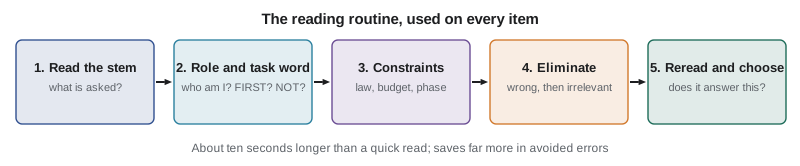
A five-step routine
The routine below takes about ten seconds longer than a quick read and saves far more than that in avoided errors. Hannah and Tomás practise it on every item until it becomes automatic.
| Step | Action | Question to ask yourself |
|---|---|---|
| 1 | Read the stem | What exactly is being asked? |
| 2 | Name your role and the task word | Who am I in this scenario, and is this FIRST, BEST, NOT...? |
| 3 | Read the scenario for constraints | What facts limit the answer: law, budget, data type, phase of an incident? |
| 4 | Eliminate options in order | Which options are wrong, which are true but do not answer the stem, which remain? |
| 5 | Reread the stem and choose | Does my choice answer this exact question better than the alternative? |
Step 2 is where many marks are won. If the item says 'As the data owner', the answer will involve decisions about classification, access approval or risk acceptance for that data. If it says 'As the auditor', the answer will involve evaluating and reporting, not fixing. If it says 'As a consultant hired to advise', the answer will often be to recommend rather than to implement. CISSP-111 and CISSP-110 described these roles; the exam uses them constantly.
How distractors are built
Item writers build wrong options deliberately, and most fall into a few families. Recognizing the family helps you eliminate them quickly and with confidence.
| Distractor type | How it looks | How to spot it |
|---|---|---|
| True but irrelevant | A correct statement about security that does not answer the stem | Ask: does this answer the question asked? |
| Right idea, wrong order | A step that belongs later in the process | For FIRST items, ask what must happen before this |
| Too technical | A hands-on fix where the stem asks what a manager should do | Check your role and the task word |
| Too extreme | Shut everything down, fire the employee, block the whole country | Prefer proportionate responses |
| Outside authority | Act without approval, contact the media, go to the regulator over management | Check who owns the decision |
| Unlawful or unethical | Hack back, read private messages, hide a finding | Law and ethics outrank effectiveness |
| Partly right | Covers one aspect but misses the main one | Compare it directly with the broader option |
The hardest items usually end with two options left that are both 'right' in some sense. At that point, compare them directly against the stem. Which one addresses the root cause rather than a symptom? Which one is broader and includes the other? Which one is earlier in the process? Which one serves a higher priority on the manager's ladder from lesson 2? One of these tests nearly always separates them.
Worked example: a FIRST question
Worked problem
A FIRST item from Domain 7
A security analyst at Ridgeline notices that a database server is sending large amounts of data to an unfamiliar external address at 3 a.m. The organization has an approved incident response plan. What should the analyst do FIRST? (A) Disconnect the server from the network. (B) Follow the incident response plan and notify the incident response team. (C) Begin a forensic image of the server's disk. (D) Block the external address at the firewall.
Show solution
- Stem: what should the analyst do FIRST. Role: analyst, not incident manager.
- Constraint: there is an approved incident response plan.
- Eliminate C: imaging comes later and may not be the analyst's call.
- A and D are containment actions that may well be right, but taking them alone, outside the plan, could destroy evidence, alert the attacker or break a business process. The plan says who decides.
- B invokes the plan, which will direct containment quickly and properly.
Answer: B. When an approved plan exists, the first step is to follow it and engage the incident response team, who will direct containment such as A or D.
Tomás chose D on his first attempt. He reasoned, correctly, that blocking the address would stop the exfiltration. The item, however, names the role (analyst) and the constraint (an approved plan). Lesson 2's process priority and this lesson's reading routine both point to B. When he rereads the stem in step 5, the word FIRST and the phrase 'approved incident response plan' make the choice clear.
Worked example: a BEST question with two good answers
Worked problem
A BEST item from Domain 1
Ridgeline is launching a security awareness program because phishing emails keep succeeding. Which approach would BEST reduce successful phishing over time? (A) Annual mandatory training with a test. (B) Regular short training combined with simulated phishing exercises and feedback. (C) Disciplining employees who click phishing links. (D) Deploying an email filter that blocks all external attachments.
Show solution
- Stem: BEST reduces successful phishing over time. Focus: behaviour, sustained.
- Eliminate C: punitive and likely to discourage reporting.
- D is technical and extreme; blocking all attachments would disrupt business and does not address links or behaviour.
- A and B both involve training. B is broader, repeated and gives feedback, which builds lasting behaviour; A is a once-a-year event.
- Compare A and B directly: B includes what A offers and adds reinforcement.
Answer: B. Regular, varied training with simulations and feedback builds behaviour over time; it is broader than annual training alone.
Worked example: a NOT question
Worked problem
A NOT item from Domain 2
Which of the following is NOT normally a responsibility of a data owner? (A) Deciding the classification of the data. (B) Approving who may access the data. (C) Performing daily backups of the database that holds the data. (D) Accepting residual risk for the data within their authority.
Show solution
- Stem: NOT a responsibility of the data owner. This reverses the usual question.
- Recall CISSP-111: owners classify, approve access and accept risk; custodians carry out day-to-day protection such as backups.
- A, B and D are owner duties. C is a custodian duty.
Answer: C. Daily backups are performed by the data custodian, usually IT operations, not by the owner.
Hannah, reading quickly, picked A on her first try. She saw the phrase 'responsibility of a data owner', recognized classification as an owner duty and clicked. The word NOT was in the middle of the stem, not capitalized. Step 1 of the routine, reading the stem slowly and naming the task word, would have caught it.
Advanced item types
A small share of items use other formats. In drag-and-drop items, you place options into categories or put steps into order. In hotspot items, you click the part of a diagram that answers the question, such as the network zone where a control belongs. These items test the same knowledge but give less room for elimination, because there are more possible arrangements. Published guidance from training providers suggests they are scored on the whole response, so a partly correct order earns no credit.
The routine adapts easily. For an ordering item, identify the first and last steps with confidence and then fill the middle. For a categorizing item, sort the items you are sure of first, then use elimination for the remainder. For a hotspot, read the diagram's labels carefully before clicking, because a misplaced click is as wrong as a wrong option. Tomás practises ordering items on the incident response and software development life cycles, which are the most common subjects for them.
# Score a practice ordering item: whole-response scoring vs partial credit (for study only)
correct = ["Preparation", "Detection and analysis", "Containment", "Eradication", "Recovery", "Post-incident activity"]
attempts = {
    "Tomas":  ["Preparation", "Detection and analysis", "Containment", "Eradication", "Recovery", "Post-incident activity"],
    "Hannah": ["Preparation", "Detection and analysis", "Eradication", "Containment", "Recovery", "Post-incident activity"],
}
for name, order in attempts.items():
    matches = sum(a == b for a, b in zip(order, correct))
    whole = "correct" if order == correct else "incorrect"
print(f"{name:<7} positions right {matches}/{len(correct)} whole-response result: {whole}")Tomas positions right 6/6 whole-response result: correct Hannah positions right 4/6 whole-response result: incorrect
Hannah has four of six positions right but swapped containment and eradication, so under whole-response scoring she earns nothing. The program is a reminder that an ordering item rewards a precise model of the process, not a rough sense of it. Her fix is to remember why containment comes first: you limit the damage before removing the cause, so that eradication does not trigger further harm.
Common mistakes
MistakeAnswering the most important step when the stem asks for the FIRST step.
InsteadFor FIRST items, ask which step must happen before the others.
MistakeMissing NOT, EXCEPT or LEAST because it was not capitalized.
InsteadRead the stem slowly and name the task word before reading the options.
MistakeIgnoring the role named in the scenario.
InsteadAnswer as the person described: owner, custodian, auditor, analyst or manager.
MistakeChoosing a true statement that does not answer the question.
InsteadAsk whether each option answers the stem, not just whether it is true.
MistakeApproaching ordering items with a rough idea of the process.
InsteadLearn the exact sequences; whole-response scoring gives no credit for near misses.
Summary and key terms
- Most items have a scenario, a stem and four options; read the stem first on long items and reread it before confirming.
- Task words such as FIRST, BEST, MOST, PRIMARY and NOT each ask for a different judgement.
- A five-step routine works for every item: read the stem, name your role and task word, read for constraints, eliminate, reread and choose.
- Distractors are often true but irrelevant, in the wrong order, too technical, too extreme, outside authority or unlawful.
- When two options remain, prefer the one that addresses the root cause, includes the other, comes earlier or serves a higher priority.
- Advanced items such as drag-and-drop and hotspot need precise knowledge of sequences and placements.
- Stem
- The sentence that states the actual question in an item.
- Distractor
- A wrong option written to look plausible.
- Task word
- A word such as FIRST, BEST or NOT that defines the judgement the item asks for.
- Drag-and-drop item
- An item in which the candidate orders or categorizes options by moving them on screen.
- Hotspot item
- An item in which the candidate clicks a region of a diagram to answer.
Practice problems
Work each problem on paper first, then reveal the answer to check.
What is the difference between a FIRST item and a MOST important item?
Show answer
FIRST asks which step comes earliest; MOST important asks which matters most, which may come later.
Name three common types of distractor.
Show answer
Any three of: true but irrelevant, wrong order, too technical, too extreme, outside authority, unlawful, partly right.
In a scenario that names you as the auditor, what kind of answer is usually expected?
Show answer
Evaluate and report findings, not implement fixes.
Two options remain and one includes the other. Which is usually better for a BEST item?
Show answer
The broader option that includes the other.
Why are ordering items harder to guess than four-option items?
Show answer
There are many more possible arrangements, and the whole response must be correct.
A scenario mentions a legal hold on email. What does that rule out?
Show answer
Any option that deletes, alters or fails to preserve the held data.
Lesson quiz · 5 questions
Score 60% or more to complete this lesson.
Create a free account to save your progress, take quizzes and earn a certificate.