
CISSP-160 · Lesson 12 of 12 · 21 min
The final two weeks, exam day and after
The last two weeks before the exam are different from the weeks before them. New material is no longer the priority; consolidating what you know, fixing the last weak spots and arriving rested matter more. This lesson sets out a final-fortnight plan, explains what happens at the test centre, describes how to manage the three hours, and covers what comes after the result: endorsement and maintenance if you pass, and a recovery plan if you do not.
Hannah and Tomás book their exams for the same week, three days apart, at a Pearson VUE test centre near Ridgeline's office. Their final practice simulations, taken in week 9, were 79 % for Hannah and 76 % for Tomás, with no domain below 68 % for either. Both are within the range training providers associate with readiness, and both still feel nervous, which is normal.
The final two weeks
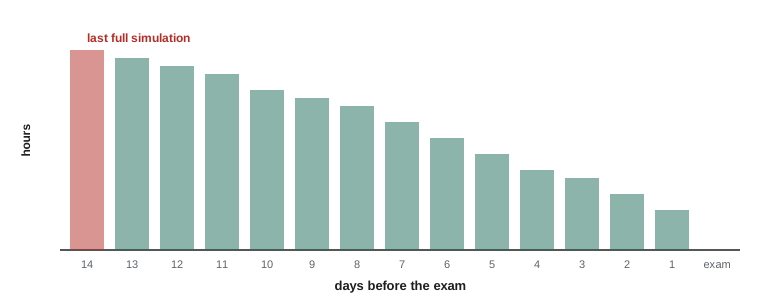
The plan below works for most candidates. It assumes that content study is essentially complete and that an error log and spaced review cards exist. It tapers the workload towards the exam, because tired candidates make reading errors that rested candidates avoid.
| Days before the exam | Focus | Avoid |
|---|---|---|
| 14 to 10 | One last full simulation; work through the error log; target the weakest domain | Starting a new book or question bank |
| 9 to 5 | Daily spaced review; short mixed practice sets of 25 to 50 items; reread the outline once | Marathon study sessions late at night |
| 4 to 2 | Light review of summary sheets, sequences and formulas; confirm logistics | Full simulations that leave you exhausted or discouraged |
| 1 | A short review in the morning, then rest; prepare identification and travel | Cramming new material |
| Exam day | A normal breakfast, arrive early, use the reading routine | Last-minute studying in the waiting room |
Rereading the official exam outline once in the final week is worth the hour it takes. It is a checklist of everything that can appear, and reading it with fresh eyes often reveals a sub-domain that has slipped out of review. Hannah finds two topics she has not touched for a month: data remanence in Domain 2 and software-defined networking in Domain 4. Each takes a short evening to refresh.
Summary sheets
A one-page summary for each domain is a good final-week tool. It should hold only what you still need to see: the sequences, distinctions and formulas you most often get wrong, drawn from your error log. Writing the sheet is itself retrieval practice. Reading it on the last two days keeps the details fresh without the fatigue of new practice exams. Summary sheets are for study only; nothing may be taken into the exam room.
| Domain | Items on Tomás's summary sheet |
|---|---|
| 1 | Senior management owns risk; due care vs due diligence; policy hierarchy; BIA first; canon order |
| 2 | Owner classifies, custodian protects; legal hold overrides retention; SSDs: cryptographic erase |
| 3 | What each crypto mechanism provides; the four models by purpose; reference monitor properties |
| 4 | OSI layers with devices; IPsec AH vs ESP, transport vs tunnel; WPA3-Enterprise and 802.1X |
| 5 | Factor types; OAuth vs OIDC vs SAML; access models; FRR/FAR/CER |
| 6 | SOC 1/2/3, Type 1/2; written authorization before testing; static vs dynamic |
| 7 | Incident response phases; order of volatility; DR tests in order; separation of duties |
| 8 | Security early in the life cycle; parameterized queries; SBOM; escrow; revoke exposed secrets |
| Calculations | SLE, ALE, safeguard value; RTO + WRT <= MTD; availability; key counts |
Logistics
Small practical problems cause a surprising amount of exam-day stress. Confirm the test centre address and travel time a few days ahead, and plan to arrive at least 30 minutes early. Check the identification requirements in your confirmation email: published guidance typically requires a current, government-issued photo identification whose name matches the registration exactly, and some locations ask for a second form. A mismatch between the name on the booking and the name on the identification can mean being turned away.
Test centres follow strict security procedures. Expect to store personal items, including phones, watches and bags, in a locker; to have a photo and possibly a palm vein or signature scan taken; to be checked for prohibited items; and to be shown to a workstation with a whiteboard or notepaper and a marker provided by the centre. Earplugs or noise-cancelling headphones are often available on request. Read the centre's rules in advance so that none of this is a surprise.
Candidates in Canada sit the exam at Pearson VUE centres in major cities. If you are travelling from a smaller community, plan for weather in winter months, and consider booking a morning slot the day after you arrive rather than travelling on the exam day itself. Ridgeline books Hannah's and Tomás's exams for mid-morning so that neither has to battle rush-hour traffic in Calgary.
The morning of the exam
Keep the morning simple and familiar. Eat the kind of breakfast you normally eat, not a large or unusual meal, and drink enough water to stay alert without needing frequent breaks. Leave home with plenty of margin, carrying only what you need: identification, the confirmation email and perhaps a light jacket, because test rooms are often cool. Many candidates find it helps to glance at one summary sheet over coffee and then put it away for good.
In the waiting area, resist the urge to quiz yourself or to listen to other candidates comparing notes. Last-minute reviewing rarely adds a mark and often adds anxiety. A few slow breaths and a reminder of the routine you have practised, read the stem, name the role and task word, read for constraints, eliminate, reread and choose, is a better use of the time. Hannah spends her ten minutes rereading the canon order and the incident response phases on her phone before locking it away; Tomás simply sits quietly and stretches.
Managing the three hours
Once the exam starts, the plan from lessons 3 and 4 takes over. Use the reading routine on every item. Keep to the checkpoint pace of roughly 70 seconds per item, checking at about 50 and 100 items. Take a short break if you feel concentration slipping; many candidates take one around item 75. Drink water and stretch during the break, but remember that the clock keeps running.
Expect to feel uncertain. Because the adaptive engine targets items near your ability, a large share of items will feel like a choice between two plausible answers. Do not try to judge how you are doing from how the items feel. When you notice yourself replaying an earlier answer, use whatever short reset phrase you practised; Tomás's is 'next item, fresh'. Each new item deserves your full attention, and earlier answers cannot be changed anyway.
Worked problem
A mid-exam pacing check
At item 100, Hannah sees that 1 hour and 50 minutes have passed and the exam continues. How much time does she have per item if the exam runs to 150, and should she change anything?
Show solution
- Time remaining: 180 - 110 = 70 minutes.
- Items remaining at most: 150 - 100 = 50.
- 70 minutes / 50 items = 84 seconds per item.
- That is more than the 70-second target, so she is slightly ahead and can keep her careful pace.
Answer: About 84 seconds per item. She is ahead of plan and should keep the same care; there is no need to speed up.
After the exam: results
When the exam ends, candidates leave the room and the test centre provides a printed provisional result. Published descriptions say that the official result follows after ISC2 completes its checks, which can take several weeks. A provisional pass is not yet certification; it means you can begin the endorsement process. A provisional fail comes with a score report that ranks your performance by domain, which shows where to focus.
If you pass, the next step is endorsement. The application is completed online, and another ISC2-certified member in good standing confirms your experience; ISC2 can act as endorser when no such member is available. Published guidance gives nine months from the exam date to complete the process. Some applications are selected for audit, so keep records of your employment and responsibilities. Once endorsement is approved and the first annual maintenance fee paid, you are certified.
| Step after passing | What to do | Timing |
|---|---|---|
| Provisional result | Keep the printed result | On the day |
| Endorsement application | Complete online; an ISC2-certified member confirms your experience | Within nine months of the exam |
| Possible audit | Provide evidence of employment and duties if selected | During endorsement |
| Annual maintenance fee | Pay the first fee | On certification |
| Continuing education | Earn 120 CPE credits per three-year cycle, at least 90 in Group A | Throughout each cycle |
Hannah's provisional result is a pass at item 100. Tomás sees all 150 items and walks out convinced he has failed; his printed result says he passed. Both complete their endorsement applications that week, with Priya Raman as endorser. Ridgeline announces their certifications in its next bank partner newsletter, and the board's goal of three CISSP holders is two-thirds met.
If you do not pass
A fail is disappointing, but it is common and recoverable. Many CISSP holders passed on a second attempt. ISC2's retake policy sets waiting periods: 30 days after a first attempt, 60 days after a second and 90 days after a third or later, with no more than four attempts in twelve months. Each attempt needs a new registration unless a training package includes a retake.
Use the score report well. It ranks domains rather than giving percentages, but it shows clearly which domains were below the standard. Combine it with your error log to plan the next four to eight weeks: rebuild the weakest domains first, take fresh practice simulations, and review whether misreading or mindset errors played a part. Candidates who fail narrowly often need technique more than content.
# Plan a retake: earliest date given the waiting period, and weeks of study available
from datetime import date, timedelta
waits = {1: 30, 2: 60, 3: 90}
attempt_dates = {1: date(2026, 11, 16)}
for attempt, d in attempt_dates.items():
    wait = waits.get(attempt, 90)
    earliest = d + timedelta(days=wait)
    print(f"After attempt {attempt} on {d:%d %b %Y}: wait {wait} days, earliest retake {earliest:%d %b %Y}")
    target = d + timedelta(weeks=6)
print(f"A six-week study plan would target {target:%d %b %Y}, which is {(target - earliest).days} days after the earliest date")After attempt 1 on 16 Nov 2026: wait 30 days, earliest retake 16 Dec 2026 A six-week study plan would target 28 Dec 2026, which is 12 days after the earliest date
The program shows that a six-week recovery plan after a first attempt on 16 November 2026 lands comfortably after the earliest permitted retake date. Most candidates benefit from using more than the minimum wait, because the extra weeks go into the domains the score report flagged.
Beyond the CISSP
Certification is a beginning. Maintaining it means earning continuing education credits through training, conferences, writing, teaching, volunteering and other activities, and paying the annual fee. Many CISSP holders later pursue one of the three concentrations, in architecture, engineering or management, or move into related ISC2 credentials such as the cloud security certification. Others pair the CISSP with credentials in audit, privacy or project management, depending on their role.
The 2027 outline is a reminder that the field keeps changing: passkeys, post-quantum cryptography and threats to AI systems will be named topics for the next generation of candidates. Holders who keep learning, mentor others and contribute to the profession fulfil the fourth canon in the most practical way. Priya asks Hannah and Tomás to lead Ridgeline's next study group in the spring, which is how the board's goal will finally be met.
Common mistakes
MistakeCramming new material in the last few days.
InsteadTaper study, review summary sheets and protect sleep.
MistakeArriving with identification that does not exactly match the registration.
InsteadCheck the name and identification requirements days in advance.
MistakeJudging your result from how hard the items feel.
InsteadThe adaptive exam feels hard for everyone; keep your routine.
MistakeTreating a provisional pass as certification.
InsteadComplete endorsement within the deadline and pay the first fee.
MistakeRebooking immediately after a fail without changing anything.
InsteadUse the score report and error log to plan targeted study before the retake.
Summary and key terms
- In the final fortnight, take one last simulation, work the error log, then taper to light review and rest.
- Reread the exam outline once and keep a one-page summary sheet per domain drawn from your errors.
- Confirm the test centre, travel and identification requirements in advance; arrive at least 30 minutes early.
- During the exam, use the reading routine, keep a steady pace with checkpoints and take a short break if needed.
- After passing, complete endorsement within nine months, pay the maintenance fee and earn 120 CPE credits per three-year cycle.
- After a fail, follow the retake waiting periods and use the score report and error log to target study.
- Provisional result
- The result given at the end of the exam, before ISC2 completes its checks.
- Endorsement
- The process in which a certified member confirms a candidate's experience after passing.
- Audit (endorsement)
- A check of a candidate's claimed experience, to which some applications are selected.
- Retake policy
- The rules setting waiting periods and limits on exam attempts.
- Concentration
- An advanced ISC2 credential that builds on the CISSP in architecture, engineering or management.
Practice problems
Work each problem on paper first, then reveal the answer to check.
What should the final two weeks focus on?
Show answer
One last simulation, the error log, the weakest domain, then tapering to light review and rest.
Why reread the exam outline in the final week?
Show answer
It is a checklist of everything examinable and can reveal topics that slipped out of review.
What must match exactly on exam day?
Show answer
The name on your identification and the name on your registration.
How long do candidates have to complete endorsement after passing, according to published guidance?
Show answer
Nine months.
After a second failed attempt, how long must a candidate wait?
Show answer
60 days.
At item 120, 2 hours 20 minutes have passed. How much time per item remains if the exam runs to 150?
Show answer
40 minutes for 30 items, which is 80 seconds per item.
Lesson quiz · 5 questions
Score 60% or more to complete this lesson.
Create a free account to save your progress, take quizzes and earn a certificate.