
CISSP-160 · Lesson 10 of 12 · 26 min
Calculations and quick-reasoning items
The CISSP is not a mathematics exam, and most candidates see only a handful of items that need arithmetic. Those few items, however, are some of the most reliable marks available, because there is one right answer and no judgement call between two good options. This lesson gathers the calculations the outline and the earlier courses use, works examples of each and shows the traps that make candidates pick the wrong number.
No calculator is provided for most candidates, and the numbers in exam items are usually chosen so that mental arithmetic or a few lines on the provided whiteboard are enough. Practise doing these by hand. Hannah, who works with risk numbers daily, finds this lesson easy; Tomás, who is comfortable with network maths, has to slow down on the risk formulas.
Quantitative risk: SLE, ARO and ALE
The most common calculation on the exam is quantitative risk analysis from CISSP-110. Four quantities are involved. The asset value (AV) is what the asset is worth. The exposure factor (EF) is the share of that value lost in one incident. The single loss expectancy (SLE) is the loss from one incident. The annualized rate of occurrence (ARO) is how often the incident is expected per year. The annualized loss expectancy (ALE) is the expected loss per year.
The value of a safeguard compares the reduction in annual loss with the safeguard's annual cost. A safeguard is justified on cost grounds when this value is positive.
Worked problem
A flood-risk calculation
Ridgeline's backup data centre is valued at 2,000,000. A flood would destroy about 40 % of its value, and floods are expected once every 25 years. What are the SLE and ALE? A flood barrier costing 20,000 a year would reduce the exposure factor to 10 %. Is it worth installing on cost grounds?
Show solution
- SLE = 2,000,000 x 0.40 = 800,000.
- ARO = 1 / 25 = 0.04, so ALE = 800,000 x 0.04 = 32,000.
- With the barrier, SLE = 2,000,000 x 0.10 = 200,000 and ALE = 200,000 x 0.04 = 8,000.
- Value = 32,000 - 8,000 - 20,000 = 4,000 a year.
Answer: SLE 800,000; ALE 32,000. The barrier adds about 4,000 of value a year, so it is justified on cost grounds, though only narrowly.
Three traps account for most wrong answers. The first is confusing ARO with a time interval: 'once every 25 years' is an ARO of 0.04, not 25. The second is comparing the safeguard's cost with the SLE rather than with the reduction in ALE. The third is forgetting that a safeguard can change either the exposure factor or the rate of occurrence; read which one the item says it changes.
Qualitative risk and risk matrices
Not every risk item uses currency. Qualitative analysis rates likelihood and impact on scales such as low, medium and high, or 1 to 5, and combines them into a risk level, often by multiplying or by reading a matrix. Items in this family usually ask which risk should be treated first. The answer is the one with the highest combined rating, unless the item adds a constraint such as a legal requirement or a risk to life, which changes the priority.
| Risk | Likelihood (1-5) | Impact (1-5) | Score | Priority |
|---|---|---|---|---|
| Payment API outage | 3 | 5 | 15 | 1 |
| Laptop theft | 4 | 3 | 12 | 2 |
| Office flood | 1 | 4 | 4 | 4 |
| Phishing compromise of finance staff | 3 | 3 | 9 | 3 |
Continuity numbers: MTD, RTO, RPO and WRT
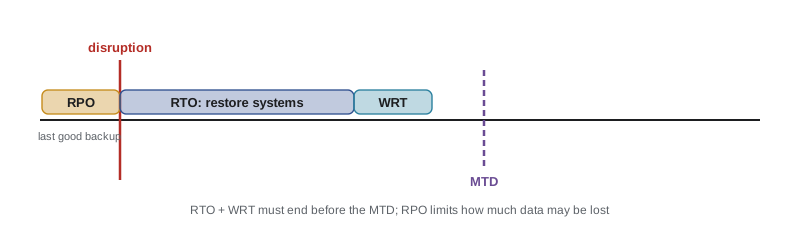
Business continuity items use several time measures from CISSP-110 and CISSP-116. The maximum tolerable downtime (MTD), also called the maximum tolerable period of disruption, is the longest a business function can be unavailable before the harm becomes unacceptable. The recovery time objective (RTO) is the target time to restore a system. The work recovery time (WRT) is the time needed after systems return to verify data and resume normal work. The recovery point objective (RPO) is the maximum acceptable amount of data loss, measured in time.
The key relationship is that recovery must fit within the tolerable downtime: \(\text{RTO} + \text{WRT} \le \text{MTD}\). If the MTD for payment processing is 8 hours and staff need 2 hours to verify and catch up after systems return, the RTO must be no more than 6 hours. RPO is independent of RTO and drives backup frequency, as lesson 8 showed.
Worked problem
Setting an RTO
The business impact analysis gives Ridgeline's merchant settlement function an MTD of 12 hours. After systems are restored, finance staff need 3 hours to reconcile transactions before settlements can resume. What is the longest acceptable RTO for the settlement system?
Show solution
- RTO + WRT must not exceed MTD.
- RTO <= 12 - 3 = 9 hours.
Answer: The RTO must be 9 hours or less.
Availability: MTBF and MTTR
Operations items sometimes ask about reliability. The mean time between failures (MTBF) is the average operating time between failures; the mean time to repair (MTTR) is the average time to restore service after a failure. Availability is the share of time a system is working.
Two components that must both work, in series, have a combined availability equal to the product of their availabilities, which is lower than either. Two redundant components, in parallel, where either can carry the load, have a combined unavailability equal to the product of their unavailabilities, which is much lower than either. This is why redundancy improves availability so dramatically.
Worked problem
Redundant firewalls
A firewall has an availability of 99 %. What is the availability of (a) two firewalls in series, both of which must work, and (b) two firewalls in an active-passive pair, where either can carry the traffic?
Show solution
- Series: 0.99 x 0.99 = 0.9801, or 98.01 %.
- Parallel: unavailability of each is 0.01, so both fail with probability 0.01 x 0.01 = 0.0001.
- Parallel availability = 1 - 0.0001 = 0.9999, or 99.99 %.
Answer: (a) 98.01 %. (b) 99.99 %, assuming failures are independent and failover works.
Keys, entropy and combinations
Lesson 6 introduced key counts: a group of n people needs \(n(n-1)/2\) symmetric keys or \(2n\) asymmetric keys. A related item asks about the size of a key space. A key of k bits has \(2^k\) possible values, so each extra bit doubles the work of a brute-force search. A password of length L drawn from an alphabet of N characters has \(N^L\) possible values, and its entropy in bits is \(L \log_2 N\). These items usually ask which change increases strength most; length usually beats a slightly larger alphabet.
| Password policy | Alphabet size N | Length L | Approximate entropy (bits) |
|---|---|---|---|
| Lowercase letters only | 26 | 8 | 37.6 |
| Mixed case, digits, 10 symbols | 72 | 8 | 49.4 |
| Lowercase letters only | 26 | 16 | 75.2 |
| Mixed case, digits, 10 symbols | 72 | 16 | 98.7 |
One caution matters for the exam's manager-level items: entropy figures assume random choice. Human-chosen passwords are far weaker than these numbers suggest, which is why the guidance from CISSP-114 favours long passphrases, screening against known breached passwords, multifactor authentication and, increasingly, passkeys, rather than complex composition rules.
Other quick-reasoning items
A few other calculations appear occasionally. Network items may ask how many usable host addresses a subnet provides: a prefix of /n leaves \(32 - n\) host bits, giving \(2^{32-n} - 2\) usable addresses in a traditional IPv4 subnet. Backup items may ask how many tapes or sets are needed to restore after a failure: a full backup plus every incremental since then, or a full backup plus only the latest differential. Testing items may ask about test coverage as a percentage of paths, functions or requirements exercised.
Worked problem
Restoring from backups
Ridgeline takes a full backup every Sunday night. On a Thursday morning the database fails. How many backup sets are needed to restore if Ridgeline takes (a) incremental backups each weeknight, or (b) differential backups each weeknight?
Show solution
- Weeknight backups before Thursday morning: Monday, Tuesday and Wednesday nights.
- Incremental: each captures changes since the previous backup, so restore Sunday full + Monday + Tuesday + Wednesday incrementals = 4 sets.
- Differential: each captures all changes since the last full backup, so restore Sunday full + Wednesday differential = 2 sets.
Answer: (a) 4 sets with incrementals. (b) 2 sets with differentials. Differentials take longer to create each night but restore faster.
Reading numeric options
Calculation items are designed so that each common mistake produces one of the wrong options. If you compute an ALE and your answer matches an option, check that you did not land on the number a typical error would produce, such as the SLE or the result of multiplying by the interval instead of the rate. A quick sanity check helps: the ALE for a rare event should be much smaller than the SLE, availability in series should be lower than either component, and a parallel pair should be higher than either. If your answer fails the sanity check, recalculate before confirming, because there is no going back.
Write intermediate values on the whiteboard rather than holding them in your head. Tomás's habit is to write the formula first, then the numbers, then the result, which takes ten seconds longer and prevents most slips. Units matter too: keep hours with hours and money with money, and convert percentages to decimals before multiplying.
Checking the arithmetic
The program below works through every calculation in this lesson so that Hannah and Tomás can change the numbers and check their hand calculations. Practising with it a few times builds the speed that matters on the day.
import math

# Quantitative risk
av, ef, aro = 2_000_000, 0.40, 1 / 25
sle = av * ef; ale = sle * aro
ale_after = av * 0.10 * aro
print(f"SLE {sle:,.0f}  ALE {ale:,.0f}  ALE after barrier {ale_after:,.0f}  value {ale - ale_after - 20_000:,.0f}")

# Continuity
mtd, wrt = 12, 3
print(f"Maximum RTO = {mtd - wrt} hours")

# Availability
a = 0.99
print(f"Series {a * a:.4%}  Parallel {1 - (1 - a) ** 2:.4%}")
mtbf, mttr = 2000, 4
print(f"Availability with MTBF {mtbf} h and MTTR {mttr} h = {mtbf / (mtbf + mttr):.3%}")

# Entropy
for n_chars, length in [(26, 8), (72, 8), (26, 16), (72, 16)]:
    print(f"N={n_chars:>2} L={length:>2}: {length * math.log2(n_chars):5.1f} bits")

# Subnet hosts
for prefix in (24, 26, 28):
print(f"/{prefix}: {2 ** (32 - prefix) - 2} usable hosts")SLE 800,000 ALE 32,000 ALE after barrier 8,000 value 4,000 Maximum RTO = 9 hours Series 98.0100% Parallel 99.9900% Availability with MTBF 2000 h and MTTR 4 h = 99.800% N=26 L= 8: 37.6 bits N=72 L= 8: 49.4 bits N=26 L=16: 75.2 bits N=72 L=16: 98.7 bits /24: 254 usable hosts /26: 62 usable hosts /28: 14 usable hosts
Every number in the output matches the worked examples and tables above. The MTBF line is a small extra: a device that fails on average every 2,000 hours and takes 4 hours to repair is available about 99.8 % of the time, which is roughly 17.5 hours of downtime a year.
Patterns to remember
| Calculation | Formula | Common trap |
|---|---|---|
| Single loss expectancy | SLE = AV x EF | Using the full asset value instead of the exposed share |
| Annualized loss expectancy | ALE = SLE x ARO | Using the interval (25 years) instead of the rate (0.04) |
| Value of safeguard | ALE before - ALE after - annual cost | Comparing cost with SLE |
| Recovery fits downtime | RTO + WRT <= MTD | Setting RTO equal to MTD and forgetting WRT |
| Availability | MTBF / (MTBF + MTTR) | Adding availabilities for components in series |
| Symmetric keys for n people | n(n - 1) / 2 | Using n or 2n |
| Usable IPv4 hosts | 2^(32 - prefix) - 2 | Forgetting the network and broadcast addresses |
Common mistakes
MistakeUsing 25 as the ARO for an event expected once every 25 years.
InsteadThe ARO is 1/25 = 0.04.
MistakeSetting the RTO equal to the MTD.
InsteadLeave room for work recovery time: RTO + WRT must not exceed MTD.
MistakeMultiplying availabilities for redundant components.
InsteadFor parallel components, multiply the unavailabilities and subtract from 1.
MistakeAssuming complexity rules make passwords strong.
InsteadLength adds more entropy; human choice makes real passwords weaker than theory.
MistakeCounting only the last incremental backup in a restore.
InsteadIncrementals need the full backup plus every incremental since it.
Summary and key terms
- SLE = AV x EF, ALE = SLE x ARO, and a safeguard's value is ALE before minus ALE after minus its annual cost.
- Qualitative risk combines likelihood and impact; life safety and legal obligations can override the score.
- RTO plus work recovery time must fit within the maximum tolerable downtime; RPO drives backup frequency.
- Availability is MTBF / (MTBF + MTTR); redundancy in parallel raises availability sharply.
- Symmetric key counts grow as n(n - 1)/2; asymmetric counts grow as 2n; each extra key bit doubles a brute-force search.
- Incremental restores need the full backup and every incremental; differential restores need the full backup and the latest differential.
- Exposure factor (EF)
- The share of an asset's value lost in a single incident.
- Annualized rate of occurrence (ARO)
- The expected number of times an incident occurs in a year.
- Maximum tolerable downtime (MTD)
- The longest a function can be unavailable before harm becomes unacceptable.
- Work recovery time (WRT)
- The time needed after systems are restored to verify data and resume normal operations.
- Mean time between failures (MTBF)
- The average operating time between failures of a component.
- Mean time to repair (MTTR)
- The average time to restore a component after a failure.
Practice problems
Work each problem on paper first, then reveal the answer to check.
An asset worth 500,000 has an EF of 20 % and an ARO of 0.5. What is the ALE?
Show answer
SLE = 100,000; ALE = 50,000.
An event happens once every 10 years. What is its ARO?
Show answer
0.1.
The MTD is 24 hours and WRT is 6 hours. What is the maximum RTO?
Show answer
18 hours.
Two servers each 98 % available run in parallel. What is the combined availability?
Show answer
1 - 0.02 x 0.02 = 99.96 %.
How many symmetric keys do 20 people need for pairwise communication?
Show answer
20 x 19 / 2 = 190.
How many usable host addresses does a /27 IPv4 subnet have?
Show answer
2^5 - 2 = 30.
Lesson quiz · 5 questions
Score 60% or more to complete this lesson.
Create a free account to save your progress, take quizzes and earn a certificate.