
CISSP-117 · Lesson 1 of 12 · 33 min
Security in the software development life cycle
Almost every organization now writes software, even if it does not think of itself as a software company. A bank builds mobile apps, a hospital configures and extends an electronic health record, a retailer runs an online store, and a manufacturer programs the controllers on its production line. Much of that code is assembled from open source components, generated by tools, or bought from vendors and then customized. Each of those routes creates security risk, and each is governed by decisions that managers make long before an attacker ever finds a flaw. Domain 8 of the CISSP outline, Software Development Security, is about making those decisions well.
Domain 8 carries about 10 % of the exam weight under the outline ISC2 introduced on 15 April 2024. ISC2's exam refresh page still listed that outline as current when we checked in October 2026, so confirm the outline on isc2.org before you book. This course is independent study material: it is not produced, endorsed or reviewed by ISC2, and every question in it is original. As in the other CISSP courses, the point of view is that of a security manager or senior practitioner. You are not expected to be a programmer, but you are expected to understand how software is built, where security belongs in that process, what good secure development looks like, how to judge the security of software you buy, and how to measure whether a development program is working.
The domain has five objectives in the official outline: understand and integrate security in the software development life cycle; identify and apply security controls in software development ecosystems; assess the effectiveness of software security; assess the security impact of acquired software; and define and apply secure coding guidelines and standards. This course follows those objectives across twelve lessons. Several neighbouring topics are taught elsewhere and only referenced here: threat modelling as a general risk technique (CISSP-110 Lesson 12 and CISSP-112 Lesson 1), cryptography (CISSP-112), identity and authentication (CISSP-114), security testing programs and vulnerability scoring with CVSS, EPSS and KEV (CISSP-115), and incident response and change management in operations (CISSP-116). For hands-on software engineering, CMPUT-301 covers process models and DevOps, CMPUT-331 covers secure software from a computing science view, and CMPUT-404 covers web application security in code.
Throughout the course we follow Ridgeline Payments, an invented company of about 400 people headquartered in Calgary. Ridgeline builds a payments platform used by small businesses: a web dashboard, mobile apps, a public API for partners and a set of back-office services that move money through Canadian and US banking networks. It has about 90 developers in twelve product teams, a platform team that runs its cloud environment and continuous delivery pipeline, and a security team of eight, two of whom specialize in application security. Ridgeline is growing quickly, has just signed its first large bank partner, and has been asked by that partner to show evidence of a mature secure development program.
What the software development life cycle is
A software development life cycle (SDLC) is the set of phases through which software moves from an idea to retirement. Different organizations name and order the phases differently, and agile and DevOps teams repeat them in short cycles rather than once, but the underlying activities are always present. Someone decides what the software must do, someone designs it, someone writes and builds it, someone tests it, someone releases and operates it, and eventually someone retires it. Security has a job to do in every one of those activities, and the central idea of Domain 8 is that security is most effective and least expensive when it is built into each phase rather than inspected at the end.
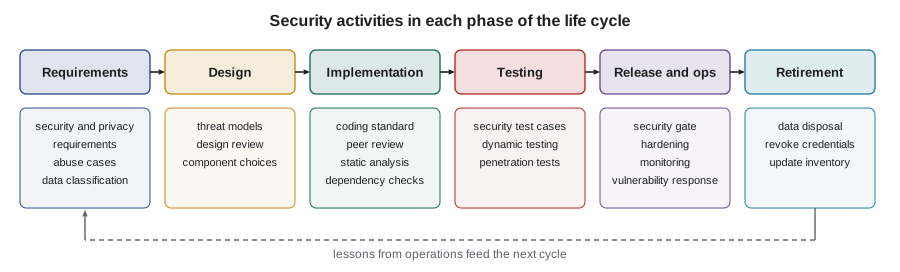
| Phase | Main question | Typical security activities | Typical evidence |
|---|---|---|---|
| Requirements | What must the software do, and what must it never do? | Security and privacy requirements, abuse and misuse cases, data classification, regulatory analysis | Security requirements in the backlog with acceptance criteria |
| Design | How will it be structured? | Threat modelling, secure architecture patterns, design review, selection of frameworks and components | Threat model, design review record, approved component list |
| Implementation | How is it written and built? | Secure coding standard, peer review, static analysis, software composition analysis, secrets scanning | Review approvals, scan results, build logs |
| Testing | Does it behave securely? | Security test cases, dynamic testing, fuzzing, penetration testing for high-risk changes | Test results, findings with severity and status |
| Release and operations | Is it ready, and does it stay safe? | Release security gate, configuration hardening, monitoring, vulnerability intake and patching | Gate decision, risk acceptances, patch records |
| Retirement | How is it shut down safely? | Data migration or disposal, revocation of keys and accounts, removal from inventories | Decommissioning checklist, sanitization records |
The final column matters to a manager. An auditor, a customer or a regulator rarely asks whether developers care about security; they ask what evidence shows that security activities actually happened. A program that performs threat modelling but keeps no record of it cannot demonstrate due care. Ridgeline's bank partner, for example, has asked for exactly this kind of evidence: proof that security requirements are defined, that designs are reviewed, that code is scanned and reviewed, and that releases pass a defined gate.
Why early is cheaper: shifting left
Fixing a defect costs more the later it is found. A missing security requirement noticed during a design workshop costs a conversation; the same gap found after release may cost an emergency patch, an incident investigation, customer notifications and lost trust. The industry calls the practice of moving security activities earlier in the life cycle shifting left, because the early phases sit on the left of the usual diagram. You will often see precise multipliers quoted, such as a defect costing 30 or 100 times more to fix in production than in design. Those figures come from old and much-debated studies and should not be treated as laws of nature, but the direction of the effect is well established and is the reason every modern secure development framework emphasizes early activities.
Shifting left does not mean abandoning later controls. Some problems can only be found in a running system, such as a misconfigured server or an access control flaw that appears only when components interact. Mature programs therefore shift left and also shield right: they keep testing, monitoring and responding to vulnerabilities in production. The aim is defence in depth across the life cycle, with each phase catching what earlier phases missed.
Security requirements
Software can only be as secure as its requirements demand. Functional requirements describe what the system does; security requirements describe the protections it must provide and the behaviour it must refuse. Good security requirements are specific and testable. 'The application must be secure' is not a requirement. 'Every API request that reads or changes a merchant's data must be authorized against the merchant identifier in the caller's token, and requests for another merchant's data must be refused and logged' is a requirement a developer can build and a tester can verify.
Security requirements come from several sources. Regulations and contracts impose some, such as payment card industry rules for card data, privacy law for personal information, and the bank partner's own security schedule for Ridgeline. Organizational policies and standards impose others, such as approved cryptography or logging rules. Data classification drives many: data classed as restricted needs encryption, stricter access control and shorter retention. Threat modelling, covered in Lesson 2, identifies further requirements specific to the design. Industry catalogues help teams avoid starting from a blank page; the OWASP Application Security Verification Standard (ASVS), whose version 5.0 was released in 2025, is a widely used list of verifiable application security requirements organized into levels of rigour.
Privacy requirements deserve separate attention. Canadian privacy law, including PIPEDA and Quebec's Law 25, expects organizations to limit collection to what is necessary, protect personal information with safeguards appropriate to its sensitivity, and, under Law 25, assess privacy impacts for new systems that handle personal information and apply the most privacy-protective settings by default. In practice, that means asking at the requirements stage which personal information the feature truly needs, how long it will be kept and who can see it. CISSP-110 and CISSP-111 cover the law in detail.
Abuse cases and misuse cases
Use cases and user stories describe how legitimate users achieve their goals. Abuse cases, sometimes called misuse cases, describe how someone might use the same features to cause harm. They are written from the point of view of a hostile actor, a careless insider or a confused customer. For each important feature, the team asks: who might want to misuse this, what would they try, and what must the system do to stop or detect it? The answers become security requirements and test cases.
Worked problem
Turning a user story into security requirements
A Ridgeline product team writes the story: 'As a merchant, I want to issue refunds from my dashboard so that I can resolve customer complaints quickly.' The security champion on the team is asked to add security requirements before the story is estimated.
Show solution
- Write abuse cases: a former employee with a still-active account issues refunds to their own card; a compromised merchant account is used to drain the balance through many small refunds; a merchant refunds more than the original payment.
- Derive requirements: refunds require a role with refund permission; a refund cannot exceed the original payment amount; refunds above a configurable threshold need a second approver; refund activity triggers a notification to the account owner.
- Add detection: log every refund with user, amount, original transaction and source address, and feed unusual refund patterns to fraud monitoring.
- Write acceptance tests for each requirement, including negative tests such as attempting a refund larger than the payment.
Answer: The story gains four testable security requirements and a detection requirement before any code is written, at almost no cost compared with fixing the gaps after release.
Abuse cases work best when they are short and concrete and written collaboratively by developers, product owners and security staff. They should not become a catalogue of every conceivable attack. The test of a good abuse case is whether it changes what the team builds or tests.
Security gates and the definition of done
A security gate is a checkpoint at which defined security criteria must be met before work moves to the next phase. Traditional waterfall projects used formal phase gates: a design could not proceed to implementation until the security architecture review was signed off. Agile and DevOps teams move too quickly for heavyweight sign-offs on every change, so they build security criteria into the definition of done for each story and into automated checks in the delivery pipeline. A release might be blocked automatically if static analysis reports a new critical finding, if a dependency has a known exploited vulnerability, or if a required peer review is missing.
Gates must be designed carefully. A gate that blocks too much will be bypassed or quietly disabled by frustrated teams. A gate that blocks nothing gives false comfort. The usual approach is to block only on a small set of high-confidence, high-severity conditions, record everything else as findings with remediation deadlines, and provide a documented exception process through which an accountable business owner can accept a time-limited risk.
# Evaluate a release against Ridgeline's security gate policy (illustrative)
policy = {
    'max_new_critical': 0,       # new critical findings allowed
    'max_new_high': 2,           # new high findings allowed with tickets
    'kev_dependencies': 0,       # components with known exploited vulnerabilities
    'require_peer_review': True,
    'require_threat_model_for_new_service': True,
}
release = {
    'name': 'refunds-service 2.4.0',
    'new_critical': 0, 'new_high': 3, 'kev_dependencies': 0,
    'peer_reviewed': True, 'new_service': False, 'threat_model': False,
    'exceptions': {'new_high': 'RISK-118 accepted by product owner until 2026-11-30'},
}
reasons = []
if release['new_critical'] > policy['max_new_critical']:
    reasons.append('new critical findings')
if release['new_high'] > policy['max_new_high'] and 'new_high' not in release['exceptions']:
    reasons.append('too many new high findings')
if release['kev_dependencies'] > policy['kev_dependencies']:
    reasons.append('dependency with known exploited vulnerability')
if policy['require_peer_review'] and not release['peer_reviewed']:
    reasons.append('missing peer review')
if release['new_service'] and policy['require_threat_model_for_new_service'] and not release['threat_model']:
    reasons.append('new service without threat model')
print('Release:', release['name'])
for k, v in release['exceptions'].items():
    print('  exception on', k, '->', v)
print('Decision:', 'BLOCK (' + '; '.join(reasons) + ')' if reasons else 'PASS')Release: refunds-service 2.4.0 exception on new_high -> RISK-118 accepted by product owner until 2026-11-30 Decision: PASS
Look at what makes this gate defensible: the criteria are written down, the decision is reproducible, and the exception names an accountable owner and an expiry date. Those are the same governance properties that CISSP expects of any control, applied to software delivery.
Roles and responsibilities
Secure development is a shared responsibility, and confusion about who owns what is a common cause of failure. Senior management sets policy, funds the program and accepts residual risk. Product owners decide what is built and own the business risk of their products, including the decision to accept or fix security findings. Developers write secure code and fix the defects they introduce. Architects choose patterns and components. The security team defines standards, provides tools and training, performs expert reviews and testing, and reports on risk; it supports teams but should not become the only line of defence. Operations or platform teams run the pipeline and production environment.
Many organizations add security champions: developers in each product team who receive extra training, act as the first point of contact for security questions, help with threat modelling and reviews, and represent their team in a community of practice. Champions scale a small security team across many developers. Ridgeline, with eight security staff for 90 developers, relies heavily on this model: each of its twelve teams has one champion who spends about a tenth of their time on security work.
Worked problem
Sizing a security champion program
Ridgeline's two application security engineers cannot review every design and pull request for twelve teams that release several times a day. The chief information security officer asks how a champion program would change coverage.
Show solution
- Without champions: two engineers can realistically take part in about four design reviews and a handful of high-risk code reviews a week, leaving most changes unreviewed by anyone with security training.
- With champions: twelve champions at 10 % time add roughly 1.2 full-time equivalents of security effort, spread across every team and present in every planning meeting.
- The application security engineers move from doing reviews to training champions, building automated checks, reviewing the highest-risk designs and handling escalations.
- Measure success by coverage (share of new services with a threat model), quality (findings caught before release versus after) and champion retention.
Answer: Champions extend security judgement into every team; the specialists concentrate on training, tooling and the highest-risk work.
Retirement and the end of the life cycle
The last phase is often forgotten. Software that is no longer maintained still runs, still holds data and still exposes interfaces. Unmaintained applications are a frequent source of breaches because nobody patches them and nobody watches them. Retirement should be a planned activity with its own checklist: migrate or securely dispose of the data in line with retention rules, revoke service accounts, keys and certificates, remove DNS records and firewall rules, update the asset inventory, and archive the documentation needed for legal holds. The same thinking applies to components: a library that its maintainers have stopped supporting is effectively retired, and the software that depends on it inherits the risk. Lesson 10 returns to this in the context of the software supply chain.
Common mistakes
MistakeTreating security as a penetration test just before release.
InsteadBuild security activities into every phase, starting with requirements, and keep testing and monitoring in operations.
MistakeWriting vague requirements such as 'the system must be secure'.
InsteadWrite specific, testable security requirements derived from regulations, policy, data classification and threat modelling.
MistakeDesigning release gates that block on every finding.
InsteadBlock on a small set of high-confidence, high-severity conditions and manage the rest with deadlines and owner-approved exceptions.
MistakeMaking the security team solely responsible for software security.
InsteadAssign clear ownership to product owners and developers, supported by security specialists and champions.
MistakeQuoting a fixed cost multiplier for late defects as established fact.
InsteadExplain that late fixes cost more, while noting that published multipliers are old and disputed.
MistakeLeaving retired applications running without owners.
InsteadPlan retirement with data disposal, credential revocation and inventory updates.
Summary and key terms
- Domain 8 is about integrating security into how software is specified, designed, built, tested, released, operated, acquired and retired.
- Every SDLC phase has security activities and should leave evidence that they happened.
- Shifting left finds defects earlier and more cheaply, but later controls in testing and operations are still needed.
- Security requirements must be specific and testable; they come from law, contracts, policy, data classification and threat modelling.
- Abuse and misuse cases describe how features could be used for harm and turn into requirements and tests.
- Security gates and the definition of done enforce criteria; exceptions need an accountable owner and an expiry date.
- Security champions extend a small security team across many developers.
- Software development life cycle (SDLC)
- The phases through which software moves from conception to retirement.
- Shift left
- Moving security activities earlier in the life cycle, where defects are cheaper to fix.
- Security requirement
- A specific, testable statement of a protection the software must provide or a behaviour it must refuse.
- Abuse case
- A description of how a feature could be misused to cause harm, used to derive requirements and tests.
- Security gate
- A checkpoint at which defined security criteria must be met before work proceeds.
- Definition of done
- The criteria, including security criteria, a work item must meet before it is considered complete.
- Security champion
- A developer in a product team with extra security training who acts as the first point of contact for security.
- OWASP ASVS
- The Application Security Verification Standard, a catalogue of verifiable application security requirements.
Practice problems
Work each problem on paper first, then reveal the answer to check.
Name the five objectives of CISSP Domain 8.
Show answer
Integrate security in the SDLC; apply controls in development ecosystems; assess software security effectiveness; assess the security impact of acquired software; define and apply secure coding guidelines and standards.
Why should each SDLC phase leave evidence?
Show answer
Evidence demonstrates due care to auditors, customers and regulators and shows the activity actually happened.
What does shifting left mean?
Show answer
Moving security activities earlier in the life cycle.
Rewrite "the API must be secure" as a testable requirement.
Show answer
For example: every request must be authorized against the merchant identifier in the caller's token, and requests for other merchants' data must be refused and logged.
What is an abuse case?
Show answer
A description, from a hostile or careless actor's point of view, of how a feature could be misused.
What should a security gate exception record include?
Show answer
The risk, the accountable owner who accepted it and an expiry date.
Who owns the business risk of a product's security findings?
Show answer
The product owner or business owner, supported by security advice.
Why do organizations appoint security champions?
Show answer
To scale security knowledge across many teams that a small security team cannot cover directly.
Name three steps in retiring an application securely.
Show answer
Dispose of or migrate data, revoke credentials and keys, remove network exposure and update inventories.
Which OWASP project provides a catalogue of verifiable application security requirements?
Show answer
The Application Security Verification Standard (ASVS).
Lesson quiz · 5 questions
Score 60% or more to complete this lesson.
Create a free account to save your progress, take quizzes and earn a certificate.