
CISSP-101 · Lesson 11 of 12 · 29 min
Endorsement, certification and maintaining the credential
Passing the exam is a milestone, but it is not the finish line. Between passing and holding the credential lies endorsement, the process in which ISC2 verifies your experience and good standing. After you are certified, you must maintain the credential for as long as you want to keep it, by earning continuing professional education credits, paying an annual maintenance fee and continuing to follow the Code of Ethics. Candidates sometimes treat these steps as paperwork to deal with later, and some lose time, money or even their exam result as a consequence. This lesson walks through endorsement step by step, explains the three-year certification cycle, describes how continuing education works and what counts, and covers the rules for using the CISSP designation correctly.
Endorsement: the deadline
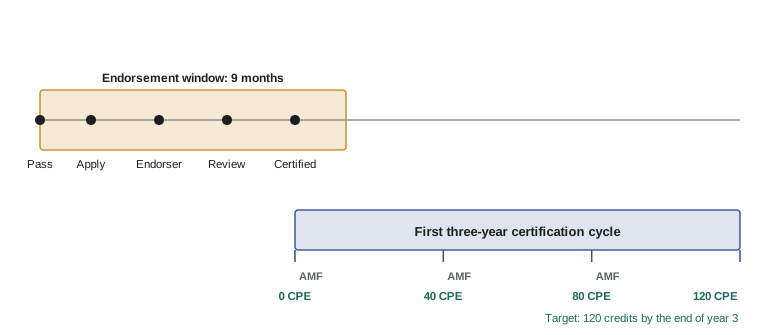
After you pass the exam, ISC2 sends you instructions for completing the endorsement process. At the time of writing, you must complete your endorsement application within nine months of the date you passed. If you do not complete it in time, you may have to retake the exam, so treat the deadline seriously and start promptly. Candidates who do not yet meet the experience requirement can instead choose to become an Associate of ISC2, as explained in lesson 3, and complete endorsement later when they have the experience.
Worked problem
Working out your endorsement deadline
Aiden passed the CISSP exam on 14 November 2026. He meets the experience requirement. By when must he complete his endorsement application, and when should he aim to submit it?
Show solution
- Nine months after 14 November 2026 is 14 August 2027.
- Endorsement can take several weeks if ISC2 audits the application or needs more information from his endorser.
- A sensible personal target is to submit within one month of passing, by mid-December 2026, leaving a large buffer.
Answer: The deadline is about 14 August 2027, but Aiden should aim to submit by mid-December 2026 to leave time for queries or an audit.
Endorsement: the application
The endorsement application is completed online. You provide your employment history, including employers, dates, hours, job titles and a description of your duties mapped to the CISSP domains. You confirm that you agree to the Code of Ethics and answer questions about your background, such as any criminal convictions or past sanctions by professional bodies. You then nominate an endorser.
An endorser must be an active ISC2 credential holder in good standing who can attest to your professional experience. The endorser does not need to have been your supervisor, but they must be able to vouch for your work honestly; they are bound by the Code of Ethics too, so they should not endorse experience they cannot confirm. If you do not know an ISC2 credential holder, ISC2 can act as your endorser, in which case it verifies your experience directly, typically by asking for documents such as letters from employers.
ISC2 reviews each application and randomly selects some for audit. An audited candidate must provide additional evidence, such as employer letters confirming dates and duties. This is where the experience log described in lesson 3 pays off. Once the application is approved, you pay your first annual maintenance fee and receive confirmation that you are certified, along with access to your digital certificate and badge.
| Step | What happens | Typical timing |
|---|---|---|
| 1. Pass the exam | Provisional result at the test centre, official result by email | Exam day and shortly after |
| 2. Start the application | Enter employment history, duties, background answers | As soon as possible after passing |
| 3. Endorser confirms | Active ISC2 credential holder attests, or ISC2 acts as endorser | Days to weeks |
| 4. ISC2 review and possible audit | ISC2 checks the application; some are audited | Usually several weeks |
| 5. Approval and fee | Pay the annual maintenance fee; certification confirmed | Within the nine-month window |
The three-year certification cycle
Once certified, you enter a three-year certification cycle. During each cycle you must earn and submit continuing professional education (CPE) credits and pay an annual maintenance fee (AMF) each year. At the end of the cycle, if you have met the requirements, your certification renews for another three years. There is no need to retake the exam as long as you keep up with maintenance.
At the time of writing, the CISSP requires 120 CPE credits per three-year cycle. ISC2 expects credits to be earned steadily, and a common rule of thumb is about 40 credits a year; check the current ISC2 CPE handbook for whether any annual minimum applies to your credential. The AMF for the CISSP is US$135 per year. One AMF covers all of your ISC2 credentials, so a member who holds both the CISSP and the CCSP pays one fee, not two. Associates pay a lower AMF, as described in lesson 3.
For Canadian members, the AMF is charged in US dollars, so the Canadian-dollar cost varies with the exchange rate; at recent rates, US$135 is roughly C$185 to C$190 a year. Many Canadian employers reimburse the AMF and the cost of conferences and courses that earn CPE credits. Whether these costs are deductible for income tax purposes depends on your circumstances, so check current Canada Revenue Agency guidance or ask a tax professional.
Worked problem
The long-run cost of maintenance
Estimate the total AMF a member would pay over a 20-year career at the current CISSP rate, and the average number of CPE hours per month needed to stay current.
Show solution
- AMF: 20 years × US$135 = US$2,700, before any future fee changes.
- CPE: 120 credits per three years = 40 credits a year.
- One credit generally corresponds to one hour of qualifying activity, so 40 ÷ 12 ≈ 3.3 hours a month.
- Many professionals earn this through webinars, conferences, reading and work-related training without much extra effort.
Answer: About US$2,700 in fees over 20 years at today's rate, and roughly 3.3 hours of qualifying learning per month.
What counts as continuing professional education
CPE credits recognize activities that maintain and develop your professional knowledge. ISC2 divides them into two groups. Group A credits are for activities directly related to the domains of the credential, such as attending security training, conferences and webinars; preparing and delivering security presentations; publishing security articles or books; completing relevant university courses; or volunteering for ISC2 exam development. Group B credits are for general professional development outside the domains, such as project management or leadership training. For the CISSP, most of the 120 credits must be Group A; ISC2's handbook has set the minimum at 90 Group A credits per cycle, with up to 30 from Group B.
Some activities have limits. For example, credits for your own security work duties, self-study or reading may be capped. One credit generally equals one hour of qualifying activity. Credits are recorded in your ISC2 member account, and you should keep evidence such as certificates of attendance, agendas, receipts or copies of published work, because ISC2 audits CPE submissions. Credits that cannot be supported in an audit can be removed, which might leave you short at the end of a cycle.
| Activity | Group | Evidence to keep |
|---|---|---|
| Security conference or webinar | A | Attendance certificate or registration confirmation and agenda |
| University course in information security | A | Transcript or course completion record |
| Writing a security article or book chapter | A | Copy of the published work |
| Presenting at a security meetup | A | Event listing and slides |
| Volunteering for exam item writing | A | ISC2 confirmation |
| Leadership or project management course | B | Completion certificate |
Worked problem
Planning a CPE cycle
Nadia needs 120 credits over three years, with at least 90 in Group A. She expects to attend one two-day security conference a year (14 hours), watch two security webinars a month (1 hour each) and complete a 20-hour leadership course in year two. Is her plan enough?
Show solution
- Conferences: 3 × 14 = 42 Group A credits.
- Webinars: 2 × 12 × 3 = 72 Group A credits.
- Group A total: 42 + 72 = 114 credits, above the 90 minimum.
- Leadership course: 20 Group B credits; only up to 30 Group B credits count, so all 20 count.
- Total: 114 + 20 = 134 credits, above the 120 required.
Answer: Yes. Her plan yields about 134 credits, including 114 Group A, comfortably meeting both requirements, provided she records them with evidence.
What happens if you fall behind
If you do not earn enough credits or do not pay the AMF on time, your credential can be suspended. ISC2 generally allows a short grace period after a deadline, during which you can catch up. During suspension you may not use the CISSP designation. If the problem is not fixed within the period ISC2 allows, the credential can be terminated, and you would need to pass the exam and complete endorsement again to regain it. Keeping your contact details current, setting reminders and earning credits steadily throughout the cycle avoids most problems.
Using the designation correctly
Once certified, you may use the CISSP designation after your name, for example 'Jordan Lee, CISSP', on business cards, email signatures, résumés and professional profiles. ISC2 sets rules for using its marks: you should use the designation only while your credential is active, you should not use it as a noun or verb in ways that dilute the mark, you should not imply that ISC2 endorses your company or products, and you should not include it in a company or product name. Associates must use 'Associate of ISC2' rather than CISSP. ISC2 issues digital badges that employers and clients can verify online, and it maintains a verification service through which anyone can confirm that a person holds an active credential.
Holding the credential also brings benefits beyond the letters. Members have access to the ISC2 community, local chapters, discounts on events and training, professional development resources and research. Local chapters, which exist in many Canadian and US cities, are a good source of CPE credits, networking and potential endorsers for colleagues.
Staying current beyond the minimum
Continuing education requirements set a floor, not a ceiling. Security changes quickly: new attack techniques, new technologies such as generative AI, new laws and new standards appear every year, and the exam outline itself is revised every few years. Professionals who treat CPE as a box to tick can find their knowledge drifting out of date even while their credential remains active. A better approach is to choose activities that serve your career goals, such as a course in an area you want to move into, a certification in a specialty or a talk you prepare for a local chapter, and to let the credits follow naturally. Teaching and writing are particularly effective, because explaining a topic to others deepens your own understanding.
It is also worth reviewing your credentials periodically. If you hold several, ask whether each still serves your goals, given its maintenance cost. Some professionals let a narrower credential lapse when they change specialties, while keeping the CISSP as a broad foundation. Others add a concentration such as the ISSAP or ISSMP once their careers move toward architecture or management.
Some members also choose to volunteer with ISC2, for example by writing or reviewing exam items, contributing to the job task analysis or supporting community programs. Volunteering earns Group A credits in many cases and gives an inside view of how the exam is built, although volunteers are bound by strict confidentiality rules.
Common mistakes
MistakeLeaving the endorsement application until the deadline approaches.
InsteadSubmit soon after passing to allow time for audits and queries.
MistakeAsking someone who cannot verify your work to endorse you.
InsteadChoose an endorser who knows your experience, or ask ISC2 to act as endorser.
MistakeSaving all CPE activities for the last few months of a cycle.
InsteadEarn about 40 credits a year and record them as you go.
MistakeRecording credits without keeping evidence.
InsteadKeep certificates, agendas or copies of work in case of audit.
MistakeContinuing to use the designation while suspended.
InsteadUse CISSP only while the credential is active.
Summary and key terms
- Complete endorsement within nine months of passing the exam, or choose the Associate path.
- An endorser must be an active ISC2 credential holder who can attest to your experience; ISC2 can act as endorser.
- Some applications are audited, so keep evidence of your experience.
- The CISSP renews in three-year cycles requiring 120 CPE credits, about 40 a year.
- The CISSP AMF is US$135 a year, and one AMF covers all your ISC2 credentials.
- Most credits must be Group A (domain-related); Group B credits are capped.
- Falling behind can lead to suspension and termination; use the designation only while active.
- Endorser
- Active ISC2 credential holder who attests to a candidate's experience.
- Endorsement window
- Period of nine months after passing to complete endorsement.
- Certification cycle
- Three-year period over which maintenance requirements are met.
- CPE credit
- Unit of continuing professional education, usually one hour.
- Group A credit
- CPE credit for activities related to the credential's domains.
- Group B credit
- CPE credit for general professional development.
- AMF
- Annual maintenance fee paid to keep ISC2 credentials active.
- Suspension
- Temporary loss of the right to use a credential.
- Digital badge
- Online, verifiable representation of a credential.
- Chapter
- Local ISC2 member group offering events and networking.
Practice problems
Work each problem on paper first, then reveal the answer to check.
How long do you have to complete endorsement after passing?
Show answer
Nine months.
Who can act as an endorser?
Show answer
An active ISC2 credential holder in good standing, or ISC2 itself.
How many CPE credits does the CISSP require per cycle?
Show answer
120 over three years.
What is the CISSP annual maintenance fee at the time of writing?
Show answer
US$135.
Does a member with two ISC2 credentials pay two AMFs?
Show answer
No; one AMF covers all.
What is a Group B credit?
Show answer
Credit for general professional development outside the domains.
What should you keep for each CPE activity?
Show answer
Evidence such as certificates or agendas.
What happens if you fail to pay the AMF?
Show answer
After any grace period, the credential can be suspended and later terminated.
How should a certified member show the designation?
Show answer
After their name, for example 'Jordan Lee, CISSP'.
Can a company include CISSP in its name?
Show answer
No; the mark rules forbid it.
Lesson quiz · 5 questions
Score 60% or more to complete this lesson.
Create a free account to save your progress, take quizzes and earn a certificate.